

This article is a part of Poland Unpacked. Weekly intelligence for decision-makers
The government recently adopted another draft bill aimed at placing the crypto-assets market under supervision. Politicians from Law and Justice (PiS) want to go further. On Monday they submitted a bill that would ban all business activity related to crypto-assets.
The Council of Ministers adopted and sent to parliament the government’s third draft bill on the crypto-assets market. Like the previous two versions rejected by the president, its aim is to implement the EU’s Markets in Crypto-Assets Regulation (MiCA) regulation.
Under the government’s draft legislation, the Polish Financial Supervision Authority (KNF) would become the authority responsible for supervising the crypto-assets market. The KNF would be granted supervisory powers designed to prevent market abuses. It would be able to suspend a public offering of crypto-assets, halt an offering for a specified period, prohibit the launch of a public offering, and ban the admission of crypto-assets to trading.
The government’s crypto-assets bill
Under the draft legislation, the chair of the Polish Financial Supervision Authority (KNF) would have the power to “submit a written request to a crypto-asset service provider to block a crypto-assets account or cash account (...) for a period not exceeding 96 hours from the moment the request is received, in the event of a justified suspicion of a breach” of certain provisions of the Markets in Crypto-Assets Regulation (MiCA) regulation.
The draft also allows such a freeze to be extended for up to six months if “this is necessary to ensure the security of trading on a crypto-assets trading platform or if the interests of crypto-asset holders are at risk”.
Another tool available to the KNF would be the ability to impose sanctions on offerors and issuers, as well as financial penalties on individuals who professionally intermediate transactions involving crypto-assets.
The bill also sets out the obligations of issuers of asset-referenced tokens and e-money tokens. It further defines the responsibilities of providers offering such services.
The presidential bill
In the first week of May, Karol Nawrocki submitted his own draft bill concerning the crypto-assets market. It contains 170 articles, compared with 168 in the government’s version.
The president’s proposal also refers to the KNF chair’s authority to request a 96-hour account freeze. However, the maximum extension period has been reduced to three months. Any request to prolong the freeze would additionally require the approval of an administrative court.
The presidential draft also provides for tougher penalties for fraud on the crypto-assets market. The Ministry of Finance proposed a maximum fine of PLN 25m (around EUR 5.8m), while the upper limit in the presidential proposal is PLN 20m (around EUR 4.6m).
Different penalty thresholds
The two drafts also differ in the level of penalties for insider trading and market manipulation. The Ministry of Finance proposal increased the penalties – compared with the previous version of the bill – from PLN 22.3m (around EUR 5.2m) to PLN 30m (around EUR 7m) for individuals, and from PLN 66.9m (around EUR 15.5m) to PLN 75m (around EUR 17.4m) for companies.
The presidential draft sets penalties at PLN 22.284m (around EUR 5.2m) for individuals and PLN 66.852m (around EUR 15.5m) for companies, or the equivalent of 15% of the total annual revenue of the entity that committed the violation.
PiS lawmakers go further: they want a total ban
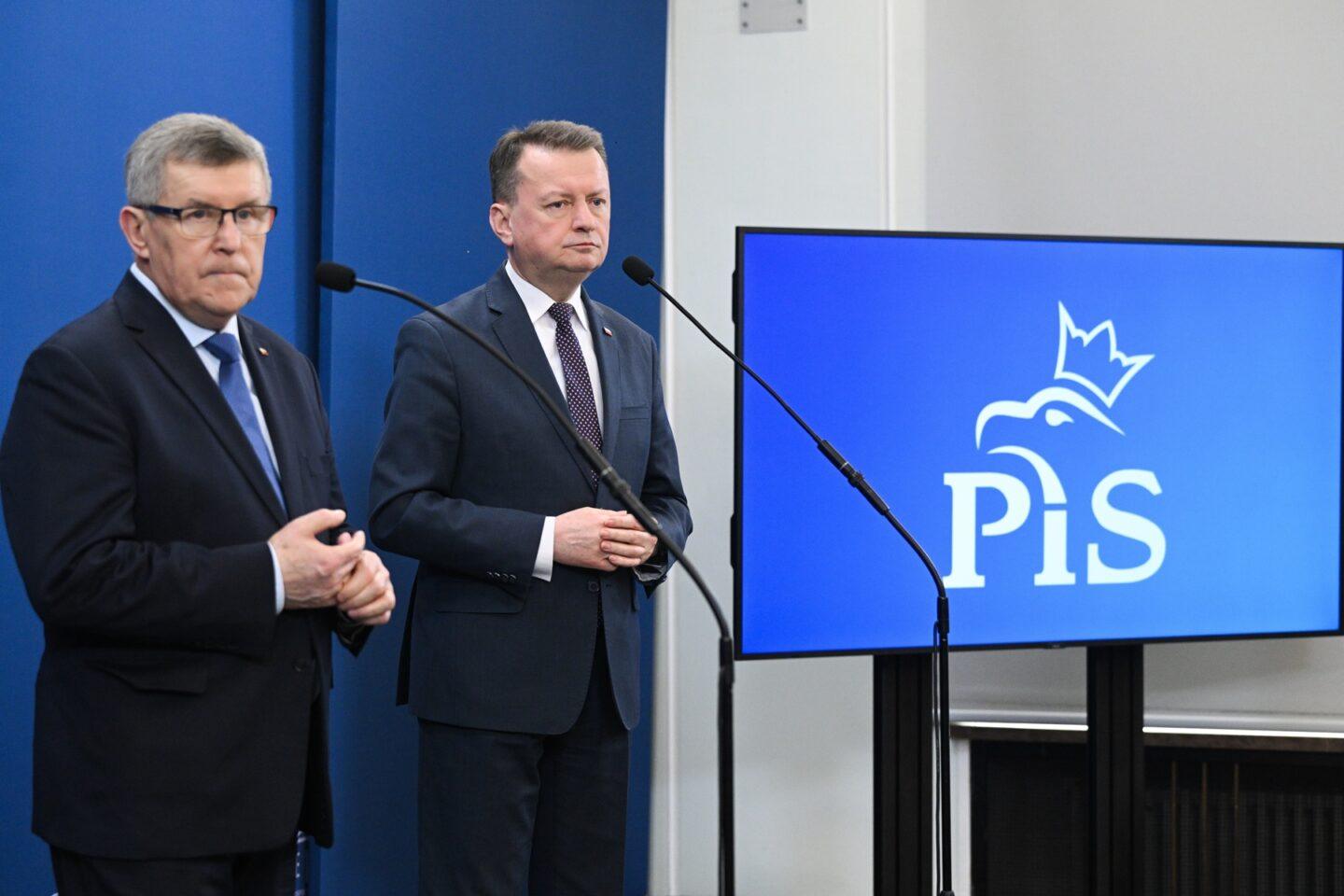
On Monday, the parliamentary caucus of Law and Justice (PiS) submitted its own bill to parliament. The proposal goes much further than either the government’s or the president’s drafts. It calls for a complete ban on conducting crypto-assets-related business activity in Poland.
Such a move could effectively bring Poland’s cryptocurrency market to an end. In December, during parliamentary debate over overturning the presidential veto of the government’s first crypto-assets bill, Donald Tusk said that around 3m Poles invest in this market.
In their proposal, PiS lawmakers classify activity on the crypto-assets market – including issuance, public offerings and admission to trading – as an unfair market practice.
The PiS bill: new powers for the UOKiK president
Unlike the drafts put forward by the president and the Ministry of Finance, the PiS proposal would grant supervisory powers not to the Polish Financial Supervision Authority (KNF), but to the Office of Competition and Consumer Protection (UOKiK). In cases of justified suspicion of a violation, the president of the UOKiK would be able to submit a written request to the Internal Security Agency (ABW) to freeze a crypto-assets account or a cash account holding funds entrusted by a client in a transaction involving crypto-assets.
The bill drafted by PiS lawmakers envisages prison sentences of between six months and eight years for conducting business activity on the crypto-assets market. The sentence could rise to as much as ten years if the value of the assets accumulated through such activity is deemed substantial. However, the authors do not specify what threshold would qualify as “substantial”.
In the explanatory memorandum, PiS lawmakers point to the risks associated with investing in crypto-assets and the difficulties consumers face in pursuing claims. They also argue that the state currently lacks adequate enforcement tools.
MP Zbigniew Kuźmiuk was authorized to represent the caucus during work on the bill. The proposal was also signed by MPs Waldemar Andzel, Dorota Arciszewska-Mielewczyk, Barbara Bartuś, Mariusz Błaszczak - the caucus leader – Joanna Borowiak, Anna Gembicka, Maria Kurowska, Krzysztof Lipiec, Maciej Małecki, Grzegorz Matusiak, Jan Mosiński, Marcin Porzucek, Urszula Rusecka, Jacek Sasin, Ryszard Terlecki and Agnieszka Wojciechowska van Heukelom.
The signatories include both members of the party’s so-called “butter boys faction”, led by Jacek Sasin and Mariusz Błaszczak, as well as members of Rozwój Plus Association associated with Mateusz Morawiecki, including Krzysztof Lipiec and Ryszard Terlecki.
Explainer
Butter boys
Butter boys (maślarze) are nicknamed after an incident on board a Polish LOT airlines plane when one of these politicians was served German-branded butter and loudly complained about it in the social media.
Previously, PiS leader Jarosław Kaczyński had repeatedly said that, in his view, crypto-assets should be banned. Even so, the PiS caucus twice voted against overturning the presidential veto of the government’s crypto-assets bills. In the second of those votes, neither Jarosław Kaczyński nor caucus leader Mariusz Błaszczak took part.
Support withdrawn
At the same time, four of the MPs who submitted the new bill – Barbara Bartuś, Jacek Sasin, Maciej Małecki and Zbigniew Kuźmiuk – withdrew their support for an earlier private members’ bill on crypto-assets submitted in mid-April. As a result, that proposal no longer has the required number of signatures and, contrary to earlier plans, will not proceed in parliament.
The sponsors of that earlier bill were to be represented by MP Janusz Kowalski, who recently left Law and Justice (PiS). The politician has openly expressed outrage at the new proposal put forward by his former party colleagues. On X, he suggested that the PiS lawmakers’ move amounted to a lifeline for Prime Minister Donald Tusk and a gesture that would push younger PiS voters toward Confederation Liberty and Independence (Konfederacja). Its leader, Sławomir Mentzen, mocked the PiS lawmakers’ proposal.


Key Takeaways
- Until now, PiS lawmakers had backed the president when the governing coalition twice attempted to overturn his veto of legislation regulating the crypto-assets market. However, PiS leader Jarosław Kaczyński did not take part in the vote on the second veto. He has publicly stated that he supports banning crypto-assets.
- Both the government’s and the president’s draft bills give the Polish Financial Supervision Authority (KNF) tools to intervene in the event of violations. The presidential proposal, however, provides for lower penalties, shorter extensions of account and domain freezes, and requires the approval of an administrative court before any freeze can be prolonged.
- The bill submitted by MPs from Law and Justice (PiS) envisages a total ban on conducting business related to crypto-assets. The lawmakers want such activity to be classified as an unfair market practice. Their proposal assumes that violations would be handled by the president of the Office of Competition and Consumer Protection (UOKiK), who would then request action from the Internal Security Agency (ABW). The intelligence services would be responsible for freezing accounts involved in prohibited transactions.