

This article is a part of Poland Unpacked. Weekly intelligence for decision-makers
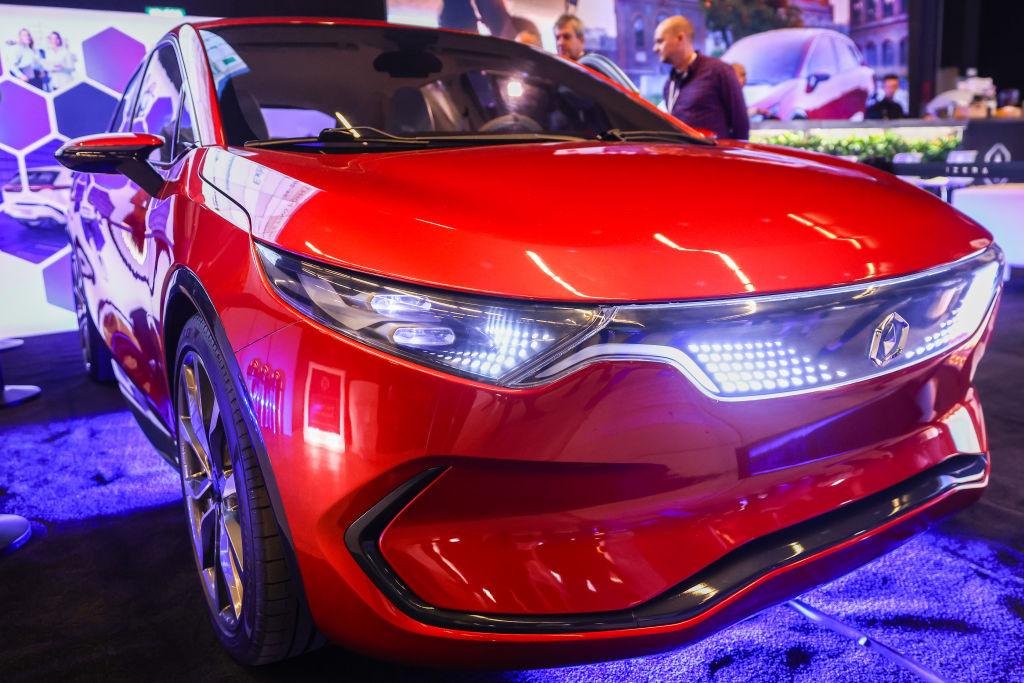
The company that was supposed to become Poland’s first electric car manufacturer is now vying for PLN 4.5 billion from the National Recovery Plan. Documents obtained by XYZ show that between 2018 and 2023 ElectroMobility Poland spent hundreds of millions – on a Chinese research center, an Italian upholstery manufacturer, and consulting firms. Yet the factory in Jaworzno and the electric car itself remain nonexistent.
ElectroMobility Poland (EMP) – established in 2016 to produce Poland’s first electric car under the Izera brand – is currently seeking funding from the National Recovery Plan (KPO). The sum in question is PLN 4.5 billion (EUR 960 million). The government wants to revive the project – not just as the production of Poland’s first EV, but in a reconfigured form. Instead of the original factory in Jaworzno, the plan is now to create an electromobility hub. Manufacturing the electric car would no longer be the project’s main goal but one of its components. Though the concept remains vague, EMP is the only project with a realistic chance of receiving support from the fund allocated to electromobility.
Securing KPO funding is crucial for the project’s survival. In February 2026, EMP, together with the National Fund for Environmental Protection and Water Management (NFOŚiGW) and the Ministry of State Assets, signed a so-called term sheet. This agreement lays out the financial framework for the project, but does not guarantee automatic funding. The final investment agreement is expected by the end of the first quarter, at which point EMP will be able to formally apply for KPO funds.
“We have the appropriate recommendations from both state agencies and the Ministry of Foreign Affairs. We are determined to seek solutions that will ultimately allow us to find a way forward for this large-scale project,” said Wojciech Balczun, Minister of State Assets, at a recent press conference.
Yet it is difficult to overlook the company’s disastrous track record. Over the past decade, ElectroMobility Poland has failed to build a factory or begin car production, while consuming hundreds of millions of zlotys in public funds. The question remains: is it worth giving the company a second chance?
Izera’s failed story
EMP was established in 2016 as an initiative of four state-owned energy groups: PGE, Energa, Enea, and Tauron. Over time, the majority shareholder became the State Treasury, which took control of 90% of the company. A key milestone for the project’s development was selecting a technology partner. In November 2022, EMP signed a licensing agreement with the Chinese conglomerate Geely Holding, which became EMP’s official technology partner.
The Chinese partner was to provide the Polish company with the SEA platform (Sustainable Experience Architecture), designed specifically for electric vehicle production. Geely was also expected to deliver engineering know-how and support car design. EMP, in turn, was responsible for the vehicle’s bodywork, interior, brand, and sales under the Izera name.
Production was planned for Jaworzno, with the plant expected to create over 2,400 jobs. Yet, despite the grand promises of the Law and Justice government at the time – who envisioned a million electric cars on Polish roads – Izera still had no factory. The timeline for the country’s first electric car kept slipping. Frustrated by Poland’s delays, Geely eventually withdrew from further cooperation. EMP was left without a factory, facing eroded public trust and a large question mark over the project’s future.
That is not all. During preparations for Izera’s production, EMP spent significant sums on activities connected to its Chinese partner. The scale is striking – hundreds of millions of zlotys of public money were involved.
Almost PLN 100m for the Chinese
XYZ obtained EMP’s expense records for 2018–2023. They show that over six years ElectroMobility Poland spent enormous sums on external partners. The money came from state-controlled entities, and total expenditures exceeded PLN 580 million (EUR 123 million) net.
The largest payment went to Ningbo Geely Automobile Research & Development, part of EMP’s would-be technology partner. It received over PLN 93 million (EUR 20 million) net from EMP. For Geely, this entity is a key research and development unit.
More than PLN 15 million (EUR 3.2 million) went to the Italian design firm Pininfarina, known for designing cars – including the iconic Ferrari – and applied arts. Over PLN 12 million (EUR 2.6 million) was paid to AVL List, a company developing powertrain systems for the automotive industry. A smaller sum, PLN 7 million (EUR 1.5 million), went to another designer, Edag.
Other notable payments included PLN 6.9 million (EUR 1.5 million) to the German automation firm Dürr Systems, PLN 5.4 million (EUR 1.1 million) to Italian design company Torino Design, and nearly the same amount to Austrian tire manufacturer Magna Steyr. Valeo Visions SAS, a French firm producing lighting and other components, received PLN 2.8 million (EUR 600,000).
EMP also spent heavily on consulting firms. Boston Consulting Group received PLN 25 million (EUR 5.3 million), Baker McKenzie PLN 10 million (EUR 2.1 million), Deloitte PLN 4 million (EUR 850,000), PwC PLN 3 million (EUR 640,000), A.T. Kearney PLN 2.9 million (EUR 620,000), Rothschild Polska PLN 1.6 million (EUR 340,000), Grant Thornton PLN 1.6 million (EUR 340,000), McKinsey PLN 1.5 million (EUR 320,000), Capgemini PLN 1.5 million (EUR 320,000), KPMG PLN 1.2 million (EUR 260,000), and CMS Cameron McKenna PLN 1 million (EUR 210,000) (all figures net).
To be clear, there is no reason to doubt that these sums corresponded to delivered services or products. These are professional entities, and in most cases the fees are in line with market rates. The fact remains, however, that these expenditures did not result in a Polish electric car or a factory. And this list represents only a fraction – hundreds of other contractors were also paid.
Former CEO: The project was ready for implementation
Piotr Zaremba, who served as CEO of ElectroMobility Poland from 2018 to 2024 and previously held positions including at the Ministry of Economy, commented on the scale of the company’s expenditures. He explained that the costs reflected the entire process of building a car and developing a new industrial sector. By 2023, he adds, the project was fully ready for implementation – yet it lacked the formal approval from the owner to move to the next stage.
“We were in discussions with nearly 200 component suppliers and, together with them, developing individual parts of the car. As part of the collaboration, we had a factory and its entire logistics designed. We managed to complete two of the five technical stages for both the car and the factory,” Mr. Zaremba told XYZ.
According to him, by 2023 the company had obtained a building permit, all environmental approvals, a chosen general contractor, and a factory designed down to the smallest detail. At the project’s peak, around 300 technical staff and engineers worked for EMP and Geely.
“At that time, prototypes were created, only some of which we showed to the public, as we were protecting our competitive advantages. From the funds you mention, a project ready for implementation was created. Regarding the vehicle itself, much of the design was done using computer-based engineering programs, which is the standard today. It is not necessary to produce physical prototypes at every stage; that would have been more costly,” explained the former EMP CEO.
What went wrong? According to Mr. Zaremba, in 2023 the project lacked decisive action and the owner’s signature on key documents. Subsequently, a change in government, audits, and the withdrawal of the Chinese partner occurred, prompting the search for a new one. Additional months were spent revising the concept and shifting from Izera production to an electromobility hub.
“In the broadest terms, the problem was a lack of decisiveness on the part of the state – and such a project cannot succeed without the state, or without an engaged owner. At many stages, support was missing, which translated into delays in the schedule,” said Piotr Zaremba.
EMP: Work results have lost their relevance
On Monday, March 16, Tomasz Kędzierski resigned as CEO of EMP, a position he had held since September 2024. The supervisory board appointed Cyprian Gronkiewicz, previously a director, as the company’s new vice president. We asked ElectroMobility Poland whether anything remains in the company that could be leveraged for the construction of the technology hub.
Piotr Michniuk, EMP’s press spokesperson, explained that over six years the company had received total capital injections of PLN 570 million (EUR 121 million), representing the full funding allocated to the project. He added, however, that due to trade secrets, EMP does not disclose contract amounts with individual partners.
The spokesperson confirmed that as part of the Izera project, EMP acquired a license for the platform technology, obtained the investment site in Jaworzno, developed the factory’s building design, and secured agreements with suppliers. The company also completed the production design for its first vehicle – a SUV – engineered to allow for serial production.
However, due to the failure to secure full project financing by the end of 2023, the results of the work had become obsolete. Consequently, the Izera project was suspended.
In its 2024 financial report, the management conducted a review and update of company assets accumulated since 2018, subsequently updating the asset value to PLN 244 million (EUR 52 million). In a December 2025 agreement, EMP was granted PLN 800 million (EUR 170 million) in funding from the Reprivatization Fund, though these funds have not yet been spent.
“From the work done so far, what remains is a concrete body of design and engineering know-how, which is being applied in the new project formula,” emphasized Mr. Michniuk.
The spokesperson also highlighted typical outcomes for automotive development projects, including the NPDS design process, technical documentation, homologation procedures, and other related processes.
Expert: This money is already lost
Krzysztof Burda, president of the Polish Chamber of Electromobility Development (PIRE), emphasizes that running any technology company requires substantial investment. In this case, however, the project stalled and completely changed direction, shifting from Izera electric car production to a technology hub.
“From the figures you mention, it is clear that a very large portion of the project budget went to consulting. Automotive companies do rely on consultants, that’s true. It is hard for me to judge whether EMP needed them in such quantities, but in absolute terms, it is indeed a very large sum,” Mr. Burda commented on EMP’s expenditures.
He added that had Geely remained involved, the money invested in the partnership would already be generating returns. The decision on a technology partner now rests with the Ministry of State Assets.
“However, if the same technology partner is not involved, we will unfortunately be facing the worst-case scenario of losing those funds,” Mr. Burda said.
The PIRE president points out that there are Polish projects that could be implemented within the electromobility hub, including production of the Evan utility vehicle, charging station manufacturing, battery cell factories, or battery pack assembly. These initiatives would contribute to developing a local supply chain.
“This is the last chance to revive the project. If the project is to support Poland’s electromobility sector – more than just importing a vehicle for production from distant Asia – then I am wholeheartedly in favor of it. But if, in the end, we only build an assembly plant for a potential Asian investor, then the funds could probably be better spent, for example by supporting Polish technologies,” Mr. Burda concluded.
Shift in approach toward the Chinese
The worst-case scenario for a Chinese partner now appears highly likely. Just a few years ago, collaborating with China on a business project might have seemed like a good idea. By 2026, the situation looks very different.
In recent months, a dispute erupted over the import of Chinese electric vehicles. The European Union concluded that Chinese manufacturers benefit from extensive state support, allowing them to sell cars in Europe at significantly lower prices. In response, Brussels imposed additional tariffs on EVs produced in China. Beijing labeled these measures protectionist and announced retaliatory measures targeting selected European products, escalating trade tensions.
In February this year, the General Staff of the Polish Armed Forces banned vehicles manufactured in China from entering protected military facilities. The decision aims to safeguard sensitive data, reflecting concerns about security. Modern vehicles can collect location information, which, if accessed by unauthorized parties, could be used to map military units or track soldiers.
Collaboration with Chinese technology partners is increasingly controversial across Europe for geopolitical reasons. Following Russia’s full-scale invasion of Ukraine, Western countries have highlighted China’s close economic and political ties with Moscow, as well as its support for the Russian economy through trade and the provision of dual-use technologies.


Key Takeaways
- The government is now reshaping the project. The plan replaces the single-vehicle production concept with a broader electromobility hub. Realizing this vision depends on securing around PLN 4.5 billion (EUR 960 million) from the National Recovery Plan (KPO) and identifying a new technology partner.
- Izera project absorbed significant funds without delivering a car or factory. Between 2018 and 2023, the company spent over PLN 580 million (EUR 123 million) on external partners, including technology, design, and consulting firms. According to EMP management, some of these expenditures resulted in technical documentation, a factory design, and a preliminary vehicle design.
- Partnership with China’s Geely was a pivotal moment. Geely was to provide the EV platform technology, and more than PLN 93 million (EUR 20 million) went to its associated R&D center. Political changes and delays in funding, however, slowed the project, and further cooperation was not pursued.