

This article is a part of Poland Unpacked. Weekly intelligence for decision-makers
President Karol Nawrocki’s inner circle openly acknowledges that he is prepared to become the patron of a right-wing Senate pact. What remains uncertain is whether he is open to cooperation with the party of Grzegorz Braun.
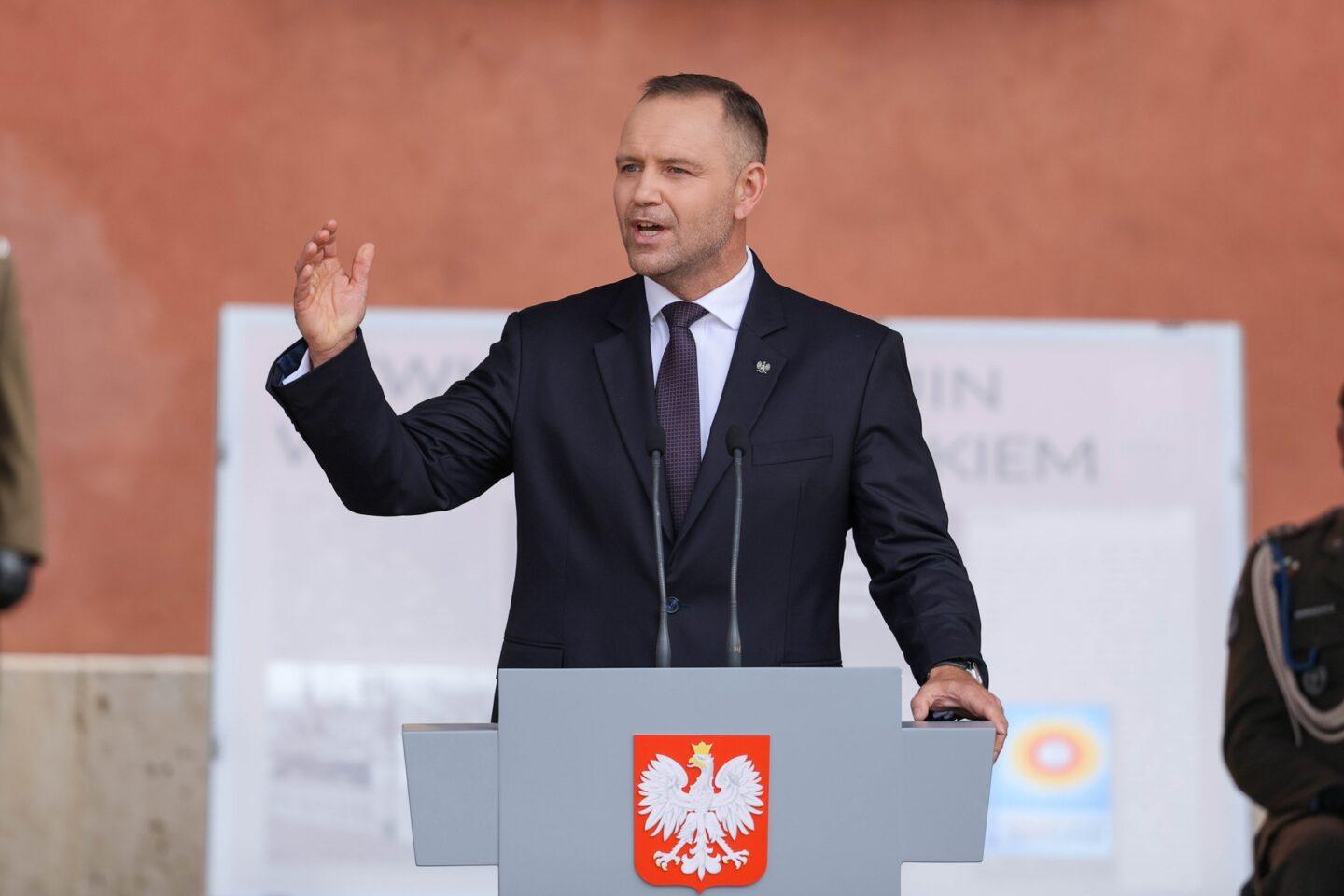
The lavish celebrations marking the first anniversary of Karol Nawrocki’s inauguration provided an opportunity for the Presidential Palace to send several political signals. The first was a desire to draw up a presidential development strategy. In an address outside the Presidential Palace, President Karol Nawrocki announced that it would be ready within several months.
The president’s ambitions
He added that he has high hopes for the strategy in the context of next year’s elections. The president expects the strategy he presents to “become a reference point for the upcoming parliamentary campaign”, which will “bring forward Poland’s patriotic forces – those that love Poland and are ready for dialogue between the presidential camp and the future prime minister’s camp.”
The second signal came not directly from the president, but from his chief of staff. It concerned a right-wing Senate pact. Minister Paweł Szefernaker said on Kanał Zero news outlet that “the president is ready to lend his patronage to such a Senate pact.”
He stressed, however, that the decision to form such a pact rests with the leaders of the political parties and also depends on their willingness to reach such an agreement.
President as patron of a Senate pact?
The president’s chief of staff was also pressed on what such a pact, which Karol Nawrocki would patronize, might look like. Paweł Szefernaker acknowledged that Karol Nawrocki was also backed in the second round by voters who had supported Grzegorz Braun. He added, however, that there are political circles “that are unacceptable to us”. He said that many controversial figures surround Grzegorz Braun.
The president’s chief of staff was also pressed on what such a pact, which Karol Nawrocki would patronize, might look like. Paweł Szefernaker acknowledged that Karol Nawrocki was also backed in the second round by voters who had supported Grzegorz Braun. He added, however, that there are political circles “that are unacceptable to us”. He said that many controversial figures surround Grzegorz Braun.
After a year at the Presidential Palace, President Nawrocki has emerged as the politician commanding the greatest trust and support, not only on the right. Law and Justice (PiS), which nominated him as its presidential candidate, is in a weaker position. The party is facing a major split. Former Prime Minister Mateusz Morawiecki, together with several dozen lawmakers, left PiS and founded the Rozwój Plus (Development Plus) association.
PiS is also being closely challenged by competition from the Confederation camp – both Confederations. The one led by Sławomir Mentzen and Krzysztof Bosak is already drawing increasingly close to Jarosław Kaczyński’s party in opinion polls.
Who would be in a right-wing Senate pact?
In an IBRiS poll for Polsat News conducted more than a week ago, the two parties were separated by just 2.5 percentage points. Law and Justice (PiS) was on 16.9%, while Confederation (Konfederacja) stood at 14.4%. The Confederation of the Polish Crown (Konfederacja Korony Polskiej) regularly ranks fourth in opinion polls: Grzegorz Braun’s party is not far from reaching double-digit support.
Since the split in PiS, opinion polls have also included Mateusz Morawiecki’s new association. It has a chance of clearing the electoral threshold and bringing a sizeable group of lawmakers into the next parliament. These four groupings – PiS, Morawiecki’s potential party and the two Confederations – would ultimately be expected to form a Senate pact.
One candidate per electoral district
Senate elections, however, work differently from elections to the Sejm. The combined support of cooperating parties plays a different role here. Senate candidates run in 100 single-member districts, which are smaller than the 41 districts used in Sejm elections. This means that each electoral committee can field only one candidate in a given district.
The parties that make up the current governing coalition have twice opted to form a Senate pact. In 2019, the move enabled them to take control of the Senate, even though the ruling Law and Justice (PiS) party retained control of the Sejm. Four years later, they repeated the arrangement. PiS then lost power, while the new governing parties increased their majority in the Senate.
They won several districts because right-wing voters’ support was split. When both PiS and Confederation fielded their own candidates in the same district, the candidate of the October 15 Coalition had a better chance of winning. A potential right-wing Senate pact would be designed to prevent this.
Resilience to third-party candidates
In October last year, the Nationwide Research Group (OGB) published a forecast for the next Senate elections. In a scenario in which Law and Justice (PiS) ran on its own, Jarosław Kaczyński’s party would fail to wrest control of the Senate from the current governing parties. It would only marginally increase its number of seats. Under a scenario in which PiS ran as part of a broader alliance, however, the opposition right would have a chance to take control of the Senate, winning 58 seats.
“Not much has changed since then, although there has been a split on the right. The right as a whole is roughly as strong as it was then, though it remains stronger than the liberal parties. We are talking about roughly 51% for the right and 49% for the liberals. There are a lot of districts that are too close to call. Karol Nawrocki’s victory over Rafał Trzaskowski in Senate districts would more or less correspond to the results of the Senate elections,” says Łukasz Pawłowski, president of OGB.
By forming a Senate pact, the right would have a better chance of reversing the balance of power in the upper house of parliament.
“If right-wing parties field a joint Senate pact and do not run candidates against one another, they are more resilient to outside candidates. They would then have a chance of winning 53-55 seats and taking the election,” Pawłowski adds.
Talks are only just beginning
What are the major parties saying about a right-wing Senate pact? PiS is waiting for the president to make the first move.
“We are not holding any such talks at all. This is the president’s initiative, and the party has nothing to do with it. We are waiting until the end of the summer, and for now this issue is not on the agenda,” a PiS source tells us.
In mid-July, however, PiS leader Jarosław Kaczyński announced a new cooperation agreement aimed at ensuring that right-wing parties run jointly in Senate elections. He struck the deal with Marek Woch, a former deputy commissioner for small and medium-sized businesses and a candidate in last year’s presidential election. Woch represented the Nonpartisan Local Government Officials movement and finished last, receiving just over 18,000 votes nationwide (0.09%). More recently, however, Marek Woch has appeared at political events alongside Grzegorz Braun.
Confederation does not want to start from a weaker position
There are also indications within Confederation that no talks have begun yet. At the same time, the party of Krzysztof Bosak and Sławomir Mentzen is said to be open to negotiations. The key issue will be the terms.
“Strategically, we believe it is worth pursuing. It would be good for the president to be involved. But, in theory, he is the president of all Poles and should not become too deeply involved,” a source in Confederation tells us.
“All the players would have to be part of the pact: Bosak and Mentzen, as well as Kaczyński, Morawiecki and Braun. It cannot be a situation where Jarosław Kaczyński comes in and says how many districts he wants for his party, with the others left to divide up the rest. There are districts where Civic Coalition beats the entire right, both the centrist and more hard-right parts of it. It will be difficult to put all this together. The candidates would not necessarily have to be party nominees,” a senior Confederation politician tells us unofficially.
Confederation does not want to be reduced to the role of a “junior partner”. Over the past year, PiS leader Jarosław Kaczyński has made no shortage of comments suggesting that this is precisely the role he envisages for Sławomir Mentzen. For now, nothing has been decided. Confederation is also aware of the political risks.
“We know that striking a deal with PiS is not necessarily in our best interests. We remember their time in government very well and how they fought Confederation. They have a lot to answer for. But it seems that removing Donald Tusk from power is something worth doing,” a Confederation politician tells us.
Can it be done without Braun?
The most difficult piece of the Senate puzzle is Grzegorz Braun. The controversial MEP and leader of the Confederation of the Polish Crown has denied the existence of gas chambers at Auschwitz, sought to relativize Russian atrocities in Ukraine and voiced anti-Semitic slogans. Braun himself called for a right-wing Senate pact as early as December, during a press conference in Kielce.
On Saturday, Krzysztof Bosak acknowledged on TVN24’s Fakty po Faktach that a Senate pact with Braun could be concluded, even though he is critical of some of Braun’s statements. The following day, PiS MEP and party discipline spokesperson Karol Karski was asked about cooperation with Braun on the same program. The PiS politician described Braun’s slogans as “disgusting statements, disqualifying any person – not only from public life.”
PiS leader Jarosław Kaczyński has also spoken about Braun in similarly harsh terms in recent months. Yet as recently as February, Przemysław Czarnek – PiS nominee for the next Prime Minister – told Rzeczpospolita daily that he did not rule out cooperation with Braun’s party. He was responding to remarks by US Ambassador Tom Rose, who said that it would be difficult for the United States to accept a government involving Grzegorz Braun after the election. Braun’s anti-Semitic and anti-Western rhetoric is an irritant for the United States, whose goodwill matters to both PiS and President Nawrocki.
PiS, however, is increasingly adopting rhetoric designed to appeal to voters drifting toward Braun. A recent example was its announcement that non-working Ukrainians of military age could be deported.
“He could ruin it”
According to Łukasz Pawłowski, for a Senate pact to be effective, it must bring together the entire right.
“That includes Grzegorz Braun. If Braun fielded his own candidates in a dozen or even just a few key districts, the right-wing pact would lose. Braun is indispensable here. The advantage is that this would not involve creating a single electoral list. A Senate pact is essentially a gentlemen’s agreement not to field candidates in specific districts. So there is no need to run alongside Braun on the same list, which is much easier than putting together a joint list for the Sejm,” says the OGB president.
The expert adds that as an independent player in Senate elections, Braun could pose a threat to PiS and its potential allies.
“Braun could ruin it. That is his bargaining chip. He does not need to field candidates in all 100 Senate districts. A few would be enough, and the whole thing would be over,” Pawłowski says.


Key Takeaways
- President Karol Nawrocki wants to set the direction for the right ahead of next year’s parliamentary elections. His inner circle says he is prepared to act as patron of a right-wing Senate pact.
- Without Grzegorz Braun, a right-wing Senate pact could struggle to defeat the parties currently in government. Braun would only need to field candidates in a few districts to split the right-wing vote, potentially handing the advantage to the opposition.
- Without Grzegorz Braun, a right-wing Senate pact could struggle to defeat the parties currently in government. Braun would only need to field candidates in a few districts to split the right-wing vote, potentially handing the advantage to the opposition.