

This article is a part of Poland Unpacked. Weekly intelligence for decision-makers
More than USD 2 million (approximately PLN 7.2 million / EUR 1.84 million) has been raised for AI agent technology designed to automate trading. Two Polish founders have convinced Frst and a prominent group of angel investors to back a product intended to “democratize” trading – meaning active trading – on platforms such as Polymarket and Kalshi.
The Elastics platform will allow users to trade on prediction markets, and eventually across other asset classes, using chat interfaces and AI agents. This is a rapidly expanding segment of the market. According to a KPMG report, Polymarket and Kalshi recorded more than USD 40 billion in turnover in 2025, with the market’s overall value rising by over 300%.
Polish founders now have a plan for how to capitalize on this growth.
Expert's perspective
The great wave of prediction markets
Prediction markets also fit neatly into the era of social media and the information economy. Users want to react to political, economic, or technological events in real time, attempting to monetize both their own expectations and those of others. As a result, these platforms are creating a new asset class – one based not on company valuations or commodities, but on the probability of events.
Importantly, they are increasingly seen as a source of “the wisdom of crowds.” In many cases, prediction markets have been more accurate in assessing the likelihood of events than traditional polling or expert commentary.
Today, prediction markets are developing rapidly, driven largely by blockchain technology, tokenization, and growing regulatory acceptance in certain jurisdictions. Just a few years ago, they were considered a technological niche or a curiosity linked to cryptocurrencies. Today, they are beginning to attract speculative capital, macro traders, and participants seeking new forms of hedging.
In my view, the coming years will bring more convergence between traditional trading and prediction platforms rather than direct competition. An increasing number of traders will use both conventional financial instruments and prediction markets in parallel – especially those who value rapid interpretation of market sentiment and event probabilities.


Significant capital for AI in trading
The round was led by the French venture capital fund Frst, which invested USD 1.7 million (approximately PLN 6.2 million / EUR 1.58 million). The fund manages more than USD 200 million in assets. The financing also included business angels linked to the Polish and European technology ecosystems, among them investors with experience in fintech, crypto, and venture capital.
The round was closed at the beginning of the year.
“We waited to announce it because we did not want to showcase only our ambitions. In the meantime, we built a product that we are now launching on the market,” said Szymon Pawica, co-founder of the startup.
The USD 2 million raised will give Elastics roughly 20 months of runway, meaning time to develop the business. The funds will be allocated primarily to technology development, hiring AI talent, and product expansion.
“In a fintech like ours, we need a substantial budget at the outset. This is not a project that can be developed slowly over time. The market is accelerating, and new ideas are emerging. We want to be the best,” Mr. Pawica said.
Decision in 36 hours
According to the startup’s founder, the lead investor decided to join the round within 36 hours. This stood in contrast to discussions with some Polish venture capital funds, which – according to the entrepreneur – sought to evaluate an early-stage project through the lens of long-term financial models.
“At the pre-seed stage, you are largely investing in the people on the other side. The product may still change, and what matters most is how quickly the team can learn and pivot,” said Szymon Pawica.
From the outset, Elastics was built with an international market in mind. The company was incorporated in Delaware, a structure that facilitates conversations with U.S. investors. This, however, became a barrier for some Polish funds.
“We spoke with many funds in Poland, but their approach to valuations and deal structures was very local. And if you are building a company with global ambitions, an overly low initial valuation can later constrain growth,” Mr. Pawica said.
Despite that, the company assembled a broad group of business angels. These include Mati Staniszewski and Piotr Dąbkowski, co-founders of ElevenLabs; Philippe Bekhazi and Karl Naim of XBTO; as well as Polish investors and startup figures including Bartek Pucek, Marcin Kaźmierczak, Bartosz Jakubowski, Aleksandra Pędraszewska, Tytus Cytowski, Jan Czarnocki, Łukasz Żurowski, and Edouard Palardy.
Investor's perspective
Huge potential in prediction markets
Elastics, led by Szymon and Mateusz, has the capabilities to close this gap. The founders bring experience from banking, work on quantitative models, and the ambition to compete with the best globally. From the perspective of RedStone, I see how strong a resource Polish technological talent is, and how our data from RedStone and risk models from Credora could in the future support the development of Elastics’ engine.
What convinces me most is their diagnosis that the natural interface between the user and the market is no longer an order form, but natural language. This is the direction in which the entire industry is heading.
From crypto trading to “picks and shovels” for traders
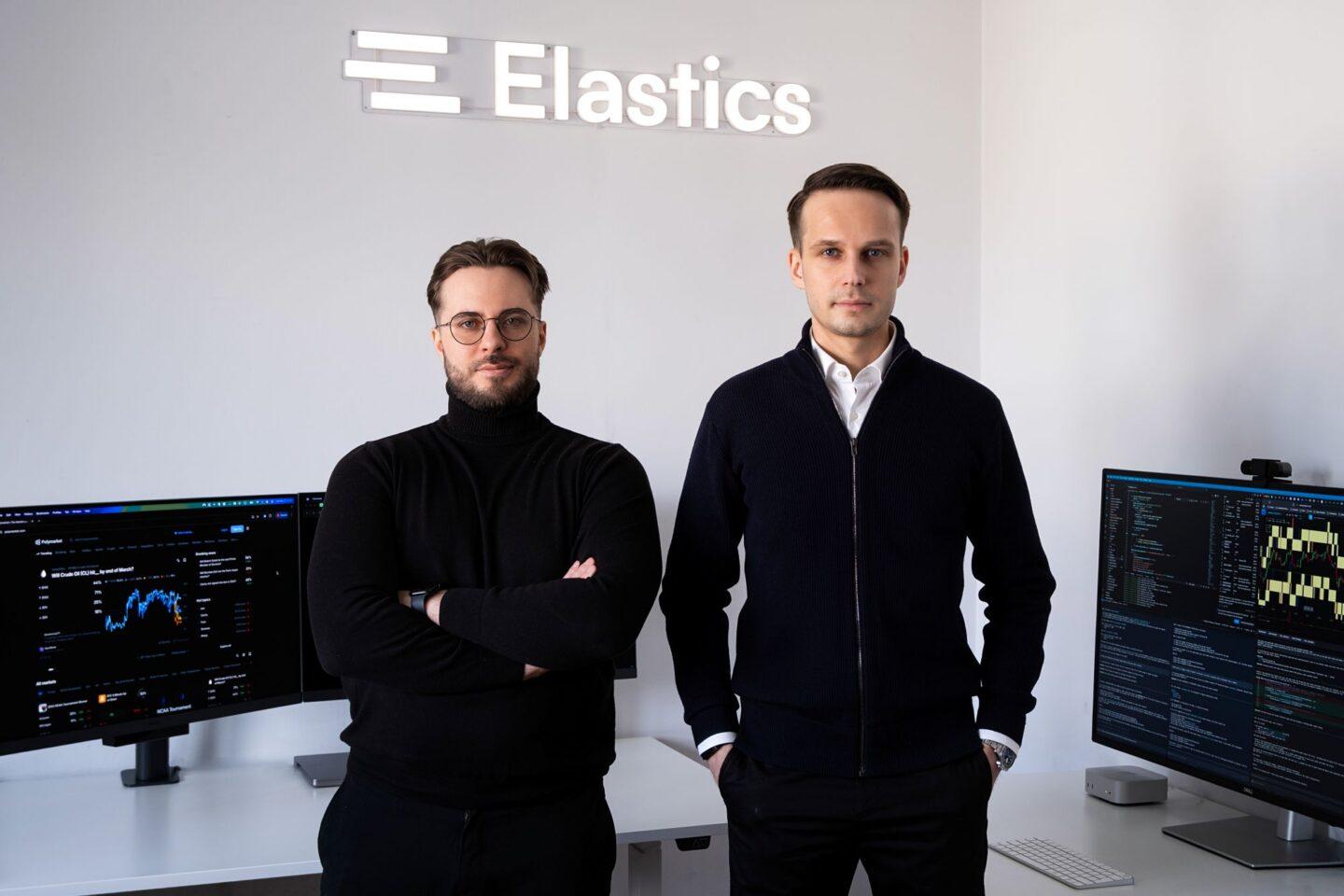
The story of Elastics began with the founders’ personal experience in trading and finance: Szymon Pawica and Mateusz Brodowicz.
Szymon Pawica has spent years in the world of finance. He studied at New York University Stern School of Business and worked at Goldman Sachs as well as in venture capital funds. Since 2017, he has also been actively involved in the crypto market.
“I have always operated somewhere between finance and entrepreneurship. Over the years I tried different projects, and in hindsight I believe those attempts increased my chances of building something larger. If I had spent a decade purely in a corporation, I would only now be making my first mistakes,” said Mr. Pawica.
Mateusz Brodowicz comes from an academic background. He paused his PhD in mathematics at the University of Houston and returned to Poland to focus on building Elastics. In the United States, he worked for an emerging market maker in prediction markets. At Elastics, he is responsible for the quantitative side of the business – the so-called quant function.
According to Mr. Pawica, the direct trigger for founding Elastics was his own trading experience.
“I was able to grow a portfolio from USD 10,000 to several hundred thousand. Later, unfortunately, I lost most of that money. At one point I was spending 10 hours a day in front of charts, executing low-risk, high-frequency trades. I realized that the most valuable thing would be to automate the strategies I was already executing manually,” he said.
That led him to Mateusz, his co-founder at Elastics. Initially, the team considered building a quantitative hedge fund. The problem, however, was the economics of such a model. Under a traditional fee structure – similar to those used in venture capital and hedge funds – building a meaningful organization would require tens or even hundreds of millions of dollars in assets under management.
That is when a different idea emerged: instead of digging for gold themselves, build the “picks and shovels” for others.
Investor's perspective
Elastics and immense potential
Elastics is a company that reads trends well, while at the same time building a solution that naturally scales across other asset classes – from cryptocurrencies to equities. The caliber of its investors and advisors only confirms the company’s enormous potential.
How Elastics builds the “picks and shovels”
“We connected several dots: trading experience, quantitative know-how, the AI wave, and my VC network. We concluded that instead of building our own fund, we could democratize access to tools that until now were reserved for expensive hedge fund teams,” said Szymon Pawica.
The Elastics product starts with prediction markets, primarily Polymarket and Kalshi. These are platforms where users bet on the probability of specific events – from election outcomes and central bank decisions to geopolitical developments and sports results.
The startup is building a tooling layer on top of existing platforms. The first feature is relatively simple: users can search for contracts across different markets via chat, compare them, and execute trades.
“There are thousands of contracts on Polymarket and Kalshi. Even finding the right instrument is already a challenge. At the beginning, we help users search for them, display the data, and execute transactions. Manual trading is the foundation you need – but the most interesting part comes later,” said Mr. Pawica.
That “later” refers to AI agents – automations that operate based on user-defined rules. For example, if a particular politician publishes a post about a geopolitical conflict, an agent could respond by taking action on contracts linked to oil prices or the probability of a specific event. The focus is not direct trading of oil or equities, but prediction contracts tied to such outcomes.
“You can imagine a scenario where Trump publishes a post on Truth Social, and your position reacts automatically. It sounds obvious, but tools like this practically do not exist for retail traders,” said Mr. Pawica, founder of Elastics.
Arbitrage, portfolio, and risk management
One of Elastics’ first use cases is arbitrage across different markets. If the same or a very similar contract is priced differently on Polymarket and Kalshi, the system can identify an opportunity to buy on one platform and sell on the other.
“Today we already see situations where money can be made across many contracts by exploiting price differences between platforms,” said Szymon Pawica.
Another area is portfolio management. According to Elastics, active prediction market traders often hold dozens or even over a hundred open positions. They do not always realize that their exposure is overly concentrated in a single category – such as U.S. politics, Iran, oil, or elections.
“We can mathematically calculate correlations between contracts and tell the user: you are overexposed to Iran, here you could hedge. This is the direction in which we want to develop the product,” Mr. Pawica said.
Ultimately, Elastics aims to combine several functions into one system: a contract search engine, a trading terminal, an automation layer, alerts, portfolio analytics, and risk management.
Business model: users first, fees later
At the beginning, Elastics will be free to use. The startup’s priority is to first build a base of active users and trading volume. Only later does it plan to introduce fees.
There are two potential revenue streams. The first is a volume-based fee, similar to models used by brokers or aggregators. The second is payments for AI token usage and compute power, should the cost of running agents prove significant.
In the longer term, the company does not rule out moving deeper into the brokerage layer.
“Just as ElevenLabs is building agents for voice, we want to build agents for trading. The vision for a truly large company is that at some point we either become a broker or capture a larger part of the value chain. That way we are no longer just an intermediary sitting on top of Polymarket or Kalshi,” Szymon Pawica concluded.
What Elastics is planning next
Following its product expansion, the company plans to integrate with Hyperliquid in the second half of the year. Hyperliquid is one of the largest decentralized crypto exchanges. It is no longer limited to cryptocurrencies alone; it is also developing tokenized exposure to commodities and equities.
“The world of traditional finance is starting to merge with blockchain. If we integrate Hyperliquid, we immediately gain exposure to crypto, commodities, and partially tokenized equities,” said Szymon Pawica.
The next step would be integrations with traditional brokers, such as Interactive Brokers. This would allow Elastics agents to operate not only on prediction markets, but also on stocks, ETFs, and other financial instruments.
The company’s target for the end of the year is to reach USD 100 million in annualized volume, calculated based on the last 30 days of activity. The founders acknowledge that prediction markets alone may not be enough to reach that level, as contracts often take a long time to settle and lack leverage. That is why exposure to crypto and commodities will be necessary.
What prediction markets are
Prediction markets are platforms where users buy and sell contracts tied to the outcome of future events: elections, central bank decisions, macroeconomic data releases, sports events, court rulings, or product launches. The price of a contract – for example, 63 cents for “yes” – simultaneously reflects the market-implied probability of that event occurring. Supporters describe them as “information exchanges,” as they aggregate the knowledge of thousands of participants faster than polls or expert commentary.
The segment is growing rapidly. According to the KPMG report “Prediction Markets: Paths to Entry”, the combined trading volume of Kalshi and Polymarket exceeded $40 billion in 2025. By comparison, it stood at just USD 9 billion in 2024. According to CoinDesk data, the overall market grew by more than 300% in 2025, reaching $63.5 billion.
“Prediction markets are popular because they offer a ‘cleaner form of market.’ Instead of analyzing charts and pretending you understand macroeconomics, you answer a simple question: ‘Will something happen?’ People love simplicity and emotion – and here you get both. On top of that, there is the element of ‘I was right and I made money from it.’ That is more addictive than traditional trading. And one more thing: this is a market based on opinion, but reinforced by money. And that is no longer just talk – that is a real signal,” said Tomasz Baliński, fintech entrepreneur and CEO of ComplyWiser.
Platforms are gaining strength
As Łukasz Jabkowski, attorney-at-law, managing partner at LegalFintech and an expert in innovative financial markets, adds, prediction platforms appear to be breaking a long-standing taboo that excluded “average” users from participation in financial or quasi-financial markets.
“Until recently, participation in such mechanisms was the domain of specialized institutions, professional investors, or entities with substantial financial resources. Prediction markets reverse that logic – their appeal is built on simplicity and accessibility. The user does not need to understand derivatives, structured products, or exchange mechanics. Basic knowledge of the world and a willingness to express an opinion in the form of a wager on an outcome are enough,” said Mr. Jabkowski.
The most popular platform is Polymarket. In October 2025, its average monthly transaction volume exceeded USD 3 billion.
Large players have also recognized the segment’s potential. In March this year, Intercontinental Exchange announced a further USD 600 million investment in Polymarket, following a prior USD 1 billion investment in October 2025. According to U.S. media reports, Polymarket is currently raising another USD 400 million round at a valuation of approximately USD 15 billion.
Expert's perspective
How platforms are changing trading
Prediction markets will continue to grow, especially alongside the development of AI and access to real-time data. However, they will not replace traditional trading – they represent a different model of the game. Trading is about exchanging price volatility, while prediction markets are about trading information.
There is also a downside: the lack of comprehensive regulation. Such markets may be vulnerable to manipulation, the use of insider information, or political influence.
This leads to a more controversial thesis: in the long run, information itself may become a more valuable asset than financial instruments. In that sense, prediction markets do not compete with trading – they redefine it.
Great popularity, but also challenges
However, controversy continues to surround prediction platforms. A recent Wall Street Journal article reported that as much as 67% of profits on Polymarket flow to just 0.1% of accounts. The majority of users, in contrast, lose money.
“Regular players don’t stand a chance,” said Michael Boss, a statistician and former poker player who, in a conversation with journalists, noted that he executes up to 60 trades per minute on Kalshi.
The issue is competition from large firms that conduct fully automated trading.
In the United States, these platforms are legal. In Europe – including Poland – they are not. Both Polymarket and Kalshi (along with many others) are blocked in Poland due to gambling regulations.
“We have archaic regulation governing games and gambling that fails to keep up with technology and market trends. Interpretative fixes are no longer sufficient to cover mechanisms that do not fit the traditional model of gambling. A separate issue should be the redefinition of the catalogue of games of chance and betting itself to adapt it to current market realities. Blocking access to certain platforms is, of course, much faster and easier than building a sensible regulatory framework,” said Łukasz Jabkowski.
Despite this, the markets continue to grow and gain popularity.
“Prediction markets are expanding because they offer something traditional trading does not: the ability to trade the future in its simplest form – not just ‘will oil go up,’ but ‘will X happen.’ This reduces the game from interpreting hundreds of variables to a single concrete event, which attracts new users. In my view, this is not a zero-sum competition. It is a new asset class. And as history shows, new asset classes do not take away from existing markets – they expand them,” added Tomasz Baliński.
Expert's perspective
Why prediction markets do not operate in Poland
The problem is broader and also applies to phenomena such as loot boxes in video games and other forms of digital entertainment. A definitive answer would require a more detailed legal analysis, although I lean toward the view that – depending on how a given product is structured – it should be treated as at least a regulated service.
Instead of addressing gaps in the legal framework or clarifying ambiguities, lawmakers have granted institutions broad powers, such as the constitutionally questionable register of banned websites. This system, however, is ineffective – not only because it can be bypassed via VPNs, but also because illegal operators continuously launch new domains, simply changing extensions or numbering schemes.
Press reports suggest that payments on such platforms – which are considered illegal under Polish law – are nevertheless processed, highlighting the practical limitations of enforcement. Similar phenomena exist elsewhere, yet the state has for years largely ignored them, pretending to take action instead of implementing effective legal mechanisms.
In my view, the likelihood that allowing prediction market providers into Poland would resolve these issues is minimal. At most, it would make life more difficult for domestic firms while foreign providers continue operating as before.


Key Takeaways
- The founders see Elastics as more than just a tool for trading prediction markets. The company plans to develop features in arbitrage, portfolio analytics, alerts, and risk management. In later stages, it intends to integrate with Hyperliquid, and subsequently with traditional brokers such as Interactive Brokers. This would open access to cryptocurrencies, commodities, tokenized equities, ETFs, and other financial instruments. The year-end target is USD 100 million in annualized volume, although the founders acknowledge that prediction markets alone may not be sufficient to reach this goal.
- Elastics has raised more than USD 2 million to develop AI agent technology for trading, with the French venture capital fund Frst as the lead investor. The startup plans to use the funding primarily to build its product, advance its technology stack, and hire AI specialists. A notable element of the story is the speed of the investment decision. According to the founders, Frst committed to the round within 36 hours, while some Polish funds reportedly approached the project in a more cautious and local manner. From the outset, Elastics has positioned itself as a global company. It was incorporated in Delaware and has been actively seeking capital and partners outside Poland from day one.
- The Elastics product is designed as a tooling layer for users of prediction markets such as Polymarket and Kalshi. The startup begins with features that simplify contract discovery, data comparison, and trade execution via chat. The company aims to build AI agents that automate traders’ actions based on predefined rules. These could include reactions to a politician’s post, a geopolitical event, or price discrepancies between similar contracts across platforms. In this way, Elastics seeks to bring tools previously reserved for professional quant teams to a broader group of active investors.