

This article is a part of Poland Unpacked. Weekly intelligence for decision-makers
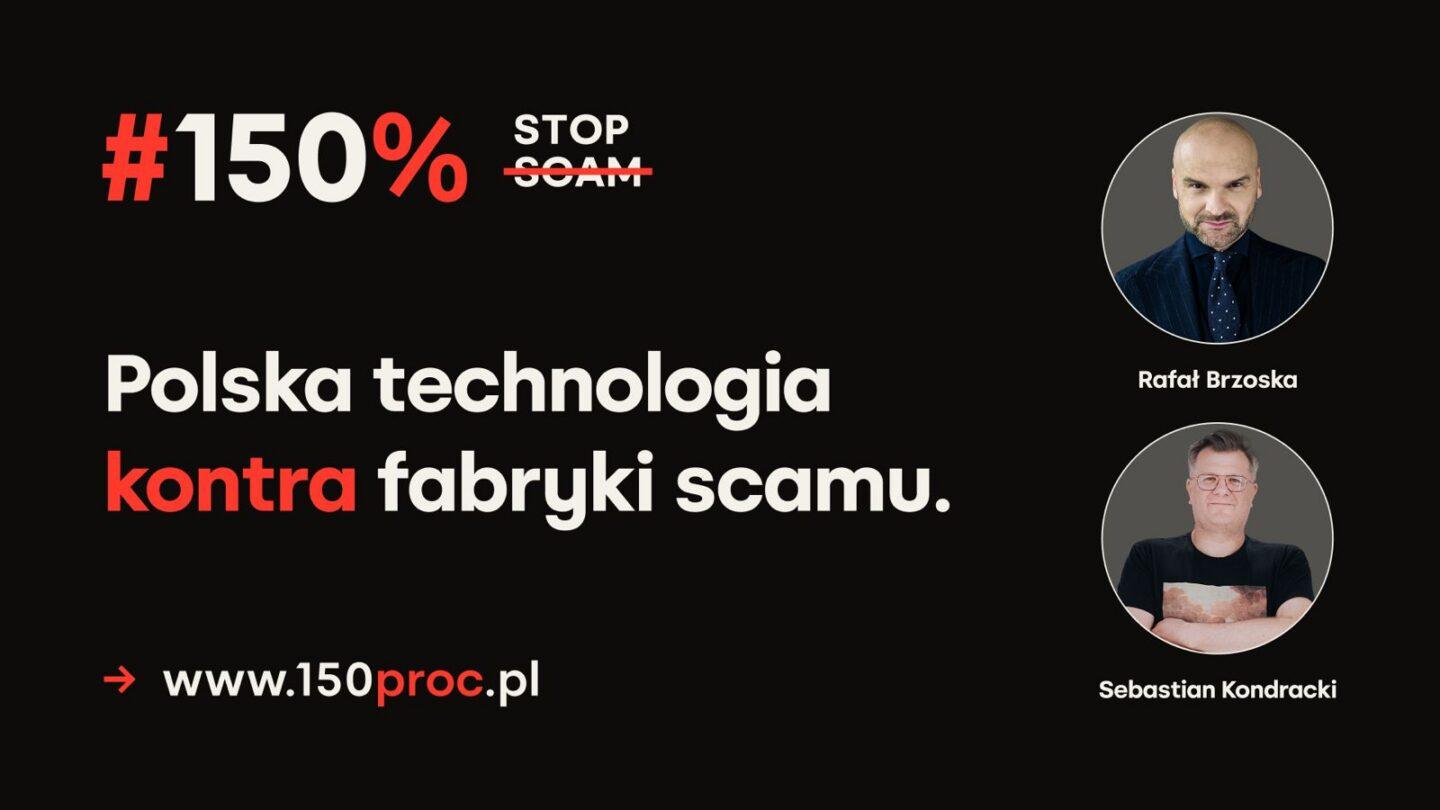
Rafał Brzoska, the founder of InPost, is taking another step in the fight against online fraud (so-called scams) with the launch of ScamWatch. The project is being developed by Polish specialists, including Sebastian Kondracki of Bielik.AI. “What Meta is failing to do effectively today can be done using Polish technology,” says Rafał Brzoska.
The “150 Percent” campaign launched by InPost founder Rafał Brzoska is entering its next phase. The response to the wave of deceptive advertisements appearing on social media is ScamWatch, built on Polish technology. Developed by Sebastian Kondracki together with a team of Polish AI experts from the startup Augurium, the solution is designed to detect, document and link suspicious campaigns, and to provide platforms with ready-to-use evidence that enables them to respond.
— Today, we are doing for Meta what Meta should absolutely be doing itself, Rafał Brzoska says of the project.
How will ScamWatch work?
The tool developed by Polish artificial-intelligence experts is designed to provide platforms on which fraudsters publish advertisements with evidence that a particular piece of content is fraudulent.
Users will be able to report a suspicious advertisement through a dedicated website using a short form. The report will then be analyzed with the support of experts from the Rafał Brzoska Foundation, while a timer will track how long the advertisement remains available. The report will be sent to the platform, and ScamWatch will measure the time from the report being filed to the advertisement being removed.
— We have created a system that is, in practice, an autonomous factory of agents, enabling us to provide platforms with evidence rather than yet another signal for them to investigate. In the solution developed by Augurium's engineers, we allow multiple elements of an advertisement and its surrounding context to be connected into a single verifiable picture. It is precisely this ability to connect facts that makes it possible to move from an individual scam to identifying the entire operation, says Sebastian Kondracki.
Sebastian Kondracki is the co-founder of SpeakLeash and the foundation of the same name, which created the Polish Bielik language model. The programmer is also chief innovation officer at Devinity and CEO of SerwisPrawa.pl. In 2026, he was appointed by Prime Minister Donald Tusk to the Future Council.
As Sebastian Kondracki explains, ScamWatch analyzes different elements of a suspicious advertisement and its surrounding context simultaneously.
— The system does not rely on a single “scam or not a scam” model. A set of AI agents analyzes, among other things, the image, text, domain, infrastructure and links between campaigns. This allows it to identify entire families of advertisements belonging to the same operation and document the evidence underpinning the analysis, the specialist says.
“What Meta is failing to do effectively today can be done using Polish technology”
The creators of the initiative emphasize that ScamWatch will archive suspicious advertisements, recreate the material seen by users, link similar campaigns and provide the platform with a documented case. It will not block advertisements itself or rule on guilt.
— We do not want to build another platform. We want to show that what Meta is failing to do effectively today can be done technologically – and using Polish technology. If a small team is able to see and document entire scam factories, a platform with incomparably greater resources should certainly be able to do the same, Rafał Brzoska says of the initiative.
The project's creators stress that AI should not replace information that a platform ought to have before a paid advertisement is run. Above all, this means knowing who actually paid for the advertisement and who is responsible for the domain to which it leads.
— Today, we are doing for Meta what Meta should absolutely be doing itself. That is not an end in itself. We want to reach a point where our efforts are no longer necessary because platforms finally begin to effectively protect their users from scams rather than profit from them while ignoring the problem, Rafał Brzoska concludes.
ScamWatch is already live. Regulation remains in politicians’ hands
Rafał Brzoska and Sebastian Kondracki spoke to journalists about the ScamWatch initiative at a press conference on Thursday, August 27. The InPost founder argued that the project is intended to demonstrate that effective tools exist for detecting and documenting fraudulent advertisements. As Rafał Brzoska added, however, it is not his goal or responsibility to influence the shape of specific regulations. In particular, he noted that the EU’s Digital Services Act (DSA), which is already in force, does not solve the problem because fraudsters are finding ways to circumvent its provisions.
— I would like this initiative to demonstrate the scale of public demand. Are there politicians on our political scene who want to put this right, who want to take ownership of solving this problem? That is a question for politicians. I am pointing to a specific social problem and the public demand for a solution. Together with experts, we are showing that we can prove criminal complicity. In a civilized country, an investigation should be launched ex officio – because we are able to demonstrate, in black and white, that specific people, a specific company, are supporting criminals. That is what I would expect from a state governed by the rule of law, Rafał Brzoska told journalists.
The entrepreneur argued that the issue should also be a political priority because the same mechanisms currently used to spread fraudulent advertisements exploited by scammers could also be used to disseminate disinformation.
Meta settles high-profile case in the US
Rafał Brzoska also pointed out that big tech companies can be forced to act when they face serious financial or legal consequences. He referred to the settlement Meta reached on Wednesday with 29 US states in a high-profile case concerning the negative impact of its platforms on children. The company did not admit wrongdoing, but agreed to pay the states that sued it USD 16.8 billion.
— The questions we should be asking Meta are simple. Why, with incomparably greater resources and a market value of USD 1.5 trillion, does it not do this itself? It does not because, as we now know, it makes money from it. The settlement in the United States nevertheless sets a precedent showing that when the company is backed into a corner, it can adapt. The penalty, however, has to be disproportionately greater than what can effectively be regarded today as the cost of a lack of accountability, the InPost founder said at Thursday’s conference.
InPost founder launches the “150 percent” initiative
The launch of the ScamWatch tool was announced less than a week after the launch of the “150 Percent” initiative. As part of the campaign, Rafał Brzoska is calling for a change in the rules governing platforms’ liability for fraudulent advertisements. The initiative proposes that platforms that earn revenue from running scam ads should face a financial penalty equal to 150 percent of the revenue generated by those ads.
A petition available for signing at 150proc.pl is intended to build public support for the principle and pave the way for further discussions with regulators. The proposed “150 percent” rule would calculate financial liability separately for each advertisement.
The campaign was prompted by further cases of fraudulent advertisements using the names and likenesses of public figures, businesspeople and experts to promote financial scams. Rafał Brzoska has been dealing with such material for years. His name and likeness are unlawfully used in fake advertisements. Online, there are also ads using the names of major Polish companies or the likenesses of other well-known figures, including the country’s top political leaders: President Karol Nawrocki and Prime Minister Donald Tusk.
These are not isolated cases, but entire operations
As the Rafał Brzoska Foundation points out, an analysis of thousands of advertisements shows that modern scams do not consist of individual fraudulent ads. Instead, they are sophisticated operations that exploit trust in public figures, AI technology and the scale of digital advertising systems. Scammers use the likenesses of well-known people and the names of recognizable brands and media outlets to make fabricated messages appear more credible. The materials analyzed by the foundation include the names and likenesses of nationwide media outlets such as TVN24, Gazeta.pl and wPolsce24, as well as companies and institutions including Lotto, PKO BP, PGE, Allegro, InPost, the National Health Fund (NFZ) and Poczta Polska, the foundation says.
The initiators of ScamWatch say that combating such fraud requires analyzing not only individual advertisements but also their links to other elements of a campaign. This means connecting the ad’s content, domain, infrastructure, the likeness used and other campaigns. Only then is it possible to see the full scale of the operation.
— The problem today is not a lack of individual pieces of data, but the inability to connect them into a single, verifiable picture. If we want to identify entire scam operations, we need to analyze the advertisement, its content, domain, infrastructure and links to other campaigns simultaneously. Technology can fill this gap, but it should not replace platform accountability or regulation, says Sebastian Kondracki.
The problem with fraudulent advertisements is not limited to the potential financial losses to which their audiences are exposed. Such content can also pose a threat to the youngest internet users. “A child may see an advertisement announcing the death of a parent. Pornography and sexualized deepfakes can appear alongside ordinary content. Ads for tools such as ‘upload a photo and undress the person’ can promote the sexualization of a classmate, teacher or neighbor,” the creators of ScamWatch point out.
Fake ads featuring Rafał Brzoska’s likeness still online
The problem of fraudulent online advertisements has been part of the public debate for some time. The discussion intensified again in August, when Rafał Brzoska published a post sharply criticizing Meta. The issue was that fraudulent advertisements featuring his likeness were still appearing on the social-media platforms owned by the company. The content continues to be published even though, in April 2026, the Warsaw Court of Appeal ruled in favor of Rafał Brzoska and Omena Mensah in their dispute with Meta. According to documents obtained by XYZ’s editorial team, the court found Meta responsible for advertisements published on its platforms.
Rafał Brzoska was asked at Thursday’s conference about his next legal steps in the case.
— I will not disclose them, so as not to tip off my opponent about what they should be prepared for. But the tools at my disposal make for a very long list. They also include potential criminal sanctions, which I intend to pursue against those who – if we already know that they are complicit in a crime and do nothing about it – will have to explain to a prosecutor why they publicly claim that there is nothing they can do about it, the entrepreneur said.
Asked whether he intends to hold specific individuals accountable, Rafał Brzoska was equally unequivocal.
— Yes. I intend to do everything in my power to ensure that those who knowingly participate in criminal wrongdoing are held accountable for their actions. Absolutely, the entrepreneur said.
Digital Affairs Minister calls for a EUR 250 million fine for Meta
Rafał Brzoska’s post sparked a broad public debate. Among those to respond was Deputy Prime Minister and Digital Affairs Minister Krzysztof Gawkowski. The politician pledged to hold large platforms accountable for user safety. He also sent Meta questions concerning both advertisements using the entrepreneur’s likeness and the steps the company was taking to curb similar practices. Meta responded to the politician toward the end of August.
— Meta responded, but it is not an answer that satisfies me. It is not an answer saying: we have a clear, straightforward plan to make these ads disappear. Celebrities and politicians are featured in these ads, Krzysztof Gawkowski said in an interview with Polsat News.
The minister therefore asked the European Commission to impose a EUR 250 million fine on the company.
“After analyzing the materials, including those received from Meta, as well as further media reports about the lack of control over published content, I have just sent a formal request to the European Commission to fine the platform EUR 250 million,” Deputy Prime Minister and Digital Affairs Minister Krzysztof Gawkowski wrote on X. He added that inaction and ineffectiveness in combating advertisements and fraudulent content harmful to Poles “will not be tolerated.”
Asked to comment on Minister Gawkowski’s decision, Rafał Brzoska thanked him for his involvement in the case, but stressed that effective sanctions against Meta would have to run into billions of euros.
— The answer is simple: thank you very much for taking up this issue from the outset. However, I hope the EUR 250 million refers to each EU country, because only penalties running into the billions can force Meta to take any action. Meta probably spends somewhat more than EUR 250 million a year on lobbying in Europe. So I hope this is only the beginning and that we will actually see an effective system put in place, Rafał Brzoska told journalists.


Key Takeaways
- Rafał Brzoska is taking another step in the fight against online scams. The entrepreneur has announced the launch of ScamWatch, a tool built on Polish technology. Among those behind the project is Sebastian Kondracki of Bielik.AI.
- ScamWatch is designed to document fraudulent advertisements and collect evidence that users can submit to the platform.
- The Ministry of Digital Affairs is also taking steps to increase platforms’ accountability for the content they publish. The ministry’s head, Krzysztof Gawkowski, said Thursday morning that he had asked the European Commission to penalize Meta. He is seeking a EUR 250 million fine, or around PLN 1 billon.
---
We are writing about this because we consider it important and interesting. For full transparency: RiO, a fund owned by Omena Mensah and Rafał Brzoska, InPost’s CEO and shareholder, is an investor in XYZ.