

This article is a part of Poland Unpacked. Weekly intelligence for decision-makers
“This site, near the Valley of the Kings, ranks among Egypt’s most prestigious. The research potential here could span years, even generations,” says Dr. Krzysztof Radtke, deputy leader of the mission at the Polish Academy of Sciences.
In an act of desperation
Katarzyna Mokrzycka, XYZ: After a six-month break, you’re back in Egypt for the next stage of an archaeological mission that might never have happened without private funding. A year ago, when the trip was in jeopardy, did you go looking for “friends with money,” or did they come to you?
Dr. Krzysztof Radtke, Polish Academy of Sciences: It was us. In desperation, we picked up the phone. The mission began as a search for money - without it, there would have been no expedition.
Last November, we faced a funding crisis. The Ministry of Science was slow to respond. There was a vague promise of support after the new year, but the mission was due to leave in January. Time was running out.
Our solution: make the project impossible to ignore. We reached out to the public, contacted nearly 300 PR agencies, and finally found people willing to step in.
Entrepreneurs to the rescue
A small group of Polish Business Council members answered the call - financing scientific research with no hope of financial return, probably a first in Poland. Among them: Grzegorz Bielowicki, Beata Drzazga, Marek Jankowski, and the OmenaArt Foundation. Others joined later.
Most conversations happened online, discussing the project’s scientific importance and the prestige it could bring to Poland. At our first meeting, Rafał Brzoska told me, “Don’t worry about money now. That’s not your job. Just do your job.” I was moved to tears. We were truly desperate.
Other prominent supporters included Jarosław Augustyniak and Andrzej Dethloff.
Expert's perspective
“I make my investment decisions based on profit—and my charitable support on values”
Supporting the Polish archaeological mission is not an investment. Like many of my colleagues from the Polish Business Council, I engage in initiatives I consider valuable.
The THC Fund invests in healthcare, technology, and research—but only in ventures that can generate a profit. Charity is different. Private charitable support is not about returns. I make investment decisions strictly based on profit; my charitable contributions are guided by the values behind the project. My partner, Andrzej Różycki, and I believe that charity should be a personal matter: one should share one’s own money, not that of partners. That is why we support various initiatives privately.
This is just one of our activities, and there will certainly be more. I am considering other initiatives in science and research, but until they materialize, I prefer not to disclose any names.”


Indiana Jones and the Tomb of the Pharaoh
Katarzyna Mokrzycka, XYZ: Was it you who came up with the slogan, “Live the thrill, become Polish Indiana Jones” used by the entrepreneurs?
No, that wasn’t my idea — it was Małgorzata Durska, CEO of the Polish Business Council (PRB).
But did this romantic Egyptian legend help? Operating somewhere between Raiders of the Lost Ark, Lara Croft, and The Mummy - who in our generation could resist such an invitation?
Egypt has always fascinated and fired the imagination. It still does. I’m glad that the “call” worked - but life a year ago was far less romantic. Between November and January, we were fighting just to get this scientific project off the ground. We had to raise the money before the mission could even start.
Mission: Archaeology
It was also important to me that ordinary Polish people could take part. A key element of the rapid fundraising process was a public collection on Patronite, suggested almost at the last minute by one of the PR agencies. The results surpassed our expectations. Within two weeks, over PLN 100,000 (EUR 24,000) was raised, with more than 2,000 people contributing. The fundraiser on Patronite remains open, though donations are now trickling in more slowly.
Expert's perspective
PLN 150,000 (EUR 35,000) in 14 minutes
When I want to convey an idea to our members, I try to make it memorable. Since this was an archaeological expedition, it was only natural to reference the famous cinematic archaeologist. That’s how the slogan “You can become the Polish Indiana Jones” was born.
The researchers needed PLN 150,000. We raised it in 14 minutes—literally. It was exhilarating, and a reminder that business in Poland is about more than profit. Over the past three years, entrepreneurs from the Polish Business Council have raised nearly PLN 20 million (EUR 4.8m) for a wide range of causes.
But this was the first time support went directly to scientific research. No one expected a return; the motivation was purely the importance of the project. To my knowledge, no other business organization has partnered with scientists in this way, which sets the Polish Business Council apart.
Do we expect intangible benefits? Absolutely. We believe in the power of civil society. Every collaboration pays off, and when it is multi-layered - connecting different communities and supporting science and culture - it creates a far greater impact.
In January, we had about PLN 250,000 (EUR 60,000), which was the minimum amount needed to set off on the first two months of the mission. Believe me, this is not much money considering the scale of the work that has been planned. We have already used up most of these funds. Each mission operates separately and has to be built from scratch. From formal and administrative matters, approvals, permits, security, and schedules to infrastructure, logistics, and facilities. Once there, we have to rent a house to live in during the work, buy food, and hire employees to work with us. Each scientist also has to find a way to get to Egypt.
Before leaving, we had to divide our time between fundraising and detailed planning of the mission. The actual archaeological work comes much, much later, but you have to prepare for it.
Agreement on treasures
I’m optimistic that the rocky start didn’t last and that you eventually received public funding?
We did - but only later. In January, we left on a mission funded entirely by private donations. Just before departure, the ministry guaranteed financial support specifically for this expedition. Minister Karolina Zioło-Pużuk played a crucial role. I can honestly say that without her help and generosity, none of this would have been possible.
Shouldn’t the order be reversed? Ideally, the ministry recognizes a great cause first, provides funding, and then publicizes it - rather than you going around the country, hat in hand, and the ministry stepping in afterward.
You’re probably right, but we couldn’t - and didn’t want to - wait. The agreement with Egypt was already in place, and in the land of the pharaohs, a mission awaited us at one of the most important archaeological sites of the ancient world. This is one of the most significant events in the history of Polish archaeology.
Why is it so important?
The Polish school of archaeology is renowned worldwide, and its achievements are numerous. But the tomb of Pharaoh Shepseskaf, where we are working, dates back to the Fourth Dynasty - the era of the Great Pyramid builders - and has never been thoroughly examined. The mastaba, as this type of sepulchral structure is called [a space associated with burial and the cult of the dead], is remarkable in every respect. It lies in the Memphite necropolis, which, alongside the Valley of the Kings, is considered one of Egypt’s most prestigious archaeological sites. Being allowed to work here is a sign of the Egyptians’ respect for us as scientists.
What discoveries do you hope to make? Will you find the pharaoh’s mummy?
We already know the sarcophagus is completely destroyed, so the pharaoh’s full mummy has not survived. But we do have a wealth of organic material that will help us reconstruct aspects of the tomb. We’ve found human remains, animal bones, fragments of pottery, and even later materials, probably Coptic. Their precise chronological sequence will only be determined through detailed analysis.
Research with potential for generations
What do you expect from the coming research seasons?
Of course, we cannot predict everything, but many promising leads are already emerging. Ongoing geophysical surveys give us reason for optimism. The mastaba itself is central to our work - it forms the core of our research. At the same time, we are already planning future investigations and can see that both the tomb and the surrounding necropolis offer enormous scientific potential. This is work that could occupy researchers for years, perhaps even generations.
Will these finds end up in the new Egyptian museum?
At this stage, it’s too early to say. We are just beginning. For example, we plan to reconstruct the royal sarcophagus from the hundreds of fragments we have excavated. It is likely, however, that it will remain in the burial chamber rather than being moved to the museum, where it will become a key part of the archaeological display.
One of our important tasks is also to conserve the mastaba and prepare it for tourists.
How long is the mission planned to last?
Our initial contract is for five years, and we are approaching the end of our second year. We begin with documentation and conservation work. Archaeological excavation is conducted in small, careful steps. The less spectacular work - precise dating of objects, areas, or materials - is often the most valuable, as it broadens our historical understanding.
When I visited the Valley of the Kings years ago, the guide warned about contemporary tomb robberies. Aren’t you worried about theft at your site?
The Egyptians protect these sites very well. You cannot simply walk in from the street. Every day on our way to the site we pass police patrols and checkpoints. Within days, the police recognize us, and over time we essentially become a single team, working together to protect the site.
Seekers of lost treasure
Are your financial problems behind you? Do you have enough funds for the next three years of work?
Not at all. The mission will continue until mid-December. For now, we are focused on this year’s objectives and hope to return to Egypt in early spring. We still have some funds, but we can already see the bottom of the wallet. We will certainly begin fundraising for the spring expedition at the start of January. It’s important to remember that the mission’s expenses fluctuate, so financial planning is an ongoing challenge.
Expert's perspective
The mission will receive funding for the next stage of excavations
This mission also represents a breakthrough for Polish science in a different sense. Scientists from the Polish Academy of Sciences began cooperating with business in a model previously unknown in Poland. Their relationship with entrepreneurs went beyond commissioned solutions for specific companies. Until now, the humanities had not received this kind of support from the private sector. By contributing funds, entrepreneurs stepped outside their comfort zone and essentially said: ‘Do good science. Represent Poland as ambassadors of excellence in research.’”
When we excavate a valuable artifact, it must be examined on multiple levels. We analyze its organic composition and chemical makeup, study how it was made, and identify the materials used. It is highly complex work. For now, we commission chemical tests in Cairo, where Egyptian laboratories have particular expertise. However, such analyses can also be conducted on-site with the right equipment - such as a mobile laboratory - a solution increasingly used by archaeological missions. Of course, this requires special permission, but we plan to move in that direction gradually, as we envision long-term research at this site.
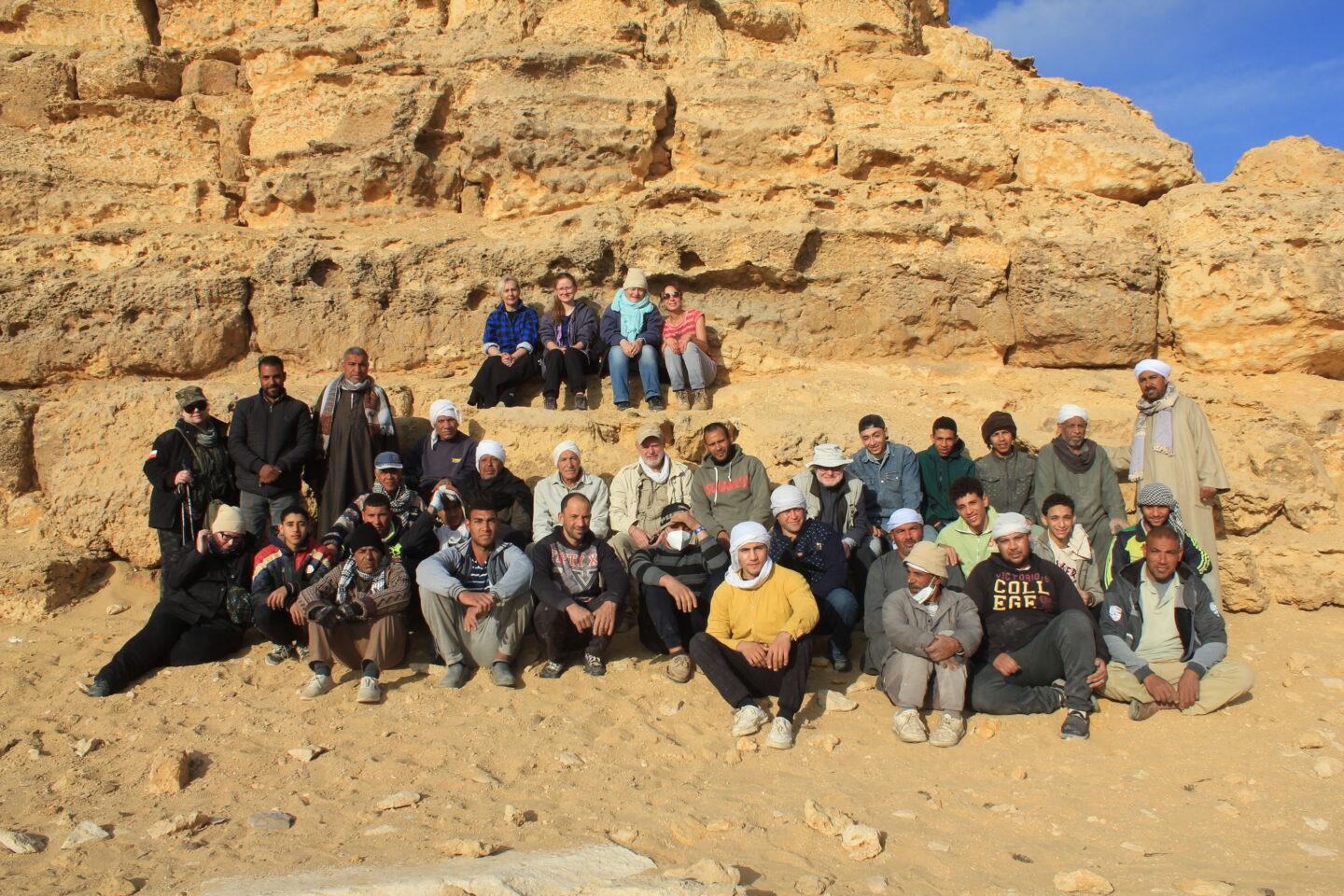
At the same time, we are beginning to showcase our progress to our largest donors from the Polish Business Council (PRB). Last Thursday, the PRB management board and a group of entrepreneurs visited the mastaba. We wanted to thank them personally: it was business funding that laid the foundation for this mission.
This is also part of building broader relationships between science and business. We are not only researchers; we are people seeking new partnerships to achieve new goals. I hope our guests agreed that it was worthwhile. This is a significant challenge for us, because the future of our collaboration depends on it. This model of cooperation is already popular internationally, and we aim to develop it further.
This is also part of building broader relationships between science and business. We are not only researchers; we are people seeking new partnerships to achieve new goals. I hope our guests agreed that it was worthwhile. This is a significant challenge for us, because the future of our collaboration depends on it. This model of cooperation is already popular internationally, and we aim to develop it further.
A new brand built on old-school foundations
In Poland, this is the first case where entrepreneurs have invested private money in science in this way - not by buying licenses, funding patents, or commissioning R&D for their companies. It’s not an investment in the usual sense, but support for research. Do you already have another idea you hope to involve business in?
Above all, we want to support - and perhaps rebuild - the brand of the Polish school of Mediterranean archaeology. The name and work of Professor Michałowski are known worldwide. The quality of our archaeological research is admired even in Egypt. We have become a benchmark for other missions; our work sets the standard. This is no exaggeration - our expertise is such that the Egyptians themselves seek to learn from us.
Thanks to business, we are riding this wave again. In discussions with entrepreneurs, the idea emerged that this brand could serve purposes beyond archaeology. Today, in Poland, this is overlooked. The government does not conduct business diplomacy, and the potential is ignored.
We have something unique on a global scale - valuable, impossible to counterfeit, and a reference point for the world of science. Our position in archaeology could also support the economy, helping companies that wish to cooperate not only in Egypt but across the Mediterranean basin.
A distinguished brand would become a product in itself, opening doors for other Polish sectors, including entrepreneurship. It could pave the way for new products and services under the umbrella of Polish excellence.
We want to engage the state administration to show why investing in such a brand makes sense. Business is a crucial partner, but brand building must be systematic and supported by the government to succeed.
“It’s about relationships, not just money”
You are one of the few Polish scientists so open to cooperation with business. What drives you?
I know most of the people who support us personally, and our relationships often go far beyond financial matters. These are individuals with not only tremendous expertise in their fields, but in some cases historical knowledge comparable to that of professional scholars. They understand the significance of our work. They are fully aware that their support is not a one-off gesture, but part of a long-term effort to build Poland’s image internationally. That is why we invest in these relationships. Money is important, of course - but it is the relationships that create lasting change, including in science.


Key Takeaways
- Unprecedented private support from Polish business. The archaeological mission in the tomb of Pharaoh Shepseskaf faced a severe funding shortfall. At the end of 2024, the Ministry of Science had not allocated resources, so, in desperation, the research team turned to the business community. Key support came from members of the Polish Business Council, including Rafał Brzoska, the OmenaArt Foundation, and Grzegorz Bielowicki.
- Significance of the project and initial results. This is one of the most important Polish missions in the history of Mediterranean archaeology—the first exploration of a previously unexamined tomb from the era of the Great Pyramids. While the sarcophagus is destroyed, the team has uncovered substantial organic material, human and animal bones, ceramics, and traces of later periods. Priorities include documentation, research, conservation, and preparing the mastaba for visitors. The mission agreement with Egypt is valid for five years, and the Ministry of Science has committed funding for the next stage.
- A new vision: business plus science, or a new Polish brand. Dr. Krzysztof Radtke, deputy head of the mission, and Dr. Karolina Zioło-Pużuk, deputy minister of science, agree that this model of business support for research - without expectation of profit - is unprecedented in Poland and represents a new quality of collaboration. Dr. Radtke aims to convince both the state and private sector to systematically rebuild the brand of the “Polish school of Mediterranean archaeology,” creating a distinctive Polish export product that could open doors for science and entrepreneurship throughout the Mediterranean.