

This article is a part of Poland Unpacked. Weekly intelligence for decision-makers
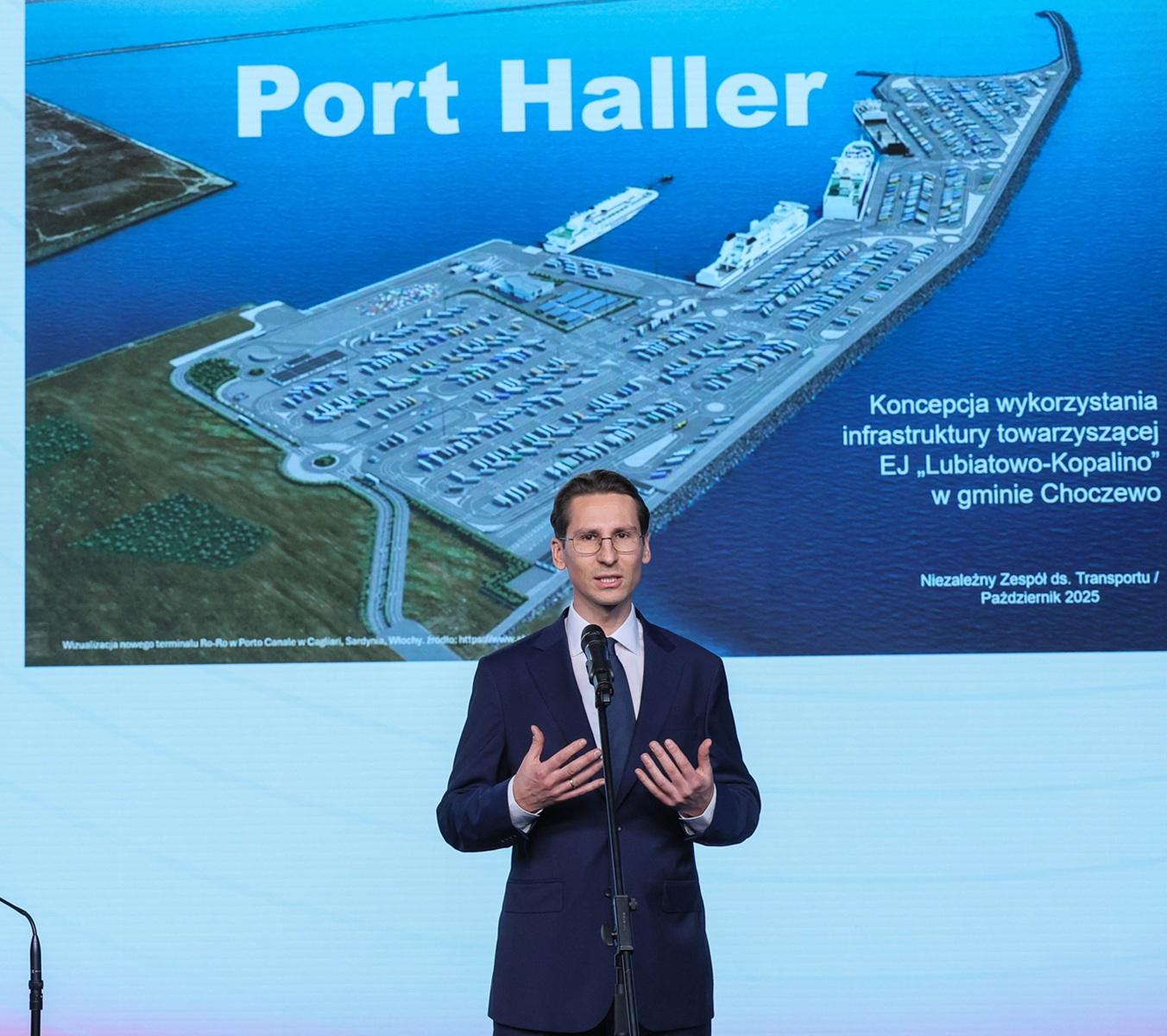
Jarosław Kaczyński has announced plans to build a new port at a location he has personally identified. He presented the project as one of the flagship infrastructure investments to be pursued should Law and Justice (PiS) return to power. The port – named after General Józef Haller – would be built near the planned nuclear power plant.
According to the PiS leader’s declaration, the facility would primarily handle roll-on/roll-off (ro-ro) cargo. In practice, this would mean ferry traffic, including vessels carrying containers, vehicles, and other wheeled cargo.
This raises several fundamental questions. While the expansion of Poland’s ports – especially those in the Tri-City area, though not only there – is a genuine economic need, building an entirely new port on a greenfield site gives rise to serious doubts.
Explainer
The Tri-City
The Tri-City (Trójmiasto in Polish) refers to the metropolitan area formed by three neighboring cities on Poland's Baltic coast: Gdańsk, Gdynia, and Sopot. Together they create one of Poland's most important urban areas with around 750,000-800,000 people.
Gdańsk is the largest and historic anchor - a beautiful port city with over 1,000 years of history, famous for its reconstructed old town, amber trade, and as the birthplace of the Solidarity movement that helped end communism. It's the economic and cultural center with around 470,000 people.
Gdynia is the youngest, built essentially from scratch in the 1920s-30s when Poland needed a modern port after regaining independence. It's more modernist in architecture, has a major commercial port and navy base, and feels more business-oriented. Population around 245,000.
Sopot is the smallest (around 35,000) but punches above its weight - it's Poland's premier seaside resort town, squeezed between the other two. Famous for its long wooden pier, beaches, the Forest Opera amphitheater, and upscale atmosphere.
The three cities blend seamlessly together, connected by the SKM (fast urban railway) that runs along the coast. You can live in one, work in another, and go out in the third without really noticing you've crossed city borders. The transport integration makes it function as one metropolitan area.
Cost is the critical issue. Constructing a port from scratch entails outlays running into the billions, particularly in a location with limited transport accessibility. While railway line no. 230 does pass through Choczewo County, passenger services on the line were suspended in the early 1990s. Its modernization is planned, but for now it remains a project for the future.
Polish ports – opportunity or guilty conscience?
Poland’s seaports handle not only commercial goods but also military equipment for an army that is rearming at record speed. They are also a key channel for critical energy imports.
According to logistics operator JAS FBG, in 2023 Polish seaports received 2,958.5 thousand tons of imported cargo, accounting for 47.3 percent of the ports’ total international throughput. In the same year, 18,900 vessels called at Polish ports.
Ports fall under the supervision of the Ministry of Infrastructure. The largest and most strategically significant include Darłowo, Dziwnów, Gdańsk, Gdynia, Hel, Kołobrzeg, Szczecin-Świnoujście, and Ustka. The question is whether Poland truly needs another major port.
It is worth first focusing on what is already in place. Poland’s ports face enormous investment needs, requiring multibillion-zloty outlays. Simply deepening the approach channel at Świnoujście (near the border with Germany) would cost around PLN 10 billion (approximately EUR 2.1 billion). Additional expenses include ongoing maintenance of waterways to accommodate the largest vessels. Perhaps the priority should be completing and financing projects that have already been planned or are underway.
New ports, old challenges: Cost and feasibility
Gdańsk’s port could handle both the construction and subsequent operation of a Polish nuclear power plant. The Baltic Hub container terminal in Gdańsk also retains potential for expansion and increased throughput. All four of Poland’s largest ports – Gdańsk, Gdynia, Szczecin, and Świnoujście – still have room to grow.
Building a new port, however, would require parallel investments in rail and road infrastructure, further driving up costs. We are likely talking about a multibillion-zloty undertaking. This raises the question of whether a genuine state need exists to justify spending on such a scale.
A project of this magnitude would need evaluation by numerous institutions, including military logistics experts. Constructing a port from scratch, while complying with EU regulations, environmental procedures, and building permits, is a decades-long endeavor. Opinions would be required from bodies such as the Maritime Office in Gdynia, the Ministry of Infrastructure, and the Ministry of Climate and Environment.
The Polish Press Agency estimated that investments in Świnoujście – including port expansion, a deep-water terminal, and new railway lines, roads, and parking facilities – would total around PLN 10 billion (EUR 2.1 billion). And this concerns a port that already exists and is highly developed.
“The cost of building a single ro-ro berth capable of handling one vessel is around PLN 100 million (EUR 21 million). And we’re not talking about a single berth, but a full set with marine and transport infrastructure. This would be a multibillion-zloty investment, requiring consideration of geotechnical conditions, availability of labor, land for development, and environmental constraints,” says Jan Kamoji-Czapiński, location strategy advisor at commercial real estate agency Colliers.
A good plan, but the map disagrees
We asked a senior director at one of the Tri-City ports for his view. He requested anonymity but emphasized that the Law and Justice (PiS) proposal deserves careful analysis – particularly regarding the investment’s location.
He raises the key issue of site selection, rightly noting that building a port “in the middle of nowhere” brings fundamental questions. Is there – if any – existing access and transport infrastructure? If it must be created from scratch, project costs rise sharply.
At the same time, it should be stated clearly: the concept of a ro-ro port makes sense, because Poland currently lacks such a facility. With imports on the rise, this approach is rational.
The problem is that, rather than starting from zero, resources could be used more efficiently. How? By expanding the existing ports in Gdynia and Gdańsk.
“That certainly makes more sense than pointing at a spot on the map and saying, ‘We’ll build a port here.’ Concrete data and analysis are needed. It was similar with the port in Elbląg and the Vistula Spit canal: PLN 2 billion was invested, yet few vessels use it. Building the terminal itself wouldn’t take long, but roads and rail lines would need to be developed. People would need to live there, and facilities for the Border Guard, customs, and various inspections would have to be established. The investment concept is sound – but the location is, at the very least, wrong,” our source says.
Military significance? “That’s nonsense”
Law and Justice (PiS), speaking through its Tri-City MP Kacper Płażyński, has advanced the argument that a new port would have defensive significance. In social media posts, the politician claimed that “howitzers from Baltiysk (Kaliningrad Oblast—ed.) are 65 km away. That means it is possible to fire on ships entering the Tri-City ports.”
How far this departs from reality was pointed out by military analyst Jarosław Wolski. He noted that no Russian mass-produced ammunition – neither 152 mm nor 203 mm – has such a range.
“Even 50 km is currently unattainable for Russia in serial production. Plans related to the 2S35 Koalitsiya-SV self-propelled gun and ammunition with a range of around 70 km (ramjet) were abandoned due to the absolute impossibility of producing it by the Russian defense industry,” Mr. Wolski wrote on his X (formerly Twitter) account.
At the same time, as he soberly observed, “Port Haller” would fall within range of all air-attack assets deployed in Kaliningrad – and in practice also from Belarus. It would also require the construction of a separate air-defense system, which the Tri-City already has in place in the event of armed conflict.
Mr. Wolski sharply criticized the plan to create “Port Haller,” calling it outright “a political sham,” designed for one purpose only: “to dazzle voters with the promise of a grand project.”
That said, it should be acknowledged that if the port were built near the future nuclear power plant, it could fall under the air-defense “protective umbrella” that the military would deploy over that infrastructure. No one assumes that an asset as expensive and strategic as a nuclear power plant – valued at more than PLN 190 billion (around EUR 40 billion) – would be left without special protection.
In response, Kacper Płażyński – the political “face” of the project – went on the offensive, calling Mr. Wolski a “port illiterate.” He later accused him of failing to distinguish between ports handling petrochemicals, bulk carriers, and container ships, and those specializing in ro-ro operations.
A separate issue is that the Kaliningrad Oblast is indeed heavily saturated with air-attack assets, largely missile-based. These include Iskander missile launchers, whose range covers a significant portion of Poland. Along the coast, this means that all key targets and installations – including ports – fall within reach. For this reason, the coastline should be protected by the strongest possible missile-defense “umbrella.”
Let’s revisit the idea with better planning: “A new port is a good idea”
It can be said that while the very idea of building a new port is not flawed, its weakest point remains the location – an issue highlighted earlier by Jan Kamoji-Czapiński.
As he emphasizes, a port requires a substantial urban hinterland to function efficiently, providing both workforce and supporting infrastructure. The Tri-City ports are already “encircled” by urban areas, which limits their potential for further expansion.
“A port is not just quays; it also needs the supporting facilities it can draw upon. For example, manufacturing plants, including those in the offshore sector. In Poland, finding land for port expansion and related infrastructure is a major challenge. A completely new port, offering full flexibility in land use, is a good idea – actually, a very good one. But in the case of the municipality mentioned, there is no significant urban center nearby. Perhaps a better location would be around Koszalin or Słupsk, which would provide greater development opportunities,” the expert notes.
He adds that if the goal is to create a “full-scale port,” with space for further infrastructure and investment, it would be easier to anchor it near existing cities.
Mr. Kamoji-Czapiński also finds it striking that the discussion focuses solely on a ro-ro port. He draws attention to the broader context of freight transport. Melting Arctic ice is shortening the sea route from Asia by up to half, potentially creating new logistical opportunities for Poland.
“This opens new possibilities for Polish ports, mainly in container handling, not necessarily ro-ro logistics. And again, location matters. Near Koszalin and Słupsk, the S6 expressway is under construction. This is a sensible direction both from a business and military perspective. Diversifying port infrastructure is, in my view, highly advisable,” Jan Kamoji-Czapiński concludes.
Ports are poetry - but budgets are not
In summary, the idea of building a new port is not bad at all. On the contrary, it is sharp and justifiable. The problem, as experts point out, lies in the location proposed by Law and Justice (PiS). Put bluntly: a good concept would be killed here by the massive costs of supporting infrastructure.
According to Jan Kamoji-Czapiński, a port in Choczewo would, in practice, need to be “built around a city” – including access roads, rail lines, and service infrastructure. This is an investment whose costs would run into tens of billions of zlotys, and the state budget is not infinitely elastic.
In this context, the PiS leader’s proposal is easier to view as a media stunt than a real, carefully calculated development strategy. Its political flavor is further heightened by reports that properties owned by the family of former Orlen CEO Daniel Obajtek are located in the proposed area.
Explainer
Daniel Obajtek
Daniel Obajtek is a controversial Polish businessman and politician who served as CEO of PKN Orlen, Poland's state-controlled oil refining giant, from 2018 to 2024 under the previous Law and Justice (PiS) government.
During his tenure, he oversaw massive expansion projects including the acquisition of smaller rival Lotos and German refiner Bayernoil, transforming Orlen into Central Europe's largest energy company, though critics accused him of empire-building and politically-motivated deals that benefited the ruling party.
His leadership was marked by allegations of conflicts of interest, questionable business practices dating back to his time as mayor of a small town, and a combative relationship with independent media, while supporters praised his ambition and business acumen.
After PiS lost power in late 2023, Obajtek became the target of multiple investigations by the new government and prosecutors, fled to Hungary (avoiding a parliamentary summons), and was recently elected to the European Parliament on a PiS ticket - a move seen as seeking parliamentary immunity from prosecution.
He remains a deeply polarizing figure who embodies the broader political divisions in Poland, with opponents viewing him as a symbol of cronyism under PiS rule and allies defending him as a victim of political persecution by the current Tusk government.
Expert's perspective
Building a new port could be justified
However, other issues must be considered, including environmental and legal conditions, transport, logistics, and – ultimately – the economic viability of such an investment. The idea cannot be discussed in isolation from these factors. Transport infrastructure and road networks are particularly important, as they must be integrated into the implementation plans of Polskie Elektrownie Jądrowe (the company in charge of the nuclear power plant project – ed.).
Local authorities and the Pomeranian regional government are watching closely. Delivering another large-scale investment in this area would require close cooperation between regional and central institutions. Current projects – such as offshore wind farms and the nuclear power plant – already demonstrate the urgency of constructing the Red Road, given the heavy congestion in Gdynia. It is also worth noting that the Via Pomerania project remains stalled, and even if it proceeds, at this scale it would require 5–7 years of design and construction.
Choczewo is located in Wejherowo County, which we manage through the Pomeranian Special Economic Zone regarding support decisions for companies benefiting from tax exemptions. The scale of energy investments in the north – wind farms, the nuclear plant, and energy storage – will strongly influence what kinds of projects can be located in this part of the country. Energy production in Pomerania, covering up to 40 percent of Poland’s demand, creates an opportunity to attract multiple energy-intensive industries.
Considering the economic development of Pomerania, building another port could be justified – but only if all the factors mentioned above are carefully taken into account.


Key Takeaways
- Rather than starting such a costly greenfield project, central and local authorities should first focus on significantly investing in the development of existing port infrastructure in Gdańsk, Gdynia, Szczecin, and Świnoujście, where expansion potential remains substantial. If Poland were nevertheless to build a completely new port, as Jan Kamoji-Czapiński emphasizes, it would make more sense to consider alternative locations near Słupsk or Koszalin. These areas offer far greater possibilities for developing urban, industrial, and transport infrastructure – without which no modern port can function today.
- Poland clearly needs further development of its port infrastructure. Ports are today a key element of the country’s economic and energy security, as well as an important logistical backbone for the military. At the same time – as experts point out – building a port from scratch can be a challenge whose costs may easily outweigh the potential benefits.
- The location proposed by PiS leader Jarosław Kaczyński in the municipality of Choczewo would require massive additional investment. The area lacks both an urban hinterland and basic transport infrastructure, meaning that roads, railways, and an entire economic ecosystem would have to be built almost from scratch.