

This article is a part of Poland Unpacked. Weekly intelligence for decision-makers
It is 2015. In a sensational outcome, the presidential election is won by the relatively unknown Andrzej Duda, then a Member of the European Parliament for Law and Justice. Bronisław Komorowski suffers a clear defeat in his bid for re-election. The electorate, disappointed with the Civic Platform (PO), rallies behind the independent candidate Paweł Kukiz (former rock star and band leader), who secures around 20 percent of the vote. The remaining candidates receive only marginal support – including Grzegorz Braun. The conservative filmmaker, known for his eccentric manner, garnered 124,000 votes at the time, or 0.83 percent.
Fast forward to 2025. Grzegorz Braun takes fourth place in the presidential race with the backing of 1.2 million voters, or 6.2 percent. In some areas – particularly rural regions in eastern Poland – Mr. Braun wins more than 10 percent of the vote. Since the presidential election, his party, the Confederation of the Polish Crown, has consistently polled around 6–7 percent. At the same time, all electoral simulations clearly indicate that Mr. Braun and his camp are becoming an essential component of any potential return of the right to power.
Jewish bunkers under planned airport CPK and the party’s internally contradictory platform
At the same time, Mr. Braun’s party, with an intensity unknown to previous anti-system movements, rejects the basic pillars of the contemporary order. It opposes Poland’s membership in the European Union, aid to Ukraine, and the isolation of Russia. Through Mr. Braun, the so-called “fire-extinguishing movement” claims that the construction of the Central Communication Port (CPK) is a “Jewish plot.” According to this narrative, the project is intended to build a vast bunker where Jews would establish an alternative global command center.
Explainer
Mr. Braun’s Fire Extinguisher Movement
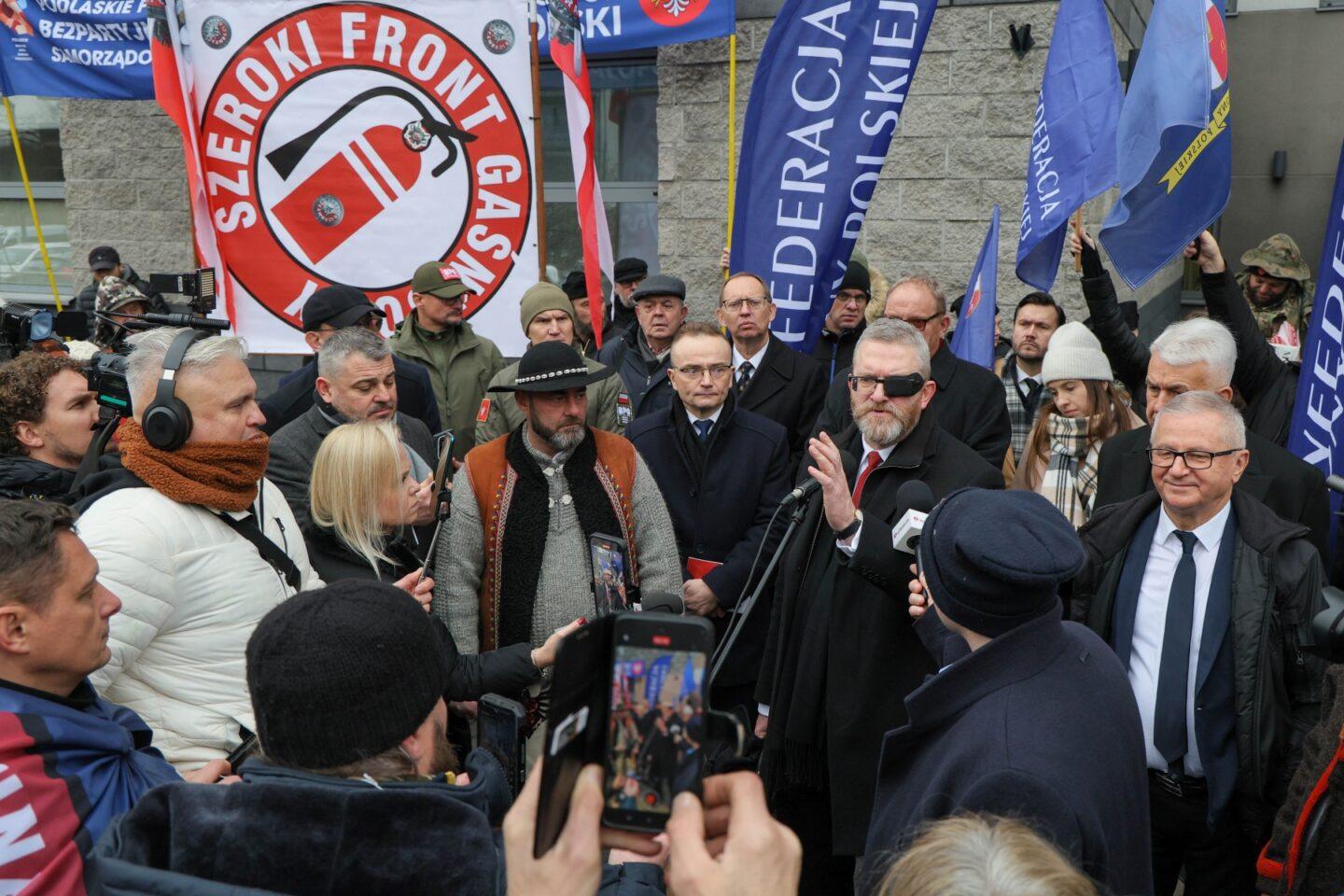
“Braun’s Fire Extinguisher Movement” (Ruch Gaśnicowy Brauna) originated from an incident in December 2023 when Polish MP Grzegorz Braun used a fire extinguisher to disrupt a Hanukkah candle-lighting ceremony in the Sejm, parliament's lower house, prompting his temporary exclusion from proceedings and widespread media coverage.
The phrase has since been adopted by Mr. Braun and his supporters as a rallying slogan for his Confederation of the Polish Crown (KKP) faction, framing it as symbolic resistance against perceived cultural and political threats during his 2025 presidential bid and efforts to form a parliamentary group.
Good to know
CPK airport
CPK, or Centralny Port Komunikacyjny (now renamed to Port Polska), is Poland's ambitious infrastructure project to build a major new international airport between Warsaw and Łódź (central Poland), integrated with high-speed rail and road networks, designed to handle 34 million passengers annually in its first phase.
A few months ago, Mr. Braun also argued that “the thesis on the existence of gas chambers in Nazi concentration camps is undocumented,” claiming he does not find it convincing. Statements that once excluded a politician from serious public life are now increasingly becoming potent political fuel, helping to expand an extremely anti-system electorate.
About Grzegorz Braun himself, there has been ample attention, and he has remained known to the public for years. Less is known, however, about the people who have been joining his movement en masse in recent months. It turns out that the “fire-extinguishing movement” has little in common with a coherent, ideological camp. It is more of a conglomerate of peculiar characters – literally “from A to Z.”
This assertion is relatively easy to substantiate. One can start by examining the party’s program itself. The policy document, issued in 2023, carries the internally contradictory subtitle “Strong Minimum State.” Within the document, one finds proposals such as abolishing the minimum wage, PIT and CIT taxes, abandoning the “climate package,” and eliminating transfers to families. At the same time, Mr. Braun’s supporters promise to strengthen the role of the family. How? By opposing what they call the “aggressively promoted neo-Marxist revolution, which triggers significant cultural transformations affecting changes in attitudes.”
Who makes up Mr. Braun’s party?
The party program also reveals a rather incoherent landscape of personalities within the Polish Crown Confederation (KKP). One of the most frequently cited elements of the KKP program, as well as Mr. Braun’s presidential campaign speeches, are ultra-Catholic and patriotic slogans.
They emphasize the central role of the Church (specifically pre-Vatican II) and call for the enthronement of Jesus as King of Poland. It might therefore be cautiously assumed that the KKP’s activist base would consist of devout Catholics like Mr. Braun himself.
This assumption quickly proves false. One of the leading figures of the “fire-extinguishing movement” is the former leader of the “Highlander’s Veto,” Sebastian Pitoń. A professional architect dressed in traditional highlander garb, he frequently appears alongside Mr. Braun at press conferences. Mr. Pitoń first gained wider attention during the coronavirus pandemic, when he publicly denied its existence.
“It’s a mild, pleasant illness,” he claimed on Radio Zet in 2021.
Mr. Pitoń also became notorious for advocating the “right of the head of the family” to kill children – including those already born. By comparison, his statements on the need to abolish Tatra National Park and create a “Kingdom of Podhale” seem almost mild -especially against the backdrop of other claims that sharply contradict Catholic social teaching and basic common sense.
The Zakopane-based KKP activist was reportedly also on a secret list of 25 individuals whom the state Commission for Investigating Russian and Belarusian Influence alleged had participated in spreading Kremlin propaganda in Poland.
In the Tatra County in southern Poland, Mr. Braun secured 12.06 percent of the vote in May 2025.
Explainer
Poland's Górale, or Highlanders
Poland's Górale, or Highlanders, are an ethnographic group inhabiting the southern mountain regions, mainly Podhale in the Tatra Mountains around Zakopane and the Beskids in Silesia and Lesser Poland. They’re known for their pastoral roots tracing back to 14th-15th century Vlach shepherds who blended with local Polish communities.
The area is usually seen as conservative as often confirmed in voting results.
The burned historical document, “patostreamers,” and hatred
Riding the wave of Mr. Braun’s success in the presidential elections, two “patostreamers” recently joined the pro-Russian Polish Crown. Wojciech Olszański (who goes by Aleksander Jabłonowski) and Marcin Osadowski, better known as “Jaszczur (Lizard)”, were released from detention this year after being held since June. The pair faced charges for 154 offenses – covering only the first half of the year – which included racial abuse and publicly endorsing politically motivated violence.
Mr. Olszański and Mr. Osadowski have long been known for online broadcasts in which they openly spread hatred against various social groups, frequently insulting viewers who called in. One might dismiss this as the atavistic logic of the modern internet. Yet their activities long ago went beyond mere “patostreaming.” During their broadcasts, the provocateurs not only attacked political opponents but also glorified Russian soldiers and insulted the Bible and Polish Christians in crude terms.
Explainer
Patostreaming
Patostreaming refers to a controversial Polish internet phenomenon involving live video streams on platforms like YouTube or Twitch, where streamers broadcast behaviors such as excessive drinking, domestic violence, verbal abuse, or humiliating acts to attract viewers and earn donations.
These “patostreamers” often monetize through viewer tips, escalating shocking content on demand, which has drawn legal scrutiny for promoting harm, prompting police crackdowns and platform bans amid debates on youth desensitization.
In 2021, in the city of Kalisz, Mr. Olszański and Mr. Osadowski burned the so-called Kalisz Statute – a 13th-century document that guaranteed personal freedom and safety to Jews. At the time, even the far right publicly distanced itself from the act. Four years later, leaders of the now-defunct “Rodacy Kamraci (Brothers Camrades)” party appeared at a Mr. Braun rally in Białystok. During the event, slogans included “For Peace,” “NO to War Mongers,” and “Polexit – No to the Eurokolkhoz.”
A former climate advocate
At the same Mr. Braun rally, Marek Woch also appeared. In the May presidential elections, Mr. Woch finished last. At the time, he ran as a representative of the Nonpartisan Local Government Association – a heterogeneous group, part of whose members distanced themselves from Mr. Woch during the campaign. Immediately after the elections, however, he and his collaborators merged their faction with the National Camp organization. His connection with Mr. Braun stems from an alliance under which they plan to field joint Senate lists in 2027.
In 2019, Mr. Woch ran for the European Parliament on the Poland Fair Play ticket. He then advocated, among other things, for more ambitious EU greenhouse gas reduction targets and supported the creation of joint EU defense forces. Today, he speaks far less frequently and with noticeably less enthusiasm about European Union policies.
As a politician, Mr. Woch also worked in the Office of the Ombudsman for Small and Medium Enterprises. In 2023, TOK FM radio station published a report accusing him of bullying subordinates at the office. Mr. Woch did not respond to the allegations and, despite employee complaints, was promoted to deputy ombudsman.
Openly pro-Russian politician with charges in Mr. Braun’s orbit
At one of the recent KKP rallies in Szczecin in north-western Poland, Mateusz Piskorski appeared alongside Mr. Braun. Mr. Piskorski served as an MP from 2005 to 2007, but he became more widely known in the following years. In 2015, he founded the openly pro-Russian party Zmiana [Change]. A year earlier, he supported the widely unrecognized “referendum” in Crimea, which resulted in the peninsula’s annexation by Russia.
Mr. Piskorski’s activities did not go unnoticed by the authorities. In 2016, Poland’s Internal Security Agency (ABW) detained him on charges of espionage for Russian and Chinese intelligence. He spent three years in detention. His trial is still ongoing. Shortly after his release, he told Russian media that he had received support during his incarceration from, among others, Mr. Grzegorz Braun. Following Russia’s full-scale invasion of Ukraine, Mr. Piskorski appeared in state-controlled Belarusian media, where he challenged Poland’s sovereignty in conducting foreign policy.
Last week in Szczecin, Mr. Braun announced that his lists would feature “extraordinary individuals,” with Mr. Piskorski reportedly among them.
The KKP also includes three sitting MPs. Włodzimierz Skalik and Roman Fritz entered the Sejm on the Confederation list, while Sławomir Zawiślak, a 20-year Law and Justice veteran, recently joined Mr. Braun’s formation. Zawiślak’s transfer allowed the Polish Crown to form its own parliamentary circle in the Sejm (requiring a minimum of three mandates). According to Michał Wróblewski of Wirtualna Polska news portal, Mr. Zawiślak’s move may have been “controlled” and served as a “gesture of thanks” for Mr. Braun’s support of Nawrocki ahead of the second round.
A motley crew of extremes: Mr. Braun’s weakness?
The sketches of these peculiar figures with murky biographies, of course, represent only a fragmentary picture of the Polish Crown Confederation’s environment. Yet it is clear that the activists are not necessarily united by a coherent ideology or a concrete vision for a “fire-extinguishing” Poland.
What may truly bind Mr. Braun’s coalition is opposition – to the system, to the European Union, and more broadly to the Western political order and contemporary values. However, the proposals implied by the biographies of the figures cited (and there are many more) remain vague and, at times, internally contradictory.
Mr. Braun’s strategy of extreme negation of the established order, on the other hand, may resonate with a wide range of constituencies: younger and older voters, former supporters of Law and Justice (PiS), or those who previously abstained from public life.
For now, Mr. Braun and his leadership have proven adept at mobilizing various fears and emotions. Currently, these include anti-Jewish, anti-Ukrainian, anti-EU resentments, as well as anti-health anxieties that trace back to the pandemic. Yet on the horizon, there is no clear vision or coherent programmatic foundation.
In a recent interview with XYZ, Professor Jarosław Flis suggested that Mr. Braun’s party may appeal to voters who are “cognitively frugal but emotionally generous.” As the professor noted, mere opposition to the world may prove insufficient “when competitors combine emotion with experience and effectiveness.”
It is also worth recalling the fates of other “protest movements.” The Palikot Movement and Kukiz15 entered the Sejm with a bang, only to exit four years later with an even louder crash. One key reason was the excessive ideological diversity of their politicians, who subsequently scattered to other parties or left politics entirely.
This, however, is a future challenge for Mr. Braun. It is conceivable that in two years, dozens – or even several dozen – individuals openly lobbying for Vladimir Putin’s interests could occupy seats in the Polish parliament.


Key Takeaways
- KKP’s personnel base as a fragmented extremist conglomerate. The Polish Crown Confederation (KKP)’s personnel base is an inconsistent conglomerate of extreme figures, including patostreamers known for hate speech (Wojciech Olszański, Marcin Osadowski) and politicians facing serious allegations, such as Mateusz Piskorski, accused of espionage on behalf of Russia. Despite a declared commitment to Catholic tradition, Braun’s circle includes individuals espousing views that contradict Church teaching, such as Sebastian Pitoń, signaling a prioritization of controversial potential over ideological coherence.
- Opposition as the unifying principle. The primary element uniting Braun’s diverse camp is total rejection of the existing political order, including Poland’s EU membership, Western alliances, and support for Ukraine. Instead of a constructive program - “Strong Minimum State” contains internally contradictory proposals – the party builds support by exploiting fears and resentments (anti-Semitic, anti-Ukrainian), targeting voters driven by strong emotions and limited cognitive skepticism.
- Electoral success and risks for the right. Grzegorz Braun’s fourth-place finish in the presidential elections (1.2 million votes) makes his formation an indispensable component for any potential return of the right to power, paving the way for parliamentarians pursuing Kremlin-aligned interests. The KKP faces risks from extreme ideological diversity and a lack of professional infrastructure, which could reproduce the fate of the Palikot Movement or Kukiz15, where internal chaos led to rapid disintegration after parliamentary entry.