

This article is a part of Poland Unpacked. Weekly intelligence for decision-makers
Alternative for Germany’s victory in the state election in Saxony-Anhalt reverberated across Europe, including Poland. For years, the AfD has openly promoted an anti-Polish narrative while also openly supporting Vladimir Putin’s Russia. Even so, parts of the Polish right remain ambivalent toward the party.
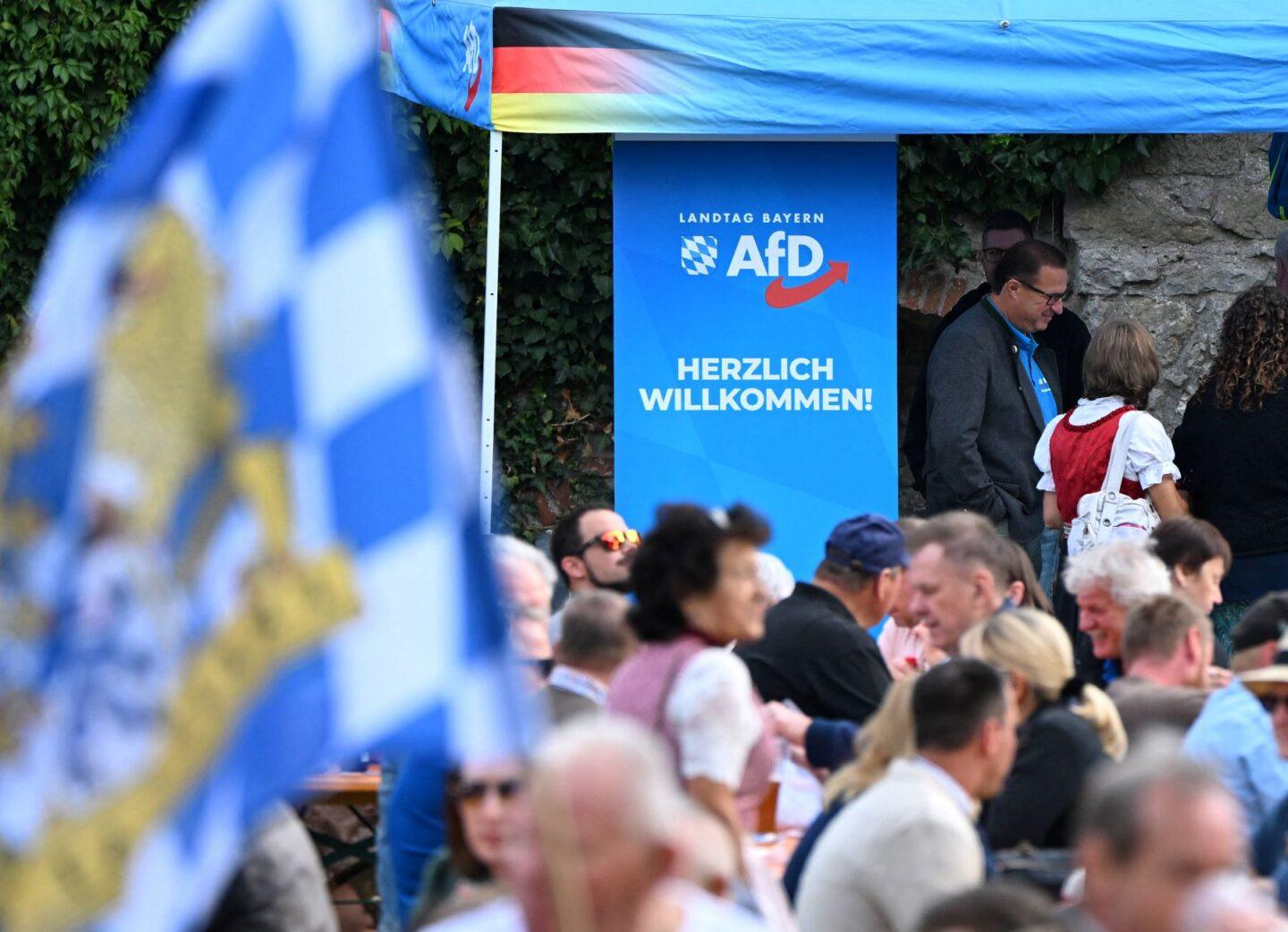
Alternative for Germany’s unprecedented triumph in Sunday’s state election in Saxony-Anhalt sent shock waves through European public opinion. Although the victory itself could hardly have come as a surprise, the symbolic end of the “firewall” against Germany’s far right prompted strong reactions and a wave of commentary. In Poland, too, the AfD’s triumph in Saxony-Anhalt attracted intense interest from commentators and politicians.
Polish parties and the AfD
The Polish political class’s reactions to developments in other EU countries are, to a large extent, predictable. Parties that sit in the same political groups in the European Parliament tend to rally behind the electoral successes of their political allies in other member states.
The case of the AfD, however, is more complicated.
The party’s main narratives and policy demands are not all necessarily achievable at the state level – including the expulsion of people with immigrant backgrounds, a revision of Germany’s historical policy and a return to normal economic relations with Russia.
The AfD’s attitude toward Poland, however, is a separate issue altogether. Contrary to the jubilation and triumphalism seen among parts of the Polish right – more on that shortly – the party led by Alice Weidel and Tino Chrupalla views Poland as an adversary, and even as a threat to Germany.
Anti-Polish rhetoric from leading AfD politicians
In 2023, party co-chair Alice Weidel referred to the territory of the former East Germany as “Central Germany.” Her remark was quickly interpreted as an implicit challenge to the shape of the Polish-German border. In an interview with Germany’s Bild, Prof. Herfried Münkler, a political scientist and historian at Humboldt University in Berlin, had no doubt about Weidel’s intentions.
“From a political point of view, using such language calls Germany’s eastern border along the Oder and Neisse rivers into question,” Münkler said.
Provocative remarks about Poland from senior AfD politicians have also surfaced much more recently. In November last year, appearing on ZDF television, the party’s other co-chair, Tino Chrupalla, argued that Poland could pose a threat to Germany’s security.
“It is possible that Poland could be a threat to us,” Chrupalla said.
Asked by interviewer Marcus Lanz whether Poland could pose as great a threat to Germany as Russia, Chrupalla answered in the affirmative.
“We can see that Poland’s interests differ from Germany’s (…) We are currently seeing double standards, a double morality over the Nord Stream pipeline. Poland did not extradite to Germany a wanted criminal, a terrorist [a reference to Volodymyr Zhuravlov, who is currently being held by the German authorities - ed.],” the AfD co-chair argued.
These are statements by the two most important politicians in the entire party. At the beginning of this year, AfD MP Kay Gottschalk went even further, making still more absurd accusations.
Absurd demands for Poland to pay reparations to Germany
“EUR 1.3 trillion should be enough in reparations for complicity in blowing up Nord Stream. My first official decision as finance minister will be to pursue these claims against Poland,” the far-right politician wrote on X.
The party’s openly anti-Polish rhetoric is neither incidental nor accidental. A few weeks ago, even Confederation (Konfederacja – a right-wing party – ed.) came under fire from the AfD, despite the fact that two of its MEPs sit alongside the German far right in the Europe of Sovereign Nations (ESN) group in the European Parliament.
AfD politician Fabian Keubel called Poles “eternal victims hungry for pity” and “the African Americans of Europe.” The context? On the anniversary of the outbreak of the Warsaw Uprising, Sławomir Mentzen, together with Confederation politicians and supporters, lit flares in front of the Brandenburg Gate in Berlin.
The statements above are only a sample of Alternative for Germany’s unequivocally confrontational narrative toward Poland. Yet remarks that are scandalous from a Polish point of view have not deterred parts of Poland’s political scene from maintaining alliances with the AfD.
Once enthusiastic, Nowa Nadzieja is more restrained today
In 2024, when Sławomir Mentzen was asked why Nowa Nadzieja’s MEPs had joined the ESN group, which includes AfD politicians, he defended his German colleagues.
“The AfD is the most pro-Polish party in Germany. It opposed the European Commission blocking funds for Poland over the so-called rule of law, it opposed climate policy, which is anti-Polish, it opposes treaty changes, stripping Poland of its veto rights and transferring further Polish competences to the European Union,” Mentzen said on Radio Zet.
That, however, was two years ago. Today, as Onet news outlet reports, Confederation’s reaction to the AfD’s electoral success is more restrained. Confederation spokesman Wojciech Machulski said Sunday’s AfD result was neutral for Poland.
“We are critical of statements by Polish politicians saying that there are people one simply cannot talk to. No, we should not get carried away by emotion and we should talk to everyone. It may indeed turn out that one day the AfD forms a government in Germany. And if the day comes when someone from the AfD becomes chancellor, it will be better to have normal relations with them,” Machulski told Onet.
Ruch Narodowy has long been skeptical of the AfD
This is not, however, the position of the entire Confederation camp. Its other component, Ruch Narodowy, takes a critical view of cooperation with the AfD. Two years ago, after the European Parliament elections, RN politicians declared that, unlike their colleagues from Nowa Nadzieja, they would not join a parliamentary group with the AfD. Ruch Narodowy’s politicians belong to a different group in the European Parliament – Patriots for Europe – whose members include the Czech ANO party, Hungary’s Fidesz and France’s National Rally.
“The party’s position on Nord Stream I and Nord Stream II, as well as statements by some of its members that are directly at odds with Poland’s national interest, make it impossible to envisage building trust and constructive cooperation within a single political group,” Anna Bryłka, an MEP from Ruch Narodowy, said at the time.
Today, Ruch Narodowy politicians do not officially comment on Nowa Nadzieja’s cooperation with the AfD. The split within Confederation over the issue is nevertheless clear. Can we therefore expect cooperation between Sławomir Mentzen’s faction and the AfD to loosen?
Expert: a “controlled taboo” in relations between Nowa Nadzieja and the AfD
According to Marcin Fronia, an expert on international relations, that does not necessarily have to happen.
“Belonging to the same group in the European Parliament does not mean sharing the same position on every issue. Europe of Sovereign Nations (ESN) primarily brings together parties united by opposition to further European integration, an emphasis on national sovereignty and some shared views on migration and security policy. Its members include both AfD MEPs and representatives of Poland’s Confederation, including Nowa Nadzieja. So far, I would describe the situation more as a ‘controlled taboo’ than as a complete ban on discussing contentious issues. This has also applied to matters directly related to Polish-German historical disputes, which are far more prone to generating conflict,” Fronia says.
Confederation’s position on the AfD’s growing strength remains ambiguous. The same cannot be said of the former political allies of Sławomir Mentzen and Krzysztof Bosak.
Braun’s party backs the AfD
“Europe is waking up and the establishment is panicking. The AfD’s result shows that people have had enough of Brussels’ diktat, the Green Deal and the destruction of nation states through illegal immigration. The political earthquake is only just beginning. A beautiful, white Europe of nations will soon return,” Włodzimierz Skalik, an MP from KKP, wrote on X.
Shared opposition to the European mainstream, criticism of Kyiv and a favorable attitude toward Moscow are common denominators for the AfD and KKP. In this context, the AfD’s anti-Polish rhetoric does not appear to trouble MPs from Grzegorz Braun’s party at all.
PiS keeps its distance, Rozwój Plus is openly critical
Law and Justice (PiS), and especially Rozwój Plus (Development Plus, a newly-formed group around former PM from PiS – Mateusz Morawiecki – ed.), take a more critical stance toward the AfD.
PiS MP Andrzej Śliwka argues that the main lesson from the state election result is to draw conclusions from it, “rather than fall into euphoria or, heaven forbid, be terrified by it.”
“Rising support for the AfD shows that German politics will become increasingly polarized, less predictable and more focused on domestic problems. Public pressure for changes to migration, economic and energy policy will grow, and with it the way Berlin defines its interests in Europe will also change. That makes it all the more important for Poland to have a sovereign-minded, patriotic government capable of firmly defining the interests of the Republic of Poland and defending them effectively,” Śliwka wrote on X.
Łukasz Schreiber, head of the Rozwój Plus parliamentary caucus, took a much more forceful position.
“44% for the AfD in Saxony-Anhalt… If the exit poll is confirmed, these are terrifying results. I do not understand how a Pole and a patriot can take pleasure in their success. Their distance from Brussels changes nothing here,” Schreiber wrote on social media.
Paweł Szefernaker, head of the president’s office, struck a similar tone.
“The AfD is running on a platform that runs counter to the interests of the Republic of Poland,” Szefernaker said on Kanał Zero.
Marcin Fronia: the AfD cannot be dismissed
While the Polish right speaks with many voices on the AfD, the position of the governing coalition is unequivocal. Prime Minister Donald Tusk did not mince his words on Sunday. He also used the occasion to launch the customary attack on the right-wing opposition.
“In Poland, only idiots or traitors can celebrate the AfD’s triumph in Germany. There are quite a few of them in Confederation and PiS,” the prime minister wrote on X.
The AfD may win another election later this month. On September 20, voters in Mecklenburg-Vorpommern and Berlin will elect their state authorities. Will further successes make the AfD even more entrenched in the hardline positions it already holds today?
According to Marcin Fronia, the answer remains uncertain.
“After winning the election in Saxony-Anhalt, the AfD will certainly become more self-confident, and its appetite for greater access to further levels of power in Germany, as well as for a bigger role in the German political mainstream and beyond, will grow even further. The key question is whether, as the AfD’s importance increases, statements of this kind will remain the views of individual politicians or begin to form part of the party’s official line as a whole. For now, only at the level of a single state, it is ceasing to be merely an opposition party and gaining access to power and government. This can no longer be either dismissed or ruled out,” Fronia concludes.


Key Takeaways
- The rhetoric of leading AfD politicians toward Poland is consistently confrontational rather than friendly. Statements by party co-chairs Alice Weidel and Tino Chrupalla, as well as MP Kay Gottschalk, point to challenges to the Polish-German border, portrayals of Poland as a threat to Germany and demands for reparations from Warsaw.
- Reactions across Poland’s political landscape to the AfD’s success are divided along established ideological lines, with a particularly visible split on the far right. Nowa Nadzieja maintains a restrained distance from its allies in the ESN, Ruch Narodowy takes a critical view of cooperation with the AfD, while the Confederation of the Polish Crown openly celebrates the German far right’s electoral result. The parties of the governing coalition, as well as parts of the parliamentary right, including PiS and Rozwój Plus, criticize the AfD’s anti-Polish course.
- According to Marcin Fronia, growing support for the AfD could in future translate into a greater role for the party in German and European politics. That, in turn, will raise the question of whether anti-Polish statements remain the views of individual politicians or become the party’s official line. The next test of this dynamic will be the state elections in Mecklenburg-Vorpommern and Berlin scheduled for September 20.