

This article is a part of Poland Unpacked. Weekly intelligence for decision-makers
Against the backdrop of the Kraków attack and the dispute over the Constitutional Tribunal, another Independence March is set to make its way through Warsaw. The entire parliamentary right and President Karol Nawrocki are expected to take part.
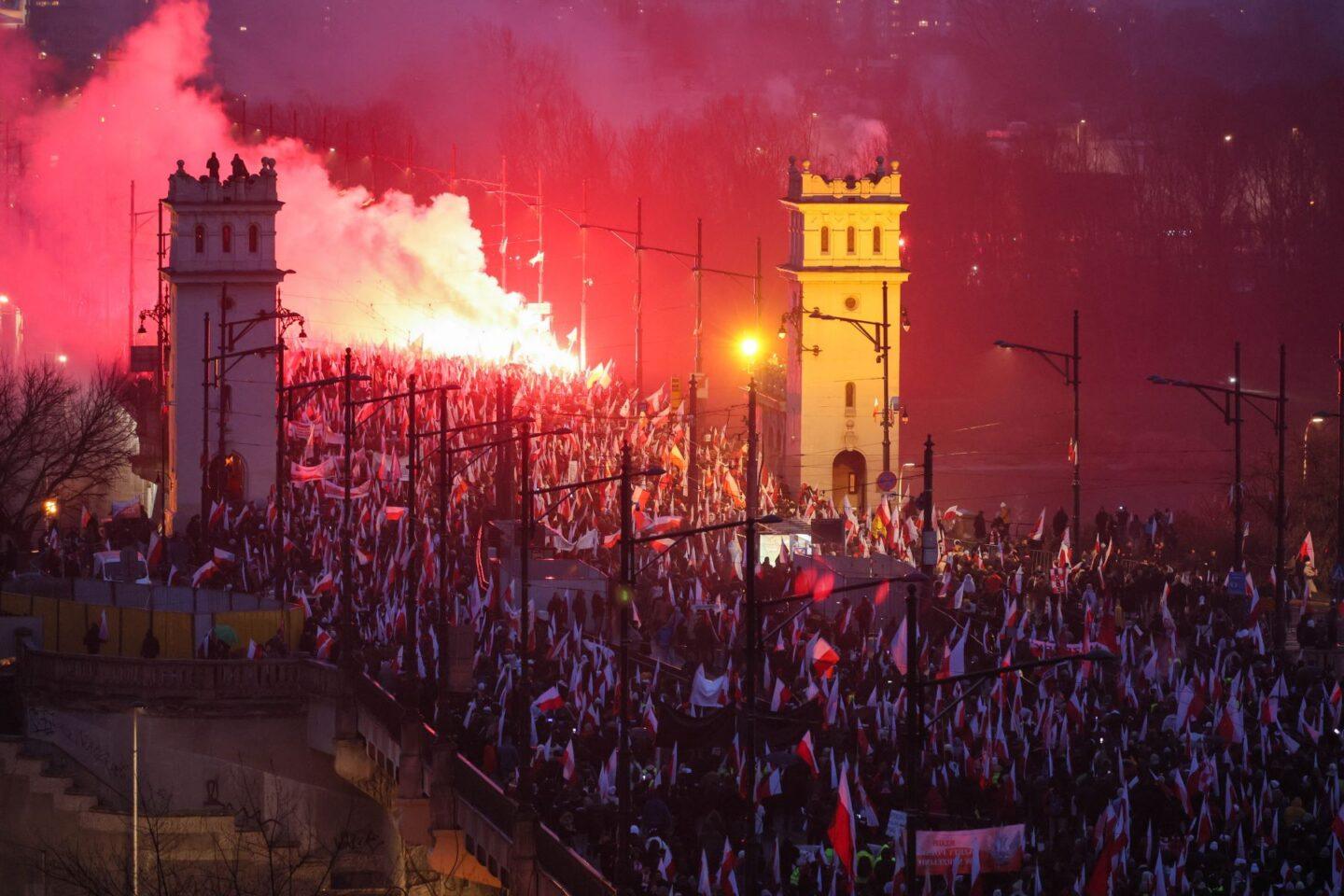
The Independence March (Marsz Niepodległości, or MN) will pass through Warsaw on Wednesday. The annual event, initiated by nationalist groups, has for years drawn hundreds of thousands of participants from across the country. It has also generated considerable controversy.
Explainer
Poland’s Independence Day
Poland celebrates National Independence Day on November 11, marking the restoration of its statehood in 1918 after 123 years of partitions between Russia, Prussia and Austria.
This year’s march took place in an exceptionally difficult and tense social atmosphere. The dramatic and unprecedented act of terror in Kraków, preceded by a dispute over the Constitutional Tribunal that has intensified political tensions, is highly likely to dominate the mood around the event.
Explainer
The Kraków attack
On November 7, 2026, a gunman killed six people in Kraków’s main square. Two police officers were wounded while confronting him. The government said the attack might have been inspired by far-right ideology, while prosecutors cautioned that it was too early to establish the motive.
Organizers expect high turnout and report a sharp increase in registrations for the march.
Warsaw Mayor Rafał Trzaskowski has announced stronger security along the route. We asked the city’s press office for details.
“Following the events in Kraków, we have remained in contact with the Warsaw police from the outset and are at their disposal should any measures be needed to strengthen security in the capital. Following a police recommendation, we placed concrete barriers on Krakowskie Przedmieście (Warsaw’s main tourist street), closing the street to traffic.
“The mayor of Warsaw has also instructed all municipal services to increase their vigilance, with particular attention to the Municipal Guard, monitoring services and the duty service at the Warsaw Security Center,” the city press office told us.
People will also be prohibited from carrying weapons in Warsaw that day. Carrying and using pyrotechnics will likewise be banned across the city. This is not new: similar restrictions applied during previous editions of the march.
Another brief show of unity on the right
Leading right-wing politicians are expected to take part, including Karol Nawrocki. The president joined participants a year ago, although he did not speak at the event. According to Rzeczpospolita, Jarosław Kaczyński and Mateusz Morawiecki are also expected to attend. The Rozwój Plus press office confirmed to us that members of the association would participate.
Confederation leaders Sławomir Mentzen and Krzysztof Bosak have also announced their attendance, as has Grzegorz Braun, leader of the Confederation of the Polish Crown.
Explainer
Poland’s divided right
Law and Justice (Prawo i Sprawiedliwość, PiS) is the national-conservative party led by Jarosław Kaczyński. It governed Poland from 2015 to 2023 and backed Nawrocki’s successful presidential campaign in 2025. Warsaw Mayor Rafał Trzaskowski, a politician from Prime Minister Donald Tusk’s Civic Coalition, was Nawrocki’s opponent in that election.
Rozwój Plus is an association founded by former PiS prime minister Mateusz Morawiecki. Its supporters formed a separate parliamentary group amid divisions within PiS.
Confederation (Konfederacja) brings together right-wing currents including Mentzen’s free-market New Hope and Bosak’s nationalist National Movement.
Braun’s Confederation of the Polish Crown is a separate far-right party: his faction was expelled from Confederation in 2025.
This is another moment of unity among right-wing politicians in recent weeks. On the now-memorable Friday evening before All Saints’ Day, all the right-wing leaders named above gathered outside the Tribunal. The unity was short-lived, however. In the following days, Confederation politicians in particular distanced themselves from the “Tribunal festivities” and the singing outside the court by lawmaker Michał Wójcik and a journalist from Telewizja Republika.
Explainer
Why the Constitutional Tribunal matters
Poland’s Constitutional Tribunal — commonly known by its Polish initials, TK — rules on whether laws comply with the constitution. Its composition and the legitimacy of its rulings have been contested since a dispute over judicial appointments began in 2015.
The conflict intensified in 2026 when Nawrocki refused to administer the oath to several judges elected by the current parliament. Tusk’s government says the new appointments are needed to restore the rule of law; the president and his allies have challenged the legality of the government’s actions. The standoff culminated in a confrontation at the Tribunal’s headquarters on October 30.
There is much that divides right-wing politicians, and even more will divide them when they compete for votes in 2027. But they share one thing: opposition to Tusk’s camp.
Of course, unity is easier for an eclectic right-wing camp when it is in opposition and united by a common objection. That has not always been the case, however. The history of the Independence March reflects the slow but steady rise of nationalist groups on the Polish right — and, more broadly, across the political spectrum.
Small beginnings and early incidents
The march began as a series of relatively small demonstrations during the first term of the government led by the then Civic Platform and Polish People’s Party coalition. Its first organizers came from ultranationalist groups: the National Radical Camp (ONR) and All-Polish Youth (MW). Initially, the marches were small and attracted attention only from the most extreme nationalist circles, which were not numerous at the time.
Explainer
The march’s early organizers
The National Radical Camp (Obóz Narodowo-Radykalny, ONR) and All-Polish Youth (Młodzież Wszechpolska) are nationalist organizations whose names and ideological roots refer to movements active in interwar Poland. The National Movement (Ruch Narodowy), now associated with Bosak and Confederation, emerged from the broader nationalist political milieu.
The march grew over the following years. In 2010, the first counterdemonstrations appeared alongside it, initiated by left-wing and anarchist groups. That year also saw the first request to withdraw permission for the march.
That did not happen. More participants joined in subsequent years, followed in time by politicians. Controversy around the event also grew.
In 2011, stones and firecrackers were thrown during the march, and a TVN broadcasting van was set on fire. Police detained more than 200 people. Interestingly, almost half of them were anti-fascists who had traveled from Germany for the counterdemonstration. All major political groups distanced themselves from the German group’s arrival at the time.
That does not mean, however, that incidents in subsequent years were distributed equally between marchers and counterdemonstrators. Although the march’s leadership has consistently disavowed support for violence and property damage, incidents did occur at the event.
In 2013, the well-known rainbow installation on Plac Zbawiciela (a square in the city center with a number of places to hang out - ed.) was burned during the march, and a guard booth outside the Russian Embassy was set on fire. The investigation into the latter incident was discontinued in 2019.
Explainer
The rainbow on Plac Zbawiciela
Tęcza — “Rainbow” — was an art installation by Julita Wójcik, erected on a central Warsaw square in 2012. It became associated by many people with LGBTQ+ rights and a symbol in Poland’s cultural disputes. The installation was set on fire repeatedly, including during the 2013 Independence March.
Organizers were also accused of allowing antisemitic and fascist slogans to appear. Such accusations recurred in subsequent years, particularly as attendance grew.
Leading Law and Justice politicians joined the march. In 2015, a letter from the sitting president — Andrzej Duda at the time — was read out for the first time. Tensions were high in 2018, the centenary of Poland’s return to independence.
Warsaw Mayor Hanna Gronkiewicz-Waltz banned the march. A court overturned the ban, however, and the event went ahead. It was an unprecedented march: it was announced as an official state ceremony, with President Andrzej Duda at its head.
Explainer
What happened in 2018?
Contemporary accounts distinguish between two events on the same route: a government-organized White and Red March, led by Duda and given the status of a state ceremony, and a separate nationalist-organized march that followed it.
Divisions within the march
It was then that the first divisions appeared within the Independence March Association. PiS and the nationalists disputed who deserved credit for the turnout. Robert Bąkiewicz, the association’s president at the time, aligned himself with PiS, giving him access to state funding. He later ran unsuccessfully for parliament on a PiS list in 2023.
Bąkiewicz is no longer on the march’s management board following internal clashes between rival factions. Today, the march’s leadership is once again closer to its original milieu: the National Movement, which is part of Confederation.
Calmer marches in recent years
In recent years, the marches have been calmer than in the previous decade. Police have not recorded major incidents. It should be noted, however, that anti-Ukrainian sentiment was prominent at some previous editions. Given the events of recent months surrounding the Ukrainian authorities’ controversial commemoration of the Ukrainian Insurgent Army (UPA), anti-Ukrainian slogans are likely to return during the march.
Explainer
The Ukrainian Insurgent Army and Volhynia
The Ukrainian Insurgent Army (UPA) was a nationalist armed movement that fought for Ukrainian independence during and after World War II. In 1943–1945, Ukrainian nationalists, including UPA units, carried out mass killings of Polish civilians in Volhynia and eastern Galicia. Polish estimates put the number of Polish victims at around 100,000; Polish forces also killed Ukrainian civilians in retaliatory violence.
The UPA’s legacy remains contested: in Ukraine, some commemorate its fight against Soviet rule, while in Poland it is strongly associated with the massacres. The dispute intensified in 2026 after President Volodymyr Zelensky named a Ukrainian military unit after the UPA.
Today, supporters on the right say Wednesday’s march will be the largest conservative demonstration in years. Its main driving force is expected to be opposition to the government, which right-wing politicians have accused for months of pursuing policies harmful to the country. That could increase turnout.
The perennial dispute over turnout
In the past, the turnout picture has been unclear. Figures published by police and City Hall differ considerably from those provided by organizers. If the organizers’ figures are to be believed, attendance records have been broken in recent years. They say 250,000 people took part two years ago and 300,000 last year.
City Hall’s figures differ. According to the city, 90,000 people participated in 2024 and 100,000 the following year.
This year will probably bring another gap between the estimates. The battle over turnout figures — and over which images dominate social media — will begin before the march even starts.
Update after the march.
Warsaw’s City Security Center estimated that up to 250,000 people took part in the Independence March on November 11, 2026. Its director, Jarosław Misztal, gave the estimate after consulting the police.
Other figures were substantially different:
- Organizers: Marcin Osowski, head of the organizing team, estimated the crowd at around 500,000. The march’s official social media account later suggested there could be as many as one million.
- Onet news outlet: It independently estimated 120,000–160,000 people on the route at around 4:30 p.m., using the area occupied and estimated crowd density. This was a snapshot, not necessarily a count of everyone who participated throughout the event.


Key Takeaways
- A tense backdrop. This year’s Independence March will pass through Warsaw amid tension following the act of terror in Kraków and the dispute over the Constitutional Tribunal. City Hall has placed concrete barriers on Krakowskie Przedmieście and instructed municipal services to increase their vigilance. Organizers report a marked rise in registrations for trips to the march, with some regions seeing three or four times as many as a year ago.
- A brief moment of unity. President Karol Nawrocki, politicians from PiS and Rozwój Plus, and the leaders of Confederation and the Confederation of the Polish Crown are expected to attend. It is another moment of temporary unity in recent weeks for a right united by opposition to Donald Tusk’s camp.
- From the margins to the mainstream. The march has grown from small demonstrations by extreme nationalist groups into an event attended by leading right-wing politicians. Along the way, it has been accompanied by riots and disputes between PiS and nationalists. Turnout remains contested: organizers reported 250,000 and 300,000 participants over the past two years, while City Hall put the figures at 90,000 and 100,000.