

This article is a part of Poland Unpacked. Weekly intelligence for decision-makers
Maciej Berek, one of Prime Minister Donald Tusk’s closest aides, is leaving the government. He will be replaced by Joanna Knapińska, who will take on a broader set of responsibilities.
Before Tuesday’s cabinet meeting, Prime Minister Donald Tusk announced that Minister Maciej Berek was leaving the government. He added that they had jointly agreed that Berek would take on other responsibilities.
“He asked me to relieve him of the duties he has performed up to now. As you know, he was my right-hand man,” Prime Minister Donald Tusk said during the public part of the meeting.
Since Tusk’s current government was formed in December 2023, Berek had served as head of the Standing Committee of the Council of Ministers. In March 2025, he also became head of the government’s deregulation team.
According to Prof. Danuta Plecka, head of the Department of Political Systems at the University of Gdańsk, Berek’s departure from the government does not mark the end of his political career.
“It is difficult to interpret it at this stage: whether he wanted to leave or was persuaded to do so. He was Donald Tusk’s shadow. The prime minister himself said he had another task for him,” Prof. Danuta Plecka says.
Request sent to the president
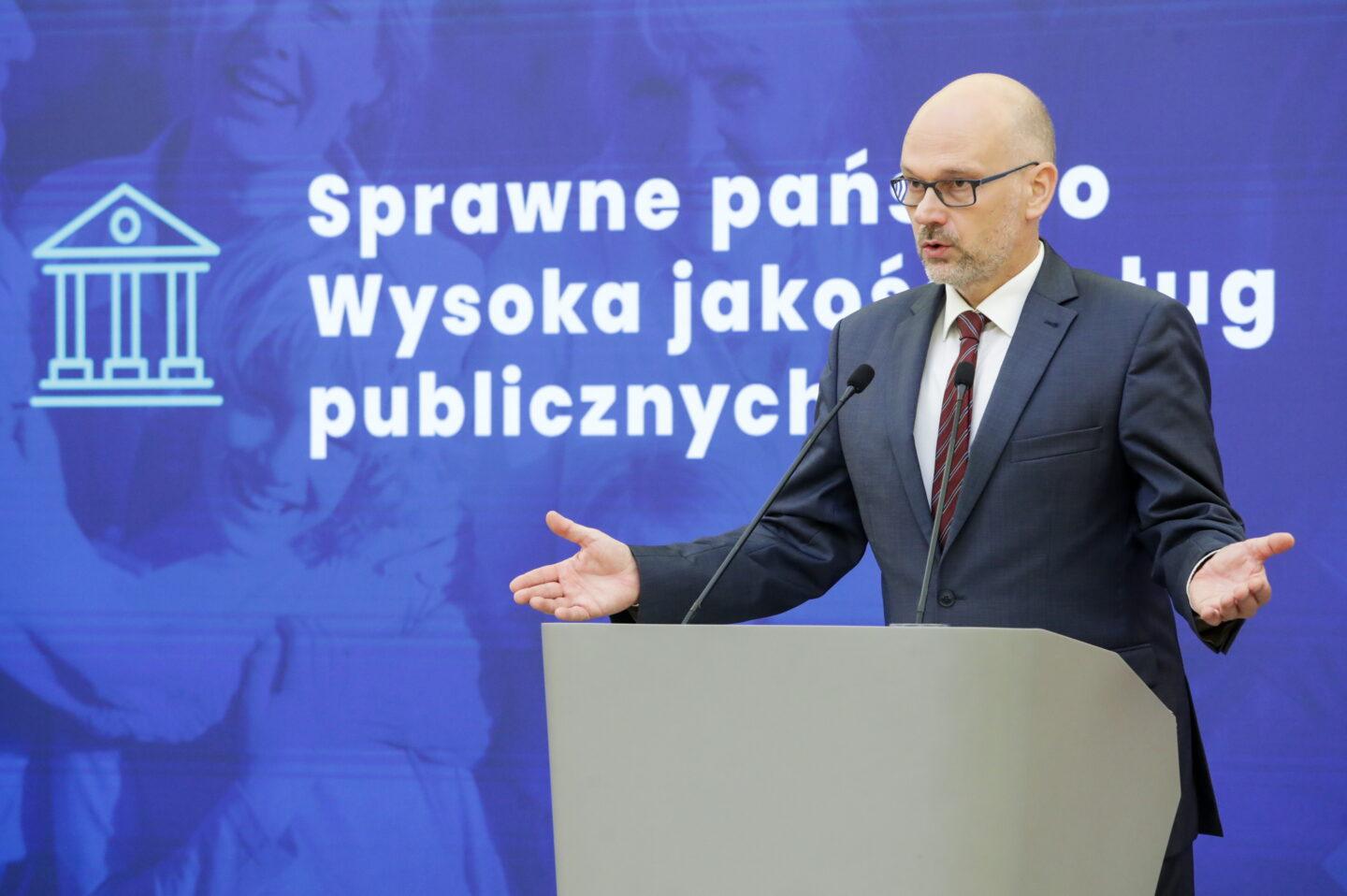
As part of the government reshuffle in July 2025, Berek was appointed minister responsible for overseeing the implementation of government policy. His role was to coordinate the implementation of tasks by individual ministries and hold ministers accountable for their performance. Since last year’s reshuffle, no minister had left their post until now.
In March 2025, he was appointed head of the government’s deregulation team, established within the Prime Minister’s Office. Since then, he had overseen the government’s deregulation initiatives. In July 2025, as part of the government reshuffle, he was appointed minister responsible for overseeing the implementation of government policy. The prime minister tasked him with monitoring and assessing the performance of ministers.
Maciej Berek had already worked in previous governments led by Donald Tusk. From 2007 to 2015, he headed the Government Legislation Center. He has also worked at the Supreme Audit Office, served as director general of the Office of the Commissioner for Human Rights, and was chief legislative counsel at Employers of Poland.
After the Council of Ministers meeting, government spokesman Adam Szłapka commented on the resignation. He did not, however, provide many details. He confirmed that a request for President Karol Nawrocki to accept Maciej Berek’s resignation had been sent to the president.
Without the right-hand man: who will replace Maciej Berek?
Maciej Berek will be replaced by Joanna Knapińska. A lawyer, she has headed the Government Legislation Center since the current government took office. She worked her way through every level of professional advancement at the center. She has also worked at the Ministry of Entrepreneurship and Technology and at the Public Procurement Office, where she served as deputy president.
She will be responsible for more tasks than her predecessor. As Adam Szłapka – the government’s spokesperson – announced, Joanna Knapińska will combine the roles of head of the Standing Committee of the Council of Ministers and coordinator of government policy implementation with her position as head of the Government Legislation Center.
Surprise in the coalition
Maciej Berek’s departure came as a considerable surprise within the governing coalition. The outgoing minister had played an important role in the government’s work.
“I have a great deal of respect for Minister Berek. I worked with him at the Supreme Audit Office. I can say that he is an exceptionally competent person who performs his duties professionally and makes sure deadlines are met in connection with legislative commitments and other plans of the institutions he is involved with. I had the opportunity to see this firsthand as justice minister,” says Krzysztof Kwiatkowski, a Civic Coalition (KO) senator.
Civic Coalition lawmakers we spoke to informally say there had been no earlier indications that the resignation was coming. They also say they do not know what prompted the decision.
“I don’t want to speculate,” says a senior Civic Coalition lawmaker, cutting the conversation short.
Another admits that he had no prior knowledge of the decision. He learned of Maciej Berek’s departure when he picked up our call asking for comment.
“I’m surprised. At the Sejm’s last session in July, every issue requiring coordination went through him. He also recently presented a review of the government’s first year in office,” the Civic Coalition politician says.
Representatives of the coalition’s other parties are equally surprised.
“It’s a significant loss. He was a giant of intellect and hard work,” says one deputy minister, who asked to remain anonymous.
Will there be more changes?
A representative of one of the smaller coalition partners suggests that Berek’s departure could be the beginning of broader changes in the government. They could come after the summer break. She points to Monday’s meeting between the leaders of the Civic Coalition, the New Left and the Polish Peasant Party.
“For the first time, the meeting was kept completely under wraps. Almost nothing leaked out. It is rare for such a meeting to be held at the prime minister’s request. Minister Berek was still talking to the media recently about what the government had accomplished over the past year. He was the one who coordinated the ministers’ work, and it is difficult for me to imagine the government operating without him. In light of yesterday’s meeting of the leaders, one could conclude that this is the beginning of changes, and that the prime minister will keep them secret until the very end. He has no choice. The divisions within Law and Justice are not helping us, while the right is polling well,” we hear unofficially.
As part of the changes, Szymon Hołownia could join the government, as Interia news outlet recently reported. One lawmaker from Poland 2050 whom we asked about the matter declined to confirm it.
However, in another coalition party, we hear that this could be an attempt to rebuild Poland 2050’s standing in the polls. Hołownia’s entry into the government could also mean the marginalization of Katarzyna Pełczyńska-Nałęcz.
“Perhaps this is the first brick in the changes to come, even if unintentionally. A crucial year lies ahead of us. The prime minister is certainly considering what else can be done. He is looking at what Szymon Hołownia would like to do. This could be the beginning of changes that may not yet be fully planned. We need something new. The government is doing good things, but we are very good at throwing sand into the gears ourselves,” we hear from within the coalition.
Government spokesperson plays down speculation
At a Tuesday press conference, government spokesman Adam Szłapka acknowledged that, in addition to meeting with Władysław Kosiniak-Kamysz and Włodzimierz Czarzasty, the prime minister had also met with Katarzyna Pełczyńska-Nałęcz on Monday and with Paulina Hennig-Kloska, leader of the Union of the Center, on Tuesday. He also stressed that there was currently no information about a government reshuffle and that no changes to the government had been planned.
Shortly after Maciej Berek’s departure from the government was announced, the Polityka Insight service reported unofficially that he could become the new judge of the Constitutional Tribunal. In mid-September, the nine-year term of Justyn Piskorski, a so-called “substitute judge”, comes to an end, and the coalition will choose a new judge.
Explainer
Poland’s Constitutional Tribunal crisis
The crisis surrounding Poland’s Constitutional Tribunal began in 2015, when the outgoing and incoming parliamentary majorities each tried to appoint judges to the same vacancies, leading to a dispute over the status of several so-called “substitute judges”; the subsequent Law and Justice (PiS) government also changed the Tribunal’s rules and appointments, which critics said undermined its independence.
The conflict later expanded into a broader rule-of-law confrontation with the European Union, particularly after the Tribunal’s 2021 rulings challenged the primacy of EU law and the authority of the Court of Justice of the EU.
After the change of government in 2023 (when Law and Justice lost elections), the new authorities sought to restore the institution’s independence, but disputed appointments, competing claims about the validity of judgments and the refusal to recognise parts of the Tribunal’s current composition have left the constitutional conflict unresolved.
Coalition politicians we spoke to dismiss the reports as rumors. When we asked one coalition party whether its members would vote in favor of such a candidacy, the reaction was no less surprised than their response to Maciej Berek’s departure from the government.
Anna Maria Żukowska, head of the Left’s parliamentary caucus, responded to the speculation in the media. She said that if Maciej Berek were nominated as a Constitutional Tribunal judge, the Left would not support him because it opposes appointing politicians to the tribunal. She also acknowledged that such a nomination would be unfair to Maciej Berek.


Key Takeaways
- Prime Minister Donald Tusk announced Maciej Berek’s departure from the government before Tuesday’s meeting of the Council of Ministers, describing him as his right-hand man. Berek headed the Standing Committee of the Council of Ministers and, for the past year, had overseen ministers’ implementation of government policy. Tusk said Berek himself had asked to be relieved of his duties. Berek had also worked closely with Tusk in his previous governments.
- Berek’s departure has come as a surprise both within the Civic Coalition and among the other coalition parties. Some expect it to be the beginning of broader changes after the summer break. The aim would be to improve the government’s standing in the polls and its effectiveness in the year leading up to the election.
- Berek’s departure has come as a surprise both within the Civic Coalition and among the other coalition parties. Some expect it to be the beginning of broader changes after the summer break. The aim would be to improve the government’s standing in the polls and its effectiveness in the year leading up to the election.