

This article is a part of Poland Unpacked. Weekly intelligence for decision-makers
“The past several months have not exactly been a bed of roses,” admits the CEO of Poland’s e-commerce leader. He talks about building Europe’s best marketplace, his frustration with public institutions, his expectations of InPost, the legendary commission rates, unlimited growth potential – and his love for Allegro.
Founded in 1999, Allegro accounts for roughly one-third of Poland’s e-commerce market and has consistently fended off challenges from even the world’s biggest global players. Marcin Kuśmierz has been at the helm since May 2025, taking over during an exceptionally demanding period for the company.
On the one hand, Allegro has expanded its business severalfold since 2019. Back then, its gross merchandise value (GMV) stood at PLN 22.8bn (approximately EUR 5.3bn), revenue reached PLN 2.6bn (approximately EUR 600m), and adjusted EBITDA amounted to PLN 1.3bn (approximately EUR 300m). On the other hand, its market capitalization – currently around PLN 40bn (approximately EUR 9.3bn) – is well below its valuation at the time of its Warsaw Stock Exchange debut. Meanwhile, its acquisition in the Czech Republic, worth more than PLN 4bn (approximately EUR 930m), has yet to deliver the expected results, and negotiating the terms of a new agreement with InPost, its key logistics partner, has proved anything but straightforward.
Lately, the company has been announcing one major development after another. The two most recent are particularly significant. The last of the private-equity funds that took Allegro public is expected to sell its remaining stake soon, reducing the overhang on the share price. At the same time, the letter of intent signed with InPost is expected to pave the way for extending the partnership through 2031.
 Interactive chart
 Who's who
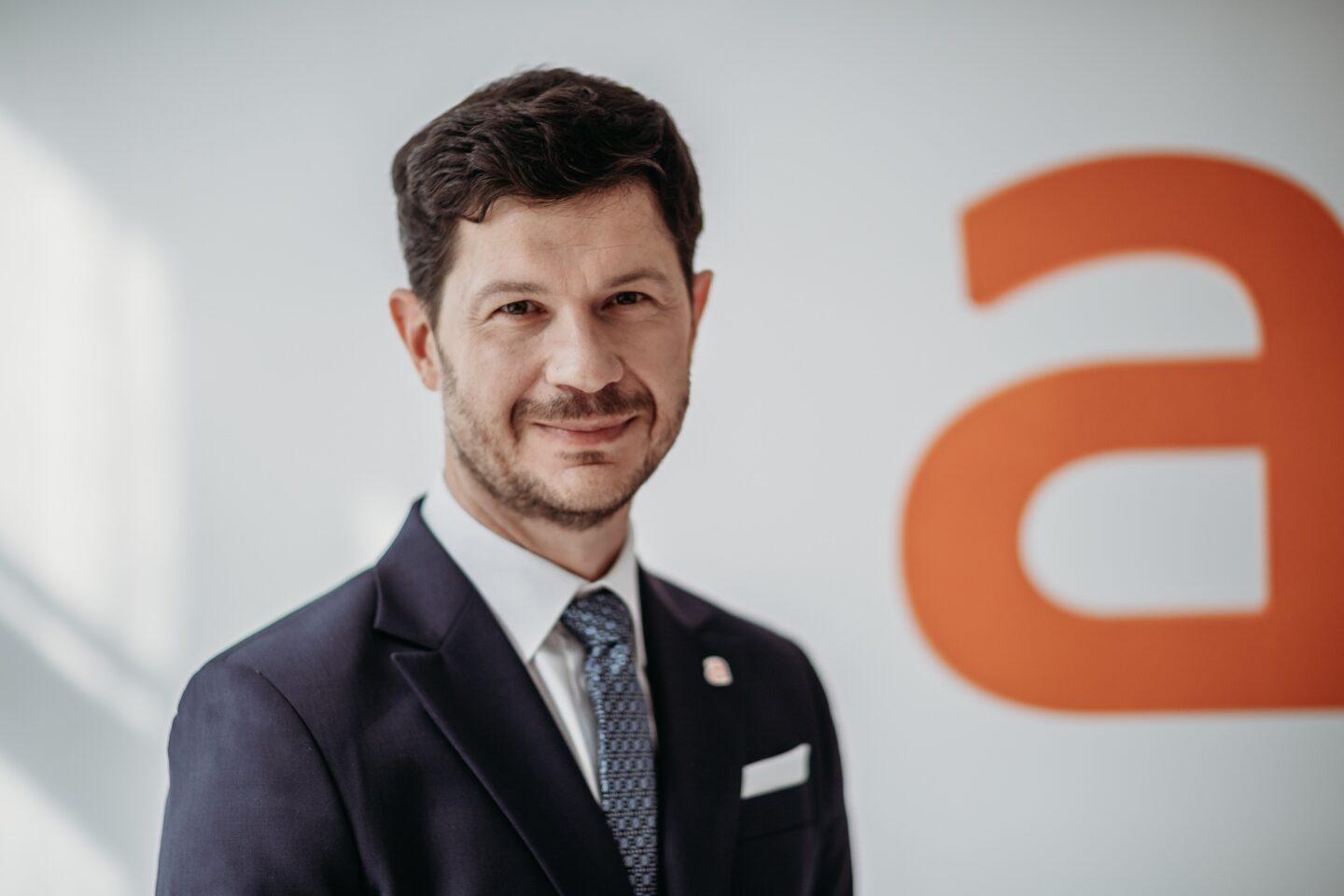
Marcin Kuśmierz
An entrepreneur, technology investor, and executive with nearly three decades of experience, Marcin Kuśmierz founded his first company in 1999 while still at university. He holds a degree in political science. He later sold the business to home.pl, Poland’s leading web hosting provider, and became its CEO in 2007. Earlier in his career, he served, among other roles, as Head of Research and Development at ITI, the largest media group in the region.
Kuśmierz later became a shareholder in home.pl. He followed a similar path at Shoper, an e-commerce software provider, where he took over as CEO in 2021. He led the company until its sale to the cyber_Folks Group in 2025 in a transaction valuing Shoper at more than PLN 1bn (approximately EUR 230m). Since May 2025, he has served as CEO of Allegro, becoming the head of yet another market leader.
Unlimited potential and technology inspirations
Mariusz Bartodziej: You've had an intense few weeks behind you – fortunately preceded by some time off. Was that your first proper break since taking over at Allegro?
Marcin Kuśmierz, CEO of Allegro: It was just four days in April, tied to a trip to the United States for an AI conference. I took the opportunity to visit two more U.S. national parks – Haleakalā and Hawaiʻi Volcanoes. I've now been to more than 20 national parks, but the rest are still on my list.
What insights did you bring back from the home turf of one of Allegro's main competitors – Amazon?
Given Amazon's global success, it's worth learning from the company. It plays a major role in e-commerce across several markets and an even bigger one in the technology sector. I have great respect for our competitors and I'm not afraid to say that I admire them.
At the same time, it's impossible to ignore the economy's growing dependence on artificial intelligence. AI is already having a profound impact on economies and societies, and its importance will only continue to grow.
Among marketplace platforms, Allegro is at the forefront globally in its use of AI. We are running more than 100 AI-based projects and continue to launch new ones. Some are designed to improve operational efficiency, while others enhance the shopping experience. AI also opens up significant opportunities to improve business process quality, data analytics, and conversion rates.
Over the past 30 years, we've seen many technologies that either transformed – or promised to transform – the way businesses operate and, by extension, the way we live. I can say with complete conviction that AI will have the greatest impact of them all.
Today, this market is dominated by American and Chinese companies. To remain at the cutting edge, you have to keep a close eye on new technologies where they are being developed. I make a point of visiting both countries several times a year. There is simply no better place to gain knowledge and inspiration.
Your predecessor, Roy Perticucci, spent many years at Amazon. What made Allegro choose not another international executive, but a Polish CEO with deep roots in the local market? What does that say about the stage of development the company had reached when you took over?
Every CEO brings a new set of capabilities and a fresh perspective, shaping the company's evolution in different ways. My predecessor drew on his extensive experience in optimizing business processes. He also launched several strategically important initiatives, including the development of Allegro's own logistics infrastructure and the rollout of marketplace platforms across the region.
My own experience and know-how come from working as an executive, entrepreneur, and technology investor across numerous e-commerce and technology companies focused on Central and Eastern Europe, particularly Poland. That is a fairly unique combination of expertise, valuable both for scaling the company's core business and for developing new lines of business.
Ever since joining Allegro, I have said that the company has almost unlimited growth potential. My goal is to unlock it. The results of the past few quarters show that we are moving in exactly that direction.
“There is no area of Allegro that hasn't been touched by change”
You've now completed your first year as CEO of Allegro. If you had to sum it up in one word, what would it be?
Change. There isn't a single part of the company that hasn't been affected by it. I'm talking about our strategy, culture, organization, technology, and people. Today, the ability to lead change is a fundamental capability that drives growth.
What has been the biggest challenge, and what has given you the greatest satisfaction?
I get the greatest satisfaction from seeing how quickly we're accelerating the company's growth, strengthening our value proposition for both buyers and sellers, staying ahead of – or surprising – our competitors, and, finally, seeing how market sentiment toward the company is improving.
In just a few weeks, we announced our expansion into healthcare and travel services through partnerships with Lux Med and Itaka. We launched new versions of our AI agents for both buyers and sellers. We also began working closely with OpenAI. Our international business has started growing at an exceptional pace, and we've announced a pilot program enabling exports to Ukraine.
And this is only the beginning. This organization can – and must – achieve much more. Its impact on economies and societies across the region is immense and impossible to overstate. For businesses, it means greater competitiveness; for consumers, a higher quality of life. That represents both a tremendous opportunity and a tremendous responsibility.
There has been – and continues to be – a great deal of satisfaction, but at least as many challenges. The past several months have not been easy. I have made many important, and at the same time controversial, decisions, including changing our working model and bringing the entire team back to the office, winding down our offices in Gdańsk and Wrocław, and selling our business operations in Croatia and Slovenia.
Our ambition is to build the best e-commerce company in Europe – for customers, partners, investors, and ourselves. We want to be genuinely proud of what we achieve, and we will do everything in our power to make that happen.
Every inch of Allegro can be reinvented
You often describe yourself as a transformation leader. What have you already managed to change, and what remains a work in progress?
We are pursuing a deep transformation across three key areas. The first is the business itself and building a new value proposition for buyers and sellers. The second is technology, driven by AI. The third is our organizational culture and the development of a new set of values that will help Allegro reach the top tier of European e-commerce.
We are accelerating both business and technological development, simplifying our organizational structure and processes, and thinking more boldly about our next phase of international expansion.
Within the marketplace, the biggest change is what we call verticalization. It involves combining the best capabilities and technologies from the 1P world – specialist retailers selling directly – and the 3P world of third-party marketplace sellers. We are doing this on a scale that, to our knowledge, no one else has achieved globally, and we see it as an opportunity to strengthen our position across a number of fast-growing product categories.
We have also announced plans to make some of our services available beyond the Allegro platform, including financial, logistics, and advertising solutions. For example, merchants operating their own online stores will also be able to use them.
Those are only the most important initiatives. There are many more, but we are disciplined about setting priorities.
What, if anything, has proved impossible to change at Allegro?
There isn't such an area, nor is there such a process. Our customers and their expectations are constantly evolving, and we evolve with them – sometimes even staying one step ahead.
Like any organization of this size and market position, we have inherited a mix of technology and business processes – some excellent, others less so. The opportunity to have a real impact on the company and reshape it was one of the main reasons I decided to join Allegro.
I believed then – and experience has fully confirmed – that this is a company capable of change. There are no taboo subjects and no untouchable dogmas here. Virtually every part of Allegro can be redesigned. It's simply a matter of time and determination, and our team has no shortage of either.
The one thing we must always remember is that the pursuit of something better can become the enemy of what is already good. Change should never be introduced for its own sake.
Unfounded accusations of greed and friction with institutions
Temu has, for the first time, overtaken Allegro in terms of user numbers. The media storm around the decision to return to office work four days a week has lingered for months. The Office of Competition and Consumer Protection (UOKiK) has brought charges in several cases and even searched your offices. Tensions have also been building around the extension of the InPost contract. And as if that were not enough, one of your competitors has filed a lawsuit. Did you expect this much turbulence?
Each of the issues you mentioned either directly or indirectly supports our transformation and accelerates our growth. We could, of course, complain, explain, or search for justifications. I can also add that I inherited most of these matters. But what would that change?
We are fully focused on resolving them successfully and using them as an opportunity to strengthen our position at the intersection with customers, partners, competitors, and regulators. We learn quickly, we adapt quickly, and the tangible results are already visible.
Let’s go through these points one by one. User numbers are one thing; the number of buyers and the scale of their spending is another. Still, it is hard to pretend that if a consumer buys gadgets on Temu, they will not reduce spending elsewhere on Allegro. Household budgets are not elastic.
We have been successfully competing with Chinese platforms for over a decade, continuously updating our value proposition to match customer expectations. I am referring to the breadth of our offering, pricing, convenience, and shopping safety, as well as our ecosystem of added services.
The core of our offering consists of branded products and direct cooperation with brands and strong local sellers. Ninety-nine percent of sales on our platform are generated in a 3P model [third-party sellers only – editor’s note], with only around 1 percent coming from Allegro’s own official store. We offer an enormous catalog – nearly 100 million products. That scale is simply incomparable. In a wealthier society, we see this as a major advantage. We provide customers with extensive guarantees, pre- and post-sales support, financial services, the widest choice of delivery methods, and fast, frictionless returns. We respect our competitors, closely observe their strategies, and sometimes draw inspiration from them.
And returning to the competition with China...
Some consumers welcome lower prices for selected goods on Chinese platforms and, in the same breath, describe European sellers as greedy. They often do not realize that price differences do not stem from higher margins, but from “markup” effects such as taxation – for example, the inclusion of VAT in the final price.
I have some reservations about EU and national institutions for having, for years, turned a blind eye to unfair competition. The consequence will be a gradual deterioration in the economic condition of small businesses and, indirectly, their disappearance from the market. There is also a significant impact on the Polish state budget – several billion zlotys a year are effectively lost.
Fortunately, things are starting to change. The first quarter showed that Chinese platforms are losing momentum, and from July the EU has introduced the first – admittedly symbolic – fees on parcels shipped from China. Further measures are expected later this year. This will not resolve the issue of unfair competition, but it is certainly a step toward establishing a level playing field across EU markets.
On what do you build your long-term competitive advantages? Allegro’s key differentiator is the widest offering from Polish sellers. Yet those sellers are also present on other domestic platforms, and on your marketplace there is no shortage of listings with absurdly high prices and long delivery times, often from China.
We have spent more than 25 years building trust with customers and partners. That may sound corporate, but it is the truth. We invest in breadth of assortment, attractive prices, convenience, and shopping safety. We stay closely aligned with trends, products, and brands, and we remain eager for further growth. In terms of agility, we aim to resemble a startup; in terms of comfort and safety, the most mature global organizations.
Allegro is the natural starting point for e-commerce for 15 million loyal customers in Poland and 5 million across the region. Our offering includes Smart!, Allegro Pay – the best deferred payment system on the market – and Allegro Delivery, a powerful parcel locker and pickup-point network being built with DHL, DPD, and Orlen Paczka, alongside our cooperation with InPost. This creates a self-reinforcing flywheel.
Issues related to product quality and price discrepancies are as old as commerce itself and are faced by virtually every platform and large retailer in the world. We provide customers with a range of tools to find offers from sellers with the best reputation, pricing, and product availability. If we receive reports or have justified concerns about sellers’ professionalism, we respond immediately.
We also use artificial intelligence to continuously improve product search and comparison. Our AI assistant is capable of recommending the most relevant products based on a conversation with the user.
Myths about marketplace commissions
Between 2026 and 2028, Amazon will invest PLN 23bn (approx. EUR 5.3bn) in Poland, following PLN 45bn spent since 2012. In your view, is that a lot or a little? Allegro’s annual CAPEX is around PLN 1bn (approx. EUR 230m), including foreign investments.
We welcome every złoty invested in the development of the Polish and European e-commerce market – whether by us or by competitors. Amazon’s investments in Poland have been primarily linked to its expansion in Western European markets and its search for greater operational and cost efficiency. That said, every złoty spent on infrastructure and know-how development in Poland should be recognized.
We are steadily increasing our own investments – both in the platform itself and in infrastructure, such as logistics. As I mentioned, this also includes more than 100 AI projects. We are fully focused on Poland and the other Visegrad Group countries. I can say with full responsibility that we invest the most in this region for customers here.
Between 2021 and 2025, Allegro’s average commission rate on sales increased from 10.2% to 12.3%, even as competition in the Polish market intensified significantly. Does that mean Allegro is unavoidable, and any seller aiming to succeed online must be present on your platform?
Our business model is based on profit-sharing. We can only grow if our partners grow. We invest in the development of the platform and added services, build infrastructure, and purchase traffic from search engines and social media so that our partners can sell more. We also cover part of the costs related to delivery, returns, payments, and more.
There are many myths surrounding our commission rates. In reality, compared with other global platforms, they remain at a highly competitive level. It is also important to remember that if a commission in a given category is, for example, 10%, this does not mean Allegro earns 10%. We have costs to cover, and in recent years those costs have increased significantly – driven, among other things, by high inflation.
Interactive chart Return to the office? A strong and sound decision
Another issue: how do you assess the effects of implementing the new working model? And what would need to happen for you to consider a universal option of two days of remote work?
We have been operating under the new model – four days in the office – for less than six months. That is too short a period to draw firm conclusions, so for now we are not discussing any changes. From the perspective of building a strong organizational culture, knowledge sharing, and fostering innovation, I continue to believe that returning to the office was a strong and sound decision.
The past months show how significantly we have accelerated business development. This is the result of many changes we have introduced across the company, including improvements in the quality and efficiency of teamwork and better communication.
Following your decision, critics suggested it was a form of covert layoffs. Between 2023 and 2025, group headcount rose from 5,500 to 6,100, including an increase in Poland from 4,100 to 5,100. What level of employment do you expect this year and next, considering the closure of offices in Gdańsk and Wrocław?
At no stage was there any intention to use the new model as a disguised mechanism for workforce reduction. On the contrary, we are highly focused on retaining talent. We are encouraging colleagues from both cities to consider relocation to other offices and are providing support for that process. In one of the locations, nearly half of employees have already chosen to do so.
The size of the team is directly linked to the pace of business growth and productivity gains. These, in turn, depend on several factors: the technologies we use, process optimization, and ultimately our business priorities.
What kind of people do you want on your team, and who should pursue their careers elsewhere? In an episode of the XYZ podcast “You Are a Brand. Leadership Factor” featuring you, it was said that you do not tolerate “incompetence.”
We aim to have the strongest possible team. That means developing existing employees and attracting new talent. High competence must be combined with engagement, accountability, and a willingness to take ownership and have impact. There is no room for compromise here.
I am a strong believer in using positive language and avoiding labels. The Polish language is rich and allows for directness while still showing respect for others.
Will the rollout of AI assistants for buyers and sellers reduce employment? How high are your expectations for this technology?
Artificial intelligence is a technological springboard for Allegro. It is our gateway to the global forefront of e-commerce. We do not view AI narrowly as a tool for reducing headcount or simply cutting operating costs. Our goal is to significantly improve process quality and everyday efficiency.
For buyers, our AI assistant represents a completely new advisory layer – a redefinition of how people search for and compare products online. For sellers, it is a powerful enabler for onboarding to the platform, automating product descriptions, and managing large catalogs. We have a unique agreement with OpenAI and work closely with Google and Microsoft. We are opening up development channels that were previously not technically accessible. If technology allows us to do breakthrough things, it would be a mistake not to use it.
Allegro expects more competitive rates from InPost
Moving to another topic: to what extent are you prepared for part of your traffic to be captured by external AI-based shopping agents such as Von Halsky by InPost?
Why “captured”? I see this as an opportunity for us: customers using AI agents may well end up buying products on Allegro. Our AI assistant recommends products from a catalog of 100 million items offered by more than 150,000 sellers. No one in Poland has anything comparable. Moreover, customers can already use one of the first such applications in Poland within the widely used ChatGPT environment.
You insist there is no conflict with InPost. Yet Rafał Brzoska (the CEO of InPost – ed.) has publicly estimated how many parcels his company is losing due to what he calls a “platform-imposed change in delivery methods.” Allegro also promoted the use of its parcel lockers before Christmas, effectively taking customers from InPost. Is this simply business?
Every year, we ask all logistics partners we work with whether they are willing and able to handle deliveries during the Christmas period. All those interested did so. There were no preferences or restrictions in this regard.
I consistently maintain that there is no conflict between Allegro and InPost. What we are dealing with are different interpretations of the commercial terms of an existing agreement. One party has chosen to initiate arbitration to formally verify which interpretation is correct. This is a completely standard and transparent legal mechanism, used for decades in the civilized business world.
Our overriding objective is to ensure that customers have access to all major logistics operators in the market. We aim to democratize this market – we are the only major e-commerce platform offering DHL, DPD, InPost, and Orlen Paczka side by side.
A few days ago, we signed a letter of intent with InPost, defining the framework for our cooperation in the coming years. It serves as a foundation for negotiating a final agreement that should give us access to attractive pricing and new functionalities within the operator’s infrastructure, while providing InPost with a stable and forward-looking business partnership.
Will you ensure that the terms of the renewed InPost agreement, expiring in 2027, are at least as favorable for Allegro as the current ones?
We want to continue this cooperation. At the same time, we openly expect the terms of the new agreement to be more competitive from a market perspective.
“The lawsuit filed by Erli is retaliation”
In the case of your relationship with Erli, we can clearly speak of a conflict. How much attention does the lawsuit filed by Erli alleging abuse of a dominant position demand from you?
Erli has for some time been unlawfully using our API [application programming interface enabling access to data – editor’s note], for example to copy listings from our platform and automatically extract content from Allegro’s product catalog.
We are currently involved in legal proceedings, and an injunction has been issued in this regard. We did not turn this into a “marketing campaign,” because this is a legal dispute between two companies that should be resolved in court. However, it is difficult not to describe Erli’s current actions as retaliatory, which – as I understand it, given their PR activities – are intended to exert pressure on us.
We fundamentally disagree with Erli’s narrative. It presents the situation as if Allegro were restricting price competitiveness, whereas in reality the lawsuit concerns only a narrow aspect of our cooperation with sellers. Certainly, no one can accuse us of subsidizing partners who offer competitive prices. This is our investment, which partners may use voluntarily. In this way, we help them generate the highest possible sales and ensure the best possible prices for millions of consumers.
Even if the court rules in your favor, such accusations do not help Allegro’s image – nor do the growing number of regulatory proceedings and fines imposed by the UOKiK, even if not yet final. How do you manage this crisis of trust in the brand?
We live in a country with free media, and everyone is free to communicate – competitors and regulators included. I am primarily a supporter of resolving issues directly and a strong opponent of conducting difficult discussions through the media.
We take care of our brand. Trust levels remain very strong. Customer numbers are growing, and so is GMV. That is the best proof of customer loyalty toward Allegro.
In our relations with the UOKiK, we always prioritize full transparency and readiness to cooperate. One of the ongoing proceedings concerns so-called greenwashing. We have proposed an amicable solution to the Authority: instead of financial penalties, we would prefer to invest those funds in real environmental initiatives, such as planting another million trees. I always look for constructive solutions that deliver tangible impact on the market.
“Allegro has no ceiling – new services are only a matter of time”
We’ve talked about problems and challenges, so let’s also talk about prospects. Where is the ceiling for Allegro in Poland when it comes to product intermediation?
Allegro has no ceiling. We want to boldly explore entirely new, untapped segments of the market – such as services in the broadest sense. This market is our “blue ocean.” We are building a completely new, strong pillar of the business on it.
At the same time, new products continue to emerge on the market. We will follow these changes, but we also want to shape them. We are consistently building what we internally call a “center of everyday life” for consumers. It is meant to meet customers’ expectations: if they want to buy more, we are ready; if they want to save, Allegro is the ideal place for that.
Services – financial, medical, travel-related, and many others – are expected to be the main growth driver in the coming years. What level of results would confirm that this direction is the right one, and when will you say, “this is the test”?
We effectively say “this is the test” every day. We have already demonstrated success in advertising and financial services; they already have a tangible impact on the group’s results. Entering the services sector is a deliberate and strategic move on our part. We choose markets with strong growth potential.
Our advantage lies in a unique proposition – we do not only sell products and services, but also deliver real added value to customers. We are not afraid to experiment. Innovation is in our DNA.
PKO BP (bank – ed.), Lux Med (medical outlets – ed.), Itaka (travel agency – ed.) – how many more strategic partners of this caliber would you like to bring on board, and how advanced are the discussions?
The list of entities interested in cooperation is very long. The partnerships we announce with market leaders act like a magnet, naturally attracting further large players, which we are very pleased about.
We are open to discussions with any organization whose offering fits our strategic goal: building a platform that maximally meets customers’ everyday product and service needs. It is also worth mentioning our agreement with OpenAI. I can assure you that in this area as well, we can achieve much more.
PLN 40 per share? “Significant upside potential”
If conditions on the Polish stock market do not deteriorate significantly, do you see room for Allegro’s record valuation to be rebuilt? The gap between PLN 40bn and PLN 100bn is substantial.
The past several months show how quickly we are able to create value for shareholders. Our current market valuation is around PLN 40bn (approx. EUR 9.3bn). We are a public company and we want that valuation to be higher, because shareholders – regardless of their size – are, indirectly, our employers. We believe that rapid and innovative business development will translate into higher value creation.
If that is too vague, when will Allegro enable long-term investors to make money? To profit from your shares, one needs to time entry and exit very precisely. Until recently, the stock fluctuated between PLN 28 and PLN 38.
The share price is currently around PLN 40. I believe there is significant upside potential. However, my role is not to encourage anyone to buy shares at a specific price point.
We are building a stable and predictable long-term business. The removal of the so-called overhang resulting from private equity funds selling shares will also have a positive effect on the share price, as it eliminates uncertainty regarding further large ABB transactions [accelerated book-building – editor’s note].
We are also seeing an increasing presence of Polish investment funds in our shareholder base. They bring unique local expertise and know-how, which gives us additional opportunities.
The problematic PLN 4bn acquisition
When does Allegro expect to recover its investment in the Mall Group? More than PLN 4bn (approx. EUR 930m) was spent on the acquisition alone, with additional hundreds of millions invested in subsequent years. This year’s sale of the Croatian and Slovenian businesses was described as a way to limit further losses. The group only expects to reach profitability abroad in 2029.
Our international marketplace business is developing very well, but we should remember that the first market was launched less than three years ago, and the most recent just over a year ago. GMV in our international operations is growing by “high” double-digit percentages each quarter, and the customer base is expanding rapidly. We want to unlock the potential of the region’s markets and become the platform of first choice – and clearly the largest one – in each of them.
Regarding the Mall acquisition, I would have to comment on the past and on decisions made before I joined the company. I am focused primarily on the future and on building value that will deliver satisfactory returns for shareholders, regardless of when or at what price they bought our shares. I will do everything in my power to achieve that.
No one likes to evaluate predecessors’ decisions. Let’s assume that in 2021 market conditions justified the acquisition of Mall. In today’s environment, would you make a similar move, or would you instead choose to build your position from scratch in individual countries?
I not only dislike judging past decisions – I simply do not do it. Those were different times, a different market perspective, and perhaps a somewhat different vision of Allegro’s development. It is easy to analyze decisions ex post and say one would have acted differently. But that would not be fair.
One of my key tasks, together with the team, is to build market confidence that we are capable of developing a profitable international business. We are on the right track.
After the largest transaction in Polish e-commerce history, have you at least temporarily lost appetite for acquisitions? Or is M&A still on the table?
We have a very strong ability to grow organically, but M&A [mergers and acquisitions – editor’s note] remains a permanent option in our strategy. In the near term, however, one should expect acquisitions focused rather on technology, products, customer bases, or expertise in specific vertical markets.
A CEO in love with Allegro
What is it like to celebrate your 50th birthday as CEO of Allegro? What would you still like to achieve in your managerial career?
I have never felt as good as I do this year – personally, professionally, in terms of health, and mentally. I think joining Allegro has contributed to that. In every respect, it has positively accelerated the pace of my life.
It may sound somewhat romantic, but I am… in love with this company. I see how it changes every day, how the team develops, how individual people gain new energy and enjoyment from what they do. I want us to build the best e-commerce company in Europe and simply be proud of it.


Key Takeaways
- A clear objective amid difficult conditions. Negotiating the extension of the InPost contract in a tense atmosphere, a lawsuit filed by a competitor, and allegations brought by the Office of Competition and Consumer Protection (UOKiK) – Marcin Kuśmierz argues that all of these headwinds are, in fact, accelerating Allegro’s development and transformation. He assures that one year after taking over as CEO, change is taking place across every area of the organization. All of it is aimed at a single, clearly defined goal: building the best e-commerce company in Europe.
- A technological springboard to the global elite. Allegro views artificial intelligence as a technological springboard and a gateway to the global forefront of e-commerce. The company sees AI primarily as a means of significantly improving process quality and efficiency, rather than cutting costs, including through job reductions. It stresses that its unique agreement with OpenAI is only the beginning, and that AI-based shopping assistants are not a threat but an opportunity. “If technology allows us to do breakthrough things, it would be a mistake not to use it,” says Marcin Kuśmierz.
- Problematic competition from China. The CEO of Allegro expresses frustration with EU and national institutions for having, in his view, “turned a blind eye to unfair competition” for years. He argues that this not only leads to a gradual deterioration in the situation of small European businesses, but also to the loss of billions of zlotys from national budgets. He notes that some consumers welcome lower prices on Chinese platforms and describe European sellers as “greedy,” without understanding the underlying reasons for price differences. Marcin Kuśmierz takes a positive view of the introduction of fees on parcels shipped from China starting in July, while stressing that this is only a first step toward addressing the issue.
------
We are publishing this information because we consider it important and noteworthy. For the sake of full transparency, we would like to inform readers that the RiO fund, owned by Rafał Brzoska – CEO and shareholder of InPost – is an investor in XYZ.