

This article is a part of Poland Unpacked. Weekly intelligence for decision-makers
Since Karol Nawrocki’s victory in the presidential elections in late 2025, the battle for right-wing voters has intensified. In just the past few days, we witnessed the first gathering of groups around Grzegorz Braun, where the concentration of pro-Russian, anti-Semitic, anti-Ukrainian, and a wide array of extreme and eccentric views reached a level rarely seen.
Meanwhile, Mr. Braun’s former colleague, Sławomir Mentzen, has been encouraging his supporters to submit ideas for the 2027 electoral program. Within PiS, nothing has changed – internal quarrels between conflicting factions continue to dominate, alongside a wait for party leader Jarosław Kaczyński, who is currently indisposed due to health reasons.
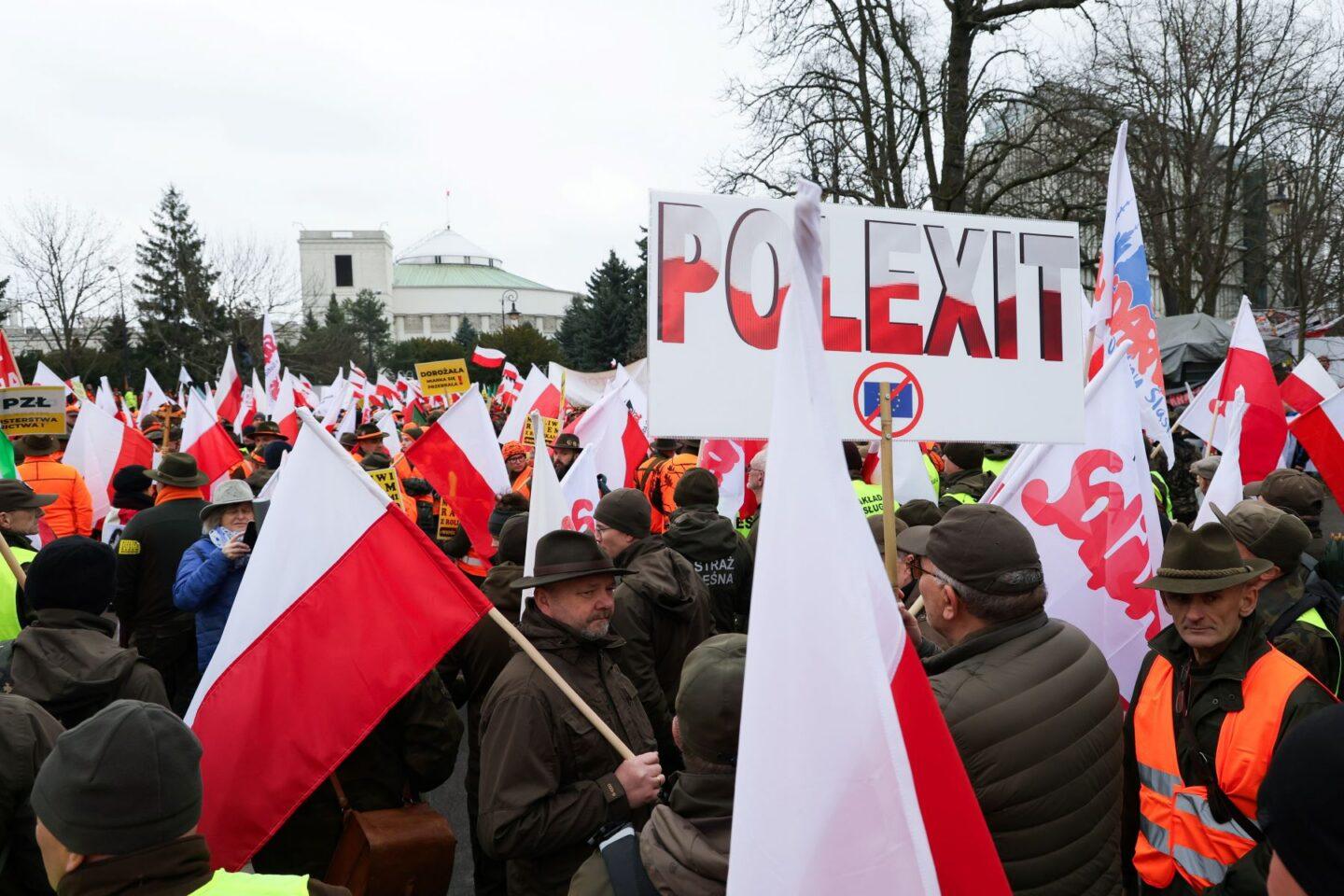
One in four Poles supports “polexit”
Perhaps even more interesting is how developments on the right are dividing at the level of electorates. Recently published polling from Eurobazooka caught the attention of the Polish public. The survey suggested that one in four Poles would support a “polexit.” Advocates of a hardline, ultra-right course against the EU celebrated, while supporters of European integration sounded the alarm. Skeptics, meanwhile, urged caution: perhaps it was just an outlier.
On the morning of February 4, new research from the Nationwide Research Group (Ogólnopolska Grupa Badawcza, OGB) was released. The survey, conducted with a sample of 1,000 respondents, confirmed the earlier findings: 24.5% would vote to leave the EU. Two-thirds opposed leaving, while the remainder would abstain.
 Interactive chart
 The more intriguing aspect of the survey is its reference point in February 2019. At that time, OGB conducted similar research. Seven years ago, 87% of respondents supported remaining in the EU, while fewer than 7% were opposed. It is worth remembering that 2019 marked a period of record popularity for Law and Justice (PiS), while international politics were dominated by negotiations over Brexit terms.
Men are driving “polexit”
The picture becomes even more interesting when the survey results are examined in greater detail. Łukasz Pawłowski, president of OGB, noted in a YouTube video the growing gap over the years in how men and women perceive the EU.
In 2019, the difference between genders regarding support for a “polexit” was within the margin of error. Over 86% of both women and men favored remaining in the EU, while 6.1% of women and 7.4% of men supported leaving.
Seven years later, the dynamics have shifted noticeably. Today, 73% of women declare support for Poland staying in the EU, while nearly 17% favor leaving – a rise of over 11 percentage points. Significant, but the change among men is even more striking.
Interactive chart Currently, only 62% of male respondents support remaining in the EU, while nearly one in three favors a “polexit.” This represents an increase of more than 24 percentage points compared with February 2019. The phenomenon of widening ideological differences along gender lines is not new. What is noteworthy, however, is that Poland’s EU membership has become yet another issue highlighting these growing divides between women and men.
Young voters growing more eurosceptic
What is particularly striking is the rising support for a “polexit” among the youngest respondents.
In February 2019, three-quarters of those aged 18–24 supported Poland’s EU membership, with only 11% favoring leaving. Today, however, these gaps are narrower than in the population as a whole.
Interactive chart Some 55.1% of the youngest voters now support remaining in the EU, while 35.5% would vote for a “polexit.” This represents an increase of more than 20 percentage points compared with seven years ago – though it should be noted that the age cohorts are slightly different. In 2019, OGB studied the 18–24 age group, while in 2026 the survey covered a broader cohort of 18–29-year-olds.
From a political standpoint, however, the most intriguing insights come from examining the results by party electorates.
Law and Justice (PiS) divided – internally and among its voters
It comes as no surprise that voters on the right are more favorably inclined toward a “polexit.” Until recently, however, the only political formation openly calling for Poland’s withdrawal from the EU was Mr. Brown’s Confederation of the Polish Crown (KKP). While the Mentzen–Bosak wing of Confederation (Konfederacja) routinely deploys anti-EU rhetoric, since Grzegorz Braun’s departure it has been far less explicit in backing an outright exit.
The relationship between Polexit and its own political agenda is far more complicated for a divided Law and Justice (PiS). In recent months, competing visions have clashed within the party. The so-called “boy scouts” faction, associated with former prime minister Mateusz Morawiecki, is pushing toward a more centrist narrative. On the other side stands the faction dubbed the “butter-boys,” which includes Patryk Jaki, Jacek Sasin, Przemysław Czarnek, and Tobiasz Bocheński. This group is moving toward a harder line, designed to compete directly with both strands of Confederation.
Explainer
Boy scouts vs. butter boys
“Harcerze” (boy scouts) are Mr. Morawiecki's people while the “Maślarze” (butter boys), more radical than Mr. Morawiecki and his team, were nicknamed after an incident on board a Polish LOT airlines plane when one of these politicians was served German-branded butter and loudly complained about it in the social media.
PiS’s electorate finds itself in a similar bind. Supporters of Law and Justice are now almost evenly split between those favoring Poland’s continued EU membership and those backing a Polexit.
Interactive chart This marks a significant shift compared with analogous polling from 2019. Seven years ago, despite ongoing disputes with the European Commission, PiS voters – then backing the governing party – were nearly unanimous in supporting Poland’s place within the EU. After years of flirting with more radical narratives, PiS now faces a double challenge. Its credibility on European issues can be questioned from both sides: on the one hand, it was Prime Minister Morawiecki who agreed to adopt the Green Deal; on the other, PiS politicians advocating confrontation with Brussels appear less credible than their counterparts from the Polish Crown (KKP) or Confederation (Konfederacja).
Civic Coalition’s (KO’s) electorate fully pro-EU; the KKP electorate (almost) entirely against
This alignment leads to a fundamental conclusion. If a “Polexit” becomes part of the campaign agenda in the 2027 elections, it could emerge as one of the central issues.
According to Łukasz Pawłowski, president of OGB, the political formation most likely to position itself forcefully in such a confrontation is the Confederation of the Polish Crown (KKP), where nearly three-quarters of voters support leaving the EU. Facing the so-called “fire-extinguisher movement” would be the governing, pro-European Civic Coalition (KO). In both 2019 and 2026, nearly 100% of KO’s electorate supported Poland’s EU membership.
Interactive chart Explainer
Mr. Braun’s Fire Extinguisher Movement
“Braun’s Fire Extinguisher Movement” (Ruch Gaśnicowy Brauna) originated from an incident in December 2023 when Polish MP Grzegorz Braun used a fire extinguisher to disrupt a Hanukkah candle-lighting ceremony in the Sejm, parliament's lower house, prompting his temporary exclusion from proceedings and widespread media coverage.
The phrase has since been adopted by Mr. Braun and his supporters as a rallying slogan for his Confederation of the Polish Crown (KKP) faction, framing it as symbolic resistance against perceived cultural and political threats during his 2025 presidential bid and efforts to form a parliamentary group.
In this polarized landscape, the most awkward position would belong to a divided Law and Justice (PiS) – split both internally and across its electorate.
Confederation also caught in the middle
Interestingly, Confederation finds itself in no less of a bind. Sławomir Mentzen’s success in the presidential elections has drawn new voters to the party – among them people who are far less committed to an anti-EU narrative. This is reflected in OGB’s polling.
Interactive chart Much like PiS, Confederation’s electorate is split almost evenly, though with a slight edge for Polexit supporters. Some 42.6% of Confederation voters favor remaining within the EU’s structures, while a somewhat larger share – 47.3% - support leaving.
This leaves Confederation with a difficult problem to solve. Although most of Mr. Mentzen’s voters backed Karol Nawrocki in the second round, it is far from certain that the party is destined for a Polexit-driven course. Since then, Grzegorz Braun has surged onto the political scene. His Confederation of the Polish Crown (KKP) has begun to siphon voters from the so-called “big Confederation” and leaves no doubt about the agenda it represents.
Mr. Mentzen’s formation, much like PiS, will have to answer a fundamental question about its direction toward Brussels. Mr. Mentzen and Krzysztof Bosak face a double risk: lean too far toward moderation, and they may lose their more radical base to Mr. Braun’s party; embrace radicalism, and they risk alienating the “lukewarm” voters who supported Mr. Mentzen in 2025, but not necessarily out of Polexit-driven motives.
How should the polexit polls be read?
Finally, it is worth stepping back from the raw numbers and asking what they actually mean. OGB’s survey was conducted in the midst of an international storm over Greenland and Mercosur.
Writing in “Kultura Liberalna”, Professor Bob Stanley of SWPS University suggests that the immediate context surrounding polls measuring polexit sentiment is crucial. He points to the “thermostatic model” developed by political scientist Christopher Wlezien.
In simplified terms, Mr. Wlezien’s theory holds that public preferences tend to shift in the opposite direction of current policy. In other words, when a pro-European coalition is in power – one whose absolute foundation is Poland’s EU membership – public support for that membership tends to decline. Expectations adjust in a “thermostatic” fashion to the prevailing political reality. When EU membership appears guaranteed, it becomes easier to criticize. The reverse is also true: the highest levels of support for Poland’s place in the EU were recorded during the rule of Law and Justice (PiS), which frequently engaged in rhetorical clashes with Brussels – even among its own voters.
Explainer
Kultura Liberalna
Kultura Liberalna is one of Poland’s important intellectual magazines and a voice in the country’s cultural and political debates. Founded in 2011, it is a weekly online magazine that publishes essays, reportage, interviews, and cultural criticism. Despite ‘liberal’ in its name – which in Polish context means progressive or left-liberal rather than economic liberalism – it’s intellectually serious rather than partisan.
Does this mean concerns about Poland’s future in the EU should be set aside? Public-opinion data from the United Kingdom in the period preceding Brexit suggest otherwise. Even when fewer than half of voters support a 180-degree change in a country’s direction, overturning the table remains possible. Moreover, the sources of eurosceptic sentiment continue to be a social reality. Emotions surrounding the Green Deal or the Mercosur agreement remain vivid and genuine.
One thing is already clear: the 2027 election campaign is likely to be unlike anything Poland has seen before.


Key Takeaways
- One framework for interpreting these findings is provided by the so-called “political thermostat” theory. According to this model, public preferences often shift in the direction opposite to the policies pursued by those in power. Paradoxically, the rule of a pro-European governing coalition may therefore fuel growing criticism of the EU. The pattern was reversed during the years of Law and Justice, when confrontational rhetoric toward Brussels coincided with higher public support for EU membership. This does not mean, however, that eurosceptic sentiment is merely a reaction to the current political climate. It remains entirely possible that Polexit will emerge as one of the themes of next year’s election campaign.
- Support for Poland leaving the European Union is no longer a marginal phenomenon and has reached nearly 25%. This marks a sharp increase compared with 2019, when fewer than 7% of respondents favored such an option. The latest poll by the Nationwide Research Group (OGB), conducted in February 2026, reveals deep demographic divides. Skepticism toward Brussels is rising far more rapidly among men: nearly one in three now supports a “polexit.” Among women, the figure stands at just under 17%. A radicalization is also visible among the youngest generation of voters. More than 35% of those aged 18 to 29 would vote to leave the EU – a dramatic shift in attitudes within a cohort that was once a bastion of Euro-enthusiasm.
- The right-wing political landscape is grappling with an unprecedented fracture within its own electorates. Voters of Law and Justice (PiS) and Confederation are now almost evenly split on Poland’s membership in the EU. This represents a fundamental change for Jarosław Kaczyński’s party. In 2019, PiS supporters were nearly unanimous in backing European integration. The current situation places right-wing leaders in a difficult strategic position ahead of the 2027 elections. PiS must balance internal factions with sharply diverging visions of relations with Brussels. Confederation faces a similar dilemma, risking either the loss of its more radical voters to Grzegorz Braun’s party or the alienation of moderate supporters brought in by Sławomir Mentzen.