

This article is a part of Poland Unpacked. Weekly intelligence for decision-makers
With just over 1.5 years until the next parliamentary elections, Law and Justice (PiS) is turning to American-style tactics. Inspired by Charlie Kirk – the American conservative activist who was shot last year – they have planned a series of debates in various parts of Poland. The guiding principle, much like in the university debates organized by Kirk, is to have students attempt to convince politicians of their arguments.
Explainer
Butter boys
Butter boys (maślarze) are nicknamed after an incident on board a Polish LOT airlines plane when one of these politicians was served German-branded butter and loudly complained about it in the social media.
The format of these PiS debates works as follows: one politician presents a thesis and supporting arguments, which are then challenged by a willing participant. After the exchange, the next politician presents their thesis, kicking off a new round of discussion.
“Change Our Minds”: PiS launches debates
The initiative features MEPs Patryk Jaki and Tobiasz Bocheński, along with former Minister of Education and Science and current MP Przemysław Czarnek. The latter two are frequently mentioned in political circles as potential PiS candidates for prime minister, a decision party leader Jarosław Kaczyński could announce in March. All three are leading figures of the PiS faction headed by Mariusz Błaszczak and Jacek Sasin. In intra-party rivalries, they are nicknamed the “butter boys” and compete with Mateusz Morawiecki’s faction, known as the “boy scouts.”
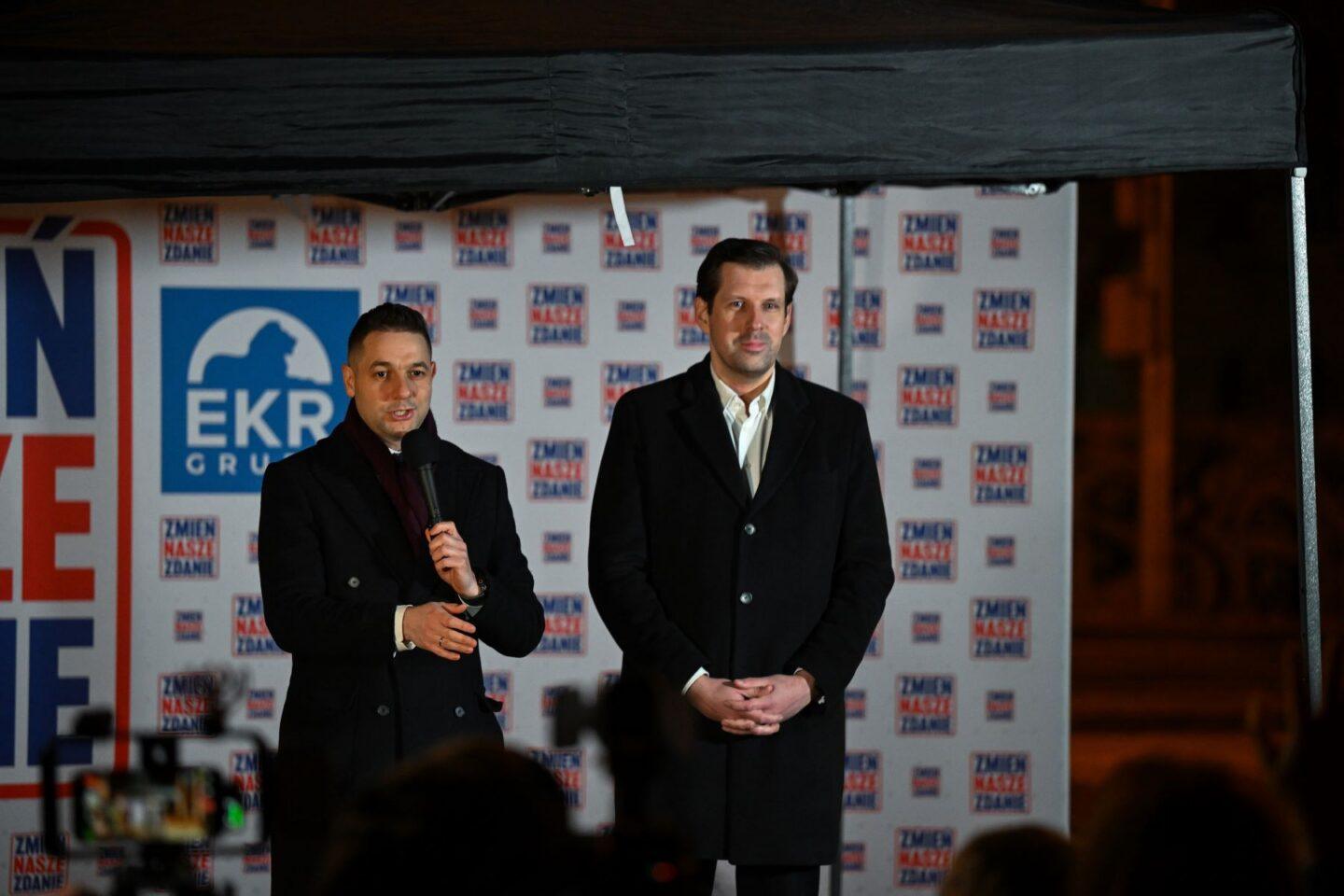
The first meeting in the “Change Our Minds” series took place outside the library of the University of Wrocław. A week before the event, Patryk Jaki announced that the university had refused to rent a hall to PiS politicians, citing concerns over political neutrality.
Opening the session, Mr. Jaki expressed regret that Donald Tusk had not faced a similar refusal when speaking on campus. The current prime minister met with students at the University of Wrocław in 2022, one year after his return to Polish politics and one year before the election that brought him back to office.
Wrocław was not the only city where PiS politicians were denied university venues. Similar refusals occurred in Warsaw and Lublin. On the day of the event, a car with a trailer and sirens promoting the debate toured Wrocław.
A minor tension before the debate
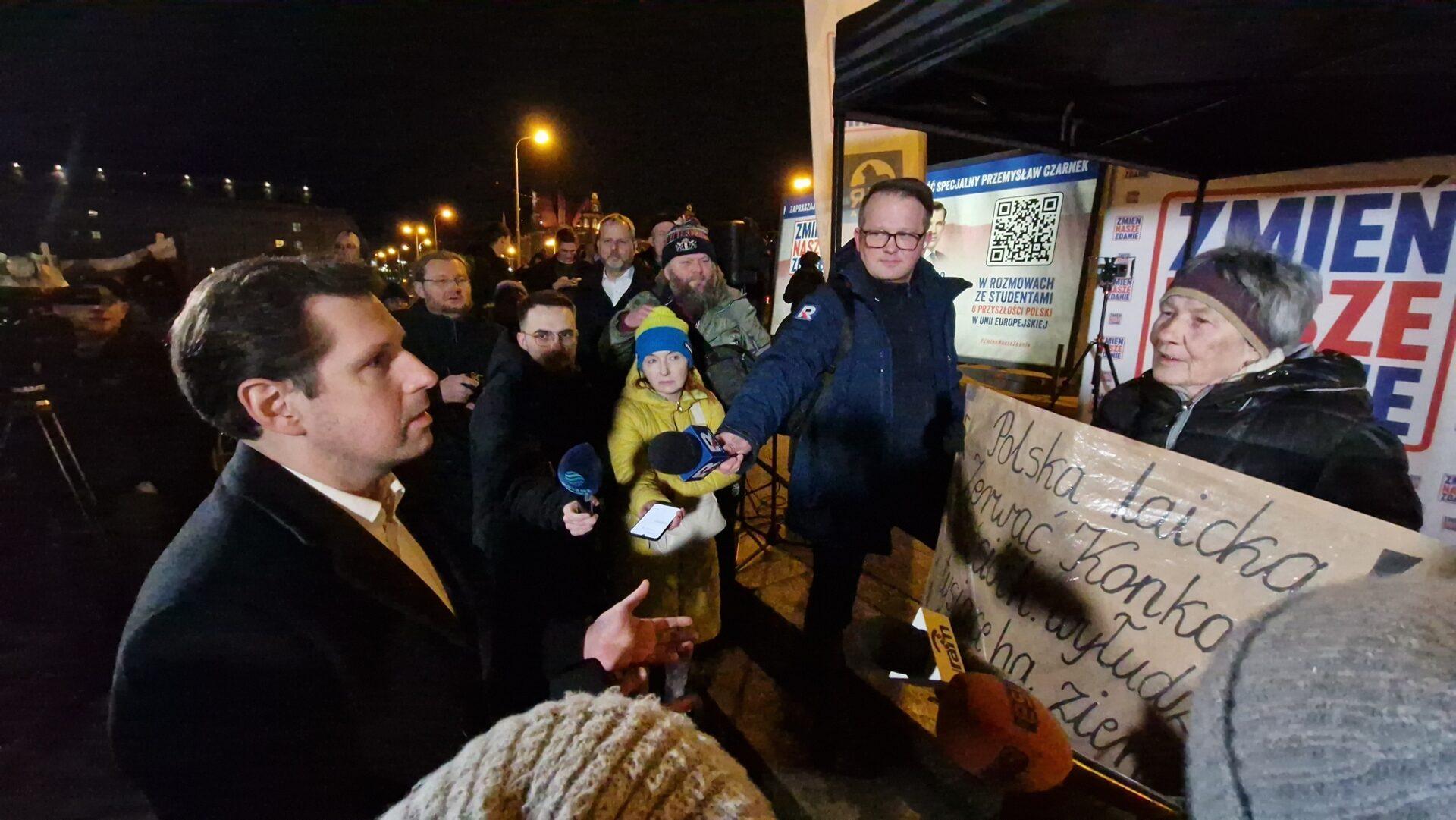
Even before the debate began and before a tardy Patryk Jaki appeared, Tobiasz Bocheński had a chance for a “warm-up” exchange. A woman stepped forward holding a sign calling for the termination of the Concordat.
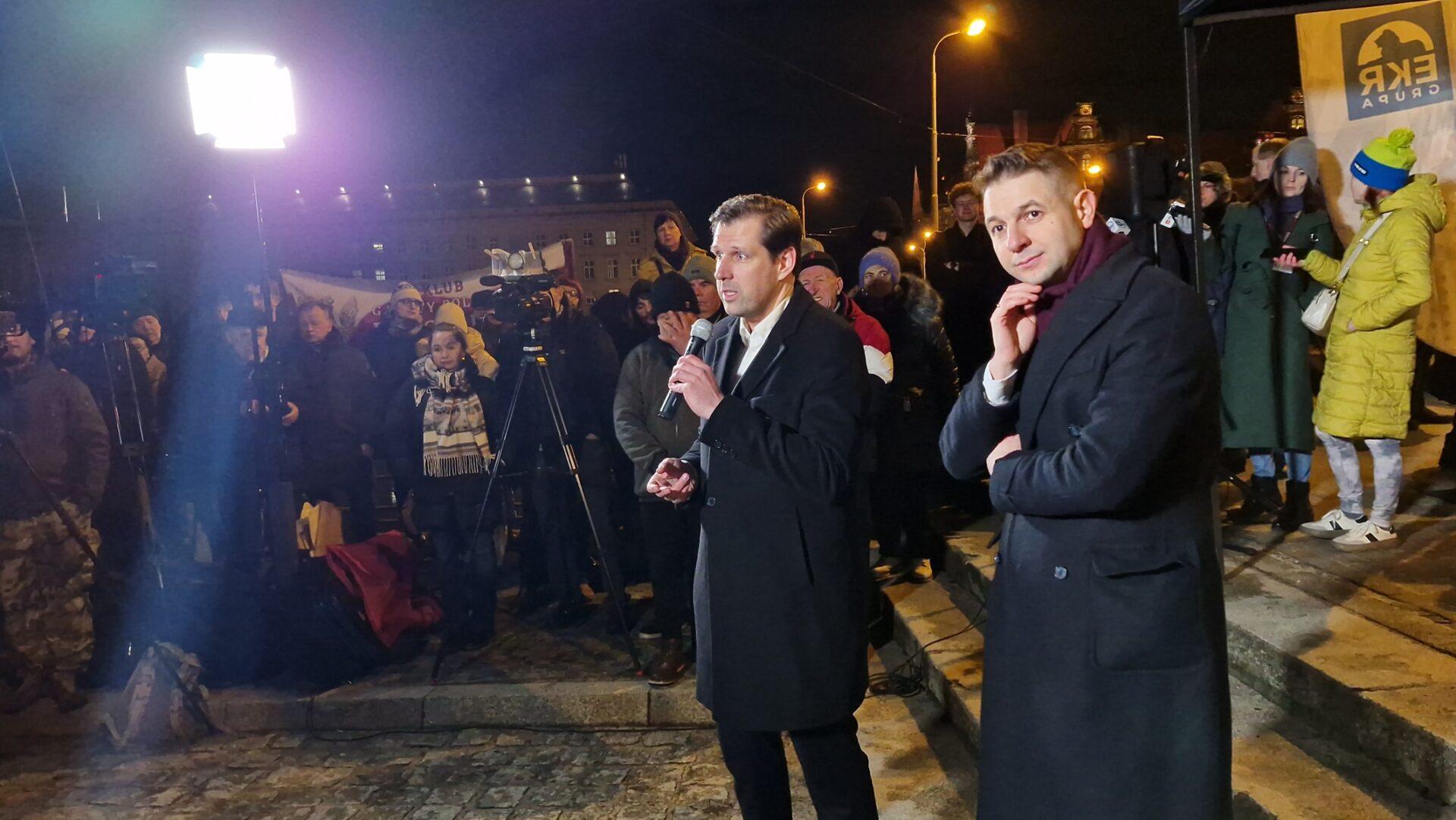
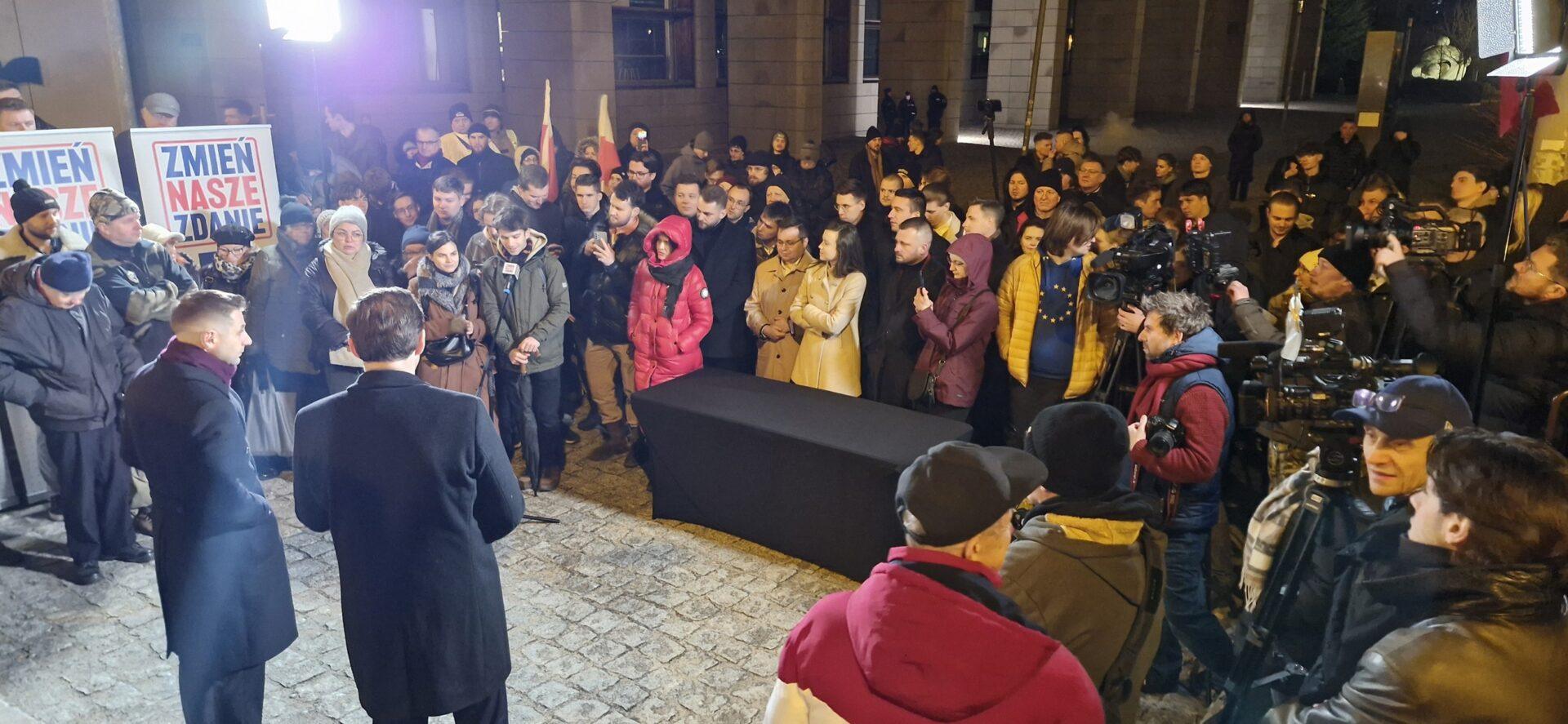
Once the main session started, the MEPs set the agenda, focusing on topics that have recently dominated PiS political narratives. While the audience included both party activists and supporters, they largely refrained from asking questions. The exchanges mainly involved students holding views sharply at odds with Mr. Jaki and Mr. Bocheński – critical of PiS but with some right-leaning sympathies.
Starting with SAFE
The first exchange lasted several minutes. Patryk Jaki delivered a critical assessment of the SAFE program, which has recently become a major topic in public discourse. He described the EU loan initiative for military procurement as harmful to Poland due to its conditionality mechanism. He suggested that Poland could lose SAFE funds if PiS returned to power in 2027. He compared this conditionality to that of the National Recovery Plan (KPO).
Opposing Jaki was a diplomacy student who defended SAFE. He explained that the conditionality mechanism in SAFE differs from that in the KPO. In the case of SAFE, any suspension of payments would be decided not by the European Commission but by the European Council – that is, the governments of all member states.
Jaki remained unconvinced. He argued that EU funds had been withheld from Hungary for political reasons. In fact, Hungary lost billions of euros from cohesion funds because Viktor Orbán’s government failed to ensure transparency in EU fund spending – a point also highlighted by the student interlocutor.
“You are trying to argue that these funds can only be blocked in cases of corruption. Meanwhile, I am showing you that the SAFE regulation allows significant discretion and unequal treatment of states. In Hungary’s case, you know very well that one reason was the situation in the judiciary there. Please compare what is happening with Poland’s judiciary now with what happened previously,” Mr. Jaki said.
He also accused Donald Tusk’s government of making judicial reforms through resolutions without objection from the European Commission.
A student convinced Mr. Jaki
Discussing Germany’s dominance in European institutions, Patryk Jaki asked a student to provide even a single example in which Germany had been outvoted in an EU forum. The student responded with the October 2024 vote to impose tariffs on Chinese electric cars. Germany had opposed the tariffs, while Poland was among the countries supporting them.
Mr. Jaki admitted that the student had managed to change his mind on this particular point. However, this remained the only instance of such persuasion.
The discussion on SAFE did not end with that exchange. Another student asked the PiS politicians whether Mariusz Błaszczak had ever reconsidered his position on SAFE. He also raised the argument that SAFE could negatively affect relations with the United States, even as the American administration urges Europe to arm itself.
Mr. Jaki noted that Germany itself does not participate in SAFE. The student countered, reminding him that Germany’s credit rating allows it to seek funds independently on better terms.
“If it weren’t for the conditionality mechanism, I would consider it myself. I think that was also Minister Błaszczak’s intention. The conditionality mechanism decides everything,” Mr. Jaki said.
“If we have a situation where industrial production rises in the United States and China but falls in Europe, I seriously doubt that SAFE will stimulate Europe’s defense industry,” added Tobiasz Bocheński.
Mr. Bocheński on Ukraine in the European Union
Mr. Bocheński put forward another argument, referencing recent remarks by Sejm Speaker Włodzimierz Czarzasty made in Kyiv, in which he expressed support for Ukraine’s EU membership aspirations. Mr. Bocheński argued that Poland should not act as a spokesman for Ukraine’s accession at this time.
“Why? Just because Ukraine is waging a war it did not start, having been attacked by the Russian Federation, does not mean Poland should forget its national interest. The Sejm Speaker Czarzasty’s words are unacceptable. We had to go a long way, reform our laws. There were protective periods imposed on our economy. I do not agree with the assumption that we should admit a country with the largest agricultural potential in Europe, possessing the richest black soil, capable of producing so much food that Polish agriculture would become unnecessary,” Mr. Bocheński said.
Here, as with SAFE, PiS has gradually shifted its narrative. Shortly after the full-scale invasion began in February 2022, President Andrzej Duda declared support for an accelerated EU accession process for Ukraine. Today, PiS is less supportive of Ukraine’s European ambitions.
During the debate, a young participant admitted that he opposed Ukraine joining the EU. Yet he accused PiS governments of pro-Ukrainian bias and described their current stance as inconsistent. He questioned PiS politicians about their credibility in the context of a potential return to power and criticized the current government for increasing Poland’s debt, pointing out that the state also accumulated debt under PiS rule.
Mr. Bocheński: “The biggest misunderstanding in public debate”
Tobiasz Bocheński responded by arguing that Poland’s aid to Ukraine in February 2022 was not motivated by pro-Ukrainian sentiment.
“You compared pro-Ukrainianism with aid to a fighting Ukraine. This is the biggest misunderstanding in public debate that we face today. On the eastern front, Russian imperialism has reemerged. Poland’s national interest would be best served if Russia were fragmented into 20 small states. But that will not happen. Realistically, Poland’s national interest today is to keep Russian tanks as far from our border as possible. Polish and Ukrainian interests align in pushing back Russia, but diverge elsewhere, as President Zelensky has repeatedly shown. Was the PiS government pro-Ukrainian because it welcomed refugees? No. I do not see a more Christian action than taking in women and children,” Mr. Bocheński said.
He directly addressed criticisms coming from the party’s right-wing competitors:
“Should certain rules have been changed over time? Yes, I can agree with that. The problem is that some parties mix all these issues together in one pot. If someone says that everything the PiS government did regarding Ukraine was ‘kowtowing’ to Ukrainians, that is not true. When we debate on the right with our competitors, Mr. Mentzen and Mr. Bosak – I am not even talking about Mr. Braun – it is not that we disagree on everything. But there is one thing that drives me absolutely mad: they have never governed, they have never been responsible, so they speak entirely theoretically. Our credibility comes from being aware of our mistakes,” Mr. Bocheński concluded.
“Mr. Braun is irresponsible”
References to rivals on the right of the political spectrum continued later in the debate. Discussing the coronavirus pandemic, Tobiasz Bocheński recalled its early days, when he served as governor of the region of Łódź in central Poland. He claimed that he had made decisions in good faith, after consulting with doctors, and that PiS had learned from past mistakes. He also criticized Grzegorz Braun.
“I regret that public discourse focuses more on mistakes than on the successes of the PiS government. Secondly, we are capable of admitting our errors, but I cannot accept Grzegorz Braun, who claims the virus never existed. He is irresponsible. There is no more credible party than PiS. We set a standard in Polish politics: we make promises and we deliver. Every promise made in 2015 has been fulfilled,” Mr. Bocheński said.
Mr. Bocheński cited measures such as the introduction of the 500+ child benefits, decommunization, and repairing public finances through tighter VAT collection. However, contrary to earlier announcements, VAT was not reduced to 22 percent. Other pledges were also left unfulfilled, including abolishing the National Health Fund (NFZ), hiring under civil law contracts (instead of regular employment contracts), fully funding public media through subscription fees, and streamlining the judicial system.
Discussion on gender
The next topic introduced by Patryk Jaki touched less on international security and more on issues of identity. He emphasized that there are two biological sexes.
This referred to a recent vote in the European Parliament on UN recommendations regarding the status of women. The parliamentary majority rejected a right-wing amendment stating that only a biological woman can become pregnant. The amendment was dismissed because the majority did not want to rule in a vote on whether a transgender person could become pregnant – a topic PiS politicians have increasingly raised in recent months.
A student intervened, arguing that in addition to biological factors, psychological criteria also define gender. Mr. Jaki debated the point, with the discussion focusing, among other things, on the possibility of gender reassignment. The PiS MEP expressed skepticism about such procedures, saying he was not convinced by arguments about minors’ rights to make decisions about changes to their own bodies.
The “Change Our Minds” debate was not an opportunity for everyone to engage with PiS politicians. Activists from Młodzież Wszechpolska took the microphone to promote a fundraising campaign to help the Polish community in Moldova. Representatives of individuals harmed by a developer who failed to complete a construction project also spoke.
Explainer
Młodzież Wszechpolska - “All-Polish Youth”
Młodzież Wszechpolska (MW) – literally “All-Polish Youth” - is a Polish nationalist youth organization. Think of it as the youth wing of the far-right National Movement (Ruch Narodowy) political current, though it operates independently. It’s one of the most active and visible far-right youth groups in the country.
The name itself is a deliberate historical callback. The original Wszechpolacy (“All-Poles”) movement dates back to the late 19th century, when Poland didn't exist as a state. That movement, led by Roman Dmowski, promoted an ethnically defined vision of Polish nationhood: Polish identity rooted in blood and Catholicism, not just citizenship. MW sees itself as the direct heir to that tradition.
Questions on Belarus and Lviv
The final questions from the audience stirred significant emotion. The penultimate participant challenged Poland’s support for the Belarusian opposition, questioning the sense of assisting Sviatlana Tsikhanouskaya on Polish soil and suggesting that it could anger Alexander Lukashenko and provoke an attack on Poland. Patryk Jaki argued that Poland should support the democratic Belarusian opposition, while Mr. Lukashenko’s regime, in his view, should simply be endured.
“You question whether Russia poses a threat to us. This is a topic we often debate with Konfederacja, which frequently doubts that Russia’s ambitions are limited to Ukraine. We should strive to make Belarus our ally. The key question is how to do that. As I understand it, you would prefer to reach an agreement with Mr. Lukashenko. I agree that we need to work with Belarus, but the democratic side, represented by Sviatlana Tsikhanouskaya – who undoubtedly won the 2020 election – seems a better choice than Lukashenko,” Mr. Jaki countered.
The final question, read from a phone, asked why Poland had not attacked Ukraine simultaneously with Russia to reclaim Lviv and avenge the Volhynia massacre. The question sparked outrage among the audience.
“Tell me, why would you want to conquer Lviv? If you wage a war, it is for a purpose, so explain what that purpose would be. Putting aside the fact that we would violate international law and pay dearly for it: we would be partitioning our neighbor, creating a casus belli, and another state could apply the same principle against us – including the Russian Federation,” Tobiasz Bocheński replied.
Explainer
Lviv and Volhynia
The city of Lviv has been called Lwów (Polish) and Lemberg (German/Austrian). Each name reflects a different era of ownership. Lviv sits in western Ukraine, close to the Polish border. For centuries it was one of the great cities of Polish civilization. It was founded in the 13th century, became a major center of the Polish-Lithuanian Commonwealth, and by the 19th century was the cultural capital of Galicia under Habsburg rule. Poles, Jews, Ukrainians, Armenians, and Germans all lived there – but the city’s high culture, its university, its cafés and theaters, were overwhelmingly Polish in character.
When the borders were redrawn after World War II, Lwów was transferred to Soviet Ukraine. The Polish population was expelled westward in a massive forced resettlement. Families left behind graves, libraries, universities, and centuries of accumulated life. This wasn't a small community. Interwar Lwów was one of Poland's most important cities — home to world-class mathematicians (the famous Lwów School), poets, and intellectuals.
If Lviv is a source of nostalgic grief, Volhynia (Wołyń in Polish, Volyn in Ukrainian) is the single most explosive issue in Polish-Ukrainian relations. Volhynia is a region in northwestern Ukraine. During 1943–1945, the Ukrainian Insurgent Army (UPA) — the military wing of the Organization of Ukrainian Nationalists (OUN-B), led by Stepan Bandera's faction — carried out a systematic ethnic cleansing campaign against the Polish civilian population there, and in neighboring Eastern Galicia.
The scale was catastrophic: entire villages massacred, often with extreme brutality. The violence was not incidental to the war but organized and deliberate: the goal was to eliminate the Polish population from territory the UPA considered Ukrainian land, ensuring there would be no Polish claim after the war. The killings were not only military. Women, children, and the elderly were targeted. Many were killed with farm tools. Polish communities that had lived alongside Ukrainian neighbors for generations were wiped out within days. In Poland it is most often referred to as genocide.
One-man show in Lublin
The Lublin meeting took place in a room at a local conference center. Even before the formal start, organizers exchanged expressions of satisfaction, having had to bring in extra chairs. The room could hold about 100 people and was full. Yet, to the surprise of attendees, only Patryk Jaki appeared on stage.
Most of the students in attendance had graduated decades ago. The audience was largely composed of the party’s traditional older electorate, who came more to listen to Jaki than to engage in debate. Nevertheless, some younger participants did pose questions.
The European Union was indeed a recurring theme in Mr. Jaki’s responses, though it was not the dominant topic. He was more frequently challenged on questions regarding Ukraine or the legacy of Mateusz Morawiecki’s government. Exchanges did occur, but they generally revolved around the details of a right-wing worldview rather than fundamental clashes of opposing values.
Firm opposition to SAFE remains unyielding
Patryk Jaki opened the meeting with a critique of the prime minister.
“Donald Tusk has achieved nothing for the Polish state. He has done nothing good for the country,” Mr. Jaki began, before inviting the audience to change his mind on the subject. No one stepped forward.
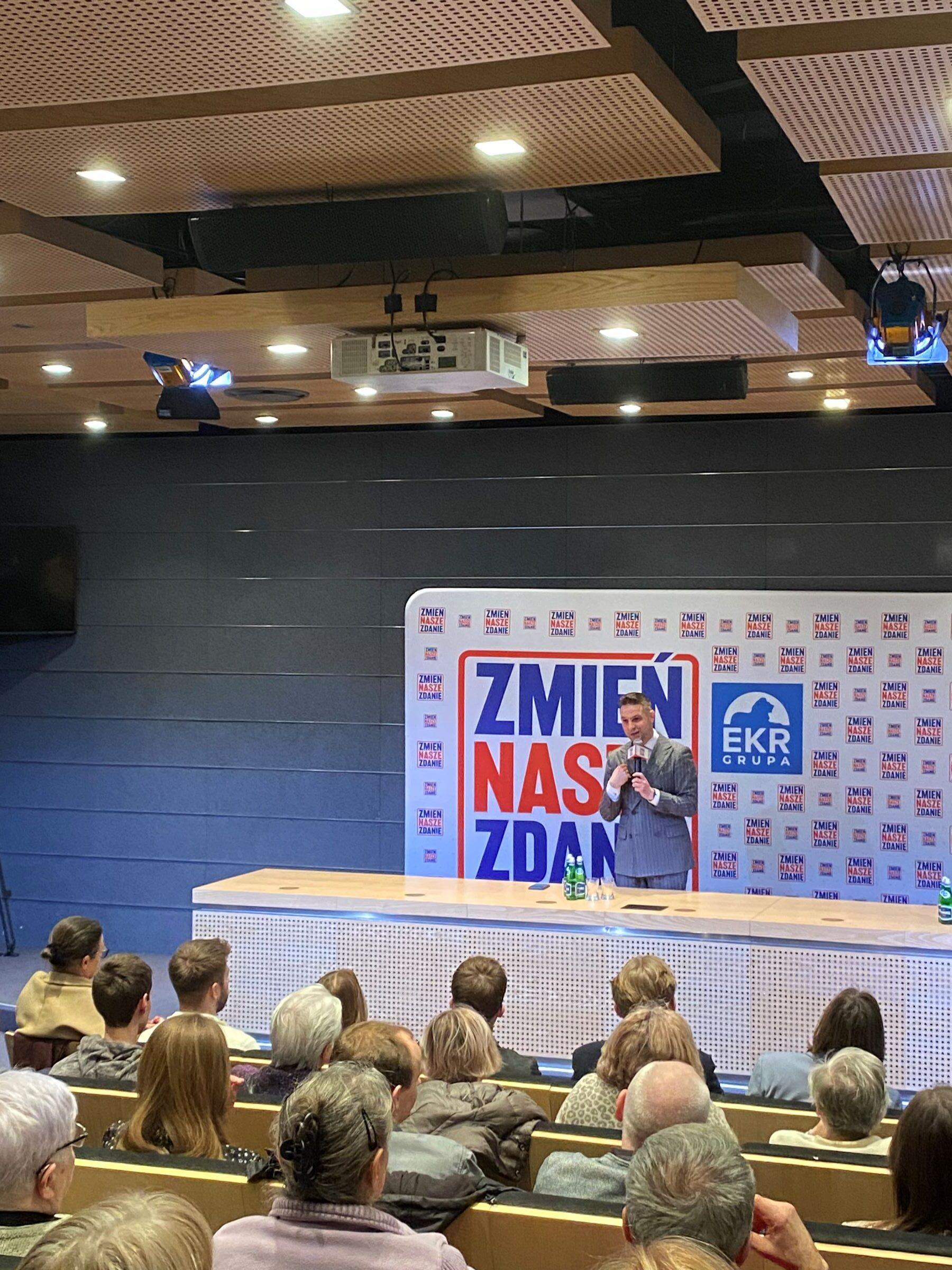
Later, SAFE was once again criticized as a mechanism that makes Poland dependent on the EU.
“It’s roughly like someone here taking a commercial loan and committing to repay it. Meanwhile, the bank could block the funds at any time… for any reason, saying, for example, that you hold the wrong opinions,” Mr. Jaki explained.
Barbs at Mr. Morawiecki and playing with a cheater
Mr. Jaki was also asked about the legacy of Mateusz Morawiecki’s government, which is currently at odds with him and his supporters.
He tread carefully when responding to a question about Law and Justice’s priorities.
“On one hand, of course, it is in our interest for PiS to remain intact. On the other hand, we must choose the right direction. The optimal scenario is to achieve both, and that is what we should strive for. If that is not possible, well… what can you do? I believe the direction is more important,” Mr. Jaki observed.
This was not the first jab aimed at Mr. Morawiecki. Responding to an earlier question on the conditionality-bound National Recovery Plan (KPO), which Mr. Morawiecki had supported as prime minister, Mr. Jaki clearly distanced himself from those decisions.
“I voted against the KPO because I knew how it would end,” he said.
Trying, however, to offer some justification for Mr. Morawiecki, Mr. Jaki compared relations with EU institutions to “playing with a cheater.”
“You can assume that when you play with a cheater, you might try once to reach an agreement with them,” Mr. Jaki remarked.
He added that, since the European Union had already deceived Poland once, he is surprised by those who would enter into the same risky arrangements a second time.
Butter boys vs. Mr. Braun: united on being anti-EU, divided on Russia
Patryk Jaki also explained to the audience the level of threat posed by Russian imperialism and propaganda in Poland.
“They [Russia] understand very well that there is no space in Poland to build a strong pro-Russian party. But there is one to build an anti-Ukrainian party. They know that from their perspective, it is best if we fight among ourselves, because then they can just step in and take what they want,” Mr. Jaki told the audience.
Mr. Jaki’s analysis, of course, did not emerge in a political vacuum. Even the radical PiS faction is currently distancing itself from any readiness to cooperate with Grzegorz Braun, primarily due to differences in their approach to Russia.
Bringing some of Braun’s voters over to their side is one, though not the only, objective of these student meetings.
The stakes and goals of the “Change Our Minds” meetings
The “butter boys” faction is trying to have their cake and eat it too. Eating the cake means attempting to win back the party’s radicalized former electorate, which had drifted to the right – particularly to Grzegorz Braun’s party – due to intensified criticism of the government, the EU, Germany, and, importantly, the legacy of Mateusz Morawiecki’s premiership. At the Lublin meeting, Patryk Jaki more often agreed with his interlocutors than debated them when it came to evaluating the former prime minister’s record.
Having the cake means reclaiming the party’s former, now loyal electorate by maintaining a clear profile while simultaneously criticizing Grzegorz Braun. In Lublin, Mr. Jaki was repeatedly asked about his stance on Ukraine. Although the MEP has on occasion criticized Volodymyr Zelensky for dealings with Germany, he made it clear that Ukraine must be supported in its fight against Russia. He also unequivocally rejected claims that “this is not our war.” Mr. Jaki spent considerable time explaining the reality of a potential Ukrainian capitulation.
“If Ukraine had fallen in 2022, and it was very close… Russian troops would have stood along our entire border, and you would have been mobilized, and everyone here would have had to give up half their salary for defense, because we would have had no other choice,” Patryk Jaki said.
It also appears that, despite Mr. Jaki’s rhetorical skill and strong grasp of social media, his Lublin presentation lacked the support of Tobiasz Bocheński and Przemysław Czarnek. At one point, the MEP admitted he was already tired from yet another stop on the tour. It is unsurprising – he was the only politician to participate in every “Change Our Minds” session.
The struggle also within the party camp
The “butter boys” trio – Mr. Jaki, Mr. Czarnek, and Mr. Bocheński – still have a chance to make their spring tour of Poland memorable for the right-wing electorate. In Lublin, there were no fierce debates, but the tour will soon reach major centers such as Warsaw, Poznań, and Gdańsk. Additionally, regular visibility on social media is likely to work in favor of Mr. Jaki and Mr. Bocheński, who aim to attract younger voters previously supporting Sławomir Mentzen.
Beyond competing for influence over the right, the butter boys are also asserting their presence and significance within the internally divided PiS camp. Media speculation is rampant, and PiS leader Jarosław Kaczyński continues to try to discipline the party he still controls – though not with the same authority as during PiS’s heyday. In this context, the “Change Our Minds” tour can be seen as a response to the increased activity of Mateusz Morawiecki, who has spent months visiting different regions of Poland to meet his supporters.
The next “Change Our Minds” session is scheduled in Milan, in a slightly different format. There, Patryk Jaki will debate Adrian Zandberg (the leader of Razem party, left-wing) at the International Congress of Polish Student Associations. In March, the politicians will visit Białystok, Warsaw, and Olsztyn. Perhaps then we will finally witness someone among the butter boys actually changing their mind.


Key Takeaways
- The tour has encountered local logistical challenges, including refusals by university authorities to rent space. Nevertheless, the project has potential to allow Mr. Jaki, Mr. Bocheński, and Mr. Czarnek to reclaim some of the younger electorate currently supporting Sławomir Mentzen.
- Politicians from the Law and Justice party’s so-called “butter boys” faction have launched a series of student meetings under the banner “Change Our Minds.” Inspired by American models, the initiative pits politicians’ theses against audience opinions. The main topics at the Wrocław and Lublin events were EU financial programs and foreign policy in the context of the war in Ukraine.
- The initiative’s primary goal is to win back radical right-wing voters while distancing themselves from the pro-Russian views of the Confederation of the Polish Crown (KPP) politicians. The debates also serve as a tool for internal party rivalry, particularly with the faction of former Prime Minister Mateusz Morawiecki. During the sessions, politicians openly criticized his past decisions and concessions to EU institutions.