

This article is a part of Poland Unpacked. Weekly intelligence for decision-makers
Marcin Kubrak, who became CEO of Poland’s largest charter airline on February 3, forecasts a 10% annual growth in the fleet. The company is investing in its own technical infrastructure, a simulator, and a flight school.
Małgorzata Grzegorczyk: Seventeen years after its founding, Enter Air finally has a CEO. Why wasn’t there one before?
Marcin Kubrak, CEO of Enter Air: Historically, the company was always run by three or four board members with divided responsibilities. I focused on operational matters, while Grzegorz Polaniecki handled, among other things, relations with the media and investors. The market occasionally asked why we didn’t have a CEO or a long-term strategy to appoint one. When Grzegorz decided to retire, the supervisory board proposed me for the position, and I accepted.
Who's who
Pilot, CEO, Shareholder
Marcin Kubrak co-founded Enter Air with Grzegorz Polaniecki in 2009. They invited, among others, Andrzej Kobielski to join the project. The trio had previously met at Centralwings, the low-cost carrier owned by LOT, which ceased operations in 2009. Grzegorz Polaniecki served as an advisor to the LOT board, while Marcin Kubrak was a captain at Centralwings and ran an air freight forwarding company. Andrzej Kobielski managed the route network.
Since 1999, Marcin Kubrak has been a shareholder and CEO of Airnet, a company that owns and operates a freight terminal at Warsaw’s Okęcie Airport. From 2004, he has also been a shareholder and board member of Airnet Service, a holding company providing air cargo support services.
His aviation career began in 1996. In 1997, he obtained his airplane pilot license. He is currently a line pilot with an ATPL license, as well as a certified instructor and examiner for Boeing 737 aircraft. Additionally, he serves as chief pilot at Enter Air.
What has changed as a result?
Marcin Kubrak: Operationally, nothing changes – it’s more a formality. I will now be more accessible to the market, which I haven’t focused on before. Grzegorz’s other responsibilities have been transferred to the remaining board members. Konrad Dymowski, who has been technical director for many years, has been promoted to the board. I will continue to handle some of my previous duties, though perhaps at a higher strategic level and to a lesser extent.
Will you still have time to fly?
I fly both privately and professionally all the time. Professionally, perhaps less than colleagues fully dedicated to it, and in recent weeks even less. Outside work, I also fly historical aircraft and practice aerobatics.
How much is Enter Air worth?
Are you planning to increase your stake in the company? Since last year, you hold 38.7%, the largest share among all shareholders.
Marcin Kubrak: I cannot declare whether I intend to increase my stake, because I would have to disclose it through ESPI. I believe in the company and think its valuation could be higher, better reflecting the level of our business. But that’s a matter of educating the market. We are the only airline listed on the Polish stock exchange. Even comparisons with airlines listed in other markets don’t hold, because those carriers operate under different business models. We operate differently, our finances look different. My task ahead is to educate the market, show them the business, and tell the story of the risks and how we mitigate them. That gives us a chance for the market capitalization to grow significantly.
Over PLN 1 billion (EUR 210m) – is that too little?
Extremely little.
So what should it be?
I wouldn’t want to specify an exact valuation. It depends on investors and their calculations. In my view, it should be several times higher.
Analyst perspective
Light ownership structure
It’s different for travel companies with hard assets. In a ski resort, these could be lifts, facilities, or long-term contracts. In the hotel sector, it could be hotels or restaurants. In such cases, valuations can exceed 20 times earnings.
In the leisure industry, the more assets a company owns – real estate in locations where competitors are unlikely to enter – the higher the valuation. Operators of unique cable cars or theme parks can expect higher valuations because barriers to entry are high. Often, regulations on protected areas further limit market access for new entrants.
On the other hand, too many assets can weigh a company down in the face of drastic events, such as the pandemic. The travel market froze for months. Enter Air, by contrast, was able to renegotiate its leasing contracts quickly and remained more flexible.


Charters, leasing, cooperation
Is there really no comparable airline in Europe?
Marcin Kubrak: Over the past 15 years, we have done our homework and become one of the larger charter carriers in Europe. The Czech airline Smartwings, which was established earlier, has a similar fleet size. However, it is difficult to assess the company’s finances because it is privately held. There are no financial reports directly comparable to ours. There are larger charter operators, but they are tied to tour operators – for example, TUI with a fleet of 150 aircraft, or the British carrier Jet2, with more than 100. We are a pure-play charter airline.
Why did you establish Fly4 Airlines Green in Ireland with Germany’s TUI?
Fly4 is an ACMI airline, which means it leases aircraft with crews to other carriers. In certain niches, TUI-owned airlines want to rely on other operators. During the European summer season, over 100 aircraft operate on an ACMI basis. Through cooperation with us, TUI can influence quality – a significant value. The TUI headquarters decided to collaborate this way for the first time, and only with us.
The company was established in Ireland, but we operate relatively little there, flying mainly in the United Kingdom and Western Europe. Currently, part of the four-aircraft fleet has a contract in India, where it is deployed. Ireland serves operational and certification purposes.
Where will Enter Air fly?
Beyond these four aircraft, how many planes does Enter Air operate, and what are the plans?
Marcin Kubrak: This year, we will add six more aircraft. We received one in September, four more will arrive in the spring, and the last one in July or August. In total, Enter Air will operate 41 aircraft, and 50 across the group – a new record for us.
Which new markets interest Enter Air?
We continue to focus on both the Polish and European markets. Recently, we concentrated more on Poland because it was growing faster. Between 2019 and 2025, the holiday travel market there grew by over 107%. Growth in Western Europe was slower, though prices and margins are higher there. By diversifying our presence, we maintain opportunities for expansion. The Polish market will continue to grow, perhaps not at double-digit rates – that’s unrealistic. We are encouraged that winter travel demand is also increasing.
We also see a growing willingness among Poles to fly. In 2025, 37 million Poles took 60 million flights, averaging 1.6 trips per person per year. In Western Europe, the comparable figure approaches six, and in Scandinavia it exceeds six. So there is considerable room for growth. The growth rate in Poland will slow somewhat. That’s actually positive, as it allows us to stabilize development and focus on building infrastructure to take the next step.
They repair and train in-house
What kind of infrastructure are you referring to?
Marcin Kubrak: I mean the company’s internal infrastructure and organization. Last year, we hired several hundred people, and recruitment is ongoing. New employees need training and opportunities to prove themselves. We know how to do that. Across the group, we now employ around 2,000 people, and we need to manage them effectively.
I thought you meant investment in technical infrastructure?
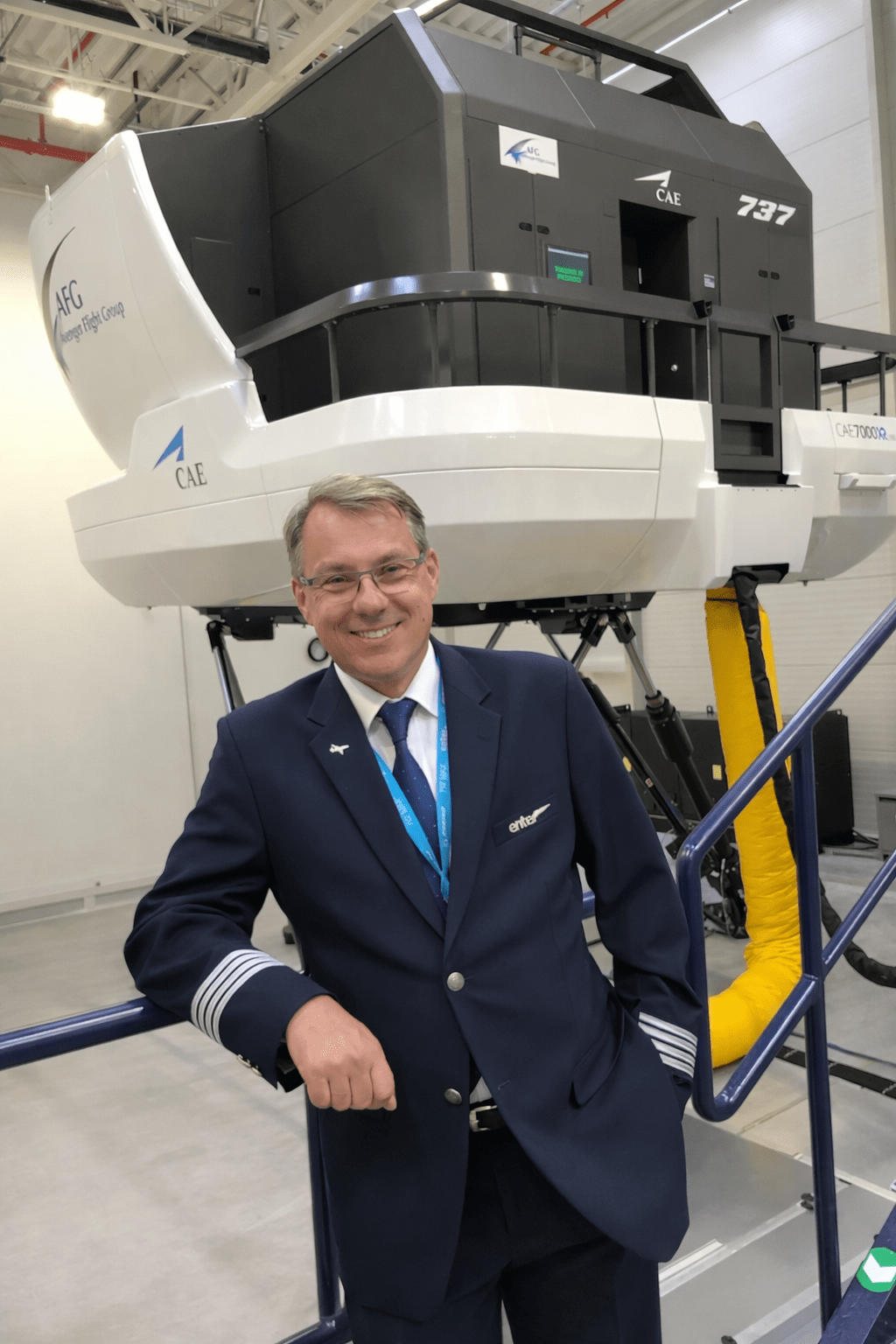
Yes, that too. We are diversifying extensively. We used to be just an airline. Now we have our own technical service, which was a breakthrough. Two years ago, we added heavy maintenance and hangar operations, which we previously outsourced. We have hangars in Debrecen, Hungary, and in Katowice, Poland. This is currently our primary focus for investment and development. Next year, we will hire another 120–150 people – licensed and unlicensed mechanics. We also need to expand our simulator center and are considering an additional simulator. The number of crews is growing.
Do you train crews internally?
Yes. We have a training center where we train pilots for our specific aircraft types. The center operates 24/7, and pilots must train continuously. Our capacity is approaching its limits, so we are planning a new B737 MAX simulator.
We are also in the process of obtaining certification for our Aviata Pilot Academy, which will train pilots from scratch. We are in the final stage of recruiting the first group of ten candidates, who will undergo three years of training. Next year, we will accept more recruits. Over three years, we aim to train a cohort that will cover half of our pilot needs. Currently, we hire 20–40 first officers annually. This plan assumes 10% annual fleet growth.
How are the Swiss airline Chair Airlines doing?
Excellent. We are very satisfied. We acquired shares in 2019, then the pandemic hit, making the situation difficult. The last five years have been a restructuring process. The company is now generating substantial profits, and we are adding a fifth aircraft for the summer season.
Will there be further acquisitions?
We are constantly reviewing the market and exploring different opportunities. We don’t have a specific target yet. Our focus is definitely on Western Europe.
No swinging risks
What are your plans?
Marcin Kubrak: Aviation is a business that must be structured to be predictable, and the various types of risk that threaten companies like ours should be minimized. That is the responsibility of the board. At Enter Air, this works well – there will be no “swing,” because it is undesirable. As long as the market remains favorable – and I believe it will – and as long as our relationships with clients remain strong, which they are, we will maintain a unique structure in which everyone develops successfully. We strive to be the best for our customers. We have no plans to become a low-cost carrier or a national airline. Those overly optimistic “hurrah” plans rarely succeed. Our focus is on growing our business and building barriers to entry for competitors.
Enter Air controls 40% of the market – is that a significant barrier?
Attempts to enter the market do occur. Ukrainian companies without European certifications or slots began operating from Poland, causing disruption. It was unhealthy competition. The Ukrainians opened a travel agency [Join UP! – editor’s note] and started selling holiday packages. Their airline [SkyUp – editor’s note] operates under a Ukrainian certificate. Prices were very low, but so was quality, so financially it did not end well. Competition is always possible, but if you are a reliable partner for clients, take care of passengers, and price rationally, even low-cost competitors such as Ukrainian carriers have a reduced chance of success.
Good to know
Ukrainian airlines under scrutiny
At the end of 2025, the portal money.pl reported on the case of the airline SkyUp MT – a Malta-registered company of the Ukrainian carrier SkyUp Airlines – which operates charter flights for the travel agency Join UP!
The Civil Aviation Authority (ULC) contacted more than 50 entities operating in the Polish aviation market to request information on the Maltese carrier, its parent company, and Join UP!’s outstanding obligations. The authority then wrote to the Ministry of Infrastructure, expressing doubts about the medium-term viability of SkyUp MT’s operations.
ULC also raised concerns about the leasing of aircraft from non-EU countries (Ukrainian SkyUp Airlines), which the Maltese aviation regulator had not consistently reported to other member states. When issuing another authorization for the Maltese company to operate scheduled flights, ULC emphasized the requirement to obtain approval from the Maltese aviation authority. A ULC delegation met with representatives of its Maltese counterpart on Malta.
SkyUp Airlines assured regulators that its financial situation does not justify declaring insolvency and that it operates in compliance with regulations.
Join UP! holds an insurance guarantee of EUR 25.8 million (over PLN 110 million), valid until February 16, 2026, which was increased on November 18, 2025. In 2024, the agency served 128,000 clients, ranking eighth in Poland.


Key Takeaways
- The company is the leader in Poland’s charter market, with roughly 40% market share, and is expanding operations in Western Europe. The management has no plans to change the business model, focusing instead on stable, predictable growth..
- Marcin Kubrak, the new CEO and largest shareholder of Enter Air, believes the company’s current market capitalization (around PLN 1 billion / EUR 210 million) should be several times higher. The company plans further fleet expansion - reaching 50 aircraft in the group this year - and approximately 10% annual growth. The CEO also intends to engage more actively with the market and educate investors.
- Enter Air is investing heavily in technical infrastructure - including its own hangars in Debrecen, Hungary, and Katowice, Poland - as well as expanding technical services, its simulator center, and the Aviata Pilot Academy. The goal is to increase operational independence and build barriers to entry for competitors.