

This article is a part of Poland Unpacked. Weekly intelligence for decision-makers
“Rozwój Plus” [Development Plus] people in Toruń, Nowogrodzka people in Kraków, and Mateusz Morawiecki and Patryk Jaki engaged in a media-based correspondence duel, accusing each other of acting to the detriment of the party. What happened over the weekend in the PiS universe, and why did the temperature rise further?
Explainer
The context
Law and Justice (PiS), Poland’s main conservative party, is currently experiencing a visible internal split between two informal factions. One group, associated with former Prime Minister Mateusz Morawiecki, is promoting a more technocratic, pro-growth economic agenda under the “Rozwój Plus” association. The party leadership around Jarosław Kaczyński [Nowogrodzka - named after the street where the party HQ is - ed. ] is focused on maintaining ideological discipline and consolidating the core right-wing electorate, warning against parallel political initiatives.
The dispute has escalated into public exchanges of criticism, with both sides accusing each other of weakening the party. Mr. Kaczyński has stated that individuals involved in competing projects may be excluded from electoral lists. While talks between key figures are planned, the party’s internal balance remains uncertain, and the outcome will shape the future structure of Poland’s right-wing politics.
Previous weekend was not a calm one in Law and Justice (PiS). On Friday, party leader Jarosław Kaczyński stated explicitly for the first time that there would be no place for individuals involved in initiatives competing with PiS.
“Rozwój Plus” in Toruń, Nowogrodzka in Kraków, and Mateusz Morawiecki and Patryk Jaki are engaged in a media exchange, accusing each other of acting to the detriment of the party. What was happening over the weekend in the PiS universe, and why did the temperature only rise further?
The PiS chairman issues an ultimatum
“We need to choose, and I say clearly that there will be no places on our electoral lists for people who would engage in this,” Jarosław Kaczyński declared.
The statement by the PiS leader triggered a cascade of speculation and reactions. The weekend did not bring a breakthrough, although no signs of de-escalation were heard either. A symbol of the increasingly entrenched divisions were the off-site political meetings held by party figures over the weekend.
In Toruń, politicians associated with Mateusz Morawiecki held a debate. Although the meeting was formally held under the Law and Justice banner, members of the new association “Rozwój Plus” were present, including MEPs Michał Dworczyk, Piotr Müller, and Waldemar Buda, as well as MPs Janusz Cieszyński and Marcin Horała, and Krzysztof Szczucki, who has been suspended from PiS.
Association guys in Toruń, Nowogrodzka guys in Kraków
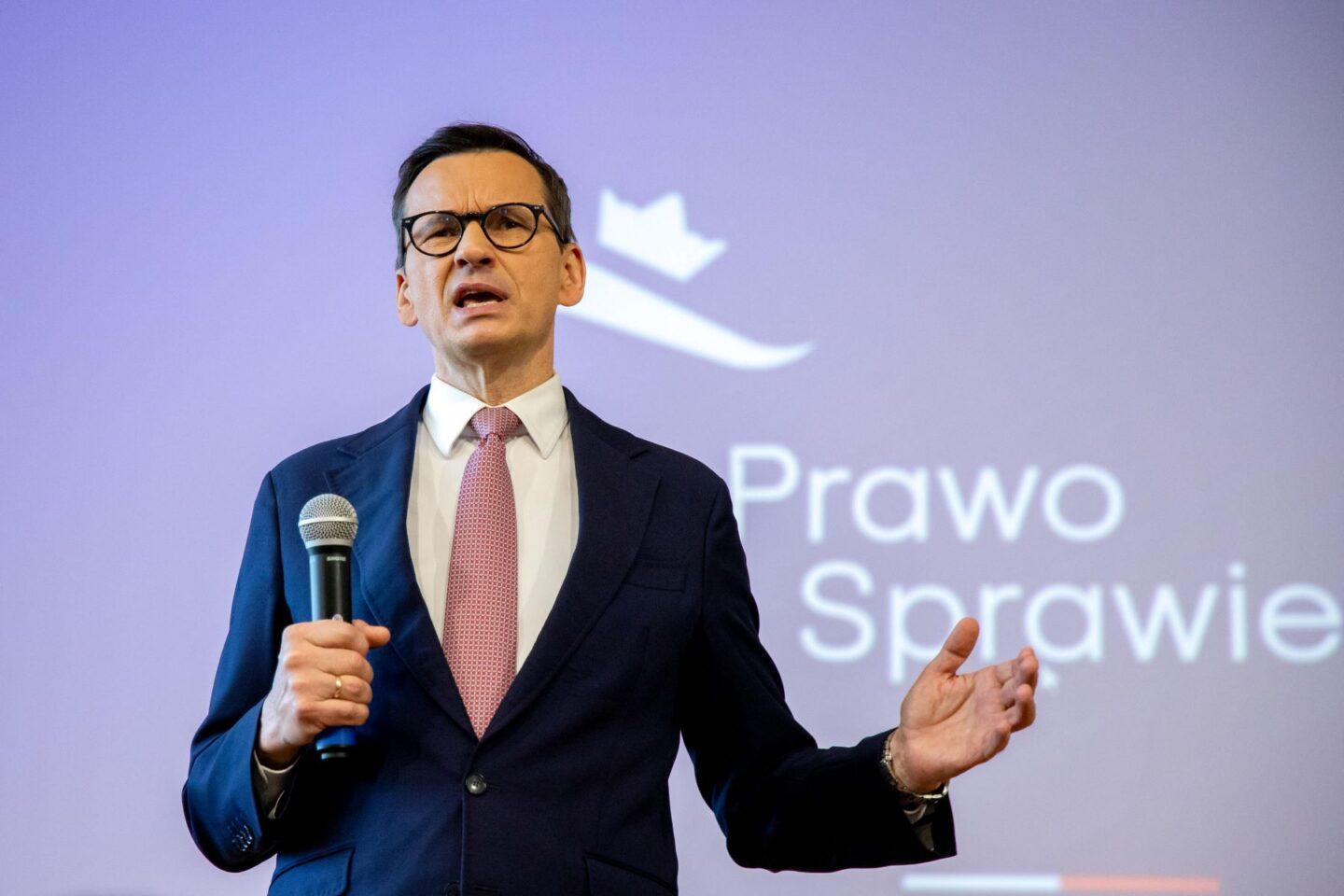
In Toruń, Mr. Morawiecki presented the economic program “One-Speed Poland.” Importantly, the former prime minister consistently referred to the party label rather than the association structure.
“In the DNA of Law and Justice lies balanced, fair development. It was here in Poland that an original offer was created – not predatory capitalism, not only economic liberalism, and not communism, but social solidarism,” Morawiecki said, outlining the program.
Meanwhile, a delegation from the Political Committee of Law and Justice [the Nowogrodzka guys – named after the street where the party HQ is – ed.] travelled to Kraków over the weekend to commemorate the 16th anniversary of the funeral of Lech and Maria Kaczyński. It is difficult to imagine a more symbolic divergence in intra-party priorities.
A weekend festival of mutual provocations
In parallel, recent days have seen no shortage of mutual jabs and provocations on politicians’ social media profiles.
Piotr Müller called on Patryk Jaki – and, implicitly, the “butter boys” faction – to stop attacking the “Rozwój Plus” association.
Explainer
Butter boys
Butter boys (maślarze) are nicknamed after an incident on board a Polish LOT airlines plane when one of these politicians was served German-branded butter and loudly complained about it in the social media.
The MEP’s post was a response to an interview given by Patryk Jaki on Telewizja Republika. The PiS vice-chairman and former Sovereign Poland politician presented a strongly critical narrative of Mateusz Morawiecki. He described the former prime minister’s association as an attempt to split PiS and act to the benefit of the Civic Coalition.
“Does the initiative led by the prime minister and his people help PiS more, or does it help Civic Platform more? Instead of information about Przemysław Czarnek’s offensive, we hear that PiS is splitting again and that some kind of party within the party is being created,” Patryk Jaki asked rhetorically on air at Republika.
The interview resonated widely among politicians and commentators close to Law and Justice.
Łukasz Schreiber responded to the “butter boys” rhetoric with a lengthy post on X, arguing that PiS’s priority should be expanding its potential electorate rather than competing in radicalism with either of the Konfederacja factions.
“We do not want to split, undermine, or fight for positions. We want to speak the language of those too often forgotten. We want to offer them a concrete, substantive program – from the economy and taxes, through infrastructure, to an ambitious vision of Poland’s development. Because only Law and Justice has the strength and experience to actually build such an offer,” declared Łukasz Schreiber.
Mr. Morawiecki: “Patryk Jaki has a problem with me – and with basic math”
These were, of course, not the only exchanges of “courtesies” between politicians who still formally belong to the same party. All of them, however, have been conducted in an openly confrontational tone, with both sides accusing each other of acting to the detriment of Law and Justice. The more combative rhetoric has come from politicians opposed to Morawiecki, but on Monday morning the former prime minister also did not mince his words in an interview on Kanał Zero.
Host Robert Mazurek asked him about his polemic with Patryk Jaki.
“I see he has some issues with me – and issues with fractions. I can only say that if you divide an apple into four parts and take one part away, three quarters remain. And I would like to end the lecture on this matter and the conversation about this gentleman here,” Mateusz Morawiecki replied with irony.
The former prime minister was referring to Jaki’s analysis of voter flows from the aforementioned interview, in which the MEP struggled with basic polling arithmetic.
The former prime minister reaches for Hungarian examples
In the same morning interview, Mr. Morawiecki again stressed that the party leadership’s shift further to the right is a mistake. He even cited Hungary, where Viktor Orbán’s strategy of taking votes from the far-right Mi Hazánk party was one of the factors behind his defeat.
“That is why we want, on the one hand, to continue showing that we are a party defending Poland’s sovereignty, but on the other hand we want to present ourselves as a development-oriented party and demonstrate our aspirational role in offering a comprehensive economic program,” Mr. Morawiecki said.
The above interactions among PiS politicians are, of course, only a fragment of the weekend’s internal dialogue between rival camps. It is clear at a glance that Jarosław Kaczyński’s appeals for unity (voiced last Thursday) were almost immediately forgotten.
President Nawrocki’s comfort zone
Bad blood continues to simmer within the party. It is, however, difficult to assess the most likely scenarios in the short and medium term. On Monday evening, Jarosław Kaczyński and Mateusz Morawiecki are scheduled to meet. According to the former prime minister, the meeting is expected to focus on clarifications rather than – so he suggests – confrontation.
In the near term, repeated “last chance” talks are not out of the question, with tensions between the rival camps likely to fluctuate, rising and falling in cycles.
It is also worth watching the reactions of the presidential camp. In the current situation, Karol Nawrocki is effectively the only PiS-linked politician who can benefit solely from the political turmoil. So far, the president has not clearly aligned himself with either side, although he has stated that Morawiecki’s camp includes people “with significant potential.” It is, however, unlikely that he will take sides in the near term, as doing so would not serve his political interests.
In the longer term, potential support for the breakaway faction could offer Nawrocki an opportunity to challenge Jarosław Kaczyński’s position as the patron of the Polish right. For now, however, this remains a prospect for the more distant future.
2001 or 2011?
And Mr. Morawiecki? Supporters of his potential secession like to invoke the analogy with 2001. From the ruins of the collapsing Solidarity Electoral Action (AWS) and the Freedom Union (UW) emerged Law and Justice (PiS) and Civic Platform (PO). Both newly formed parties at the time entered the Sejm but did not participate in governing. Four years of patience, however, led to the opening of a new chapter in Polish politics – one that continues to this day. In the eyes of his supporters, the former prime minister would be betting on a strategy of waiting it out, followed by a return to government.
Critics of the former prime minister, however, see a different precedent for any attempt at an independent run: 2011, when MPs leaving PiS led by Paweł Kowal founded Poland Comes First (PJN). The new party failed to even cross the threshold required to secure public funding, while PiS lost to Civic Platform by nearly 10 percentage points. PJN, as a political project, soon faded into obscurity.
For now, this remains political fiction. Morawiecki maintains his intention to stay within PiS, and Jarosław Kaczyński has agreed to what is being described as a “last chance” meeting. But that is the situation as of Monday. In the political imagination of Law and Justice, things change faster than in a top-flight football season.
The coming weeks will test the party’s ability to survive in its current form. The alternative is a fragmentation of the right into four blocs, the main beneficiary of which would almost certainly be Donald Tusk.


Key Takeaways
- The party’s further trajectory and the possibility of a split remain unclear at this stage. The text does not specify Karol Nawrocki’s final position or Mateusz Morawiecki’s long-term intentions. The decisive factor for the party’s cohesion will be the scheduled direct negotiations between the leaders of the two rival camps.
- A clear split has emerged within Law and Justice into two camps with differing priorities. The team aligned with Mateusz Morawiecki is promoting a new economic program under the “Rozwój Plus” association. Party loyalists and the leadership, by contrast, are focusing on the traditional message and the consolidation of the hard-right electorate.
- Representatives of both factions are engaged in an open media confrontation. The main axis of the dispute consists of mutual accusations of acting to the detriment of the party, as well as differences over strategies for broadening the electoral base. Party leader Jarosław Kaczyński has categorically ruled out placing on electoral lists anyone involved in competing initiatives.