

This article is a part of Poland Unpacked. Weekly intelligence for decision-makers
“We have to learn from you.” Those were the words of Jurek Owsiak in response to the fundraising campaign run by Łatwogang. The Great Orchestra of Christmas Charity (WOŚP) has become a national symbol, backed by the biggest players in the market and, it would seem, requiring no defense. And yet it was a livestream fundraiser led by an influencer that reignited a sense of agency, collective mobilization, and pride.
More than PLN 250 million (approximately EUR 58 million) was raised within just a few days by the influencer Łatwogang in a fundraising campaign for children suffering from cancer. The money collected during the livestream will go to the Cancer Fighters Foundation. The result is comparable to the total raised during the 34th Finale of the Great Orchestra of Christmas Charity. For the first time in two decades, WOŚP did not break its fundraising record – though anyone who understands the phenomenon would agree this hardly diminishes its significance.
Explainer
WOŚP
WOŚP, short for Wielka Orkiestra Świątecznej Pomocy (the Great Orchestra of Christmas Charity), is Poland's iconic fundraising event.
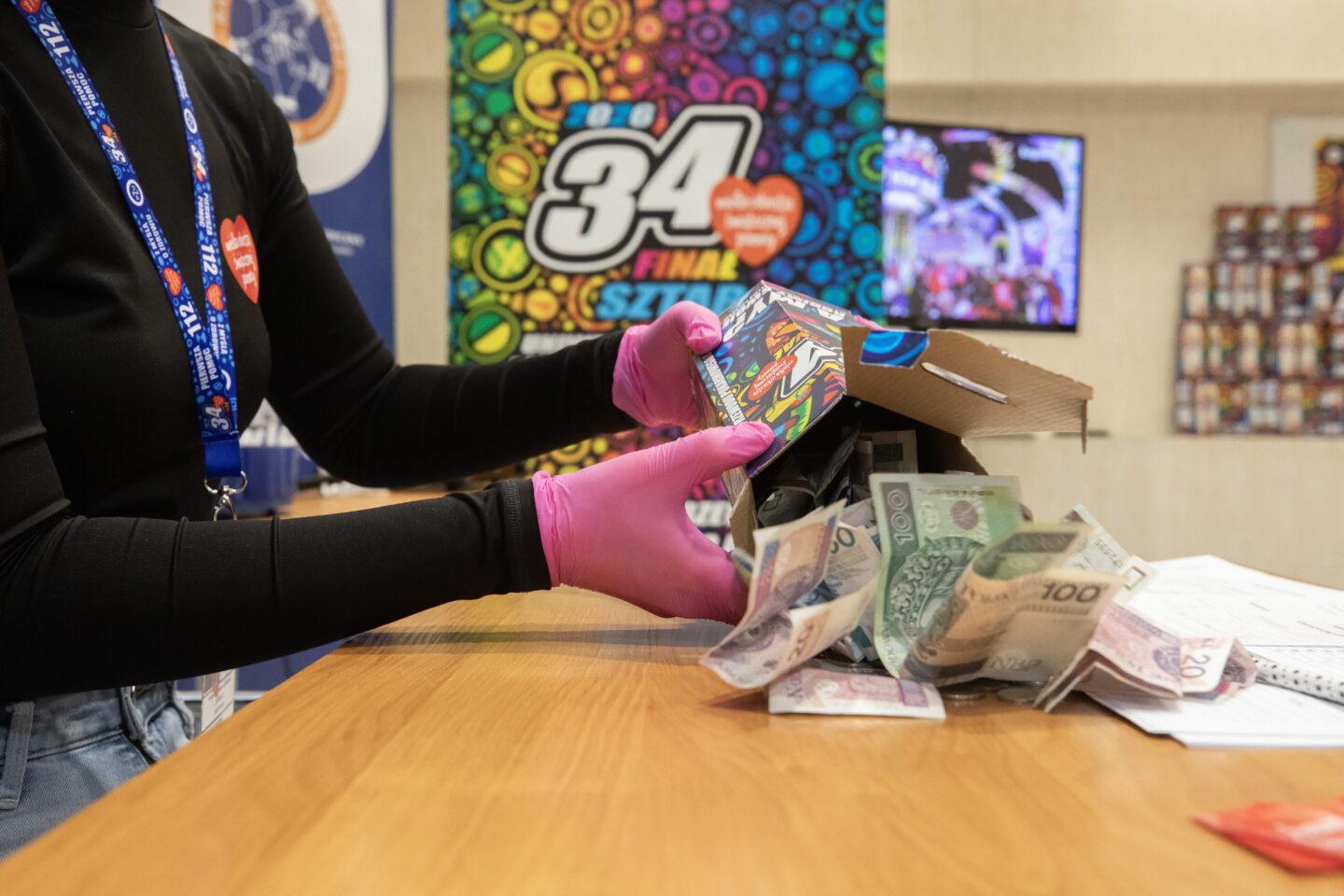
Founded in 1993 by Jerzy Owsiak, it takes place every January and has become a national institution — a single day when the entire country seems to unite around a common cause. Volunteers, most of them young people, fan out across cities, towns, and villages with distinctive red heart-shaped collection tins, gathering donations from passersby. The event is accompanied by concerts, auctions, and celebrations broadcast live on television, creating a festive atmosphere that blends generosity with joy. Each year, the funds raised are directed toward a specific medical goal, such as purchasing equipment for neonatal wards, oncology departments, or emergency services.
Poles donate with striking consistency year after year, and the cumulative totals have reached billions of złoty over the foundation's three-decade history
While one might attribute lower in-person donations to relatively prosaic factors such as the weather at the time (sub-zero temperatures prevailed), the broader challenges facing traditional fundraising are elsewhere. The campaign led by Łatwogang illustrates this clearly, signaling how the mechanics of charitable giving are being reshaped in real time.
 Interactive chart
 Did WOŚP fail to “win over” younger audiences?
One of WOŚP’s volunteers, whom we asked about a perceived decline in engagement with the foundation, points to a possible source of the problem. Speaking on condition of anonymity, she argues that WOŚP’s marketing has “got stuck in the 2000s.”
“Younger people don’t look at the Orchestra the same way. For many TikTok users, it’s something for boomers. Even volunteers themselves feel this format is starting to wear out. There is a lack of trust in the internet. Every year there are conferences of ‘older gentlemen’ presenting new stamps and postcards. Jurek Owsiak’s team doesn’t seem to believe in social media, and doesn’t realize that this is not how you reach young people. The assumption is that if something isn’t in the press or on television, it might as well not exist at all,” the volunteer says.
In her view, marketing is one of the key issues, although, as WOŚP spokesperson Aleksandra Rutkowska notes, the foundation is active on social media.
“The WOŚP Foundation has for years conducted extensive communication not only on its own websites, but also across social media platforms. The Orchestra is present on all key portals – primarily Facebook, Instagram, and TikTok – and we also use these channels to inform about available forms of support. Communication is carried out using both dedicated graphic materials and photos or recordings from previous editions of the Finale. Some posts also include statements and appeals from Jurek Owsiak,” the spokesperson explains.
Is the “generational cultural code” fading?
That simply “being present” online is no longer enough is a view shared by social media expert Dagmara Pakulska.
“The reality of 2026 is completely different from the 1990s or even the early 2010s. And the fact that this year’s finale did not produce another record does not necessarily signal the decline of WOŚP. It is rather a sign that the currency of attention – and the way we engage in helping – has changed,” she explains.
As she adds, for Generation Z and Alpha, WOŚP is “just one of many brands.”
Helping others has stopped being a one-off ritual and has become a daily choice, which fundamentally changes the rules of the game. This is reinforced by a generational shift. For many people, WOŚP is an emotional cultural code. For Gen Z and Alpha, it is often simply another brand in the feed.
“Once, the WOŚP finale was an event people waited for all year. Today, it competes with thousands of initiatives available ‘at a click’: online fundraisers, micro-campaigns, social influencers. Helping is no longer a one-time ritual, but a daily decision, which fundamentally changes the rules of the game. On top of that comes the generational shift. For many of us, WOŚP is an emotional cultural code. For Gen Z and Alpha, it is often just another brand in the feed. They don’t have the same context; they didn’t inherit this sense of ‘sacredness’ from home. And because of that, they won’t engage automatically – you need to invite them into the story anew,” she explains.
Politics has never helped
A WOŚP volunteer, speaking to XYZ, said that the involvement of fundraising leaders in politics significantly reduces its effectiveness. She pointed in particular to Jurek Owsiak’s appearance on stage during the “Million Hearts March” ahead of the 2023 elections. In her view, the key to success is remaining non-partisan, without publicly revealing political sympathies.
This is also supported by an analysis conducted by the European analytical collective Res Futura, whose researchers examined online sentiment around the widely popular fundraising campaign led by Łatwogang. The analysis highlighted accusations of so-called “charity washing” (attempts to improve one’s public image through social causes), as well as criticism of influencers who, on the one hand, support the fundraiser while on the other openly avoid paying taxes. The online discourse also included questions about the level of health insurance contributions and broader concerns over the effectiveness of the state in a system where public fundraising campaigns have become necessary.
According to the report, the campaign gained online traction precisely because it represents “a non-political value camp centered around grassroots digital society.” Professor Monika Kaczmarek-Śliwińska, quoted by Polish Press Agency (PAP), argued that “the apolitical nature of the entire initiative is of tremendous importance, because in a highly polarized environment it would be difficult to generate such interest, such reach, and such dedication.”
From the street to the livestream camera
How do you win over 20-year-olds in the way Łatwogang has done? According to a 2025 CBOS study titled “Young People and Social Media,” TikTok ranks fourth among platforms most frequently used by young users. It trails Instagram, YouTube, and Facebook. The vast majority of users of the Chinese platform are aged 18–24. In Dagmara Pakulska’s view, understanding the platform’s mechanics is essential for building a brand there.
“TikTok is a completely different ecosystem. It rewards speed, authenticity, emotion, and often controversy. In this world, it is not the one who is right who wins, but the one who fits the format. WOŚP, on the other hand, has for years built its message on longer formats, strong emotional storytelling, and above all a powerful television-driven narrative of the event. That worked very well… but in a different media environment. Today, if communication is ‘polished,’ too institutional, too refined, a young user will simply scroll past it. Not because they don’t want to help, but because the message does not resonate with the way they consume content,” the expert explains.
However, the platform has a structural drawback: it tends to favor extremes. This is confirmed by the report “TikTok LIVE in Poland,” presented by the Foundation for the Digital Democracy Observatory. The study found that extremist accounts are not uncommon on TikTok. Their creators often use live broadcasts to call for Poland’s exit from the EU, express support for Russia, or promote xenophobic content. There is also no shortage of disinformation concerning WOŚP itself.
“TikTok blocks our posts due to hate speech. This does not happen on Facebook or Instagram. TikTok is where the most hate pours out. And this translates into real-world reactions. Last year, volunteers were afraid to appear in their finale T-shirts. They were insulted, and there were also threats of violence. Volunteers were intimidated,” the volunteer explains.
WOŚP: hate speech as the main culprit
A spokesperson for WOŚP confirms that the effectiveness of charitable campaigns is increasingly constrained by growing online hate and waves of disinformation.
“We attribute the lower result of this year’s Finale primarily to massive, organized hate directed at us. We also link it to disinformation spread by groups hostile to us. One of the false claims circulating in public space – and one that we painstakingly correct almost every day – is the statement that we do not donate equipment to hospitals, but instead lease it out and charge medical facilities for it,” says Aleksandra Rutkowska.
“Financial records are not the goal”
Can a financial result alone be a sufficient basis to conclude that a phenomenon is fading? Does the red heart logo no longer evoke the emotions reignited by the Cancer Fighters fundraiser? Our interlocutor is clear that chasing records has never been WOŚP’s objective.
“What matters most is that we are playing, that so many Poles trust us and want to support what we do. That turns into something unimaginably good,” Rutkowska concludes.
According to Dagmara Pakulska, what we are witnessing is a process of normalization and a flattening-out after years of rapid growth.
“If I were to point to one thing WOŚP should do today, it would be moving from an ‘event-based’ model to a model of continuous presence in digital culture. That means less communication ‘at young people’ and more giving them a voice, more creators than institutions, and more micro-stories rather than one big annual narrative. Perhaps the solution is not another campaign, but handing over the steering wheel to volunteers – those who are already native to these platforms. Let them show, in their own language, why they do it. Today, reach comes not from authority, but from authenticity and contextual fit,” she says.
At the same time, she adds that she still believes that even in a fully digital world ten years from now, WOŚP volunteers will continue to stand in the cold with donation tins. And that, she argues, will remain the foundation of a phenomenon that is invaluable – if inevitably undergoing a shift in its narrative.


Key Takeaways
- As WOŚP itself notes, hate speech and disinformation are among the main challenges the Orchestra is facing. Growing polarization and the rapid circulation of information online mean that social initiatives are finding it increasingly difficult to maintain a neutral public image. Even formally non-political actions can be drawn into ideological disputes, which in turn affects levels of trust and willingness to provide financial support.
- The model of charitable activity that has been entrenched over recent decades – based on a single, highly media-visible annual event – is increasingly less aligned with today’s reality. In a world shaped by platforms such as TikTok, Instagram, and YouTube, fundraising initiatives require a fundamentally different strategy.
- According to a social media expert, the Great Orchestra of Christmas Charity (WOŚP) faces the challenge of transitioning from a “once-a-year finale” model to one of continuous presence in digital space. In the traditional communication model, institutions, authority figures, and recognizable social brands played a major role. Today, however, the effectiveness of messaging is determined primarily by its fit with platform formats and its authenticity.