

This article is a part of Poland Unpacked. Weekly intelligence for decision-makers
Technology startups can be financed in many ways. On one side, there are investment funds; on the other, there are experienced entrepreneurs who bring not only capital but also knowledge and expertise.
Startups are most commonly associated with venture capital funds and successive funding rounds. In practice, however, an increasingly important role is being played by seasoned entrepreneurs who invest not only their own money, but also the knowledge, networks and experience they gained while building their own companies. It is a model that enables young businesses to develop not only their technology, but also their commercial operations.
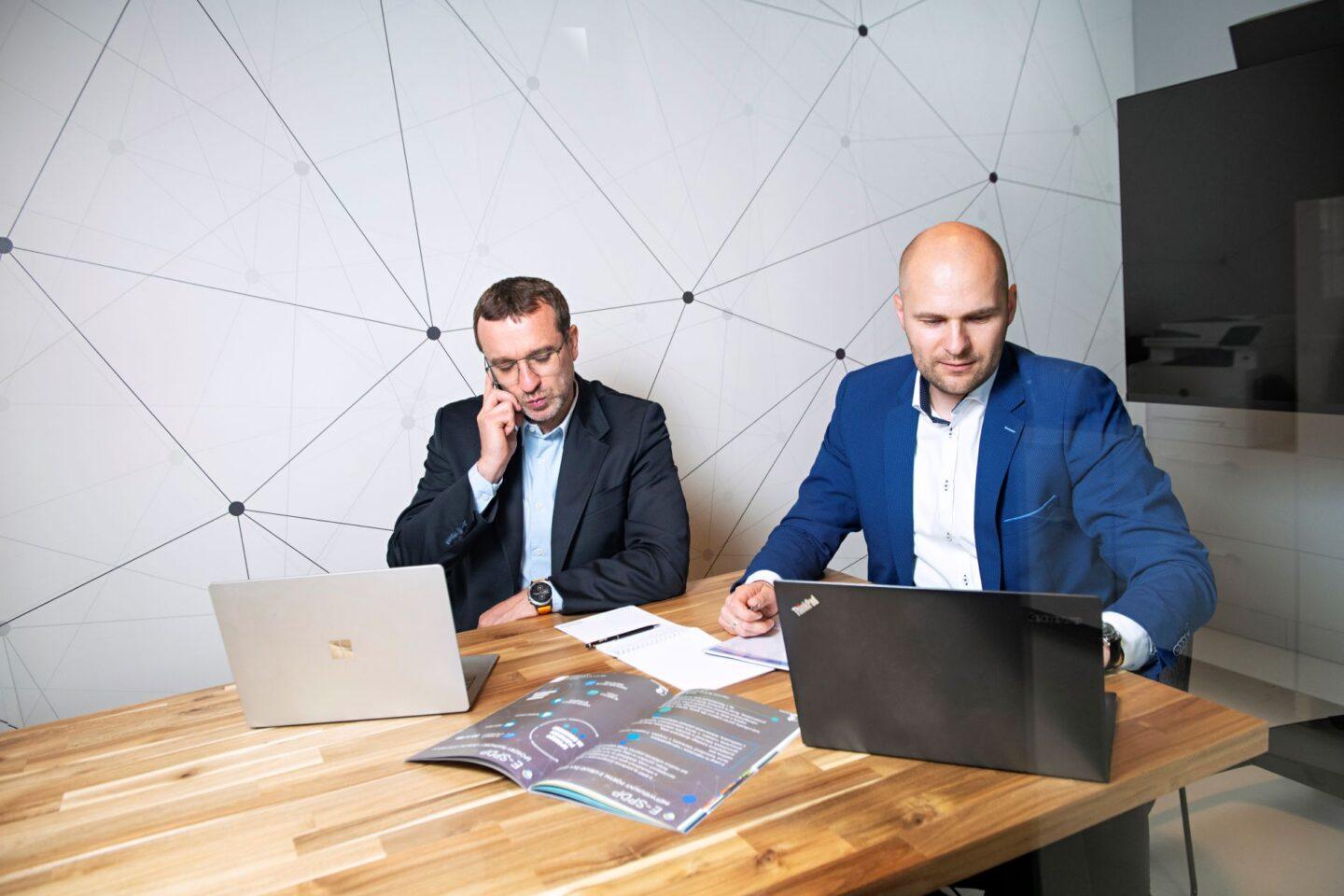
This is the approach adopted by the founders of GIAP, a Polish technology company developing software for public administration and local governments. The company specializes in geographic information systems (GIS), process digitalization and solutions supporting data management. GIAP executives Tomasz Maćkowiak and Sławomir Hemerling-Kowalczyk have spent years building technology businesses. They became more widely known, among other things, after selling their company Nefeni to the Symfonia Group.
Today, alongside developing their own products and IT group, they are also involved in supporting young technology companies. They are not building a broad investment portfolio. Instead, they select individual startups and actively engage in their development. They focus on early-stage companies creating specialized technologies with the potential to expand into international markets.
One such project is Remotly – a company developing software for remote access, IT support and endpoint device infrastructure management.
Selective investments, active support
The founders of GIAP do not follow a formal investment strategy. Rather than building a broad portfolio of startups, they select individual projects in which they become involved over the long term. Their approach is based more on responding to valuable investment opportunities than on actively seeking out startups.
“We tend to invest in individual startups. We are interested in solutions with global potential – often highly specialized and technologically difficult to replicate,” says Tomasz Maćkowiak.
The essence of their involvement is not just providing capital, but also actively supporting product development.
“We do not view these investments purely from a financial perspective. We support product development, take part in testing, and help establish relationships with customers and partners,” our interviewee says.
GoTacho and other projects
Tomasz Maćkowiak has also invested in GoTacho, a company developing a system for monitoring the work of truck and van drivers. The solution covers, among other things, the recording and settlement of working hours, as well as the creation of electronic driver cards.
The system integrates with tachographs – devices installed in trucks, buses and vans that automatically record driving and rest periods, speed and route data. This information is used to monitor compliance with regulations governing drivers’ working hours and to support road transport safety.
Tomasz Maćkowiak is also a shareholder in several other technology ventures. However, given their early stage of development, he is not disclosing details about them for now.
It is worth recalling that GIAP has also acquired Designers, a company specializing in digital road management systems. The acquisition further strengthens its offering for the public sector.
They prioritize involvement over scale
The strategy adopted by the entrepreneurs does not involve building a broad investment portfolio. As the founders of GIAP emphasize, the limited number of investments stems from their chosen operating model, which is based on actively supporting the growth of individual companies.
Available capital and a deliberately accepted level of risk also play an important role. “We neither have the ambition nor the capacity to invest like venture capital funds, which reduce risk through a large number of investments. We prefer to share our own experience and resources – including those we have built at GIAP – to support the growth of individual companies wherever we can,” says Tomasz Maćkowiak.
Investor's perspective
Not just venture capital: how technology startups finance themselves
At the earliest stage, founders’ own funds are usually the most important source of financing. Some startups also fund product development through service-based activities – revenue generated by the business allows them to maintain the team and continue working on the technology. Grants are another major source of capital. Despite the many misconceptions surrounding them, in practice they often enable startups to move from the concept and research phase to building and testing a prototype. This allows a project to reach a level of technological readiness at which venture capital funds can assess its potential and make an investment decision.
In some cases, business angels enter the picture earlier. However, in Poland they more often join investment rounds organized by VC funds rather than investing independently at the very earliest stages of a company’s development.
The situation is somewhat different for software startups, which typically require less investment in research and development. Such companies can acquire their first customers faster, and revenue from operations can partially finance further product development.
Financing from industry partners is a separate category. Cooperation with such a partner can accelerate a company’s growth by providing not only capital, but also access to expertise, infrastructure and customers. However, excessive involvement from a strategic partner can become a challenge when raising future funding. From the perspective of venture capital investors, it is important that founders retain control of the company and remain strongly motivated to build its value, while the presence of a strategic investor does not limit opportunities to cooperate with other companies in the same industry.


Experience helps scale the product
The entrepreneurs emphasize that their involvement in Remotly goes beyond providing financing. They also support the company’s business and product development.
“We view our involvement in Remotly primarily through the lens of product development rather than the investment itself. We regularly attend industry trade shows, speak with customers and explore new use cases for the software. This allows us to develop the product in line with market needs. The results of these efforts can be seen in the growing interest from global companies such as Disney, Intel and Saudi Arabia’s APcom,” says Sławomir Hemerling-Kowalczyk.
It was precisely their market knowledge and experience using similar solutions that led the entrepreneurs to recognize Remotly’s potential beyond its role as an IT remote support tool.
“When we became involved in Remotly, the company already had a strong technological foundation. We saw, however, an opportunity to use this technology on a much broader scale. In our own companies, we had previously used competing remote support tools, so we understood users’ needs very well. Today, those companies are already using Remotly’s solution. Importantly, the platform goes far beyond remote support – it can be applied in many other areas. We also saw strong interest in these capabilities at the recent trade show in Las Vegas, where particular attention was paid to the quality of remote access and data processing,” adds Sławomir Hemerling-Kowalczyk.
Good to know
Startups have more than one path to capital
The investment model pursued by the founders of GIAP reflects a broader trend of experienced entrepreneurs becoming involved in the growth of young technology companies. Alongside venture capital funds, business angels are playing an increasingly important role by investing not only capital, but also their own knowledge, networks and operational experience. For early-stage startups in particular, this kind of support can be crucial to scaling a business.
“Business angels are an important part of Poland’s startup ecosystem. According to Startup Poland, 28% of Polish founders use financing from business angels, compared with 23% who rely on venture capital funds,” says Borys Musielak, founder of Smok Ventures and the SMOK Angels business angel network.
Based on his year of experience managing the SMOK Angels network, Musielak says investment amounts from business angels are typically smaller than those provided by funds. They usually range between PLN 100,000 and PLN 200,000 (approximately EUR 23,000–46,000).
“Business angels can make investment decisions with less pressure regarding market size and a startup’s growth potential than venture capital funds. They often invest in companies that have the potential to become national leaders rather than necessarily compete on international markets,” says Borys Musielak.
He notes that members of the SMOK Angels network invested around PLN 8m (approximately EUR 1.8m) in 22 startups from Poland, Ukraine and Romania over the past year.
“I estimate that this represents only around 10% of the local business angel investment market,” says Borys Musielak.
However, financing for technology startups is not limited solely to venture capital funds and business angels. Young companies can also draw on other sources of capital, including grants and public programs, accelerators, customer financing through prepayments or pilot implementations, as well as equity crowdfunding and debt financing.
The choice of funding source depends, among other factors, on the startup’s stage of development, the nature of the project and the capital requirements associated with scaling the business.
A model set to reshape the remote support market
Today, Remotly’s biggest challenge is commercializing its solution and continuing product development. The company is working on new features while refining a business model that, according to its founders, could set it apart from global competitors.
“Many solutions available on the market operate on a shared licensing model. Customers often buy fewer licenses than they actually need because they only use them at specific times. We want to change that. Our goal is to introduce a pricing model based on the actual time spent using the application. For companies whose demand for remote support is seasonal or fluctuates over time, this could be a far more efficient solution,” says Sławomir Hemerling-Kowalczyk.
The product is already ready for deployment in Windows environments, and the team is gradually expanding support for additional platforms. As the entrepreneur explains, the pace of development reflects the complexity of the technology, which uses, among other things, hardware acceleration from processors and graphics cards and requires continuous adaptation to changes introduced by hardware manufacturers.
“We could develop the product much faster by building a large team, but we have consciously chosen a different path. We are focusing on a small, specialized team and the highest possible quality of the solution. This means development does not always progress as quickly as we would like, but it allows us to deliver a stable product. We already offer features that some of our competitors do not have, which is why we are not waiting to enter the market until we achieve full cross-platform compatibility,” concludes Tomasz Maćkowiak.


Key Takeaways
- The founders of GIAP have adopted an investment model built around selectivity and active involvement. Rather than creating a broad startup portfolio, they focus on individual technology projects where they can apply their own experience, knowledge and resources. Their role goes beyond providing capital – they aim to support companies in product development and market engagement as well.
- Remotly is an example of an investment where investors’ operational experience helps validate and further develop a product. The founders of GIAP saw the technology’s potential not only in remote IT support, but also in a wider range of applications. Their own experience using similar solutions enables them to help the company better align its product with customer needs.
- Remotly’s biggest challenge remains further commercialization and scaling of the solution. The company is developing the product, adding new features and refining a pricing model based on actual application usage time. At the same time, it is prioritizing technology quality and stability, pursuing a controlled development path with a smaller, specialized team.