

This article is a part of Poland Unpacked. Weekly intelligence for decision-makers
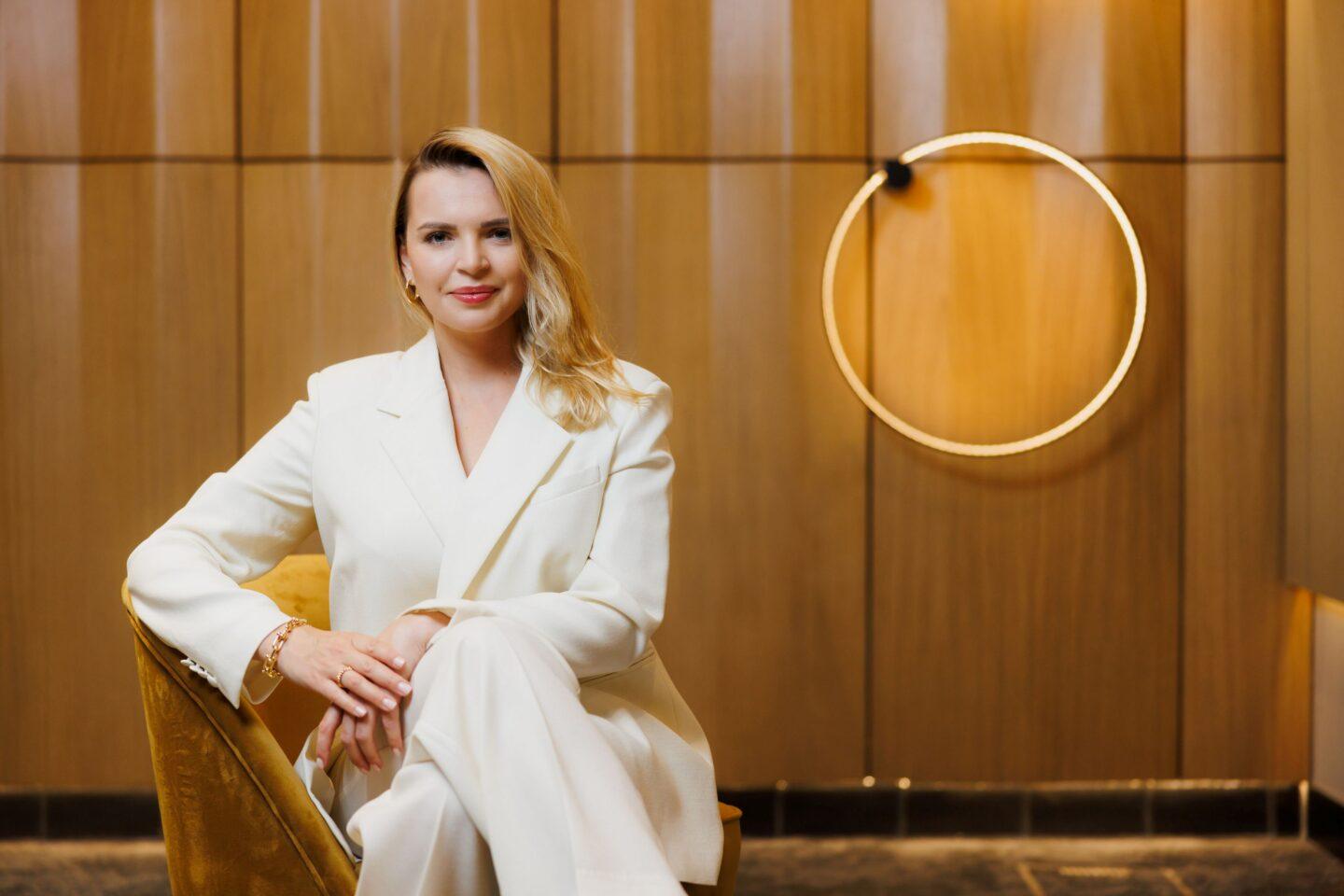
Demand for medical gloves propelled Mercator Medical into the ranks of Poland’s most valuable companies, sending its share price soaring from PLN 10 (around EUR 2.30) to more than PLN 700 (around EUR 160). Then came a brutal correction, and the company is now using its windfall pandemic profits to build a property development business. Monika Żyznowska talks about succession, a family-owned company, and the journey from ancient texts to real estate.
How long does it take for the share price of a listed company to rise from around PLN 10 (approximately EUR 2.30) to PLN 770 (approximately EUR 175)? Mercator Medical needed just 10 months to achieve that. It was not, however, the result of the company’s own actions, but rather of extraordinary demand for medical protective gloves in 2020.
The group’s history dates back to 1989, when Piotr and Wiesław Żyznowscy founded a trading company. Mercator entered the medical products market seven years later. In 2004, it began its international expansion, and two years later acquired a stake in a Thai manufacturer of medical gloves. Today, it is the largest Polish investor in Thailand.
In 2013, the company made its debut on the Warsaw Stock Exchange (GPW). In the following years, it generated net profits of several to several dozen million złoty, while its market valuation remained below PLN 100 million (approximately EUR 23 million). In 2020, profits “exploded” to more than PLN 900 million (approximately EUR 207 million). The company’s market capitalization surged above PLN 7 billion (approximately EUR 1.6 billion). The wealth of Wiesław Żyznowski, its majority shareholder, briefly surpassed the symbolic threshold of USD 1 billion at the time.
In 2022, market conditions changed dramatically once again, reshaping both the performance and valuations of companies in the sector. During this turbulent period, Monika Żyznowska was already involved in managing the family business. She has worked at the company since 2010 – throughout her entire professional career. She joined the management board in 2017, became vice president seven years later, and was appointed CEO in May 2024.
 Interactive chart
 “It was pure madness”
Mariusz Bartodziej, XYZ: How does Mercator, valued at more than PLN 7 billion (approximately EUR 1.6 billion) in 2020, differ from today’s company, with a stock market capitalization of around PLN 500 million (approximately EUR 115 million)?
Monika Żyznowska, CEO of Mercator Medical: In virtually every respect. Our core business remains the sale of mainstream medical gloves, but we have significantly expanded both their production and sales. Despite this, their share of revenue in our distribution segment has fallen from more than 90% several years ago to around 50% today. The remaining revenue in the distribution segment comes from premium gloves, including, for example, GoGrip gloves and nonwoven products.
In addition, as part of our strategy to diversify the group’s activities, we built an entirely new business area from scratch: Mercator Estates. Revenue from the real estate segment will only become visible after several years. However, it already accounts for around one-quarter of our business in terms of total assets.
When the company’s share price increased several dozen times within a few months, you were already a member of the management board. What emotions did you experience at the time?
It was pure madness. The valuation we achieved exceeded our wildest expectations. For a short period, my father ranked among the world’s 2,000 richest people according to Forbes. Everyone loved us and wrote about us. It was a very interesting year. Then came the correction, which we had expected. What surprised us, however, was its scale.
Is the company undervalued?
I do not want to judge the current share price, because it is determined by the market, not by the company’s owners or executives. Nevertheless, considering even our balance sheet total, the share price appears relatively low [the company’s assets exceed PLN 1 billion (approximately EUR 230 million), while shareholders’ equity amounts to PLN 900 million (approximately EUR 207 million) – editor’s note]. Regardless of the circumstances, we are focused on executing our plans, and we are convinced that shareholders will recognize the effectiveness of our strategy. This, in turn, will be reflected in the share price.
How do you manage market expectations in such a situation?
It is very difficult. There is no single formula, but the key is to provide market benchmarks. During the COVID-19 pandemic and afterwards, when our share price was changing sharply over short periods, we showed shareholders examples of other companies in the sector that were rising and falling alongside us. These changes were not the result of our decisions. The market lifted us to the top, and the market corrected our position.
We could never guarantee that a particular share price – measured in hundreds of złoty – would remain at that level for a long time. I believe Mercator’s share price history during the COVID-19 pandemic will one day be analyzed as an interesting case study.
I do not want to judge the current share price, because it is determined by the market, not by the company’s owners or executives. Nevertheless, considering even our balance sheet total, the share price appears relatively low.
A loss of several hundred million after a billion-złoty profit
How do you manage a business that generated nearly PLN 3.6 billion (approximately EUR 828 million) in revenue, more than PLN 1.5 billion (approximately EUR 345 million) in EBITDA, and almost PLN 1.4 billion (approximately EUR 322 million) in net profit over two years – only to record a PLN 200 million (approximately EUR 46 million) loss the following year and “just” PLN 500 million (approximately EUR 115 million) in sales?
In 2020, everyone at the company was operating at an increased pace. It was a period that required extraordinary mobilization and a speed of work we had never experienced before. We were forced to make decisions under immense pressure.
There was no time for detailed analysis, such as deciding where best to send a container of scarce goods. There were cases when shipments were suddenly blocked at the border and we had to resolve the problem immediately. Every day brought a smaller or larger crisis.
Fortunately, that period had a very positive impact on the company’s revenue and profitability. The following years were no longer as favorable.
How did you personally get through that period?
The years 2021–2023 were personally difficult for me and came at a significant cost. Due to the sudden decline in margins and revenue, we had to cut half of the workforce in our European distribution business in order to reduce costs. It was a difficult decision, and we are still feeling its consequences today. We also significantly reduced employment in the production segment, although the cuts were not as severe.
Today, we are better prepared for potential market crises. Basic, mainstream medical gloves remain the most vulnerable to fluctuations in raw material prices. Premium gloves, whose share of our product portfolio is steadily increasing, have a more stable market position and deliver higher margins.
How strong was the pressure from employees and shareholders to distribute the extraordinary profits? Especially since they could have argued: “You made your money because of COVID.”
From the profit generated in 2020, we allocated a record PLN 312 million (approximately EUR 72 million) to shareholders through a share buyback program. The following year, we paid another substantial dividend of PLN 23.9 million (approximately EUR 5.5 million) and carried out further multi-million-złoty share buybacks. However, the loss of around PLN 200 million (approximately EUR 46 million) recorded the following year led us to suspend dividend payments – a policy we are returning to this year.
We could not predict how long the difficult market conditions would last. If we had repeated such a result for several years in a row, we would have depleted all of our accumulated capital. I understand that investors always expect the highest possible dividend. As a management team, however, we must ensure that the company can also deliver strong dividends five or ten years from now. That requires investing in business diversification.
A family business instead of ancient texts
You had plenty of time to get to know the family business and prepare for extraordinary situations. You joined the team 16 years ago – starting out by making coffee. Do you still do that today?
Rarely. When I am in the office, I usually do not even have time to leave my office between meetings, let alone make coffee. I do make it at home on weekends, though.
If you had not taken over the family business, what would you have liked to do instead? You studied Indology and management.
I am turning 40 this year, which is a good time for reflecting on life choices. If I were choosing my studies today, I would probably pick architecture or construction. I feel very much at home in our real estate business.
So what ultimately led you to follow in your father’s footsteps?
I studied Sanskrit studies because I wanted to explore ancient texts. I planned to pursue an academic career, but the pace and dynamics of humanities studies did not suit my personality. That is why I also enrolled in business studies at the same time.
After completing my first full-time degree, I wanted to start earning money and gain an inside understanding of business. I joined Mercator as an assistant in the international sales department. From the very beginning, I was able to observe how the business operated rather than taking a part-time job, for example, in the hospitality industry. I am grateful for that opportunity because I believe every year should be used as effectively as possible. And every year I spent at Mercator was different.
I worked my way through all levels and various departments within the company. Initially, I was thinking about a career in finance, but I was also drawn to operational management. After several years, I first joined the management board and later became vice president. My father and I had been discussing for several years when I would take over as CEO. We planned the succession to coincide exactly with his 60th birthday, making it a symbolic date for both of us.
Did your father welcome you into the company with open arms?
He had always encouraged me to pursue humanities studies. Business was my own idea. I think he welcomed my decision because he liked the fact that I was drawn to business.
The concerns of a CEO’s and owner’s daughter
What were you worried about? That, as the daughter of the CEO and majority owner, you would be judged based on your background rather than your abilities?
Definitely. After so many years, I no longer remember all of my concerns, but the need to prove my own worth was very important to me. My father always told me that I had to work twice as hard and twice as long as others. That was the only way I could demonstrate that I was in the company because of my work ethic as well, and not just because of family ties.
Sometimes the next generation builds a career elsewhere and then joins the family business directly at board level. You, however, climbed many rungs of the ladder, starting from the lowest positions – similarly, for example, to Marcin Piechocki at LPP. What does that teach you? Humility?
Definitely. I never pretended that I knew more or understood the business better than others. I wanted to learn, not to put myself above anyone else. Even today, I have no problem admitting when I lack knowledge about a particular topic. That is hardly surprising given that we operate across several industries. Being an entrepreneur also requires openness to drawing on the experience of people who specialize in specific fields. You have to know how to listen.
What have you recently learned about?
How online positioning mechanisms work.
What years of succession preparation mean
What does a long-term succession preparation process involve? What should one pay attention to before taking on such an important role in a company?
Above all, you have to make sure that nothing is swept under the rug. What would be the point, if one day we ourselves become the owners of that mess? In addition, the goal is to fully understand not only the company’s operations but, most importantly, its people – their needs, concerns, and motivations.
What limitations do you see in building a career within a single company?
Certainly the obvious ones: a lack of diversity of experience. That is why it was so important for me to get to know the company’s individual departments. Today, however, I am learning new approaches from managers who join us from other organizations. I let them do the jobs they were hired to do and only flag issues when I see what we call “red flags.”
I have to admit that, although I have spent my entire professional career at Mercator, after several years I did consider taking a job at another company.
But?
My father had no problem with that. He did, however, point out that I would not learn as much at another company as I could at Mercator. And he was right. Here, I had access to the company’s full body of knowledge. I could go directly to the people responsible for specific departments and processes and learn from them. With another employer, my access would have been limited to a much narrower group of people.
At Mercator, I was able to take an accelerated course in professional maturity. I spent many years working alongside my father, including in the management board office. He instilled in me an owner’s mindset, which differs from a managerial perspective. It requires a different, broader outlook and a greater sense of responsibility.
And how do you differ from your father?
I choose different management methods. As a representative of a younger generation, I am more drawn to modern trends. In addition, I believe that, as a woman – and I hope this does not sound like a cliché – I tend to have a better understanding of employees’ emotions and motivations.
Has there ever been a situation when you pointed something out to your father and surprised him?
Yes. There was also a case when I dismissed someone who had been employed by him many years before I took that decision.
Keeping employees simply because they have been with the company for years is probably one of the key challenges facing family businesses.
Yes, unfortunately, that does happen. But management practices evolve as attitudes toward employees change. Until a dozen or so years ago, we did not have a soft HR function in the company. We simply had an administrative personnel department.
Today, people management at our company is much more professionalized. HR is the only department – alongside the CEOs of individual companies within the group – that reports directly to me. I personally oversee this area because people are what make this business work. They are the most important factor.
Poland’s largest investor in Thailand
You certainly have to manage employees differently in Thailand than in Poland. The country is a popular destination among Polish tourists, but not necessarily among entrepreneurs. How do you build a serious business there?
Thailand is highly supportive of foreign investors. Among other incentives, it offers an eight-year corporate income tax exemption and tax relief on machinery imported for investment purposes. However, there are also challenges: the currency is highly volatile compared with, for example, the Malaysian currency, which is more favorable for exporters, as well as cultural and language differences.
The latter initially led to many misunderstandings and wasted time. We solved this problem by creating a management team made up of Poles familiar with local realities, brought in from Poland and Vietnam.
You have already invested hundreds of millions of złoty in Thailand in three factories and a heat production facility. What does it mean to be the largest Polish investor in Thailand?
We are very pleased about it. My father even became the first Honorary Consul of the Kingdom of Thailand in Poland – a great distinction. Our local company achieves higher profitability than its competitors, so we have no plans to move production elsewhere.
For now, however, we are not planning any significant increase in investment in the country. Thai operations account for around PLN 600 million (approximately EUR 138 million) of our total assets. That is more than our current stock market capitalization.
Did you receive support from Polish institutions while expanding in the country?
The Thai side proved helpful, but unfortunately the Polish side has not yet done so. We hope that this will change one day.
Real estate strengthens the group’s stability
When it comes to real estate, however, you limit your activities to Poland. Why? Is it because every Pole would like to make money from housing and gastronomy, but the former is ultimately a more predictable business?
When we generated an extraordinary profit in 2020, we decided to invest in diversifying our business.
How many options were on the table?
First, we looked for complementary businesses, but their owners expected absurdly high valuations. They based their pricing on the “COVID-era” results at the time. Those terms were unacceptable to us.
We began looking into acquisitions in other industries. However, we did not find anything else that we would feel sufficiently comfortable investing in.
What about real estate?
My family has been investing in it for years. We had the opportunity to understand this business inside out and became convinced that it was a safe one. To lose money in real estate, you have to make a serious mistake. It can happen that the profit is lower than expected. But losing money to the extent that one złoty invested in a development project returns only 50 groszy? That has never happened to us.
This approach also allowed us to diversify the business while bringing our private know-how into the company. Today, our group stands on three pillars, and we feel significantly more stable.
After selling eObuwie, Marcin Grzymkowski founded Sagaris. Ochnik Development has also been active in the market for years. What attracted the Żyznowski family to real estate?
My father had been buying land around Kraków for years. Initially, he was not doing so with property development in mind, but eventually he invested in a residential project.
How to build a residential property business in Poland
Does this require a different approach to business?
The investment cycle is completely different from that in manufacturing, and even more so from distribution. Property development requires a great deal of patience. For at least a year, you see only costs and no revenue. EBITDA – the “mother” of all businesses – remains negative for a long time. You have to understand that this is simply how the early stages of this industry work.
And how can a company stand out in this market?
We do not compete on volume, but on quality – that is the foundation of Mercator Estates’ strategy. For now, we want to remain a medium-sized developer, with a limited number of projects executed to a high standard. This is a conscious choice. With such an approach, it is easier to maintain consistency and quality of delivery.
What does that mean in the Polish market?
It means we will develop no more than around a dozen projects simultaneously. We are slowly approaching 10. If we want to remain roughly in the middle of the market, we cannot offer mass-market housing based on low margins. We are focusing on carefully selected projects and diversification: residential estates, the revitalization of historic tenement buildings, and rental apartments.
In every case, we want to create places where we ourselves would like to live. We do not maximize usable residential floor area (PUM) [Polish abbreviation for the usable floor area of apartments — editor’s note] in order to build enormous blocks resembling factories. We attach great importance to finishing quality, shared spaces, greenery, and good locations. People today pay attention to these factors and are more willing to buy apartments that meet such criteria. We want to deliver premium and mid-market projects.
Meaning?
At this stage, we are not planning projects on the scale of Złota 44 in Warsaw. Our flagship premium investment is currently the “Lubicz 1” project in Kraków: the revitalization of historic tenement buildings opposite the main railway station. It is a beautiful but demanding project. The buildings we are restoring are, in a sense, a gateway opening onto the entire city. For now, they are very neglected, but we want them to soon become one of Kraków’s landmarks.
Not only the revitalization of historic tenement buildings
How extensively do you want to become involved in the revitalization of historic buildings?
I am a Kraków native and I love the city’s historic tenement buildings. If I could, I would focus exclusively on restoring them. Many buildings are still neglected, yet they offer the potential to create beautiful interiors by combining historic elements with modern design.
However, I must emphasize that we invested in the real estate sector in order to diversify our business. Limiting ourselves solely to the revitalization of historic properties would be too risky.
Because it requires taking into account not only economic factors but also consultations with heritage conservation authorities and sometimes even the local community?
These are significantly more complex and risky investments than buying an empty plot of land and developing it. In the case of the “Lubicz 1” project, the heritage conservator approached our proposal in a very pragmatic way.
However, it is important to remember that this involves working with existing historic structures. You can never fully predict what you will discover inside old walls and foundations. Although we conducted very thorough analyses, we still have to include a certain contingency buffer in the budget.
What about entertainment projects? Since 2026, you have been a member of the management board of Termy Lusina. This is another multi-million-złoty investment.
This is actually a private investment by my family and Tomasz Kaleta, the owner of the Malinowe Hotele chain. Termy Lusina will primarily be a holistic and health-oriented project. It represents an entirely new category of facility on the market — a medical SPA thermal complex.
We are creating it with the needs of people requiring specific treatments and rehabilitation support in mind. At the same time, we are designing separate wellness zones for adults and for families with children. In practice, we will therefore provide an offer tailored to the needs of different age groups.
PLN 200 million investment is only the beginning
How ambitious are your plans for Mercator’s real estate business?
The five projects currently underway involve the creation of around 50,000 sq m of residential space. But this is only the beginning. We have already invested around PLN 200 million (approximately EUR 46 million) in real estate, and we plan to invest more.
For now, we are talking exclusively about our own capital. Only when the projects enter a more advanced phase will we be able to secure bank financing. At that point, the scale of our investments will increase significantly.
To what extent is Mercator’s presence on the Warsaw Stock Exchange helping the development of this business, for example by improving access to financing?
The stock market certainly helps with raising capital. And this is not only about issuing shares or bonds, but also about easier access to bank financing. A public company is significantly more transparent for banks. This shortens the time needed to establish the details and finalize financing arrangements.
Qemetica, and more recently Grenevia, with Polenergia potentially next – Polish entrepreneurs have recently been willing to take large companies private by delisting them from the Warsaw Stock Exchange.
We do not say “never” when it comes to a potential delisting. However, we are not currently discussing such a scenario.
Is Mercator set to remain a family business for many years to come? Your younger brother recently joined the company.
We take a long-term view of this business. Even my children, who are 10 and 12 years old, are interested in the company. The succession path is therefore well established in our family. Tomek started working at Mercator last year. He needs several years to fully integrate into the business.
So has he already made his first coffees?
So far, he has handled simple tasks in the procurement department. In July, he moved to the sales department and will be involved in AI-related projects. When I started, marketing materials were sent by post. I still remember addressing envelopes and putting on stamps every single day. Times have changed, so Tomek no longer has to do that. He has responsibilities suited to today’s needs and the time to learn the company from the inside.


Key Takeaways
- Extraordinary profits and real estate diversification. During the COVID-19 pandemic, global demand for medical products – including protective gloves – surged. As a result, Mercator Medical’s revenue increased several times over, while its profit grew by several dozen times. The bulk of the extraordinary profit, exceeding PLN 1 billion (approximately €EUR 230 million), was returned to shareholders of the Warsaw-listed company. The remainder is being invested, among other areas, in real estate as part of the group’s business diversification strategy.
- The ambitions of a mid-sized developer. PLN 200 million (approximately EUR 46 million) already invested and five ongoing projects involving around 50,000 sq m of residential space mark only the beginning for Mercator Estates. The company aims to become a mid-sized developer, meaning it plans to carry out around a dozen projects simultaneously. It focuses on residential estates, the revitalization of historic tenement buildings, and rental apartments. It operates in the premium and mid-market segments.
- Succession in a family business. Monika Żyznowska studied Sanskrit studies because she wanted to explore ancient texts. She ultimately abandoned plans for an academic career to become involved in the family business. She started as an assistant in the international sales department and spent more than a decade working across various departments before becoming CEO. “My father always told me that I had to work twice as hard and twice as long as others. That was the only way I could prove that I was in the company because of my work ethic as well, and not just because of family ties,” the entrepreneur emphasizes.