

This article is a part of Poland Unpacked. Weekly intelligence for decision-makers
If Alimentation Couche-Tard acquires Żabka for around PLN 32 billion (EUR 7.5 billion), the Polish retailer will follow the path of Biedronka. It will become another grocery chain built from the ground up in Poland before being acquired by a foreign strategic investor.
Poland’s grocery market is dominated by international players, led by Germany’s Schwarz Group, the owner of Lidl and Kaufland. The main domestic challenger remains Dino, controlled by Tomasz Biernacki. Specjał Group has also continued to strengthen its position and reached a historic milestone this year.
For years, Eurocash operated the country’s largest network of company-owned stores and outlets under so-called soft franchise agreements, which involve less stringent obligations than the model used by chains such as Żabka. At its peak in 2021, the group had more than 17,000 stores, comfortably ahead of its rivals, including Specjał, which at the time operated around 11,000 outlets. Over the following five years, however, Eurocash’s network steadily contracted while Specjał’s continued to expand, allowing it to overtake its rival by around 100 stores, reaching 14,300 outlets at the end of May.
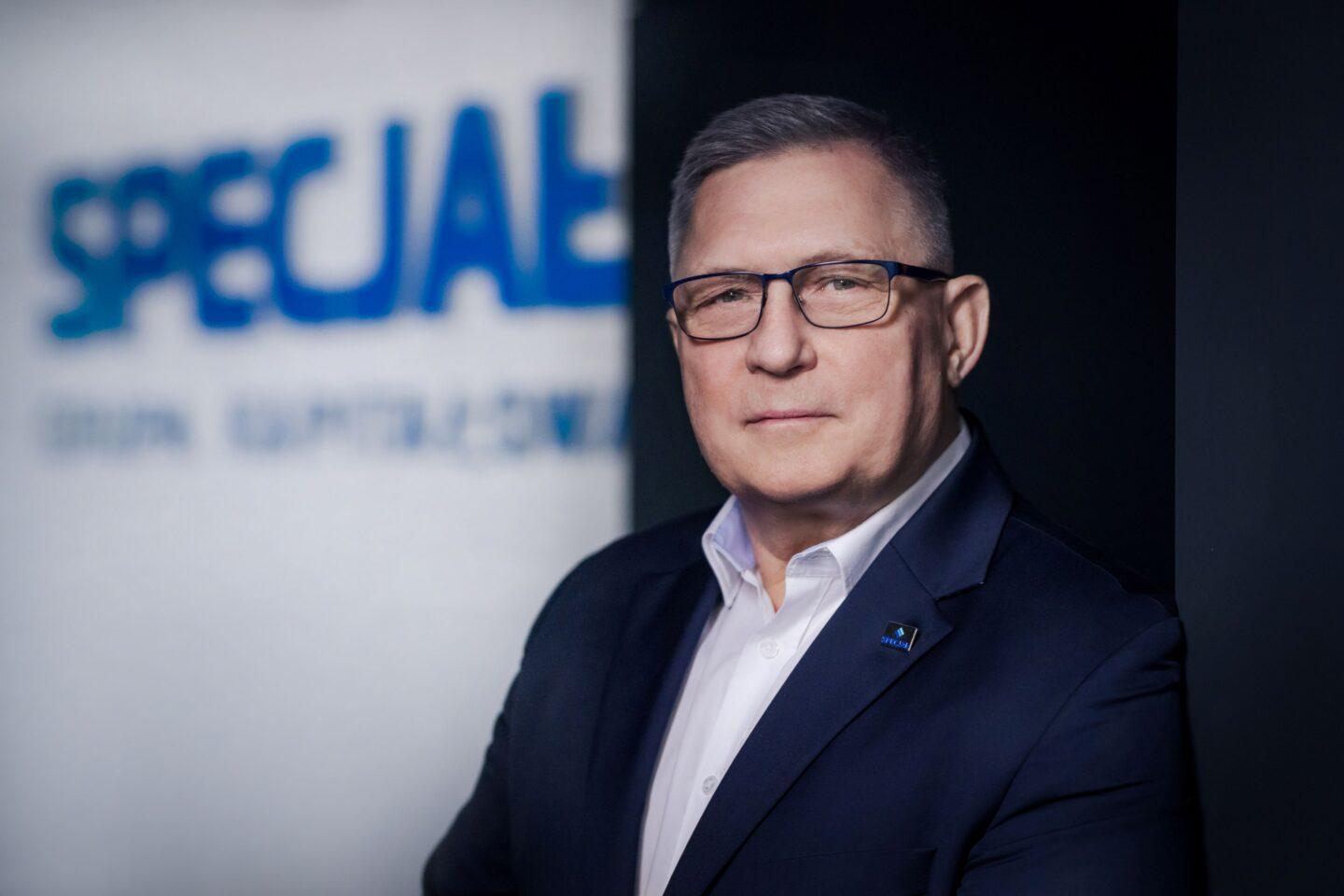
Krzysztof Tokarz is the driving force behind Specjał. The entrepreneur started out in 1990 with a single grocery store before moving into wholesale distribution three years later. After decades of steady growth and market consolidation, he has become one of Poland’s handful of key players in the sector.
In 2000, Tokarz came full circle by launching the Nasz Sklep franchise network. In the years that followed, he expanded the group to include Livio, Rabat Detal, and Spar, under which it also operates company-owned stores, including some trading under other banners. Alongside its retail business, the group is active in the medical supplies sector, through wholesale and retail operations, and in security services. Between 2019 and 2024, the group roughly doubled both its revenue and EBITDA, reaching PLN 3.6 billion (EUR 840 million) and PLN 96 million (EUR 22 million), respectively.
 Interactive chart
 Facts matter more than emotion
Mariusz Bartodziej, XYZ: “A private fan of extreme sports”—that is how you describe yourself on the company’s website. What draws you to them? The thrill, the emotional reward that comes with taking risks?
Krzysztof Tokarz, CEO and founder of Specjał Group: To be honest, bungee jumping is what I would consider extreme. I do not experience particularly strong emotions when windsurfing, skiing, riding a motorcycle or driving a quad bike. Safety is my priority. For me, these activities are about building physical fitness, not indulging a taste for risk. I do not do them for the adrenaline, but to take a break from the stresses of everyday life.
Do you tend to avoid risk in business as well?
As an entrepreneur, I can “feel” whether a particular business is attractive or not. But that is only the starting point. I never make decisions based on emotion. I take a highly analytical approach to every investment, whether it involves renovating a store or acquiring an entire chain such as Spar. I always weigh the arguments for and against. The only difference is the size of the team working on the project. I place considerable weight on the views of my in-house advisers.
To what extent?
Very often, I personally feel strongly that we should pursue a particular investment. But then a trusted group of employees presents a firm “no,” backed by a long list of arguments. In those situations, their judgment prevails. Sometimes we agree immediately, and sometimes we have vigorous debates—and that is exactly how it should be. At our company, people are encouraged, indeed expected, to challenge the CEO if they can support their position with sound arguments. I see that as a major strength.
Ultimately, the responsibility always rests with me. At the same time, I understand that if I were to push through a decision against the wishes of the people responsible for a project, they would not be fully committed to delivering it. Most likely, it would end in failure, because even the best idea requires a motivated team.
Żabka under new ownership would reshape the market
Returning to the subject of risk, how significant is Alimentation Couche-Tard’s planned acquisition of Żabka for your business? It appears that a Canadian giant—not Japan’s Seven & i Holdings, the owner of 7-Eleven—will become the new player in Poland.
We already feel Żabka’s presence in many locations, both through our company-owned stores and our franchise network. It is a major player that continues to strengthen its position in the convenience segment. If Alimentation Couche-Tard completes the acquisition, one of the world’s largest retail operators will enter the Polish market, bringing vast experience, substantial financial resources, and proven operating expertise.
That said, we are not standing still. We continuously monitor market developments and assess a range of possible scenarios. Such a transaction could certainly reshape competition in Poland’s grocery sector, but it also underlines just how attractive and promising this market is. For us, it is a signal to further strengthen the advantages that come from being close to customers, remaining operationally agile, and understanding local needs.
It is also worth remembering that any strengthening of Żabka under a global operator would affect more than just food retail. Foodservice and ready-to-eat meals are becoming increasingly important. As a result, restaurant chains such as McDonald's and other quick-service concepts will also have to contend with a stronger competitor.
Specjał overtakes Eurocash
Regardless of what competitors do, this year has given you a major reason to celebrate. Just a few years ago, Eurocash had several thousand more affiliated stores than any other player. For the past few months, however, Specjał has held the title of Poland’s largest retail network by number of affiliated outlets. Even if that was never an objective in itself, it must still be deeply satisfying.
We were completely unaware that this had happened. I learned about it from the media. I have enormous respect for our competitor. We have been steadily climbing the ranks, both in terms of the number of stores and their quality. Today, our focus is increasingly on quality, and the expertise we gained through the Spar acquisition has been instrumental in that effort. Overtaking Eurocash is certainly satisfying, but even more than that, I feel the responsibility that comes with this position.
Interactive chart How much of this achievement reflects your own sound decisions, and how much stems from missteps by a competitor that has struggled in recent years?
It is a combination of both. On the one hand, we have pursued a clearly defined strategy for well over a decade. Traditional grocery wholesaling is a declining business. The only uncertainty is how long that decline will take. The future lies in wholesale operations built around affiliated franchise networks and company-owned stores, and that is where we have concentrated our efforts. We have not allowed ourselves to be distracted by unrelated projects.
On the other hand, we are quite comfortable being the number-two player. We prefer to follow the market leader—which Eurocash still is in terms of revenue—with the aim of making far fewer mistakes. That approach has worked because Eurocash was often the first to introduce new initiatives, while we observed the results. We either adopted solutions that had proven successful or chose not to pursue them.
A Pole returns to the top of Polish retail
Does it make the achievement even more satisfying that you have restored the leadership position to a company that is entirely Polish-owned? You—or, more precisely, your family foundation—are the sole owner of the business. Although Eurocash is listed on the Warsaw Stock Exchange, it has just one significant, controlling shareholder: Luis Amaral, a Portuguese entrepreneur.
Absolutely. Like most Polish entrepreneurs, I started from scratch. After 36 years in business, it is clear that we have chosen the right path. But none of this would have been possible without the outstanding people working at every level of the organization. I can say with complete conviction that the commitment of our employees is among the strongest in Poland.
What kind of people do you look for?
People who are ambitious, hardworking, and disciplined. People who are willing to embrace our organizational culture rather than try to dismantle it. My principles are straightforward. I am not looking for stars who want to be the center of attention. We have exceptional specialists, but every one of them is prepared to stand shoulder to shoulder with the rest of the team. Few things are more damaging to a company than a management team pulling it in different directions.
We are a highly structured organization. Over the decades, we have developed hundreds of rules and procedures, and we expect them to be followed. As a result, we are not the right place for people who want complete autonomy from day one or insist on doing things their own way. We are open to developing new ways of working, but that takes time, and any new rules must be aligned with the strategic direction we have set.
From a small store in southeastern Poland
Your journey to the top began in 1990 with a grocery store in your family home in Rzeszów. At the current stage of maturity of the Polish market, would it still be possible to build a large business group that way?
Perhaps not a brick-and-mortar retail chain, but certainly an online store. That does not require vast amounts of capital—rather, it takes commitment, ambition, and strong technical capabilities. Besides, funding is available for a promising startup.
The market is by no means closed to new entrants. But success requires two things at once: a clearly defined direction and the flexibility to adapt. You cannot spend years assuming that no one else will eventually enter your segment. You have to watch how the market evolves, learn from competitors, and stay ahead of the curve. That is how lasting success is built.
How ambitious were you back then? Could you even imagine where you might be 10 or 20 years later?
My only motivation was to provide for my family. Thanks to their commitment, the business gradually began to grow. To me, it was only natural to seize the opportunities the market offered. And because I have always surrounded myself with ambitious people, I have never lacked ambition myself.
Turning points
Which key events have shaped you as an entrepreneur?
The first major turning point came a few years after I opened my store, when a small shopping center was built nearby. I immediately realized that trying to compete with it using my 18-square-meter store made no sense whatsoever. I had to find a different path, so my brother and I decided to move into grocery wholesaling.
Why?
In the early 1990s, Polish food manufacturers struggled to find buyers for their products. We managed to convince some of them to embrace what was then a unique model in Poland: exclusive wholesale distribution. We worked closely with selected producers, connecting them directly with retail customers.
Back then, the challenge was not increasing sales but securing enough financing to pay suppliers on time. Today, the situation is the exact opposite—driving sales growth has become the biggest challenge.
There have been other turning points as well?
Many of them. That is simply how the economy works—it is constantly evolving. We expanded into company-owned grocery stores, then into franchising, and later added a security services business and Cezal, our medical distribution operation. A series of individual opportunities shaped the group’s evolution over time.
The key point is that, despite all the uncertainty and harsh realities of the market, bankruptcy—or even restructuring—never crossed my mind. There were times when major customers failed to pay us what they owed. Yet on every occasion we managed to recover. Those experiences taught us valuable lessons about the risks of becoming overly dependent on any single customer or business partner.
What has surprised you most about the transformation of Poland’s retail sector?
Without question, the revolution in information technology and digital payments. No one anticipated such rapid technological progress in these areas. It is hard to imagine today, but when I started out, Poland did not even have internet access. Now some people predict a future without physical retail stores. I do not believe that will happen. Brick-and-mortar retail will endure, although it will undoubtedly take a different form. That is why I try to adapt to change and remain prepared for a world that could look completely different 10 or 20 years from now.
Poland’s grocery retail landscape is evolving rapidly
At the beginning of the century, consumers shifted a significant share of their shopping from small local stores to hypermarkets. Those formats experienced explosive growth but are now undergoing a sharp decline. They have been replaced by rapidly expanding discount chains. The next wave may belong to delicatessens offering high-quality products at affordable prices.
We have to follow what customers want. Żabka’s success is a good example of how the winners will be those that can anticipate consumer needs—especially among younger generations—and respond faster than their competitors. The dinosaurs that stubbornly cling to their old ways will gradually disappear.
Poland attracts giants—and brings them down
Why have so many powerful international chains either withdrawn from Poland or come close to doing so—Tesco, Carrefour, and others—while others, such as Netto, owned by Denmark’s Salling Group, continue to fight for a foothold despite the challenges?
Every case is different; there is no universal pattern. However, it is important to emphasize that Poland is one of the most competitive retail markets in Europe. Unlike Western Europe, it is still relatively immature and undergoing rapid transformation. Anything can still happen here.
Tesco, a powerful global player, may have struggled in Poland because it felt too confident in its position. It failed to recognize that the Polish market operates according to somewhat different rules than the UK market. Simply transferring proven solutions without adaptation does not work. And customers show no mercy. They make their choices with their wallets, ruthlessly determining which stores succeed.
At the same time, Poland—with its rapidly growing economy and significant, expanding consumer purchasing power—is an extremely attractive market for every retail chain. That is why Alimentation Couche-Tard became interested in Poland, and we will see who else follows. The arrival of US-based Walmart would truly be a revolution. I know the company considered expanding into Poland several times, but for some reason it ultimately never moved forward.
The owner of the Polish Spar business also withdrew.
Spar South Africa is a very strong company. As the master franchisee, it has successfully developed the brand in nearly 10 countries, and in many of them it is a market leader. It seemed that within a few years it would achieve the same in Poland. Yet that alone was not enough. Retail networks built from scratch in Poland, such as Biedronka and Żabka, have adapted extremely well to the local characteristics of the market.
Spar was worth acquiring despite its baggage
Why was the acquisition of Spar Polska in January 2025 so important to you?
We first tried to acquire it seven years earlier, when the struggling Bać-Pol lost its license. However, the brand owner awarded it to Spar South Africa, which had extensive experience in this area. I was disappointed, but I accepted the decision. That is simply how business works. But as soon as another opportunity emerged, we returned to the table.
What were the arguments for and against the deal?
We approached the process with caution. Spar Polska was created through the merger of two failed companies—Piotr i Paweł and Bać-Pol—so it came with a difficult legacy. We were aware that there were many skeletons in the closet. And that assessment proved accurate. There are fewer of them today, but new issues continue to emerge.
Many advisers strongly advised us against the transaction. They warned that it could become a serious burden for us. That only motivated us to conduct an even more thorough audit of the company. Because we knew those skeletons existed, we knew where to look for them.
Around 50 people spent 18 months continuously analyzing Spar. We invested enormous effort in the process. But as a result, from the first day after closing the transaction, we knew exactly what needed to be done.
What made the transaction attractive?
Traditional grocery wholesaling will largely disappear over the next decade. However, a logistics business focused on supplying company-owned and franchise stores will continue to have strong prospects. For us, Spar is an excellent platform for developing our own retail network.
Given our experience managing small and medium-sized company-owned and franchise stores, we knew how to turn the acquired outlets around—particularly by leveraging our efficient logistics capabilities.
What we lacked was know-how in developing larger-format stores. In addition, the acquired network allowed us to rapidly scale up the distribution of so-called fresh products—meat, dairy, fruit, and other categories. In 2025, we increased our wholesale revenue by nearly 30%, compared with market growth of around zero.
And Spar Polska itself?
For five years, it generated annual losses of around PLN 100 million (EUR 23 million). In the first quarter of 2026 alone, we achieved approximately PLN 6 million (EUR 1.4 million) in pre-tax profit. I am extremely pleased with the results delivered by my team.
The challenges exceeded initial expectations
This was not a typical deal involving a large cash payment for a profitable business. It was a highly complex transaction. Ultimately, what did it cost to acquire Spar and turn it around?
We took over an organization that required deep operational, financial, and organizational restructuring. The biggest challenges were rebuilding trust among business partners, ensuring continuity of supply, and creating stable conditions for franchisees to operate their businesses.
Today, I can admit that the project proved significantly more demanding than we initially anticipated. However, it also confirmed our ability to manage complex transformation processes. We have brought order to many areas of the business, stabilized the network’s operations, and created the foundations for further growth. We do not view this as a completed process, but rather as a long-term investment whose results will become increasingly visible in the years ahead.
Grocery stores remain attractive for young entrepreneurs
For now, franchise networks remain the foundation of your business. How challenging is it today to find reliable franchisees, and how can you convince them to join your network?
What was sufficient just a year ago is no longer enough. A flexible agreement that allows franchisees to exit relatively quickly is no longer a decisive advantage. Nor are better purchasing terms, expert support, or financial assistance that helps entrepreneurs rapidly expand from a few stores to a dozen or more.
That is why we are moving toward even closer integration. This includes shared software—including a consumer mobile app—product databases, unified standards, and training programs. Franchise coordinators are becoming genuine business advisers. At the same time, we continue to learn from our franchisees and share that knowledge with our other partners.
Is running your own grocery store still an attractive career path for young entrepreneurs?
Absolutely, although today it looks completely different than it did 10 or 20 years ago. Running a grocery store is no longer just about retail. It is primarily about managing a modern business: a team, costs, technology, and customer relationships.
Young entrepreneurs today are looking for a proven business model and a strong partner. That is why franchising has become a natural choice. It offers the opportunity to run an independent business while benefiting from an organization’s experience, a recognizable brand, collective purchasing power, logistics capabilities, and marketing support.
It will not be the right path for everyone, because retail requires commitment and consistency. However, entrepreneurial people who want to build their own businesses still have very strong prospects in this sector. Neighborhood and local stores remain an important part of the market—especially when they respond to residents’ needs and provide high-quality service.
Finding retail workers will only become harder
What about access to employees? Retail is one of the sectors where the influx of migrants—particularly from Ukraine—has become crucial.
Access to workers remains one of the biggest challenges facing the entire retail industry. The issue affects not only stores but also distribution centers and transport operations. It is primarily the result of demographic trends and low unemployment, rather than solely a consequence of recent geopolitical developments.
Workers from Ukraine have played a very important role in stabilizing the labor market and continue to provide significant support for many businesses. Over time, however, some have returned to their home country or moved to Western Europe, where financial conditions are often more competitive. Therefore, migration cannot be viewed as a long-term solution to workforce shortages.
For years, we have focused on stable employment and long-term relationships with our employees. We believe the best response to labor market challenges is to combine investment in people with investment in new technologies and logistics. Only this approach will allow companies to remain competitive in the years ahead.
Poland has recently seen a wave of debate over wages and working conditions in grocery chains. Dino has been at the center of criticism.
Our industry is highly competitive. Numerous small individual factors determine whether a store ultimately turns a profit. As a result, a significant proportion of retail workers earn the statutory minimum wage or only slightly more.
We understand how demanding this work is. Employees spend long hours on their feet, handle large quantities of heavy goods, and face considerable stress when dealing with impatient customers. People often take out their frustration on sales staff simply because they are the ones closest at hand.
That is why we try to pay somewhat above market rates and provide a better working environment. It is not easy. We employ more than 7,000 people, so a pay increase of just a few hundred złotys per employee translates into an additional cost of several million złotys.
The stock market is only one option
How high do your ambitions reach given these challenging market conditions?
We certainly have no shortage of ambition, but we always try to ground it in market realities. Our goal has never been to build scale at any cost. Far more important is creating lasting value for our business partners and achieving profitable growth.
Poland’s grocery retail market will continue to consolidate. Independent entrepreneurs are increasingly looking for strong partners that can provide competitive purchasing terms, efficient logistics, modern technological solutions, and marketing support. This creates further opportunities for the group to expand.
I believe that over the coming years we can continue to steadily increase both the number of stores we work with and the value of our sales. The potential of the Polish market remains very significant, and our ambition is to strengthen our position among the country’s largest retail organizations.
Taking the group public on the Warsaw Stock Exchange is one possible option? You considered an IPO on the WSE years ago. A business valued in the hundreds of millions of złotys could be an interesting alternative for other retail chains.
This issue has come up at various stages of the company’s development, and I have never said that it would be impossible. Today, however, we do not view a WSE listing as an objective in itself. The priority is to continue strengthening our market position, developing retail formats, and creating value for our partners and customers.
We are growing the group based on internally generated cash and stable financing. This model gives us significant independence and allows us to make long-term decisions—not decisions driven by expectations for the next few quarters.
Spar is acquiring companies, but could itself have been sold many times
How many offers have you rejected over the years, and what keeps you on your chosen path?
I have never counted them, but over 36 years there have been many. For me, the number has always mattered less than whether a given decision would support the company’s long-term development and benefit our business partners.
So far, we have completed 54 acquisitions. None of them was an objective in itself; each was part of a consistently implemented strategy to strengthen our Polish corporate group. Every transaction was preceded by detailed analysis and an assessment of whether it would create value both for our organization and for the entrepreneurs we work with.
Retail is constantly changing, which means you need the courage to look several steps ahead. I continue to see enormous potential in both distribution and the development of modern franchise networks, as well as in the consolidation of Polish retail. The opportunity to keep building a strong, independent Polish retail group is what motivates me most.
What about further acquisitions by your group?
I am not the only person in the company with ambitious goals. If we did not acquire anyone over the next two years—or perhaps even within a year—people might start wondering whether something was wrong with us. We are currently involved in six acquisition processes. We have significant financial capacity, but safety remains our priority. We will not buy a company simply for the sake of making a deal if we are not convinced that the terms are right.
We have an ambitious goal of reaching 20,000 franchise stores by 2030. Achieving that will be particularly challenging in a market where the total number of outlets is declining, especially with competitors showing no signs of slowing down.
At the same time, we will continue developing our own retail network. For now, around 100 stores generate annual sales of approximately PLN 1 billion (EUR 234 million). That is not yet a huge scale, but it is already significant. I believe that within three years we can triple this figure to PLN 3 billion (EUR 700 million). This would put us among the top 30 retail chains in Poland. Later, we will aim for the top 20—and perhaps one day even the top position.
Interactive chart Succession is a process, and it is already underway
Are you preparing for succession, as is the case for many entrepreneurs who started their businesses in the 1990s?
This is a natural stage in the development of every mature organization. Succession is not a one-time event, but a process. It should be carefully planned and implemented over time. It is not only about ownership issues, but above all about transferring responsibility, expertise, and the values on which the company was built.
Specjał Group is now managed by an experienced executive team. For years, we have invested in developing our people and building structures that will ensure the company’s stability regardless of personnel changes. This provides a sense of security for both our employees and business partners.
What matters most to me is that the company preserves its character—that it remains an organization built on long-term thinking, partnership-based relationships, and accountability for the decisions it makes.
How long would you like to remain an entrepreneur? What would you like to achieve to feel fully satisfied? Could international expansion be one of those potential goals?
As long as I have the energy and can continue to contribute value, I want to remain actively involved in the company’s development. I do not set myself a specific date for ending my professional activity. What matters far more is that the group remains modern, competitive, and stable.
We are always assessing new growth opportunities. The Polish market still offers significant potential, but we do not rule out projects with an international dimension—provided they are aligned with our strategy and create value for the entire group.
The greatest satisfaction comes from knowing that we have built a strong Polish company that has been growing, investing, and successfully competing with the largest market players for more than three decades. If the next generation is able to continue developing this legacy, I will consider that the greatest success.


Key takeaways
- More than three decades on the road to the top. Krzysztof Tokarz began his entrepreneurial journey in 1990 with an 18-square-meter grocery store in his family home in Rzeszów. After several years, he started developing a network of sponsored wholesale outlets and later expanded the group to include, among other assets, franchise networks and company-owned stores. Specjał Group continues to operate on this diversified model today. In 2026, it overtook Eurocash, the long-standing market leader, in terms of the number of affiliated franchise stores.
- 2. Spar as one of the growth engines. The group plans to significantly expand the scale of its own retail network. Within three years, it could triple sales from its stores to PLN 3 billion (EUR 700 million), which would place it among the top 30 grocery retailers in Poland. The foundation of this expansion is Spar, which the group has been developing in Poland since early 2025.
- “Many advisers strongly advised us against this transaction. They warned that we would fail with it. That only motivated us to conduct an even more thorough audit of the company,” Krzysztof Tokarz says.
- 3. What approach to business leads to success? The entrepreneur emphasizes that while he can “feel” whether a particular business has potential, he never makes decisions based on emotions. He values the opinions of trusted employees. “At our company, people can—and even should—challenge the CEO if they can support their position with sound arguments. I see that as a very positive thing,” says Krzysztof Tokarz. He does not want stars in the company who seek to draw all attention to themselves. He believes that a group of managers pulling the company in different directions is the worst thing that can happen to an organization.