

This article is a part of Poland Unpacked. Weekly intelligence for decision-makers
This year, Canadian soldiers will march in Poland’s Armed Forces Day parade on August 15. Cooperation with Canada extends beyond defense to energy, IT, aviation and mining. Ambassador Catherine Godin predicts further investment and a record Canadian presence at the MSPO defense trade show.
Małgorzata Grzegorczyk: We are meeting at a time when Canadian companies are attracting considerable attention. The Kinterra fund has acquired U.S. company Ascend Elements’ project to build a PLN 6.7 billion (EUR 1.6 billion) factory in Opole. The latest example is Couche-Tard’s bid for Żabka retail chain. Are we witnessing a surge in Canadian corporate activity in Poland?
Catherine Godin, Ambassador of Canada to Poland: Yes, and Couche-Tard’s talks with Żabka’s owners are evidence of this increased interest. Around 60 Canadian companies operate in Poland, employing roughly 17,000 people. Trade between our countries continues to grow. During my years as ambassador to Poland, I have seen interest steadily increase. On both sides.
What is driving it?
Certainly, one factor is our strong offering in the defense sector. We also share a common history. Canada is at a point where we recognize that diversifying trade is the right course.
Poland’s GDP grew by 3.6 percent last year. Canadians see that. Another factor is the longstanding people-to-people ties between our countries. As a result, Poland is increasingly on the Canadian radar. That is why there are more and more Canadian investors here. Cooperation between our countries spans many sectors, including defense, energy and ICT.
Good to know
Catherine Godin
Canada’s ambassador to Poland from November 2022 until 16 August 2026. She will be succeeded by Emmanuelle Lamoureux.
Catherine Godin holds a bachelor’s degree in international relations and history from the University of Ottawa, a master’s in international relations from Paris I Panthéon-Sorbonne, and a master’s in development management from the London School of Economics.
She joined Canada’s Department of Foreign Affairs and International Trade in 2001. She served as director general of the Office of Human Rights, Freedoms and Inclusion, and previously as executive director of the team responsible for Indigenous Peoples and policy, as well as director of the Humanitarian Assistance and Disaster Response group.
Godin has also served as counsellor at the Canadian Embassy in Washington and as deputy representative of Canada’s Mission to the United Nations in Geneva.
A record-breaking MSPO
Let’s stay with defense. Poland was a partner country at Canada’s CANSEC trade show, and Canada will be the lead country at MSPO in Kielce. What could come of this?
It is no coincidence that both countries have been and remain important partners at defense-industry trade shows. It is evidence of mutual interest. Our militaries cooperate, and defense companies are eager to deepen that cooperation. MSPO and CANSEC are not the end of the road; they are only the beginning.
Explainer
MSPO in Kielce
MSPO, the International Defence Industry Exhibition held annually in Kielce in Central Poland, is the country’s flagship arms trade fair and one of Europe’s largest defence expos, drawing tens of thousands of visitors, hundreds of exhibitors, and delegations from dozens of countries.
Organized under the patronage of the Ministry of National Defence and hosted at the Targi Kielce exhibition centre, the event showcases everything from small arms and armoured vehicles to air defence systems, drones, and cyber-security solutions, serving as both a business platform and a geopolitical stage where alliances are reinforced and new procurement deals are announced.
MSPO matters not just as an industry gathering but as a barometer of Poland’s security priorities and defence-industrial ambitions, especially as Warsaw ramps up military spending, deepens NATO cooperation, and seeks to balance off-the-shelf purchases with the growth of domestic producers.
What tangible benefits could come from this? Canada relies on TNT from Poland. We need it to produce ammunition. We are exploring the possibility of purchasing drones, but that is not all. We are looking at PGZ, WB Group and other defense companies. Canadian companies are conducting their own discussions. I cannot disclose which ones will sign contracts during MSPO.
We should remember our shared history. Canada was the first country to ratify Poland’s NATO accession protocol. It is time for those historic ties to translate into tangible benefits. I believe that is happening now. CANSEC, MSPO and our military engagement will translate into industrial cooperation.
For Canada, the SAFE instrument is important. We are the first and only non-European country admitted to the instrument. The first SAFE contract involved an agreement between Poland and Canada. [Montreal-based Marconi Technologies received an order worth more than USD 10 million – roughly PLN 36 million – in June for tactical communications equipment for the Polish military’s cyber-defense command. – ed.] That is why companies want to come to MSPO. We already have so many interested participants that it is genuinely difficult to squeeze in another meeting.
How many Canadian companies will attend MSPO?
More than 150. Last year, we broke the record not only for Canadian companies but for companies from all countries. Fifty-six Canadian companies attended then.
The big players are here. More will follow
Canada has many major manufacturers, such as CAE, Marconi, Bombardier and MDA Space. What do Canadian companies have to offer Poland?
Some companies are already here. This year marks the 50th anniversary of Pratt & Whitney Canada’s presence in Poland. The company played a direct role in building the Aviation Valley cluster. That applies to both civil and military aviation. Some companies have R&D centers in Poland. They operate not only in Warsaw but across the country. We have Genetec, which is headquartered in Kraków, Galvion in Gdańsk, and L3Harris WESCAM, which has an engineering and manufacturing facility in Katowice.
Will there be new investments by companies that are not yet present in Poland?
Yes. We have instruments to encourage them, such as Export Development Canada [the equivalent of KUKE and BGK in Poland – ed.] and the Canadian Commercial Corporation. Companies want to be in Poland because it is an attractive market, a country that takes defense investment seriously, but also because it is a gateway to the region. Companies want to establish hubs here. CGI is an example. It is an IT company that also serves the Baltic states from Poland.
50 concrete military initiatives
You mentioned military engagement. What does cooperation between our armed forces look like? Is it more advanced than with other countries? Is Poland in some respect a unique partner?
Yes. There are many examples. When Mark Carney became prime minister, he visited several countries. It was a very short list. In Europe, alongside major countries such as Germany, France and the United Kingdom, Poland was also on it. That was less than a year ago. It is evidence of where Poland stands and how we want to move closer to it. We have established a strategic partnership in various areas, including energy and defense.
Since 2023, the Polish and Canadian armed forces have had a bilateral agreement. General Kukuła and General Carignan meet regularly. There is a separate Memorandum of Understanding, as well as an Action Plan. The memorandum is currently being updated and contains 50 concrete initiatives. For example, we conduct joint military exercises.
Operations Nanook, Reassurance and Unifier
One example is Operation Nanook, which the Canadian Armed Forces conduct every year in the Arctic. These are enormous exercises in extremely demanding conditions. Next year, Poland will send 100 soldiers.
Another example: since 2014, Canada has made NATO’s eastern flank a priority. The first deployment under Operation Reassurance, Canada’s largest overseas military mission, was in Poland. The operation is now based in Latvia. Poland has assigned a tank company and special forces to it, and also fills several key command positions. Although it is a military operation involving 14 countries, Canada is the lead nation. We have the largest number of troops deployed, while Poland plays a crucial role in the operation.
The same applies to Operation Unifier, in which a key component of our support for Ukraine has been the training of 46,000 Ukrainian soldiers in areas such as engineering and medicine. Poland was the operation’s main logistical base and support hub. I had the opportunity to observe the Maple Arch exercises we conducted last year near Lublin together with countries from the region. So we have very broad military cooperation. These are concrete results.
And now the Canadian military has been invited to participate in the military parade on August 15. Our soldiers will march alongside Polish troops. We are genuinely moved by this. It is a sign of mutual respect. We have a long relationship, but this is not about history. What matters is the present.
Geography matters
In the past, some people said Canada was invisible, even though it was actually right in front of our eyes – “hidden in plain sight,” as the English expression goes. We do not want to hide. We want people to know and understand what we can do and what we are doing today.
We are a serious partner that can be relied upon. For the long term. The relationship between our countries is not a passing fad. We do not have it simply because the world has become more complicated. We know this is something that will last – a relationship with a future.
Does Canada want to strengthen its position within NATO?
Canada is a founding member of NATO. We are a key member. This year, our defense spending exceeded 2 percent. There was a time when people asked whether we were truly committed. But Operation Reassurance and the largest deployment in the world are evidence of how important transatlantic relations are to us.
At the same time, we are strengthening security in our immediate neighborhood. Who better than Poland understands the importance of geography? That is why we are directing some of our attention to the Arctic and North American security. We follow Article 3 of NATO, which says that members should maintain and develop their own capacity to resist armed attack in order to contribute to the security of the other allies. We protect NATO’s northern flank, just as Poland protects its eastern flank. We are committing substantial financial resources to this. Ensuring security in this region is therefore an important part of our contribution to NATO.
In Poland, the debate over defense spending is part of everyday life. Until recently, that was not the case for us. In January, Prime Minister Carney said that the world was going through a period of profound upheaval and that we needed to see it as it is, rather than as we would like it to be. Poland had already been doing that for some time. Canada had to update its perspective. And it has done so.
Business is business
The war in Ukraine has brought us closer militarily. Have tensions with the United States prompted Canadian companies to deepen their relationships, or is it simply business as usual?
U.S. policy and the change in that country’s approach were among the reasons for the change in Canada. It prompted us to focus more attention on Europe in order to diversify trade.
Poland is important because, according to Eurostat, trade between our countries grew by 54 percent in 2025. One reason is CETA, the EU-Canada trade agreement. At the same time – and again – geography is geography. We would be foolish to turn our backs on the U.S. market.
Canadians are proud people. We are proud of our culture. Increasingly, we no longer have to explain to others that we are not Americans, something I often had to do when I was younger. Today, nobody has any doubts.
In trade, however, we face a dual challenge. On the one hand, we need to diversify our economic relationships. On the other, the Canadian-U.S. border is the world’s longest international border, so we remain interested in working with the United States. The United States will remain our key partner.
Offshore wind, nuclear power and LNG
You mentioned energy as one of the areas where we can deepen cooperation. What are the specifics?
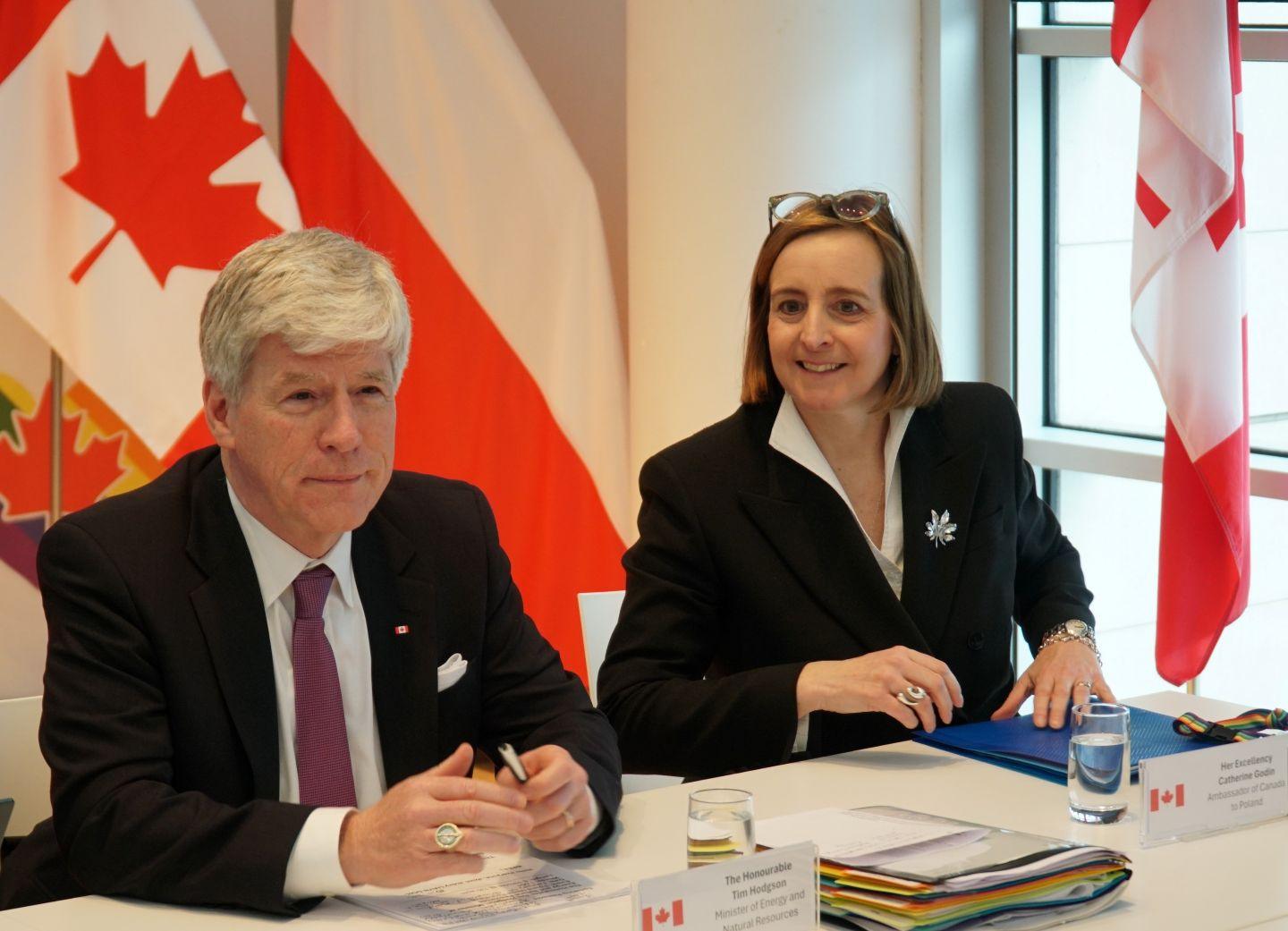
The growth prospects are enormous. On July 10, electricity from offshore wind turbines flowed into the Choczewo substation for the first time in Poland’s energy system. This is the Baltic Power project, whose shareholders are Orlen and Canadian company Northland Power. Tim Hodgson, Canada’s minister of energy and natural resources, attended the event.
The next issue is a second nuclear power plant. Canada’s offer – the Candu reactor – meets Poland’s needs. It provides energy independence. A Candu reactor does not require enriched uranium, so Poland would not have to buy it from anyone. A Candu reactor would allow Poland to build its own supply chain. Polish companies could also service a Candu reactor in Romania.
Canada was once heavily dependent on coal as well – not to the same extent as Poland, perhaps, but some provinces were highly dependent on it. We know that you cannot rely on a single energy source.
I also know that Poland is interested in purchasing Canadian LNG. That is a matter for the future. Canada is tied up by existing agreements, but it is another area of potential cooperation. We have had numerous missions from different provinces, as well as scientific cooperation. So there is enormous scope for expanding cooperation in the energy sector.
Orlen Upstream and KGHM are already present in Canada. Critical minerals are another element of future cooperation. We are actively discussing this. And then there is mining. Lumina Metals wants to build a copper mine in Nowa Sól. It debuted on the Warsaw Stock Exchange in June as the first Canadian company to do so.
ICT, gaming, aviation, food and fertilizers
What other sectors have strong prospects?
ICT. I mentioned CGI, which is in Poland. Polish company Billennium, meanwhile, is in Canada. There is also scope for growth in gaming. Cybersecurity is important as well; it was one of the areas covered by last year’s bilateral agreement between our countries. This means strengthening efforts to improve cybersecurity and promoting high standards for protecting consumers, businesses and infrastructure. We are moving closer because we trust each other. We share information and jointly monitor threats.
The aviation sector will remain an important area of growth. Last year, LOT signed an agreement to purchase 40 Airbus A220 aircraft, which are manufactured in Canada. That means expanding supply chains and cooperation between companies such as CAE, a global leader in aviation training, simulators and maintenance services.
Aircraft spare parts are another area where trade continues to grow. I do not know, however, in which direction that growth is stronger.
CETA is highly important to the development of trade relations. Polish exports of cheese to Canada have increased by more than 500 percent. Food producers worry that CETA is a threat, when they should see it as a source of support. Exports of eggs and poultry from Poland are growing. Polish agrifood companies are interested in the Canadian market. They see CETA as an opportunity.
Another area is fertilizers. Fertilizers and potash come from Russia, Belarus or Canada. I think I know whom Poland wants to buy from. And we are a reliable partner.
Time to say goodbye
How would you sum up your mission in Poland?
I am enormously grateful that I was here at this time. Relations between our countries are the best they have ever been. There is nothing to suggest they will deteriorate; quite the opposite – they will improve. So I have been extremely fortunate.
We established a strategic partnership, a nuclear cooperation agreement and a defense cooperation agreement. This year, I had the pleasure of taking part in the first meeting of the Polish-Canadian High-Level Steering Committee. We concluded an agreement on the mutual protection of classified information, aimed at facilitating the exchange of classified information in times of threat. All these agreements will allow us to work more closely together.
CETA came earlier, but only now are companies beginning to make use of it. All these agreements allow us to deepen political, commercial and people-to-people ties. These elements will remain unchanged regardless of changes in government in Canada or Poland. We have managed to take the relationship to a new level.
Will it be difficult for you to leave?
I have two children. My daughter has already had to leave Poland. She cried. My son is still in Poland, but he does not want to talk about it. And I have to comfort this man who is taller than me and tell him that everything will be all right.
Where are you going now?
I am returning to Canada and my hometown, Montreal.
Are you looking forward to it?
I feel so much gratitude for having been here. It will be difficult to say goodbye to my team. I will take beautiful memories with me. I have been to almost every region of Poland. It is an honor to represent my country. I know that this team and my successor will do a great job.
Am I sad? Of course. Do I want to talk about it? Not necessarily.


Key Takeaways
- Canadian companies are investing more heavily in Poland. Poland is becoming one of the most important markets in Central and Eastern Europe for Canadian businesses. The evidence includes Couche-Tard’s interest in acquiring Żabka, plans by other investors and Canada’s record presence at MSPO, with more than 150 companies expected to attend. Ambassador Catherine Godin says Poland attracts Canadian companies with its stable economic growth, defense spending and role as a regional business hub.
- Canadian companies are investing more heavily in Poland. Poland is becoming one of the most important markets in Central and Eastern Europe for Canadian businesses. The evidence includes Couche-Tard’s interest in acquiring Żabka, plans by other investors and Canada’s record presence at MSPO, with more than 150 companies expected to attend. Ambassador Catherine Godin says Poland attracts Canadian companies with its stable economic growth, defense spending and role as a regional business hub.
- Trade and investment are set to accelerate. Canada wants to diversify its economic relationships, and Poland is one of the main beneficiaries of that strategy. Opportunities include nuclear and offshore energy, LNG, critical minerals, aviation, ICT and agrifood. According to the ambassador, relations between the two countries are now the strongest in their history, while agreements signed in recent years should lay the groundwork for further growth in investment and trade.