Poland Unpacked week 45 (26 October - 1 November 2026)

Welcome to this week’s edition of our Poland Unpacked, where we deliver key insights and trends shaping the economic, corporate and political landscape. Catch the most important insights from Poland in this week’s briefing.

Loading the Elevenlabs Text to Speech AudioNative Player...
Topic of the week
A court in the crossfire
Krzysztof Figlarz

Friday evening brought a political earthquake of a magnitude rarely seen in Poland in recent years – at least in terms of the emotions it unleashed. Once again, the Constitutional Tribunal found itself at the center of the storm. An announcement appeared on the Tribunal's website stating that its president, Bogdan Święczkowski, and his deputy, Bartłomiej Sochański, would temporarily cease performing their duties. Both are politically associated with the right-wing Law and Justice (PiS), the political camp of President Karol Nawrocki. Anna Korwin-Piotrowska, the Tribunal's longest-serving judge, was named its new president.

The legal basis for the decision lies in legislation governing ordinary courts. The catch is that the Constitutional Tribunal has until now operated under separate rules, which grant its president extensive, almost unassailable powers. The legal reasoning behind the decision has divided leading constitutional scholars and legal experts. Among those critical of the move is the Helsinki Foundation for Human Rights.

Politically, the decision caused an uproar on the right. On Friday evening, leaders from across Poland's right-wing political spectrum gathered outside the Constitutional Tribunal – from former Prime Minister Mateusz Morawiecki, positioned closest to the political center, through Jarosław Kaczyński and the leaders of the far-right Confederation, to the pro-Russian Grzegorz Braun. All united in opposing the changes at the Tribunal, which they claimed had been orchestrated by Prime Minister Donald Tusk. There were also calls for snap elections. President Karol Nawrocki cut short his visit to Senegal and stormed into the Tribunal's headquarters during the night, where he met with judges appointed under PiS.

Prime Minister Tusk delivered a televised address in which he stressed the need to restore proper standards at the Constitutional Tribunal, linking the issue directly to the protection of Polish democracy. He also denied interfering in any decisions made by judges appointed by the current parliamentary majority. On Saturday, President Nawrocki invited political leaders for consultations on resolving the crisis. Representatives of the governing Civic Coalition (KO) and the Left declined the invitation. Deputy Prime Minister Władysław Kosiniak-Kamysz of the Polish People's Party (PSL) and former Sejm Speaker Szymon Hołownia of Poland 2050 attended.

The longer-term political consequences remain difficult to predict. Tusk is responding to the expectations of his most committed supporters, who, three years after his government took office, are still waiting for meaningful accountability for its predecessors and the restoration of the rule of law. Meanwhile, the right has achieved a moment of unity. Whether that unity will survive until the approaching election campaign is another matter – and a doubtful prospect.

One thing, however, seems certain: tensions between the most hard-line supporters and opponents of the government have reached another level. Meanwhile, Poles who simply want a functioning, honest state and some political peace find themselves even more tightly trapped in the machinery of polarization.

Business
A bigger stock market, global expansion and European growth
Małgorzata Grzegorczyk

The Warsaw Stock Exchange (GPW) has a market capitalisation equivalent to 31% of Poland’s GDP. Its president, Tomasz Bardziłowski, wants to raise that figure to 50% within four years, an increase of PLN 250bn.

Rather than pursuing mergers with other exchanges, the GPW is focusing on operational cooperation. It has signed agreements with seven stock exchanges across central and eastern Europe, paving the way for investors to gain easier access to equities from their markets.

The first results of this cooperation are expected early next year. Work is also under way on a regional exchange-traded fund (ETF) focused on central and eastern Europe. Find out more about the GPW’s plans to deepen regional capital market integration.

Trend Glass, a Polish glass manufacturer with annual revenue of EUR 100m and a supplier to IKEA, has acquired a German group twice its size.

In 2025, with EUR 45m in financing from investment fund CVI and state-owned Polish Development Fund (PFR), Trend Glass acquired Gala Group. With revenue of around EUR 200m, Gala Group is Europe's largest producer of candles in glass containers.

Following the acquisition, the Polish company moved production from Germany to Poland. It is now preparing a three-year global growth strategy, due to be completed by mid-2027. Discover how Trend Glass is building an international business.

IKEA Industry, another supplier to the Swedish retail group, manufactures 10% of the furniture IKEA sells worldwide. Half of that output comes from a single factory in Zbąszynek, in western Poland’s Lubuskie region.

The plant employs 3,400 people and is expected to produce 50m items this year. The company is also investing EUR 100m, including in the production of boards made from wood dust. Learn more about the Polish factory’s role in IKEA’s production network and its plans for investment and innovation.

GoPOS, a Polish provider of software-as-a-service (SaaS) solutions for restaurant management, has attracted a new investor: Spire Capital Partners. The parties have not disclosed the value of the transaction, but XYZ estimates it at several tens of millions of zlotys.

GoPOS serves 6,500 customers, primarily in Poland, although its international client base is growing, with customers in markets including Spain and Zanzibar. Its ambition is to build a pan-European platform for point-of-sale (POS) services. Meet GoPOS and discover its plans.

Economy & Markets
Inflation back within target, Poles saving more
Michał Kulbacki

The most important macroeconomic release from Poland last week was the flash inflation estimate. Consumer prices rose by 3.5% year on year in October, down from 4.1% in September. This puts inflation at the upper end of the central bank's target range.

The main reason for the decline was the revival of the government's Lower Fuel Prices (CPN) program, which cuts VAT and excise duties on fuel and introduces price caps. The latest reading strengthens the case against further interest rate hikes in Poland.

We usually look at price changes on a year-on-year basis. But sometimes it pays to take a longer view – all the way back to 2000, for example. That is precisely what we did, examining how the prices of various goods and services in Poland have changed over the past quarter-century. The findings? Many goods have become cheaper, while services have grown more expensive. Once wage growth is factored in, however, almost everything has become more affordable for Poles in real terms.

We also recently examined how Poland's property prices have evolved over the past two decades. Contrary to popular belief, there have been periods when prices stagnated or even declined.

New figures show that Polish households are saving more. In the second quarter of 2026, the household saving rate reached 10.1% – its highest level outside the pandemic years. More importantly, Poland has moved significantly closer to the EU average. Full analysis here.

Public investment in almost every EU country is expected to be substantially higher in 2026 than the annual average for 2015–2024. Poland, alongside other countries in the region, is among those stepping up spending. What is driving this investment push, and where is the money going?

Meanwhile, Poland's parliament is working on tax reforms proposed by the government. During a vote in the Sejm, the lower house of parliament, lawmakers adopted two amendments: one indexing personal income tax brackets and the tax-free allowance to inflation, and another scrapping a planned corporate income tax increase for the largest companies. The combined fiscal cost could reach PLN 8–10 billion annually as early as 2029, rising further in subsequent years. That would put additional pressure on Poland's public finances, already strained by a very large budget deficit. Here's why.

Politics & Policy
Crisis season in Warsaw
Krzysztof Figlarz

The crisis surrounding Poland's Constitutional Tribunal may not be the last to engulf the country's key institutions. The terms of members of the National Bank of Poland's (NBP) management board are coming to an end. Board members are appointed by the president upon a recommendation from the NBP governor, but their appointments also require the prime minister's countersignature. And that is where the trouble begins.

The deadline for the prime minister to countersign the nominations falls on Wednesday, November 4. However, a signature appears far from certain, particularly since the prime minister has already declined to approve the same lineup once before.

NBP Governor Adam Glapiński is also facing potential trouble. In October, a parliamentary committee endorsed a motion to bring him before the State Tribunal, which hears cases involving alleged constitutional violations by senior public officials. Glapiński rejects accusations from the parliamentary majority, including allegations that he indirectly financed the budget deficit. A potential crisis at Poland's central bank could have tangible consequences for the country's economy.

Last week also brought considerable attention to another crisis – one that, for now, remains largely hypothetical. Speaking at an annual political forum in Krynica-Zdrój, Law and Justice (PiS) leader Jarosław Kaczyński outlined his vision for reforming the European Union. But it was one particular remark that went viral: Kaczyński raised the possibility of "opening negotiations on Poland's possible withdrawal from the European Union." The following day, he denied advocating Polexit, but the damage was already done. Prime Minister Donald Tusk quickly responded that next year's elections would present a choice between keeping Poland in the EU and "plunging us into an abyss of isolation and risks."

Speaking of crises, at least one appears to have been resolved. Katarzyna Pełczyńska-Nałęcz, the former leader of the Poland 2050 party, recently stepped down as minister of development funds and regional policy. She is set to be replaced by Agnieszka Bartol, who has until now headed Poland's Permanent Representation to the European Union.

Bartol is an experienced EU official with extensive knowledge of European affairs, including EU funding. It is also an open secret in Polish political circles that she enjoys excellent relations with Prime Minister Donald Tusk, who recently announced her nomination.

Startups / VC / Tech
Big ambitions, tough barriers
Anna Bełcik

In a special edition of GQ, The Business Issue powered by XYZ, we spotlight Polish tech startups that have made their mark internationally and become flagships of the country's startup ecosystem.

Experts we spoke to point to strong engineering and analytical skills, adaptability, and the ability to solve complex problems while making efficient use of resources as the greatest strengths of Polish founders. Entrepreneurs are increasingly combining specialist expertise with global ambitions. Poland's rise into the ranks of the world's 20 largest economies is giving a further boost to the aspirations of a new generation of founders.

ElevenLabs is undoubtedly one of Poland's brightest startup success stories. But companies such as ICEYE, Docplanner, Brainly, and Booksy have also achieved considerable international success. Read their stories.

With applications opening for further rounds of the EU's Women TechEU grant program, we also examine how Polish women are faring as startup founders. Although more women-led ventures are emerging, they still account for a relatively small share of young companies. Female founders, particularly those with scientific backgrounds, are more likely to build businesses in fields such as femtech, medical technology, deep tech, biochemistry, and machine learning.

Many women decide to start their own businesses after maternity leave. Yet, as industry practitioners point out, they often face greater difficulties raising capital from investors seeking rapid returns. One possible explanation is that investors are more comfortable navigating a business environment that remains heavily male-dominated.

We profile six female-founded startups from Poland that participated in previous editions of the Women TechEU program.

Meanwhile, biotechnology companies continue to face significant obstacles in securing funding through domestic grant schemes. This year's STEP funding round for biotechnology, administered by the Polish Agency for Enterprise Development (PARP), illustrates the problem. Of the PLN 300 million earmarked for two calls for proposals, just one project was recommended for funding, receiving PLN 8.4 million. That amounts to less than 3% of the available budget.

Industry representatives argue that the problem lies not only in the eligibility criteria but also in how projects are evaluated. They criticize the narrow interpretation of STEP technologies and the limited involvement of experts familiar with the commercial realities of biotechnology. They want business practitioners to play a greater role on evaluation panels.

The industry hopes that recent personnel changes at the ministry responsible for development funds will bring a shift in approach. Although the National Centre for Research and Development (NCBR) has a better track record of funding biotechnology projects than PARP, it too struggles with delays and stringent project selection procedures. Here's the full story.

After hours
A Royal Castle fit for communist royalty
Michał Szcześniewski

Communism was supposed to put an end to aristocratic privilege. Poland’s communist leaders apparently had other ideas. When Warsaw’s Royal Castle was being rebuilt in the 1970s, officials planned to turn nearly one-fifth of the historic building into luxurious apartments for visiting foreign dignitaries. The plans included marble bathrooms, lavish reception rooms, a private elevator and even Western bathroom fittings – extraordinary luxuries in a country where ordinary citizens struggled to obtain basic building materials.

The apartments were partly completed but never welcomed a single VIP guest. As Poland’s economy deteriorated and the communist leadership’s ambitions faded, the rooms became offices and museum facilities instead. Now, the exhibition Secret Chambers of the People's Republic (Sekretne komnaty władzy ludowej) at Warsaw’s Royal Castle reveals this forgotten chapter of history, showcasing original 1970s furniture, colorful glassware and previously unpublished photographs by Chris Niedenthal. It is a fascinating glimpse into the paradoxes of socialist luxury – and a reminder that some revolutions are more successful at abolishing titles than privileges.
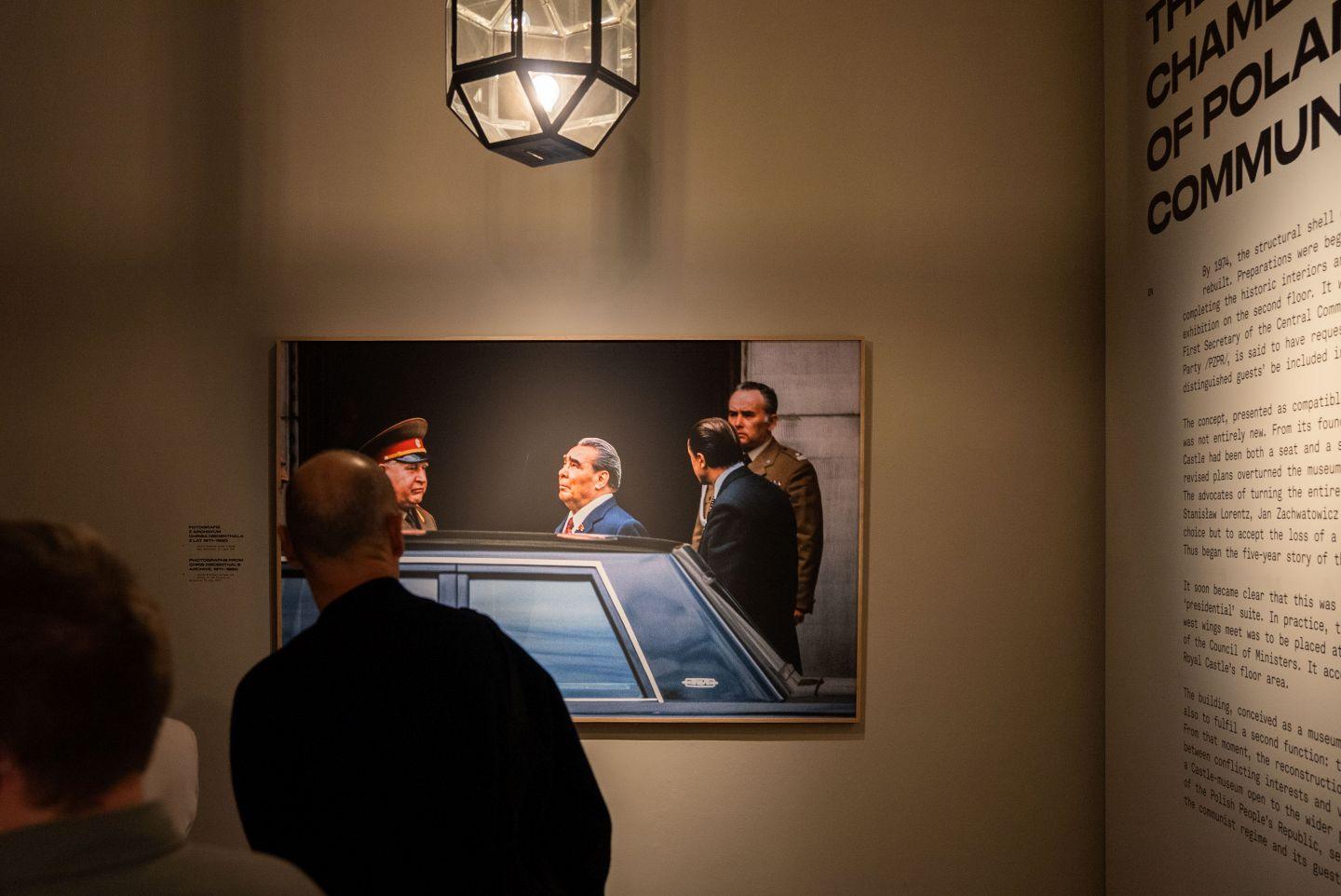
Wystawa "Sekretne komnaty władzy ludowej".
Communism was supposed to put an end to aristocratic privilege. Poland’s communist leaders apparently had other ideas. Photo: Royal Castle in Warsaw
fun fact about poland
The month that says what it does
Michał Szcześniewski

The English word “November” comes from the Latin novem, meaning nine – a reminder of the days when November was the ninth month of the Roman calendar. The Poles took a more practical approach. Our word for November, listopad, literally means “leaf fall”. No ancient emperors, no numerical confusion. Just a straightforward description of what happens outside the window.

And November is hardly an exception. April is kwiecień, named after flowers (kwiaty), while August is sierpień, derived from the sickle (sierp) traditionally used during the harvest. December, meanwhile, is grudzień, a reference to the frozen clods of earth that winter leaves behind. Polish month names offer something resembling a seasonal operating manual. Admittedly, climate change is making it a little less reliable, but at least nobody needs to explain why the eleventh month is named after the number nine.

Our word for November, listopad, literally means “leaf fall”. Photo: PAP/Darek Delmanowicz