

This article is a part of Poland Unpacked. Weekly intelligence for decision-makers
IKEA Industry's largest furniture factory, which already accounts for almost half of the Swedish company's production, is set to become even bigger. Its development center, currently employing 70 people, could also expand.
In 1961, Ingvar Kamprad placed IKEA's first order for chairs with a Polish manufacturer. By 1974, 25 Polish factories were supplying the Swedish company. IKEA opened its first store in Warsaw in 1990.
Today, IKEA Industry operates 12 factories across eight locations in Poland. Its Zbąszynek complex is the company's largest furniture manufacturing facility in the world, accounting for almost half of IKEA Industry's total output. IKEA Industry, in turn, produces 10% of the goods sold in IKEA stores. The remainder comes from suppliers around the world, among which Polish manufacturers play an important role, although the company does not disclose detailed figures.
The Zbąszynek complex covers 1 million square meters, or 100 hectares, including 401,000 square meters of buildings and facilities. These comprise four production plants, a logistics department with warehouses, and two solar farms.
The complex employs 3,400 people working three shifts, five days a week. Last year, it manufactured approximately 45 million products, with almost 24,000 trucks leaving the facility.
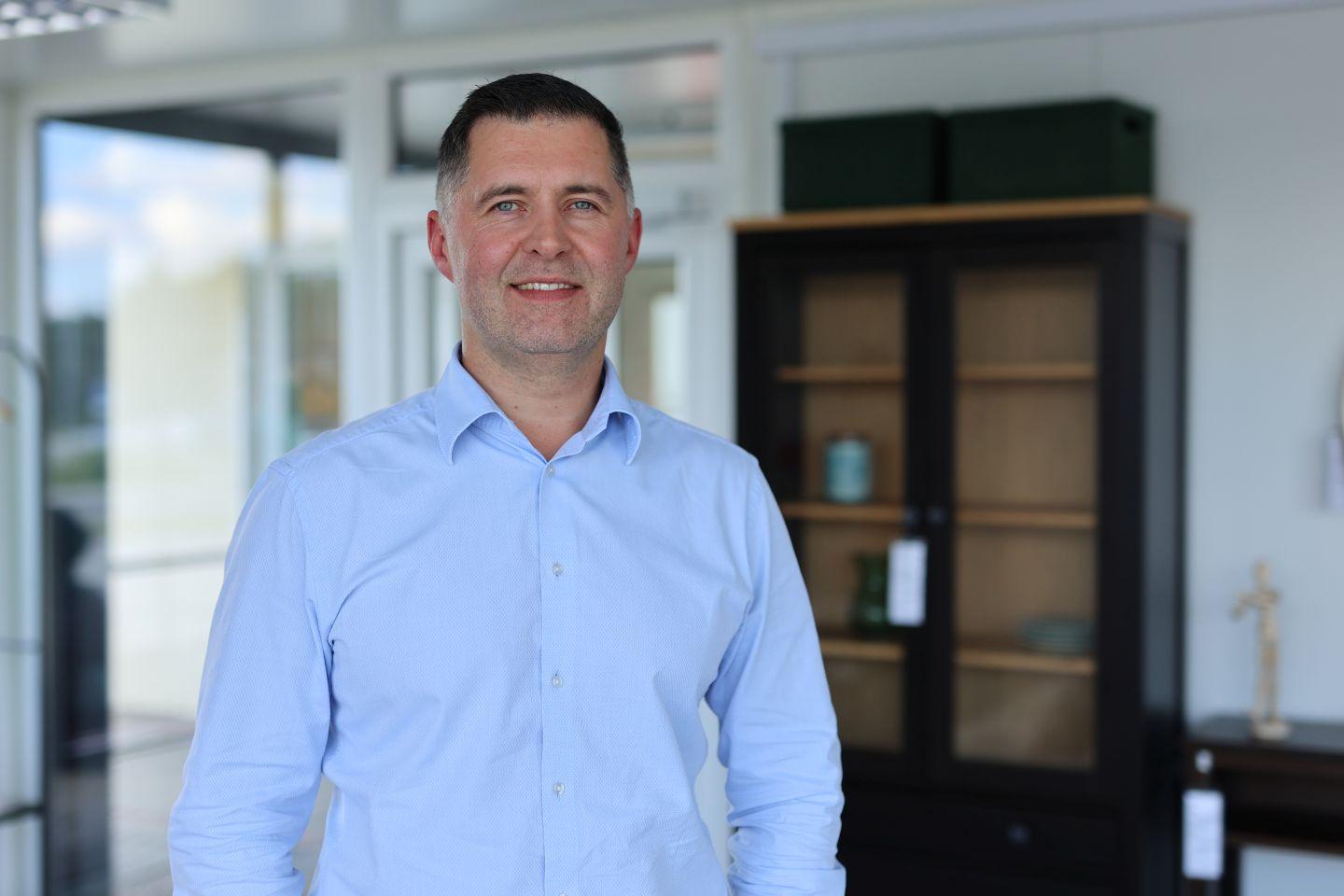
"Our plan for the new financial year, which began in September, is to produce 51 million pieces of furniture. Of course, this is a forecast that depends on certain conditions being met," says Piotr Filipiak, Managing Director of IKEA Industry Zbąszynek.
IKEA plans several major investments
Reaching that production target will require further investment in Zbąszynek.
The company's investment budget for the current financial year amounts to approximately EUR 100 million. It covers several projects, some of which will take more than 12 months to complete.
IKEA is investing in a paper foil application line and an automated packaging line. The largest project, however, will be the Cyclic Thin Board Line (CTBL) in Chlastawa, which is also part of the Zbąszynek manufacturing complex.
"On an area of 6,000 square meters, we will produce 82,000 cubic meters of board annually using wood dust generated from our waste. Nobody else in the world has a production line like this. It will begin operating at the end of 2027," says the managing director.
XYZ reported on the project in June. The facility will cost PLN 278.3 million.
IKEA has signed an agreement with Poland's Ministry of Development and Technology for a PLN 6.9 million grant, scheduled for payment in 2028. The company will also benefit from corporate income tax exemptions in the Kostrzyn-Słubice Special Economic Zone.
"We're currently closing in the building. The foundations for the technological infrastructure are complete, and everything is progressing according to plan.
"Soon, 500 trucks carrying the production line equipment will arrive here.
"We've already completed the proof of concept, but this is where we'll test the technology on an industrial scale. That will be the most important moment of the investment," Filipiak explains.
IKEA Industry has room for further expansion near its Chlastawa facility and in Babimost, approximately 10 kilometers away.
"Our production halls are designed so that additional production lines can be installed.
"However, because we're benchmarked against other IKEA suppliers, we place great emphasis on efficiency, and every investment must be justified by demand.
"We also undertake major investments that other suppliers may subsequently replicate," says the head of IKEA Industry Zbąszynek.
According to Filipiak, the complex continues to expand because it manufactures popular product families.
There are currently 31 such families, comprising 462 individual products, including IKEA bestsellers EKET and KALLAX.
Approximately 97% of production is exported, with the European Union accounting for 86% of sales.
IKEA is cutting jobs...
Other IKEA Industry factories in Poland have been less fortunate.
This year, the company announced plans to lay off 240 of its 1,500 employees in Wielbark and 160 of its 580 employees in Goleniów.
In 2024, IKEA Industry reduced employment in Poland by 285 people, bringing its workforce to 8,127. A year earlier, employment had fallen by 714 to 8,412, including the loss of more than 180 jobs in Zbąszynek.
The broader IKEA group reported EUR 44.6 billion in revenue for the 2024–2025 financial year, down 1%, and EUR 1.5 billion in net profit, a decline of 30%.
It also announced the closure of one of its large stores in Sweden and the elimination of 800 office jobs. Worldwide, IKEA employs approximately 222,000 people.
"Automation at our Zbąszynek factories is primarily intended to improve process efficiency, workplace safety, and ergonomics, while developing employees' skills.
"We want technology to take over repetitive and more physically demanding tasks, allowing employees to move into new roles and acquire additional qualifications.
"We also make use of opportunities across the entire organization. Employees can gain experience or move between factories and different areas of work.
"In recent months, more than 60 people have completed training preparing them for operator positions.
"At the same time, we continue recruiting in response to business needs and the development of our facilities," says Filipiak.
At Zbąszynek, more than half the workforce has been with the company for over 15 years, while 15% have worked there for more than two decades.
...and so is the rest of the industry
Compared with the wider Polish furniture industry, IKEA's performance is relatively strong.
The Coalition for Polish Wood estimates that the furniture sector has eliminated approximately 27,000 jobs over the past four years, equivalent to 16% of its workforce.
In March 2026, the industry employed 138,000 people.
The value of furniture production sold declined from PLN 69 billion in 2022 to PLN 62.1 billion in 2024.
The industry's profitability stands at 4.4%, while almost 36% of companies are operating at a loss.
Orders from Germany have fallen by 50–70% at many Polish furniture manufacturers.
Coalition representatives identify several reasons for the crisis: the war in Ukraine, tensions in the Middle East, declining demand, growing economic uncertainty, and rising operating costs.
The price of pulpwood, an important raw material for wood-based products, has exceeded PLN 540 per cubic meter.
IKEA's Polish development center could grow
IKEA Industry also operates in Zbąszyń, approximately 10 kilometers from Zbąszynek.
The company acquired a former furniture cooperative there in 1992. Today, the site houses one of IKEA Industry's two Manufacturing Development Centers. The other is located at the company's headquarters in Älmhult, Sweden.
The Zbąszyń center works with IKEA factories around the world and external partners.
It employs approximately 70 people, most of whom have more than ten years of experience in furniture and wood-based panel manufacturing.
The center conducts more than 500 product tests annually.
Among its priorities are products and technologies that reduce wood consumption.
These include medium-density and high-density fiberboard (MDF and HDF), manufactured from fine wood fibers bonded with resin; particleboard, made from wood particles and resin; and lightweight board-on-frame (BoF) and board-on-stiles (BoS) structures featuring honeycomb-like interiors.
The center also works with veneer, thin layers of natural wood applied to panels.
"We're considering making greater use of the center's expertise, but I can't reveal more at this stage," says Filipiak.
Among the world's leading furniture producers
IKEA Industry operates 30 factories in seven countries, employing a total of 14,500 people.
Its manufacturing operations are located in Sweden, with two factories; China, also with two; Lithuania; Poland; Slovakia, with three; Hungary; and Portugal.
In Poland, the company operates facilities in Goleniów, Zbąszynek, Lubawa, Orla, Resko, Stalowa Wola, Stepnica, and Wielbark.
"IKEA Industry is among the world's five largest furniture manufacturers," Filipiak concludes.
Poland itself ranks third globally in furniture exports, behind China and Germany, according to a report by Polish bank PKO BP.
Good to know
Better to be midsize and Polish than large and foreign-owned
Global furniture industry sales declined by 2% in 2025 to EUR 632 billion, according to Statista. Nevertheless, they remained 9% higher than in 2021.
North America is the world's largest furniture market, but Europe is expected to record the fastest growth between 2026 and 2031, at 3.1% annually, compared with a global rate of 2.5%.
Products made from environmentally friendly, renewable, or recycled materials are becoming increasingly important. More consumers are also purchasing furniture online.
In Poland, furniture manufacturers' revenues declined by approximately 5% annually in 2023 and 2024.
The negative trend eased in 2025, but business conditions deteriorated again in the first half of 2026.
Medium-sized companies stand out positively against the broader industry.
Businesses employing between 50 and 249 people increased their revenue by 8% in 2025, achieving a net return on sales (ROS) of 5.2%. ROS measures net profit as a percentage of sales revenue.
Among the largest companies, employing more than 250 people, revenue fell by 2.5%, while net ROS stood at 3.6%.
Domestically owned manufacturers also performed better than foreign-owned companies.
Polish-owned medium-sized and large manufacturers recorded a net ROS of 5%, compared with just 0.3% among the largest foreign-owned producers.
In 2025, Poland's furniture exports increased by 3% to EUR 16.8 billion.
Exports from Germany, the world's second-largest furniture exporter, grew at a similar pace.
China, the global leader, recorded an 11% decline, largely due to lower sales to the United States.
For 2026, PKO BP analysts expect a slight decline in furniture manufacturers' revenues and continued pressure on profit margins.


Key Takeaways
- IKEA Industry plans to invest approximately EUR 100 million in Zbąszynek, home to its largest furniture manufacturing complex worldwide. The investment program includes new production and packaging technologies, with the most significant project being a pioneering line that will manufacture wood-based panels from production waste. The facility, located in Chlastawa, is expected to begin operating at the end of 2027. The project is intended to improve resource efficiency and support further expansion.
- Poland remains a major manufacturing hub for IKEA Industry, even as individual factories face different prospects. The Zbąszynek complex continues to expand and invest in automation, while other IKEA facilities in Poland are reducing their workforces. Almost all products manufactured in Zbąszynek are exported, primarily to EU markets. The factory produces some of IKEA's best-selling furniture ranges, including KALLAX and EKET, and accounts for nearly half of IKEA Industry's total production.
- Poland's furniture industry is struggling with weak demand, rising costs, and declining profitability. Thousands of jobs have disappeared from the sector, and many manufacturers are facing sharp reductions in orders, particularly from Germany. Nevertheless, Polish furniture exports increased by 3% in 2025 to EUR 16.8 billion, maintaining the country's position among the world's largest exporters. Future growth will increasingly depend on innovation, automation, and more efficient production processes.