

This article is a part of Poland Unpacked. Weekly intelligence for decision-makers
Poland’s Monetary Policy Council (RPP) has once again decided to leave interest rates unchanged, keeping the benchmark rate at 3.75%. The decision was in line with the consensus among economists, although financial markets had previously priced in the possibility of a rate increase as early as November.
According to a preliminary estimate from Statistics Poland (GUS), inflation stood at 3.5% year over year in October, down from 4.1% in September. It thus returned to the National Bank of Poland’s (NBP) target band, whose upper limit is 3.5%.
 Interactive chart
The NBP’s new projection
In its statement following the Monetary Policy Council’s November meeting, the NBP presented the main results of its latest inflation and economic growth projection. The full report will be published on Friday.
It is already clear, however, that the inflation outlook has deteriorated significantly since July. The largest change concerns 2027, when CPI inflation is projected to be between 3.1% and 5.3% with a 50% probability, compared with a range of 1.5% to 4% in the July projection. The midpoint has therefore risen from 2.75% to 4.2%, an increase of 1.45 percentage points. The forecast for 2028 has also been revised upward, with the midpoint rising from 2.35% to 2.9%. The latest estimates suggest that bringing inflation back to the NBP’s 2.5% target may prove more difficult than expected just a few months ago.
Interactive chart The changes to the economic growth outlook are much smaller. The midpoint of the projected GDP growth range for 2026 fell slightly from 3.7% to 3.65%, while the figure for 2027 rose from 2.75% to 2.85%. The forecast for 2028 was revised downward from 3% to 2.8%. As always, the projection was prepared on the assumption that NBP interest rates would remain unchanged.
The case for holding rates
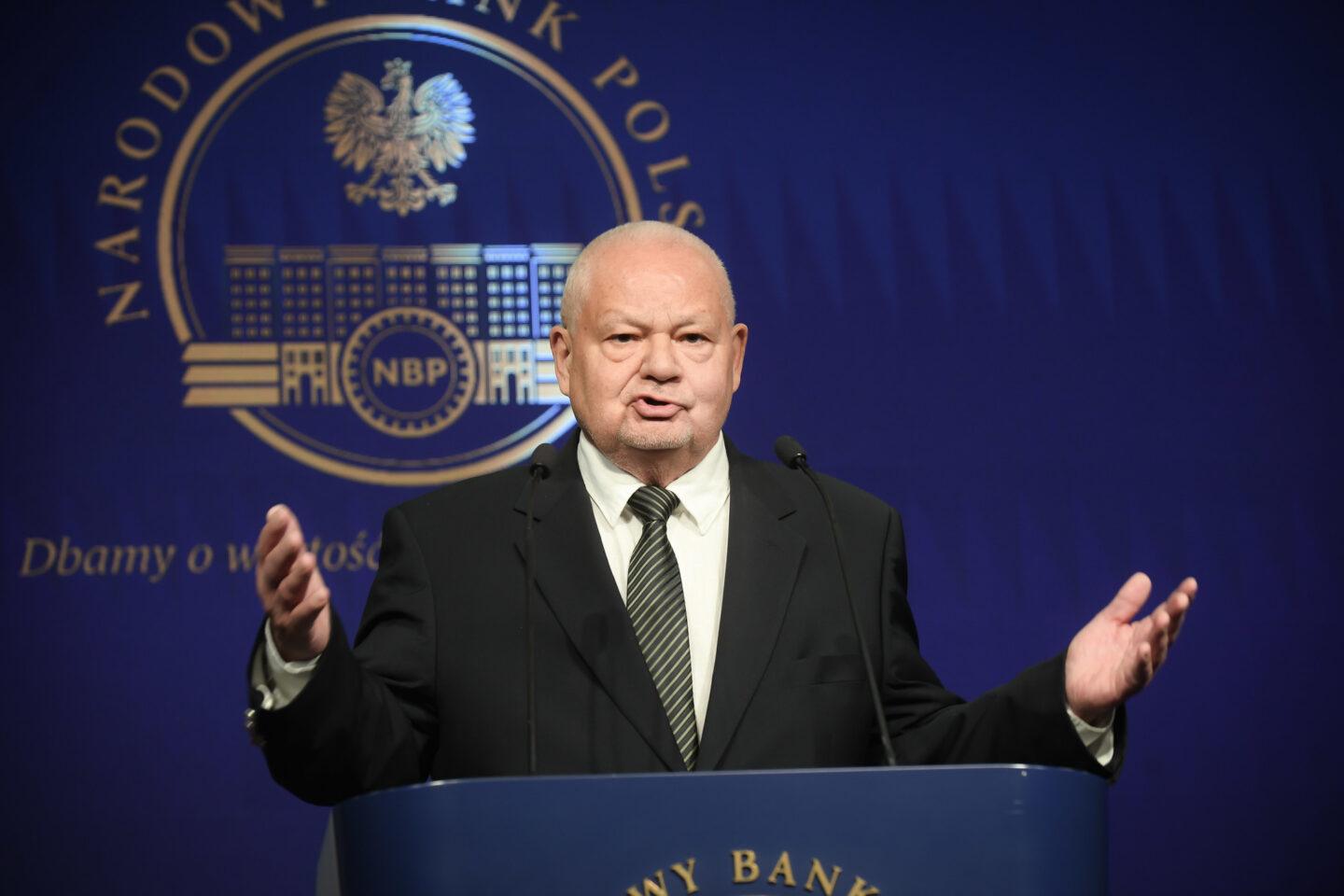
At a press conference, NBP Governor Adam Glapiński said the decision to hold interest rates had been preceded by a lively discussion within the RPP. On the one hand, inflation fell to 3.5% in October, and core inflation probably declined as well. On the other, pressure from energy commodity prices persists. According to Glapiński, gas prices in Europe are now 2.5 times higher than at the beginning of the year. Although there is little clear evidence so far that external supply shocks are feeding into other prices, a prolonged period of high energy costs increases that risk.
The NBP governor also pointed to factors containing inflationary pressure. Weak demand and competition limit companies’ ability to pass rising costs on to consumers. Wage growth is on a downward trend, and business surveys do not indicate mounting wage pressures within companies.
The economy is also beginning to slow. According to Glapiński, GDP growth slowed in the third quarter, including growth in consumption, which had previously been the main engine of economic expansion. Growth could slow further in 2027, partly because of lower use of EU funds and weaker investment growth.
But risks lie ahead
Glapiński also warned that inflation could rise again, primarily because energy commodity prices remain high. The expiry at the end of the year of the government’s Ceny Paliwa Niżej (CPN), or Lower Fuel Prices, program will also be significant. The NBP’s November projection assumes that the program will not be extended, resulting in inflation rising to around 4.5% in both the first and second quarters of 2027. If the government decided to keep the measures in place, however, the NBP estimates that inflation would be around 3.6–3.8%. Rising industrial producer prices and food prices are additional risks. High gas prices increase fertilizer production costs and could consequently lead to higher agricultural prices.
Glapiński’s comments point to a more hawkish stance from the RPP in the coming months. The governor stressed that the council is ready to act and will not delay its response if inflation risks materialize. At the same time, he noted that it had decided not to change rates at the November meeting. He did not say whether a possible future increase would be a one-off move or the start of a monetary tightening cycle.
XYZ’s view
In our assessment, an interest rate increase is not yet likely in December. The beginning of 2027 will, however, be crucial for the RPP’s subsequent decisions. Much will depend on whether the government extends the CPN program, how the geopolitical situation in the Middle East develops, and what consequences it has for energy commodity prices.
Data on economic conditions and wage growth at the beginning of the year will also be important. Despite these uncertainties, interest rate increases in 2027 appear difficult to avoid, particularly if elevated inflation begins to spread to other categories of goods and services. The longer commodity prices remain high, the harder such a scenario will be to avoid.


Key Takeaways
- The RPP kept interest rates unchanged amid opposing inflationary forces. Inflation has fallen to 3.5%, wage pressure is weakening and the economy is slowing. At the same time, energy commodity prices remain high and could push inflation up again.
- The NBP has significantly raised its inflation forecast for 2027 while making only small changes to its GDP growth forecast. The midpoint of the inflation projection rose from 2.75% to 4.2%, while the midpoint for economic growth increased only from 2.75% to 2.85%.
- The expiry of the CPN program could lift inflation to 4.5% in the first half of 2027. Extending it would limit inflation to around 3.6–3.8%. In response to the risk of renewed price growth, the RPP has signaled that it is ready to raise rates, although it has not determined whether increases will be necessary.