

This article is a part of Poland Unpacked. Weekly intelligence for decision-makers
Who pays tax on corporate profits in Poland? Which companies were the largest corporate income taxpayers in their industries? The 462 companies with tax bills above PLN 20m contributed PLN 47.5bn to the budget for 2025, up 22% from a year earlier. PKO BP topped the list again, just ahead of Orlen, while banks took five of the top 10 places. Here is the ranking prepared by XYZ.
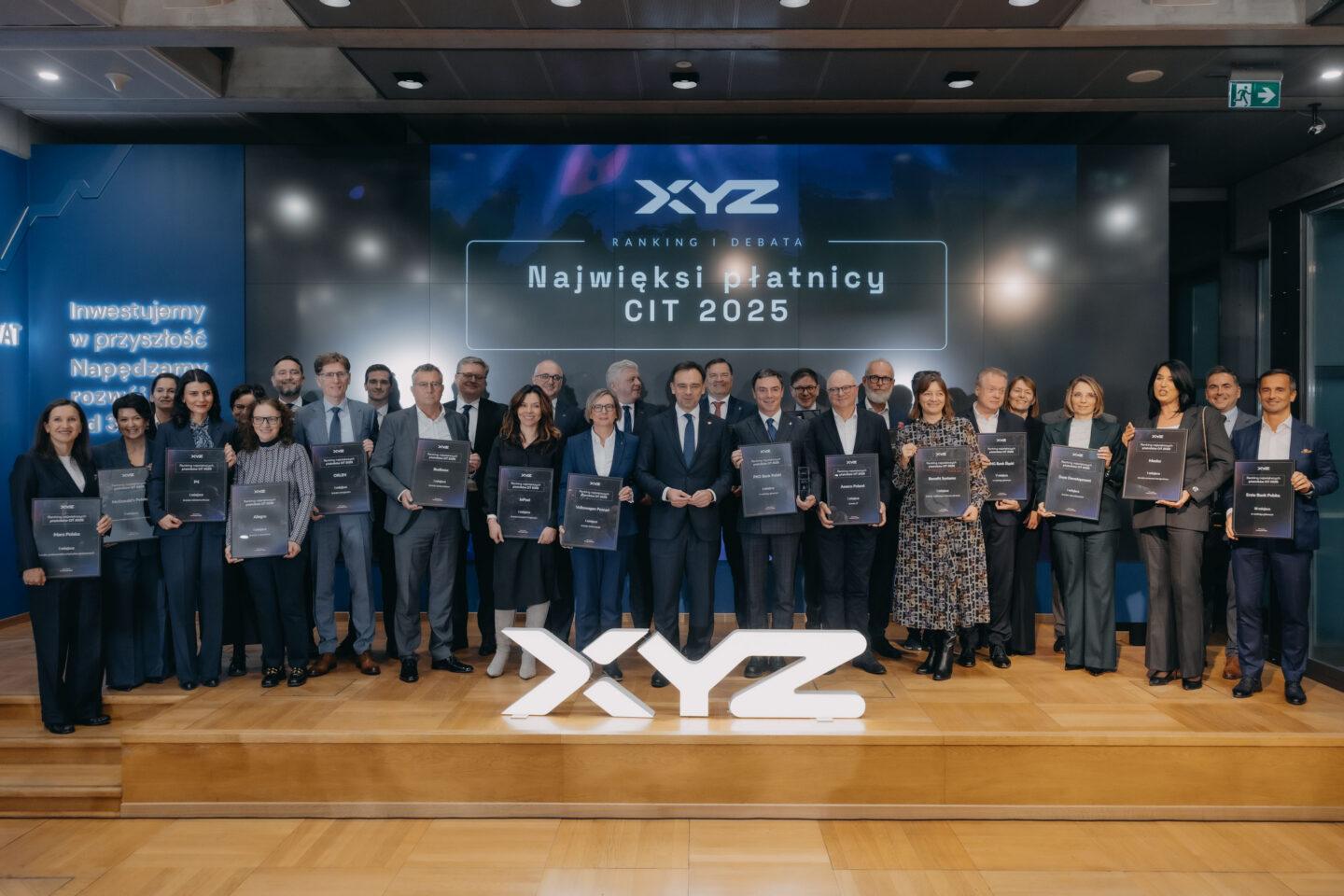
As we did last year, we examined who pays the most corporate income tax, or CIT, in Poland. We recognized the largest taxpayers across the economy and in individual industries at a special 2025 Largest CIT Taxpayers Gala. The awards were presented by Andrzej Domański, minister of finance and economy.
Our CIT ranking is based on 2025 taxpayer data published by the Ministry of Finance. We first combined the databases of individual CIT taxpayers and tax capital groups. We then ranked these entities by the amount of CIT due, producing a list of the 10 largest taxpayers in 2025.
We subsequently assigned every entity with more than PLN 20m in tax due to an industry. On that basis, we identified the largest CIT taxpayers in 27 sectors.
XYZ ranking
The largest CIT taxpayers by industry
- Banking: PKO Bank Polski tax capital group
- Gambling: Totalizator Sportowy
- Construction: Budimex
- E-commerce: Allegro
- Energy: Orlen
- Mining: KGHM tax capital group
- HoReCa, tourism and recreation: McDonald’s Polska
- IT: Asseco Poland
- Media: TVN
- Automotive: Volkswagen Poznań
- Real estate: Dom Development
- Alcohol producers: Kompania Piwowarska
- Food producers: Mars Polska
- Packaging producers: Mondi Świecie
- Tobacco producers: Philip Morris Polska Distribution
- Home furnishing producers: Aluprof
- Fast-moving consumer goods producers: Unilever Polska
- Energy-intensive industry: Górażdże tax capital group
- Pharmaceutical industry: Zakłady Farmaceutyczne Polpharma
- Machinery industry: Hitachi Energy Poland
- Agricultural industry: Animex Foods
- Defense industry: Mesko
- Retail chains: Jeronimo Martins Polska
- Telecommunications: P4 (Play)
- Transportation and logistics: InPost
- Insurance: PZU tax capital group
- Wellbeing and healthcare: Benefit Systems
XYZ analysis based on Ministry of Finance data. CIT for 2025.
Banks are the largest taxpayers again
In addition to the 27 industry leaders, we recognized the 10 largest CIT taxpayers overall.
 Interactive chart
As in the previous year, banks dominated the list, taking five of the top 10 places, including two on the podium. The largest taxpayer was PKO Bank Polski — more precisely, the PKO BP tax capital group — which paid PLN 3bn in CIT for 2025. Orlen followed closely, with tax due of around PLN 2.95bn. Third place went to Erste Bank Polska, which operated as Santander Bank Polska until April 2026 and paid PLN 2.45bn.
The next three places also went to banks: Pekao, ING Bank Śląski and mBank. The next-largest taxpayer was KGHM, with tax exceeding PLN 1.1bn. Jeronimo Martins Polska, Tauron and PZU also made the top 10.
A stronger economy means higher taxes
The Polish economy is in a phase of recovery, which is reflected in corporate income tax payments. In a clear majority of sectors — 20 out of 27 — total tax due was higher in 2025 than in 2024.
The machinery industry recorded the largest increase, with CIT paid rising by 71% year over year. Roughly two-thirds of that increase resulted from a greater number of companies crossing the PLN 20m CIT threshold. The remaining third came from higher tax payments by companies already on the list.
CIT paid also rose sharply among producers of fast-moving consumer goods (FMCG), by 54% year over year; in construction, by 52%; and in both the defense and real estate industries, by 43%. Media, energy, gambling and banking were also among the sectors with increases above 30%.
The agricultural industry was the only sector to record such a sharp decline in CIT paid: a 44% fall year over year. This was because the number of companies exceeding the PLN 20m tax threshold fell substantially. Alcohol, home furnishing, packaging and food producers also recorded declines of between 10% and 20%.
In total, companies with CIT above PLN 20m paid PLN 47.5bn for 2025 — 22% more than the companies that exceeded the threshold a year earlier.
Expert's perspective
Paying taxes fairly is fundamental to economic patriotism
Our competitors explain their low CIT payments by pointing to investment, but the numbers do not support that explanation. Between 2019 and 2025, we invested more than three times as much in Poland as DHL eCommerce and paid more than 20 times as much CIT. Investing does not prevent a company from paying taxes in Poland.
Poles should know this because, when choosing a courier company, they are also deciding whether part of what they spend on a delivery will return to the Polish budget to fund roads, schools and hospitals. Paying taxes fairly is fundamental to social responsibility and economic patriotism. Genuine market success should go hand in hand with a real contribution to the country’s development and the security of its citizens.


A high concentration of corporate tax
CIT revenue is highly concentrated, both by industry and by taxpayer. A small number of industries and companies account for a large share of all corporate income tax.
Banks are the largest CIT payers by sector. They paid a combined PLN 14.4bn in 2025. Energy ranked second, with tax exceeding PLN 8.7bn. The two sectors accounted for almost half of the tax paid by all companies with CIT above PLN 20m, with banks alone responsible for 30%.
Interactive chart Adding the eight other industries that paid more than PLN 1bn in CIT, including retail chains, insurers and transportation and logistics companies, brings the share of the 10 largest sectors to 80% of the tax.
Concentration is also very high by taxpayer. In 2025, 462 entities had CIT due above PLN 20m and paid a combined PLN 47.5bn. The largest taxpayer, PKO BP, paid 6% of that amount, while the four largest taxpayers paid more than 22% of the total.
The chart above illustrates this concentration. The horizontal axis shows the cumulative number of entities, starting with the largest taxpayer; the vertical axis shows their share of total tax paid by large taxpayers.
It shows that the 100 largest companies account for more than 70% of the revenue, while around 250 entities account for 90%.
Concentration is also visible within individual sectors. In some, a single company pays more than half of the CIT. In mining, for example, KGHM paid 85% of the corporate income tax for the entire sector. The picture was similar in gambling, where Totalizator Sportowy accounted for 80%. Tobacco production, e-commerce and telecommunications are also highly concentrated.
At the other end are sectors with a much larger number of major entities, such as banking and automotive, where the leaders account for a considerably smaller share of tax revenue.
Expert's perspective
A fair approach to taxes is the foundation of equal competition
The Polish market is more than a place to make money. It also carries a shared responsibility for its development. Companies benefit from infrastructure, education, security and the stability of the state. Paying taxes fairly is one way they help finance these foundations.
That is why we have long spoken about the need for a level playing field. Companies that invest, employ people and settle their taxes properly should not have to compete with entities that gain an additional cost advantage through aggressive tax optimization. The issue is not whether a company has Polish or foreign capital. It is about ensuring that everyone earning money on the Polish market plays by the same rules.
Responsibility, however, must work both ways. Businesses should fulfill their obligations honestly, while the state should provide stable, transparent regulations, proportionate requirements and treatment as partners.
Fair taxes are not a punishment for success. They are part of the responsibility that should accompany it.
Corporate income tax and revenue
With certain exceptions, the CIT rate is the same across all sectors. The amount paid depends primarily on profit, which in turn depends on profitability.
Tax can also be examined in relation to revenue. This ratio shows how much of every zloty in revenue a company pays in CIT and, indirectly, how high an industry’s margins are. The figures below cover selected industries and represent the median for the 10 largest taxpayers in each.
Real estate developers pay the most CIT per zloty of revenue: the median for the sector’s 10 largest taxpayers is 5.9%. Not far behind are the defense industry, at 5.8%, benefiting from record orders; transportation and logistics, at 4.8%; and energy-intensive industry, at 4%. These are sectors where margins are high or demand has risen markedly in recent times.
At the other end are retail chains, at 1.2%, and the automotive industry, at 0.75%. In both cases, this reflects a business model based on high turnover and low margins. In the automotive sector, many of the largest taxpayers are vehicle importers and distributors rather than manufacturers.
Expert's perspective
A company’s growth should serve the economy
In 2025, we paid a total of PLN 17bn in taxes to the Polish budget. We see these figures as part of the broader balance of our presence in the country. That includes not only the 7,000 people we employ, but also the 8,000 Polish companies we work with.
Poland has also become one of the pillars of our business transformation. Philip Morris is evolving from a cigarette company into a producer of advanced smoke-free technologies for the whole of Europe. Kraków is one of several places in the EU where such technologies are developed. We believe a company’s growth should benefit the economy that provides the conditions in which it operates. The state needs stable revenue and to build economic advantages, while companies need predictable and stable operating conditions. That is why we value open dialogue and partnership, allowing both sides to plan ahead.
Who pays, and who does not?
Looking at tax in relation to revenue can be useful when assessing how a company approaches its tax obligations, particularly in the context of tax optimization by multinational corporations. Of course, it is not conclusive proof: as noted above, tax depends on income. It can, however, be treated as a clue. If a company has operated in a market for years and holds a large share of it, why does it not report profits?
Consider the 10 largest CIT payers among retail chains. They pay a similar proportion of their revenue in tax, ranging from 0.8% to 2.3%. The exception is New Yorker, whose tax amounted to around 6% of revenue last year.
There is also no indication that Polish-owned companies pay more tax than foreign-owned ones. Three Polish chains paid around 1.1% of their combined revenue, while the foreign-owned chains, excluding New Yorker, also paid 1.1%.
The comparison therefore does not reveal tax avoidance, but it covers only the companies that paid the most. Outside the list are large chains that report small amounts of tax.
Research nevertheless indicates that a problem exists. According to estimates by Karolina Konopczak and Aleksander Pawlak, based on companies’ tax and financial data, foreign-owned companies may shift around 20% of their profits abroad. This costs the budget an average of around PLN 2.6bn in CIT a year, equivalent to 6.4% of revenue from the tax in 2011–2021. As the authors themselves note, this is a conservative estimate. In some sectors, there are entities that report little income despite the large scale of their operations and many years on the market.
Expert's perspective
Strong, responsible companies build a strong economy
This is an important part of our contribution to the country’s development. The taxes we pay help finance public services, develop local communities and support projects important to the entire economy. At the same time, we manage the capital entrusted to us responsibly, strengthening the stability of the domestic financial system and supporting Polish investments.
Customers should consider this aspect when choosing an insurer, alongside the quality of its offer and service and the credibility of its brand. By choosing companies that settle their taxes properly in Poland and make strategic decisions here, customers support jobs, investment and long-term economic development.


Key Takeaways
- Banks and Orlen lead the ranking. The largest CIT taxpayer for 2025 was PKO BP Group, which paid PLN 3bn, just ahead of Orlen at PLN 2.95bn. Banks took five of the top 10 places and, as an industry, accounted for 30% of the tax paid by the largest taxpayers.
- A stronger economy raised tax payments. The 462 entities with tax above PLN 20m paid a combined PLN 47.5bn, up 22% from a year earlier. Tax increased in 20 of the 27 sectors, with the largest rise in machinery, at 71%, and the largest decline in the agricultural industry, at 44%.
- A small group of companies pays much of the CIT. The 100 largest taxpayers account for more than 70% of the tax paid by large companies, while 10 industries account for 80%. Relative to revenue, developers pay the most, at 5.9%; low-margin sectors such as retail and automotive pay the least.