

This article is a part of Poland Unpacked. Weekly intelligence for decision-makers
Major healthcare groups and investment funds are competing for a market already worth nearly PLN 20bn. Three prominent businesspeople are taking their own path: Pro Dent Clinic is starting in small towns and turning to franchising. “After building a business to a value of around PLN 20m, I would prepare it for sale. But Pro Dent Clinic has the potential for much, much more,” says Damian Ozga.
Few parts of the healthcare sector are as fragmented and as reliant on private spending as dentistry. That potential, combined with a market value approaching PLN 20bn, attracted the attention of major industry and financial investors at the beginning of the decade.
Lux Med, the leader in private healthcare, has already built a network of 80 clinics with 485 dental chairs. Medicover, the runner-up, had 81 clinics and 496 chairs in Poland at the end of 2025. Local private equity funds have also built networks with dozens of facilities and hundreds of treatment rooms. Tar Heel Capital backs Dentity, while Innova Capital stands behind United Clinics.
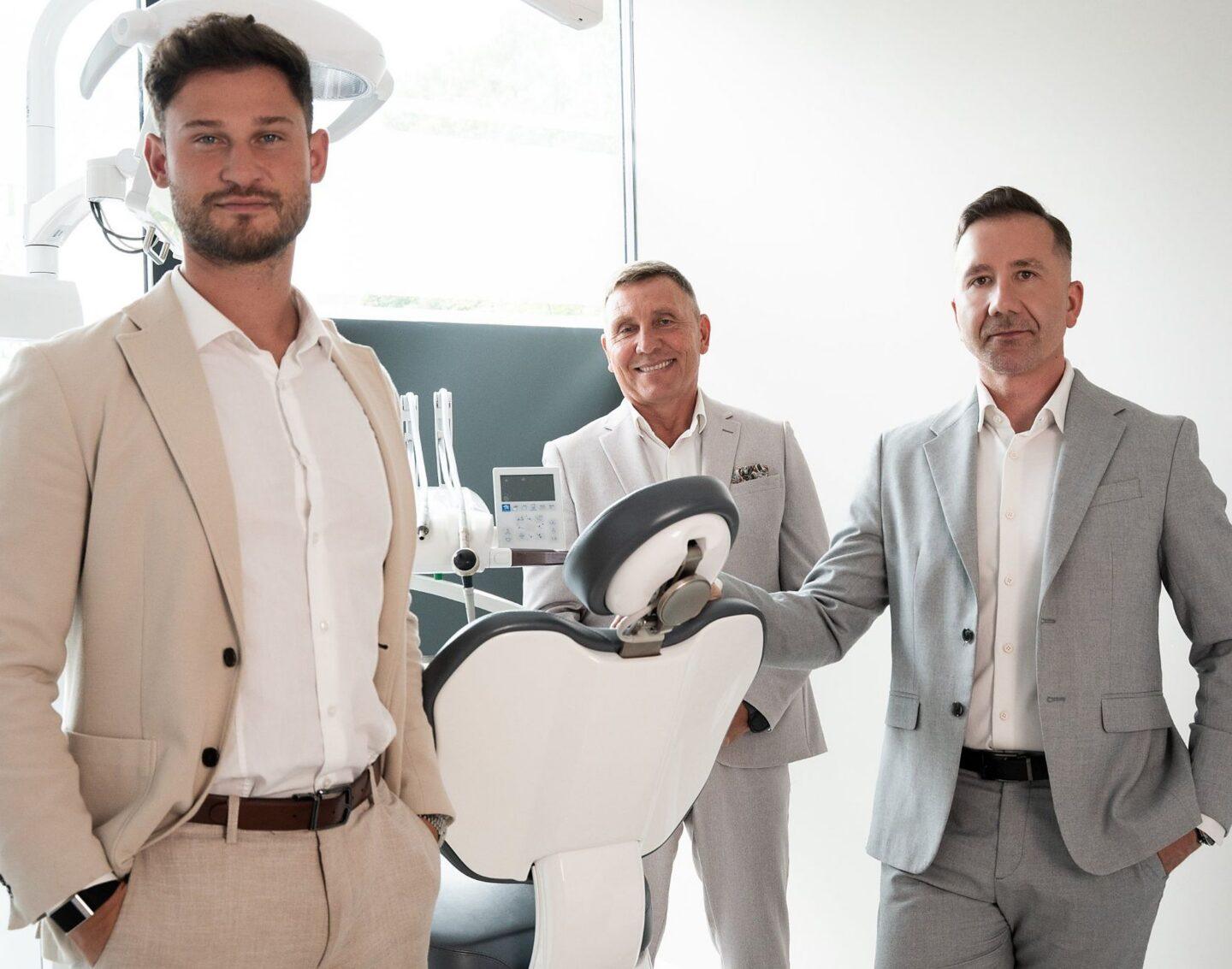
Pro Dent Clinic, which is being developed by Jakub Fajkiel, Damian Ozga and Mariusz Gnych, is joining the ranks of the consolidators. Rather than relying on large clinics of their own in major metropolitan areas, they are starting with facilities containing a few treatment rooms in small towns - and are already looking for franchise partners.
“Within a few years, we want to build a network of 100 dental clinics. We expect to become the leader in Poland by that measure. Some competitors may have more chairs because they operate large clinics. We are planning an average of 2.5 treatment rooms per location, or around 250 in total,” says Damian Ozga, president of Pro Dent Clinic and EVG Invest.
A company worth PLN 20m? Damian Ozga is aiming much higher
The ambitious plans are backed by the previous successes of the people behind them. The largest shareholder, with 40%, is Damian Ozga. He sold three franchise chains he had built from scratch — My Travel, Fitarena and Perfect Look Clinic — for more than PLN 50m. Those are only some of his businesses. He is also involved in the Savicki jewelry chain and Fit Style fitness clubs, among others.
“My previous businesses were not spectacular. Once I had built them to a value of around PLN 20m, I would prepare them for sale and move on to the next one. Pro Dent has the potential for much, much more,” Ozga says.
Entering dentistry was far from an obvious move for him, but he loves learning about new industries. Healthcare, which operates at the intersection of the private and public sectors, has long fascinated him.
“I also looked at primary care [a sector being consolidated by Unity Care, a company in Enterprise Investors’ portfolio — ed.] and ophthalmology. But Jakub Fajkiel’s experience in dentistry was decisive, especially when I saw growth at a pace I had not encountered before. In time, I would be happy to enter other healthcare segments, but first I intend to build the largest dental chain in Poland,” Ozga says.
Expert's perspective
A market with room to grow and consolidate
A chain primarily means standardized service levels and quality. It also offers greater security because chain operators usually have more extensive structures responsible for patient service and complaints. They are a more stable part of the market than individual operators, who are more exposed to the risk of closing. This is a result of advancing digitalization and the rising cost of advanced equipment, such as 3D printers and scanners. Dentistry requires ever greater investment.
From the organization’s perspective, the benefits of building a chain are fairly obvious. Cost, staffing and investment synergies are not the whole story. The ability to develop a single recognizable brand across many locations also matters.
I am not convinced that franchising is the optimal model for dentistry. Healthcare is a specific field of business. Patient relationships, responsibility for treatment quality and medical standards have a very different significance than in retail. That said, we do not yet have this kind of model on the market.
Patients’ willingness to pay out of pocket has “always” been standard in dentistry. Poland, like most European countries, has a largely private dental services market. The share of public funding in this segment is negligible, and that will not change in the coming years.
Market growth is no longer based solely on treating pain or dental problems. Aesthetics and preventive care are becoming increasingly important. Implantology and prosthetics are the fastest-growing segments, along with orthodontics, particularly treatments using digital solutions. The availability of financing for treatment, including zero-interest installments, is another factor supporting market growth.
Depending on the region, we currently see shortages of dentists in selected specialties. There is more room for improvement among other medical staff, particularly dental hygienists and assistants. Above all, however, this is a question of rising wage expectations, which pose an increasing challenge for the entire healthcare sector.


A shared business born of a long relationship
Jakub Fajkiel worked for Damian Ozga’s Fitarena a decade ago. In 2021, he entered medical services by creating Pro Medical Clinic in Legnica. Over several years, he and a partner expanded it to more than 60 doctors across more than a dozen specialties. In the fall of 2025, he proposed that his former employer build a dental chain with him. They opened the first Pro Dent facility, which they had acquired, in March.
“Kuba and I have been in good contact for years. He asked me for business advice, and I was a patient at his clinic. I supported him, but I do not make a habit of barging uninvited into someone else’s business. Especially as Kuba had a partner in Pro Medical Clinic, a multispecialty clinic in Legnica. Their paths eventually diverged, however, and I bought the clinic in July 2026,” Ozga says.
He wanted Fajkiel to be able to focus fully on their joint business, in which he holds a 35% stake. Dentistry also accounts for roughly half of the clinic’s revenue.
“It is a business worth somewhere in the low tens of millions of zlotys. Revenue is around PLN 15m, and this year, following the changes being introduced, its financial result will be positive. We do not want to spread our attention across different specialties, so we are preparing the clinic for sale to an industry investor within 12 to 24 months,” Ozga says.
“This is the most important project of my career”
Mariusz Gnych joined them this year as a 25% shareholder. He began his career in municipal companies and later served as deputy mayor of the municipality of Polkowice. In 2000, he joined CCC, where he stayed for more than two decades. After four years, he took charge of a manufacturing subsidiary and joined the group’s management board; from 2008, he was its vice president. Few people have worked alongside CCC founder Dariusz Miłek for as long.
“Mariusz and I have known each other for many years. He is my neighbor and mentor, and I closely followed his career at CCC. After leaving, he was considering retirement. Around that time, I completed a pilot training course and bought a plane. I remembered that Mariusz had flown in the military, so I suggested he get a license, and a shared passion brought us together. When the conversation turned to business, I presented him with the Pro Dent idea. He decided to share not only his capital but also his experience,” Ozga says.
When Ozga invests only as a shareholder, as he does in Savicki, or brings in a team from his company Franczyza.Pro, as he does at Fit Style, he accepts a minority position. But when he takes on management of a business, he wants a majority stake. That was the case at Pro Dent before his holding was diluted when Gnych joined.
“I remain the largest shareholder because this is the most important project of my career. It may be the last one in which I become so deeply involved operationally. Within a decade, I would like to retire in a sense and focus solely on investing,” Ozga says.
Fireside chat
An experienced manager as an investor
XYZ: Is Pro Dent Clinic primarily an investment in people or in the sector for you?
Mariusz Gnych, investor in Pro Dent Clinic and former vice president of CCC: Definitely people. I have known Damian for quite a long time, and I also had a chance to get to know Jakub before investing. Their passion and commitment are promising for the project.
Nevertheless, the market itself is very attractive from an investor’s perspective. Medical services will continue to become more commercialized. Polish society is steadily becoming wealthier and expects services that match its financial means. The sector will therefore become more professional and consolidated, attracting more private spending.
What is essential when building a company from scratch?
A new business requires patience above all. You should not get carried away picking low-hanging fruit, but build foundations for years to come. There is no point expecting to double your investment six months after joining a project. Building a good business takes patience, persistence and consistency.
What do you bring to the company after years of helping manage a large group?
Every company, regardless of its size, needs liquidity management, management accounting and so on. In every company, these figures look similar, and drawing the right conclusions from them is equally important. That is one area where I can be very helpful. More than two decades in business have also taught me — often through mistakes — that impatience does not help. Projects need time to mature, and you need to know when to close them if they no longer show promise.
In 2022, you resigned from CCC’s management board, and two years later from its supervisory board. How did you find early retirement?
I consider my 23 years at the company a wonderful period, including its stock market listing. But every adventure comes to an end. When the company gave up manufacturing, I did not want to remain a management board member “without a portfolio,” so I left.
I had already begun building a portfolio of passive assets, including several private companies and real estate. Later, I became involved in running a family foundation and providing services in areas including mergers and acquisitions. I do much of it pro bono because I need opportunities for intellectual work.

Owned clinics, acquisitions and franchising
Pro Dent plans to grow along three tracks. It is starting mainly by opening its own facilities.
“They are essential for understanding the specifics of the industry and developing the best standards. Besides, we know how to build chains from scratch. In this area, we are open to joint ventures in which we hold a majority stake; we will launch the first such facility this year,” Ozga says.
At the same time, he is assessing acquisition opportunities. He believes the company has several advantages over large corporations and funds.
“We make decisions faster, offer greater independence and are prepared to take more risk. Some companies appear to be struggling only at first glance. In practice, they just need to be organized properly. As an entrepreneur, I know that very well,” Ozga says.
The third track is franchising. This could involve close cooperation with existing facilities as well as opening new ones with partners.
“The first discussions are underway, but we will make the offer more widely available once we have refined the business model. We would like to open a few such locations in the second half of 2027 and begin rapid expansion in two years. Ultimately, we expect around 70% of locations to be franchises,” says the president of Pro Dent Clinic.
Building the network from small towns
Ozga emphasizes that no dental chain in Poland has yet exceeded 100 locations. The largest player does not even have 1% of the market, which remains exceptionally fragmented. Consolidation, which industry and financial investors have discussed for years, is proceeding very slowly.
“It is most visible in large cities, where medical packages offered as employee benefits are popular. But in towns of up to around 20,000 residents, which are our initial focus, solo dental practices dominate,” Ozga says.
The economic case for opening a facility depends on many factors. Initially, however, the company is considering towns and cities with populations of at least 15,000 and no more than 200,000.
“I do not want to be original at all costs. I draw lessons from competitors in different industries. To some extent, we are following the path of Xtreme Brands [owner of the largest fitness franchise network in the region — ed.]. It started in small towns that the biggest players stayed away from for a long time, until it reached the critical scale needed to expand into the largest cities,” the entrepreneur explains.
He believes dentistry is similar. Small towns lack the subscription customers on whom industry investors rely. Nor are there facilities large enough to attract funds looking to consolidate the market.
More than PLN 100m in potential investment
The company faces investments running into the millions. It plans to open mostly facilities with two or three treatment rooms. It estimates the cost of each at around PLN 1.2m–1.6m, half of which can be financed through leasing. Under that scenario, opening 100 clinics would cost more than PLN 100m.
“We started in early April and would like to end this year with five facilities. Next year, we plan to add at least eight. We can finance the first phase of expansion ourselves, especially since facilities can break even after three to five months. At the next stage, we are not opposed to working with a fund. Much will depend on the structure of the network, however. If franchises quickly become the majority, our partners will start covering a significant share of the costs,” Ozga says.
Although he has worked in many industries, he has not seen such a fast path to profitability as dentistry offers for a long time. He says clinics can break even with utilization of just 30–35%.
“And we have no problem attracting patients. It is a myth that Poles are attached to their dentist — only around a third say they do not want to change. Even in that group, there are patients in pain who need an appointment immediately, as well as people willing to follow ‘their’ dentist to another location,” Ozga explains.
Medical staff are harder to find than patients
Putting together a medical team takes more effort. Dentists often want to see a facility, but opening one is difficult without staff.
“There are relatively many dentists in Poland — more than 40,000 — but their number is growing by around 2% a year, compared with market growth of 8–9%. There is also a strong concentration in large cities. At our Legnica clinic, more than half of the 20 dentists commute from Wrocław,” Ozga says.
Even so, he was pleasantly surprised by doctors’ willingness to work with the company. He had believed that every dentist dreamed of opening a clinic after graduation.
“But younger dentists in particular value work-life balance. They appreciate being able to leave the entire administrative side to us under a franchise model, or go on vacation without worrying about finding a replacement. Even a small clinic has to handle administrative and IT matters — including data protection — like a large company. That takes money and time that doctors want to devote to treatment,” the head of Pro Dent Clinic says.
Expert's perspective
Dental chains still account for a fraction of Poland’s market
The level of consolidation remains low. I estimate that chains account for around 4% of dental chairs and 6–8% of market value. By comparison, around 35% of practices in the United Kingdom belong to groups; in Spain, their share is around 19%.
Poland remains very attractive. The market is worth around PLN 19.8bn, is growing by around 8–9% a year and is approximately 76% privately financed. There are also none of the ownership restrictions found in Germany or France. At the pace seen in recent years, chains reaching 15–20% of market value within 10 years is realistic. But it requires new platforms and investors.
The first barrier is the age of sellers. In the United Kingdom, dentists sell when they retire. In Poland, owners are generally middle-aged and have more than a decade of work ahead of them. The winner will be the one who retains them, so that they do not reopen a clinic after selling.
The second barrier is the market structure. Most locations have two or three treatment rooms and depend on the owner’s revenue. There are few facilities with at least six chairs and a team of doctors. That is why a regional anchor clinic, joined by smaller facilities, is an effective model.
The third barrier is integration. The value of consolidation is created only through a shared platform for IT, finance, HR and operations. It takes administration off doctors’ hands and lets them focus on patients. Polish clinics, however, have strong brands built over years, with their own structures. Standardizing them too quickly can easily destroy them. That is why the first step should be to integrate what the patient does not see: systems, standards and purchasing. The brand should be changed last.
Franchising in small and medium-sized towns could work. It is a so-called blue ocean that no consolidator has entered. The largest players remain in metropolitan areas and satellite towns such as Piaseczno and Pruszków.
The model also suits Polish owners. Most are highly entrepreneurial. They are wary of group models because they do not want to become corporate employees. That is why partnership works better than a conventional acquisition: clinical autonomy, a share of profits and a share in a future exit.
The biggest challenge will be recruiting staff and doctors, especially implantologists, endodontists and orthodontists. The second is maintaining and controlling clinical quality through shared treatment protocols, audits and quality indicators. That is harder in a franchise than in an owned network, and one weak partner can damage the entire brand.
Governance across the network and an exit need to be considered from the outset. The example of Vitaldent illustrates this clearly. In 2016, the franchise chain, which had around 350 clinics in Spain, became embroiled in a scandal. Its founder was detained on suspicion of money laundering and tax fraud, while franchisees complained, among other things, that they were forced to buy materials at inflated prices.
When Advent acquired the group in 2019, it had 150 clinics. The fund expanded it to more than 400 facilities and sold it in 2025 for around EUR 1bn. An investor pays for a result over which it has control. That is why a hybrid model with owned clinics, options to buy back franchise locations and revenue flowing through the central organization all help.


Key Takeaways
- A business trio with complementary experience. Pro Dent Clinic’s founders bring different backgrounds. Jakub Fajkiel has worked in the sector for several years and built a clinic in Legnica with more than 60 doctors across more than a dozen specialties. Mariusz Gnych spent more than two decades at CCC, where he was responsible for manufacturing, and served as the group’s vice president for more than a decade. Damian Ozga has already built and sold several franchise businesses: My Travel, Fitarena and Perfect Look Clinic.
- The franchise specialist’s defining project. Ozga spent a long time studying healthcare and considered investing in primary care or ophthalmology. Fajkiel’s experience and the market’s exceptional prospects convinced him to enter dentistry. He says he has not previously built a spectacular business: once a company reached a value of around PLN 20m, he would look for a buyer. He sees much greater potential in Pro Dent. “This is the most important project of my career. It may be the last one in which I become so deeply involved operationally,” says the president of Pro Dent Clinic.
- A new player in a large market. Poland’s dental market, which is approaching PLN 20bn in value, remains highly fragmented. Industry and financial investors began consolidating it intensively at the beginning of the decade. Lux Med and Medicover Polska built the largest chains, each with around 80 clinics and around 500 chairs. Dentity and United Clinics, backed by Tar Heel Capital and Innova Capital, respectively, are also major players. Pro Dent Clinic is aiming for 100 clinics with around 250 treatment rooms. It plans to build them from scratch, acquire them and open them with franchise partners, with the greatest potential in small towns.