

This article is a part of Poland Unpacked. Weekly intelligence for decision-makers
PLN 800 million (EUR 181.5 million) a year in interest and PLN 100 million (EUR 22.7 million) for advisers and lawyers: that is the cost of Grupa Azoty’s fight for survival, even though its CEO believes it could have become a second Orlen. Marcin Celejewski talks about missed opportunities, actions he says harmed the company, costly restructuring, high gas prices and plans to expand in Africa.
A court has recently approved an arrangement with creditors of Grupa Azoty Polyolefins, a Grupa Azoty subsidiary developing a plastics plant in Police at a cost of more than PLN 7 billion (EUR 1.59 billion). This opens the way for Orlen to acquire the subsidiary and its new plant. For now, however, the financial situation of state-controlled Grupa Azoty remains difficult.
The plastics plant investment has brought the fertilizer giant to its knees. Politicians from the Law and Justice party (PiS) inaugurated the facility with great fanfare in 2023, shortly before the parliamentary election. Yet the investment has still not been formally completed. The polypropylene plant — intended to produce one of the world’s most widely used plastics — is currently idle. Azoty took on enormous debt to carry out the project, which is now dragging down the entire fertilizer group. Some market analysts argued from the outset that the investment far exceeded the group’s financial capacity.
The new management board is now trying to turn the fertilizer company around. It has been led since March 2026 by Marcin Celejewski. After the first three quarters of 2026, Azoty had reported PLN 10.3 billion (EUR 2.34 billion) in revenue, PLN 586 million (EUR 133 million) in EBITDA [operating profit plus depreciation and amortization] and a net loss of PLN 1.14 billion (EUR 258.7 million).
Barbara Oksińska and Grzegorz Nawacki, XYZ: What surprised you most when you became CEO of Grupa Azoty?
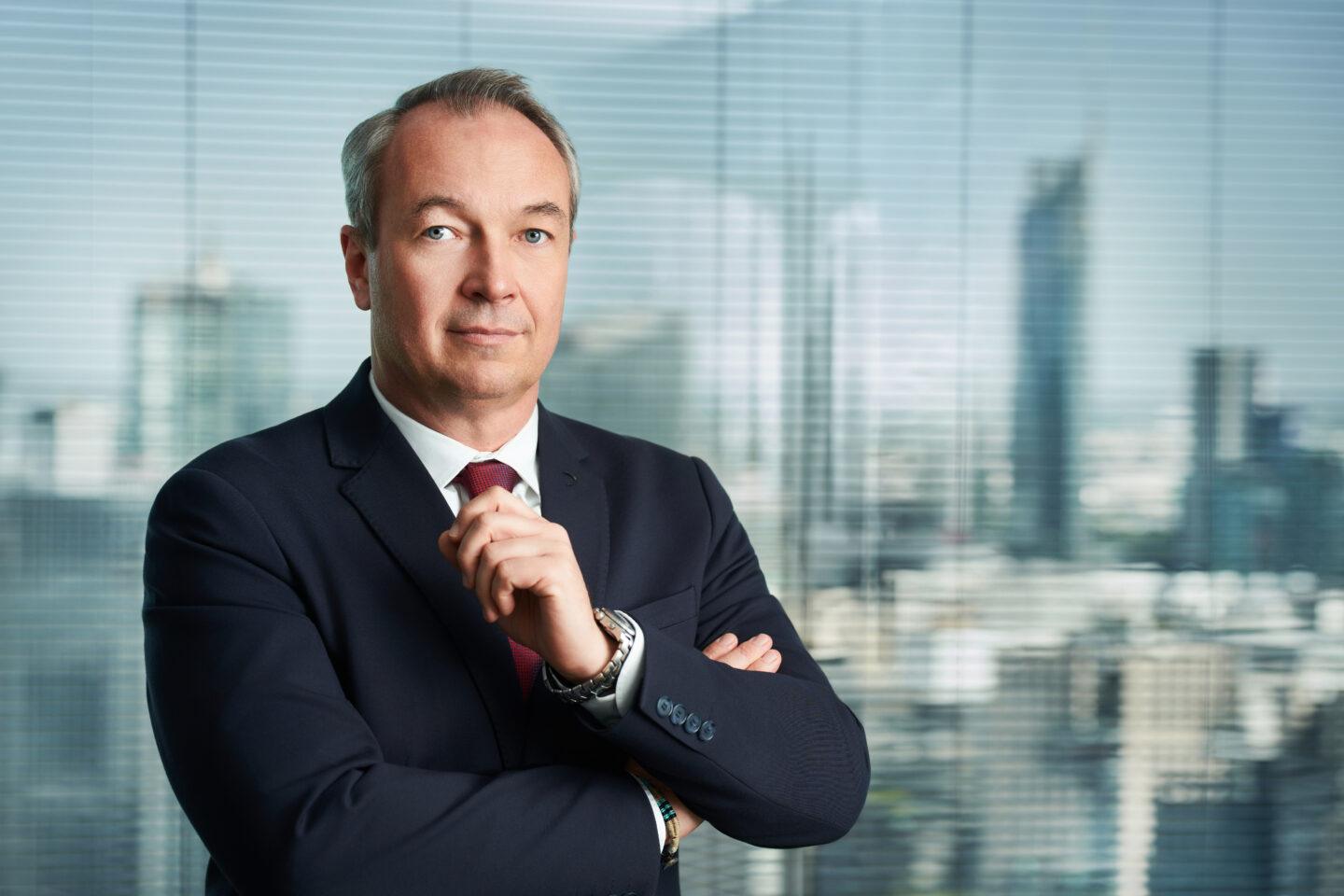
Marcin Celejewski, CEO of Grupa Azoty: To answer that fully, we would need a whole weekend-long program. I am absolutely serious: there are few things that did not surprise me. Above all, I wonder how the group could have been brought to such a critical state. Grupa Azoty is Poland’s largest fertilizer producer and the second-largest in the European Union. It has plants in Poland, Germany and Spain and sells its products worldwide. I was astonished that a company with such potential had not secured access to green ammonia earlier, given the key role it will play in fertilizer production in the future. Green ammonia is not available on a large scale in Europe, and probably will not be for a long time.
Other issues include the failure to secure gas from different sources, the lack of investment in production capacity in the core fertilizer business, the lack of investment in low-emission energy sources, and the failure to invest in fertilizer plants on other continents to offset the seasonality of production. Instead, Azoty invested in a polypropylene plant in Police and nearly went bankrupt as a result. It was a huge investment in an entirely new business. The plant is still unfinished and is dragging down the whole group. I find that shocking. I cannot rule out that it may have been deliberate.
Are you saying someone wanted to destroy Grupa Azoty?
How else do you explain the fact that someone almost succeeded in sinking a group that, from a business perspective, was unsinkable? And did so through a sophisticated mechanism that drew every company in the group into a debt spiral. I have not found a single document here indicating that an investment in the Police plastics plant on this scale made sense. So I do not really know what the Azoty management board at the time based its decisions on. Nor do I know what led as many as 13 banks to lend to Grupa Azoty on such a large scale. Today, we have to talk to each of those 13 institutions separately.
Altogether, the project left the group with between PLN 10 billion and PLN 20 billion [EUR 2.3 billion to EUR 4.5 billion] in debt, and interest on its obligations amounts to PLN 800 million [EUR 181.5 million] a year. On top of that, we have to spend around PLN 100 million [EUR 22.7 million] annually on advisers and law firms to handle the entire debt restructuring process.
Prosecutors are investigating
It is hard to believe there were no documents showing that an investment worth PLN 7 billion was viable. After all, the project was also financed by private banks and international financial institutions.
In our view, the official documents were unreliable. For example, they used understated raw material prices and were very optimistic about projected sales. Analyses by external parties that presented objective information crucial to the project were deliberately concealed. We have referred the matter to prosecutors, and I hope it will be thoroughly clarified. A special report on the investment will also be prepared, clearly identifying who was responsible for each decision and how those decisions were made.
The worst thing, however, is that no one will return to the company and its employees the billions drained from every company in the group. For years, Azoty did not develop or carry out necessary maintenance. At some facilities, including in Police, neglect of the production installations is visible to the naked eye.
How far along is the effort to save Grupa Azoty?
The company’s financial situation is stabilizing. It is much better than it was a year ago. We no longer have to sell off assets in an emergency to maintain liquidity. But things are not yet good enough for us to invest in the company’s development or even meet commitments made several years ago, for example regarding employee pay.
We remain subject to very strict controls on our spending by the financial institutions that provided us with an enormous loan to build the polypropylene plant in Police. This investment is dragging down the whole Grupa Azoty. Although we are improving our financial results, we still have not reached an EBITDA level [operating profit plus depreciation and amortization — ed.] that would allow us to keep up with interest payments and carry out essential maintenance on our installations. And the fertilizer market is not helping us either.
A rescue plan for the fertilizer giant
Will Azoty collapse without state support?
It is unreasonable to expect the state to magically save the group. We have strong support from our owner, but we have to act using market instruments.
But state-controlled Orlen is supposed to buy the new polypropylene plant, and Azoty expects to raise around PLN 600 million (EUR 136.1 million) from the State Treasury through a share issue.
The acquisition of Grupa Azoty Polyolefins by Orlen is a market transaction, not a state intervention. The process itself shows that: more than six months have passed since the preliminary agreement with Orlen was signed. Last Friday, a court approved a partial arrangement with Grupa Azoty Polyolefins’ creditors. This brings us closer to completing the transaction, which depends on the conditions set out in the agreement being met.
The second element is the first of the planned share issues, which will serve development objectives. Much of the money raised is intended to rebuild production capacity. So this, too, is a lengthy process. Before the shares can be sold, a sequence of corporate steps and agreements with financial institutions and the Capital Investment Fund must take place. Again, this is not a quick rescue mechanism, because the state simply has no such tools at its disposal for Azoty.
A bank agreement by year-end
Is it not frustrating that talks with the banks on debt restructuring have already gone on for so many months? Without that agreement and the sale of the new plant to Orlen, the group cannot move forward.
Of course it is frustrating. On our side, we have already signed preliminary key terms with the banks for the planned restructuring of our financial obligations. We have also agreed on some of the terms of a long-term debt restructuring agreement. We are now waiting for the banks’ final decision. Unfortunately, they are not unanimous, which is why the whole process is taking longer. We expect to sign an agreement this year, after which it will be possible to issue shares and raise funds for further development. The Ministry of State Assets has already secured the money for this purpose.
Is the end of the year the final deadline? How long can Azoty keep waiting?
We have to settle these matters this year. We joined the company, put things in order, conducted audits and prepared an action plan for the coming years. Nobody joined Azoty’s management board to spend all their time worrying about how bad things are. We came to solve the problem and start rebuilding Grupa Azoty’s position.
No money for pay raises
Employees have had enough of tightening their belts. Unions at the Puławy plant are seeking a net pay rise of PLN 1,500 (EUR 340). They considered management’s offer of a PLN 200 (EUR 45) raise insulting. Is an agreement possible?
These are the demands of the four main companies, not just the Puławy plant. The fact is that the company does not have the money for raises of that size at the moment. Employees received a one-off bonus in June, after three years of sacrifice, and were supposed to receive another in September. In the meantime, however, gas prices went crazy, so the budget shrank. At some subsidiaries we have already reached agreements with employees, and they have received small raises. We are currently negotiating with others. This is one of the most difficult issues in the group.
On a human level, I understand the employees and their confusion. For years, they have conscientiously done their jobs every day, taking satisfaction in seeing the products of their work sold in Poland and Europe, unaware that PLN 14 billion [EUR 3.18 billion] was simultaneously being drained from the companies for the polypropylene plant investment. Then, suddenly, they were told about the group’s dire situation and the need for deep restructuring. It was a shock, and they could not understand it. I explain the company’s situation to employees, how large the debt is and where it came from, and that there is not much more I can do ... at least for now.
Soaring gas prices
You mentioned that market conditions are not currently favorable for Azoty. How is the company coping with high gas prices?
We are holding intensive talks with our supplier, Orlen, about gas prices. We are also trying to reduce operating costs through deeper consolidation of the entire group. We are bringing together production, logistics and sales across our plants. This allows us to save money on our day-to-day needs. We are investing in restoring key production capacity — for example, restarting previously shut-down ammonia production lines in Police and Puławy.
But the price of gas, a strategic raw material for fertilizer production, is rising sharply. We are watching what the whole industry is doing. I cannot rule out that some of our competitors will suspend production, because there is already very limited scope to raise fertilizer prices further. Our interdisciplinary margin management team monitors key macroeconomic indicators and gas prices daily, adjusting production and sales across the group.
Could Azoty also suspend fertilizer production?
Such a worst-case scenario is possible, but we are not seriously considering it at the moment. We are watching how gas prices develop. We cannot keep raising fertilizer prices indefinitely because farmers cannot bear it. On the other hand, we have several factories and efficient facilities. So we have some flexibility to adapt to market conditions. We are also no longer under pressure from imports from outside the European Union. This year, fertilizer imports into Poland have fallen by around 40% year-on-year. That supports domestic production.
Gas from a single supplier
Azoty buys almost all its gas from Orlen today. With hindsight, was relying on a single supplier a mistake?
I believe it was. Azoty previously had several suppliers, and that diversification would seem safer and cheaper. We have even calculated how much the previous management’s decision to depend on a single supplier cost Grupa Azoty. Unfortunately, today our financial situation is so difficult that we cannot contemplate negotiations with new suppliers or importing gas into Poland ourselves, for example through a new floating LNG terminal. It is alarming that a company that helps ensure food security in Europe cannot develop its business, but instead spends the vast majority of its time dealing with the consequences of its predecessors’ misguided decisions, which were completely unjustified and unsupported by reliable analyses.
A call for a European fertilizer fund
What next? How will Azoty develop once it is free of debt?
We are already taking some steps. The current crisis in the Middle East has shown how important the chemicals industry and access to strategic raw materials are. Some countries have halted exports of key raw materials such as gas and sulfur, as well as finished products such as fertilizers. The European Commission responded by introducing a fertilizer action plan in May. Among other things, it is intended to strengthen production in Europe and reduce dependence on imports. It is, of course, only a document, but it shows a change in the Commission’s attitude toward local industry.
We estimate that around 9% of EU fertilizer production capacity has been lost in recent years. That is a great deal. To rebuild the industry, tariffs and the energy and environmental costs borne by producers need to be reviewed and made more realistic. Azoty is a strong European player with its own sulfur mine. Until recently, scenarios for phasing out that sulfur business were being considered. Today, we want to develop it. We are preparing several scenarios for the business, including possible cooperation with a strong domestic mining partner.
What support does Europe’s fertilizer industry need?
If the European Commission has recognized it as a strategic sector, concrete decisions must follow. The EU can use mechanisms already familiar from the rail market, for example. That entire industry relies heavily on non-repayable EU funding. Given the burdens currently faced by industry, no private investor will be interested in further investment. And they certainly will not invest in environmentally friendly production. These are facts reflected in the pace of the sector’s green transition and in the fertilizer companies that have closed down. That is why I expect more production capacity to disappear from the market in the coming years and smaller producers to vanish. The EU will then have to import even more fertilizer, and importers will dictate prices to us.
To counter this scenario effectively, the EU needs to introduce mechanisms that support the stated goal of rebuilding its own production capacity. I would like to see a European fund to rebuild fertilizer production capacity, even if it supported only “green” production. Otherwise, I worry about how effectively this policy will be implemented, both in terms of scale and — crucially — how quickly new capacity becomes available.
Consolidating the domestic sector
What is your vision for the future of Grupa Azoty and the fertilizer industry in Poland? Should Orlen-owned fertilizer producer Anwil eventually become part of Azoty?
It is obvious that a large group is the best way to operate. To start with, we need to consolidate what we already have more closely. We have one Grupa Azoty, but it consists of a confederation of several strong companies. That is not the most efficient arrangement. The natural strategic process we have begun is genuine consolidation of products, sales and logistics, to eliminate inefficiencies and maximize synergies among the companies in all areas. We have already managed to eliminate competition between our companies, but many processes still need to be standardized. Synergies in production, purchasing, sales and logistics bring concrete savings.
Bringing Anwil in would strengthen the group even further. But I would see even more companies within Grupa Azoty. Today, we cannot think about acquisitions at all because we are fighting for survival. But if I were managing Azoty without the burden of the failed investment in Police, without those loans and interest payments, I would look beyond the Polish market when thinking about a strong group.
Expansion abroad
Where could Azoty expand?
The natural directions for growth based on close cooperation or acquisitions in green ammonia, gas or fertilizer production are Africa, Asia, North America and South America. We would trade fertilizers on a large scale there and look for opportunities for cooperation or acquisitions. In Poland, our business is highly seasonal because key fertilizers really sell for only three months of the year. So I would look for opportunities in other parts of the world to offset that seasonality.
We have a subsidiary, Compo Expert, which produces specialty fertilizers at its plants in Germany and Spain and sells them around the world through its own sales network. We have Siarkopol, which mines sulfur and ships it to destinations including Africa. In Morocco, we have good relations with OCP, the giant fertilizer group. I see enormous potential to strengthen that cooperation and expand into the African market. A great deal is happening in Africa’s fertilizer industry right now, and Azoty could benefit.
But first, we have to restore the company’s ability to operate normally. If this plan to build Azoty’s strength had been pursued over the past 10 years, Poland would today have a second Orlen and the EU’s largest producer of high-quality fertilizers. Personally, I believe that scenario is still possible, provided that we quickly deal with the enormous debt carelessly incurred by our predecessors for an ill-conceived investment.


Key Takeaways
- The cost of the Police plant. Construction of the polypropylene plant in Police left Grupa Azoty with between PLN 10 billion and PLN 20 billion in debt. Interest alone costs the group PLN 800 million (EUR 181.5 million) a year. The fertilizer producer also spends around PLN 100 million (EUR 22.7 million) annually on advisers and law firms to handle the debt restructuring. “The plant is still unfinished and is dragging down the whole group. I find that shocking. I cannot rule out that it may have been deliberate,” says CEO Marcin Celejewski. The matter has been referred to prosecutors. The CEO says the company should sign a debt restructuring agreement with the banks and carry out the first of its planned share issues by the end of the year.
- Pressure from gas prices. Fertilizer market conditions, including rising gas prices, are working against Azoty. “We are holding intensive talks with our supplier, Orlen, about gas prices. We are also trying to reduce operating costs through deeper consolidation of the entire group,” Celejewski says. In his view, relying on Orlen as the sole gas supplier was a mistake. “We have even calculated how much the previous management’s decision to depend on a single supplier cost Grupa Azoty. Unfortunately, today our financial situation is so difficult that we cannot contemplate negotiations with new suppliers,” he says.
- Growth beyond Poland. Once it is free of debt, Azoty will look to strengthen its position at home and abroad. Anwil, a fertilizer producer in the Orlen group, could join Grupa Azoty. “Bringing Anwil in would strengthen the group even further. But I would see even more companies within Grupa Azoty,” Celejewski says. In his view, Africa, Asia, North America and South America are natural directions for the group’s growth. Azoty could look there for sales opportunities, partnerships and acquisitions in green ammonia, gas or fertilizer production. One option is closer cooperation with Morocco’s OCP. “But first, we have to restore the company’s ability to operate normally. If this plan to build Azoty’s strength had been pursued over the past 10 years, Poland would today have a second Orlen,” the CEO says.