

This article is a part of Poland Unpacked. Weekly intelligence for decision-makers
CLIP Group has opened a major intermodal terminal in Zabrze at a cost of nearly PLN 200m. The investment is intended to strengthen Silesia’s role on European transport routes and help Poland consolidate its position as one of Europe’s logistics hubs.
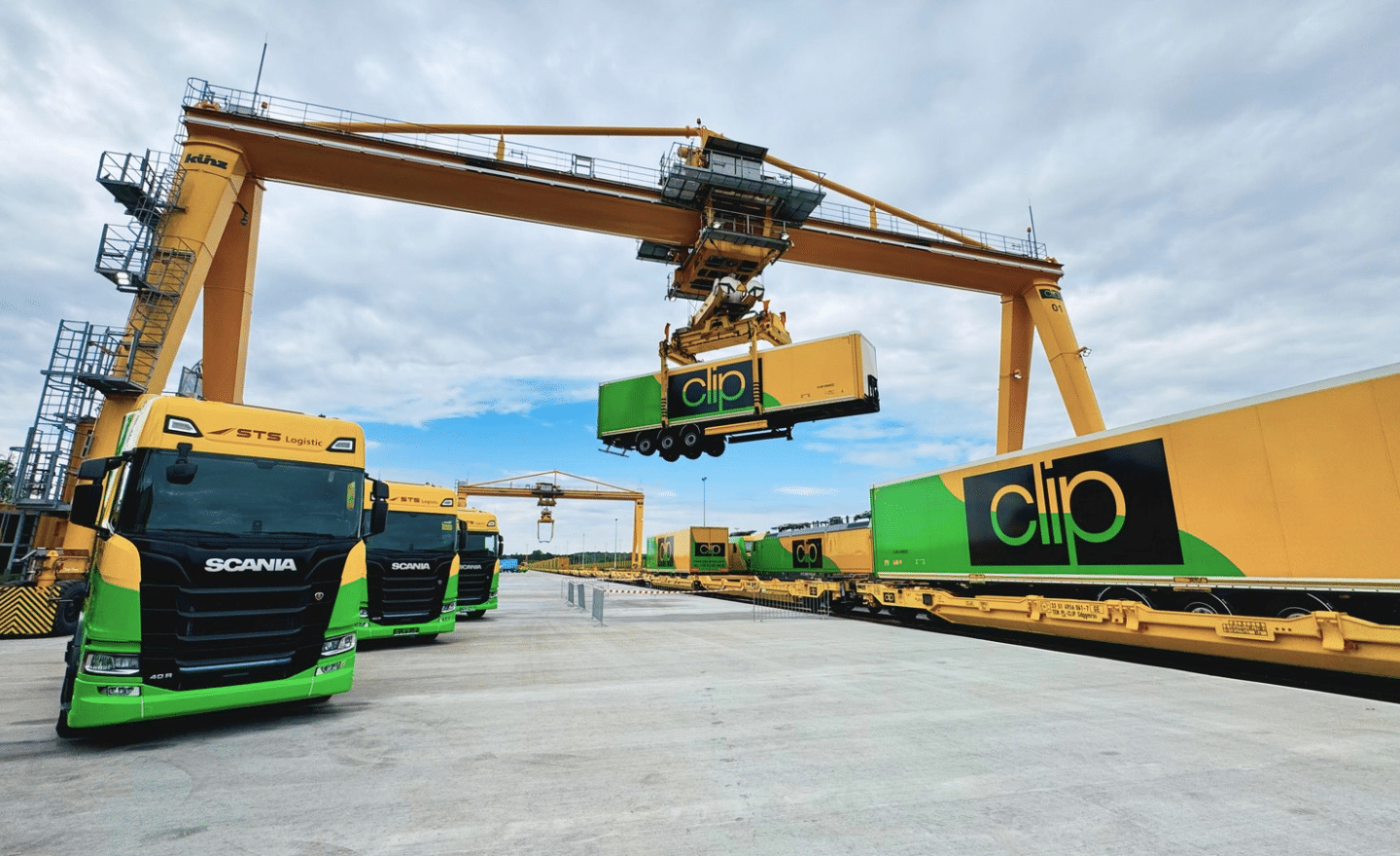
On Thursday, September 24, CLIP Group opened a new intermodal terminal in Zabrze-Makoszowy, designed to connect Upper Silesia’s industrial base with Europe’s rail-freight network. The nearly PLN 193m investment is part of the group’s broader strategy to develop its own network of terminals and intermodal connections.
Its significance, however, extends beyond the company itself. The aim is to increase rail’s share of freight transport, ease pressure on road transport and strengthen the resilience of supply chains.
Terminal on the former Makoszowy mine site
South Poland Terminal Zabrze was built on post-industrial land formerly occupied by the Makoszowy coal mine. The project is worth PLN 192.87m, of which PLN 72.45m comes from European Union funds under Poland’s National Recovery Plan and NextGenerationEU.
The investment included the construction of a new rail-track system, yards and roads, the modernization of arrival and departure tracks, and the purchase of equipment and IT systems. The terminal is designed to handle both domestic and international freight and expand intermodal transport capacity in southern Poland.
The Makoszowy site provides access to around 50 hectares of land, a large industrial market and the A1 and A4 motorways. The region also generates substantial freight volumes linked to industry, automotive manufacturing and logistics.
“The site seemed ideal to us because it is very well connected to the road network. The A4 is nearby and we have access to the local market. This is a huge consumer base and Poland’s industrial heartland, which is undergoing a transformation. I think this is an ideal location for this kind of project in Silesia, which is a vast market and needs transport arteries of this kind,” says Agnieszka Hipś, CEO of CLIP Group.
The terminal is equipped with electric RTG cranes with a lifting capacity of 40 tonnes, as well as a terminal operating system, or TOS, to manage its operations. The infrastructure can handle full-length freight trains. The terminal also allows semi-trailers to be transferred horizontally, without the need to lift them by crane.
“This is an investment of national importance. The whole of southern Poland will benefit economically, while new opportunities will open up not only for the Silesian region but also for neighboring regions. It is an opening to the world,” says Kamil Żbikowski, mayor of Zabrze.
From warehouses to its own terminal network
Zabrze is the latest addition to the infrastructure being developed by CLIP Group. The group has operated on the Polish market since 1998, with its main base in Jasin near Swarzędz. Today, its business spans warehousing, contract logistics, road and rail transport, intermodal terminals, automotive logistics, customs services and energy.
CLIP Logistyka operates nine high-bay warehouses and production halls with a combined area of around 520,000 sq m. CLIP Intermodal has a fleet of about 660 intermodal wagons. STS Logistic, meanwhile, operates 325 car transporters and four storage yards with a combined capacity of 25,000 vehicles.
Swarzędz remains the group’s largest hub to date. Following its expansion, the terminal can store 10,000 TEU (Twenty-foot Equivalent Units – the standard measure used in container transport, equivalent to one 20-foot container, or about 6.1 meters) and has eight 750-meter transshipment tracks. CLIP is also developing a terminal in Małaszewicze, on the European Union’s eastern border. Zabrze is intended to form the southern part of this network, while the group has identified Świnoujście as its next direction of expansion.
In this model, intermodal transport is not merely an alternative to road haulage. It is intended to integrate rail, roads, terminals and warehousing infrastructure into a single system. This becomes particularly important on long-distance routes, where costs and driver availability are becoming increasingly significant constraints.
Fireside chat
Intermodal is where logistics is heading
How strategically important are intermodal transport and the Zabrze terminal for CLIP Group?
Agnieszka Hipś, CEO of CLIP Group S.A.: We believe this is the direction logistics will take. It is, in a way, a sign of the times. Scale also matters. Poland still does not have enough terminals. Once we have these kinds of “transshipment stations” in many locations, a market will emerge around them and make use of them. There is little point in being alone in a market and small at the same time, which is why we are also trying to achieve scale.
We already have three large hub terminals and will build a fourth at a Polish port. We are also gradually looking at acquisition opportunities abroad. We want to achieve significant scale in logistics. This will support the economy, create new jobs and generate benefits for local governments. Of course, we are in business to make a profit, but at the same time we want to improve things rather than make them worse. We hope market conditions will work in our favor.
Does the terminal mark the end of CLIP Group’s investment in Zabrze?
No. The terminal, the large transshipment yard and the vehicle storage area are only the beginning of our investment in Zabrze. We bought a substantial part of the former mining site because we also want to develop commercial space here. Whether that will be logistics or manufacturing will depend on future customers.
We welcome anyone who would like to build their own facilities in Zabrze directly next to the terminal. This location was not chosen by accident. It used to be the mine’s logistics base, so the infrastructure already in place is far heavier-duty and more robust than modern, decarbonized logistics actually requires.
How has cooperation with the local authorities worked?
I have to say I am genuinely delighted. In the two years since we arrived in Zabrze, the city authorities have changed, but every successive administration has worked very well with us.
Everyone saw the arrival of a new investor as an excellent opportunity to redevelop something that had been somewhat forgotten for years. There was a shared desire to put the former mining land to new use.
Of course, given the region’s coal-mining history, some people here initially reacted somewhat allergically to the word “decarbonization.” But after a little explanation, it became clear that we were not talking about the mine or coal, but about decarbonizing transport. More seriously, however, cooperation with the local authorities has been excellent. It is a very capable and efficient administration.
Why Silesia? Which industries are expected to be most important for the terminal?
Silesia is one of the largest domestic markets in Poland. It remains a strongly industrial region. We have steelworks, metallurgy, the automotive industry and many other manufacturing businesses here. On top of that, there is a very large consumer market.
When I ask colleagues from our automotive company why they need such a large vehicle yard here, covering more than 20 hectares, they tell me that both Wielkopolska and Mazovia are smaller markets in this respect than Silesia. The region’s consumer potential is therefore difficult to overstate.
We also have land that is already industrial in character, so its designation does not have to be changed and it can be adapted to new uses. I think logistics can be more successful here than in many other regions of Poland. We are also looking at other locations in the south of the country, including elsewhere in Silesia. Not every investment has to look the same, but we are interested in places where we could carry out transshipment operations or handle our own trains.
How realistic is the terminal’s role in an EU-Ukraine corridor?
I sometimes feel that the public debate is getting ahead of itself. We assign particular scenarios to the future even though the war is still ongoing.
For me, Ukraine today is the place thanks to which we are still able to live in the level of comfort we enjoy. Like the rest of Europe, I hope this war ends.
Today, many Ukrainians work in Poland. We are happy to employ them and welcome them into our companies. These are people who are very close to us. We should respect the fact that they want to be here and work here. And in the future, if there is an opportunity to use this terminal as part of Ukraine’s reconstruction, we will of course want to take part.
Is intermodal transport resilient to shocks such as the pandemic, war or economic crises?
We are not particularly resilient to them. Since the beginning of the 21st century, the European Union has encouraged both public and private companies to invest in intermodal transport, but along the way the conditions for doing business have changed very significantly several times.
We are pleased that rail infrastructure is being modernized, because it will work better once the upgrades are completed. The problem is that companies have to survive the construction works in the meantime. The same applies to war, economic crises or very large changes in energy prices.
Business needs stable conditions. Electricity cannot suddenly become twice as expensive, nor can other factors affecting investment profitability change dramatically overnight.
The same applies to regulation. We are calling for a slowdown in the pace of lawmaking. You cannot change everything at once. The perfect can be the enemy of the good. Capital, both domestic and international, does not like disruption or constant changes in the factors that determine profitability.
Polish companies and businesses operating in Poland are doing well. Give them a little room to breathe, and they will do even better.

Intermodal transport must be not only green, but profitable
The official opening included a debate on Poland’s place on Europe’s logistics map and the outlook for intermodal transport. The discussion quickly moved beyond the investment itself. Panelists pointed to shortages of truck drivers and train drivers, infrastructure bottlenecks and limited capacity at border crossings.
One of the main topics was the changing economics of transport. Two decades ago, rail in the intermodal model was promoted primarily as a way to reduce emissions. Today, the business case is becoming increasingly important as well.
“I have the impression that what is happening in the road-freight sector today creates an opportunity for intermodal transport to become both environmentally sustainable and economically viable. It has lost none of its environmental advantages, while the economics now make a much stronger case for intermodal transport,” says Mateusz Zając, PhD, DSc, Eng., of Wrocław University of Science and Technology.
Another barrier is infrastructure beyond the terminals themselves. An efficient transshipment point is not enough if, further along the route, trains encounter bottlenecks or congested border crossings.
“Ports are not standalone entities. We are important links in supply chains. Whether shipping lines want to call at our port, and whether customers want to entrust their cargo to them, also depends on how accessible the port is by road and rail,” says Dariusz Mierkiewicz, Business Development Manager for Poland & North Europe at the Port of Koper.
Expert's perspective
Intermodal will grow, but it will not dominate transport
I would, however, be cautious about saying that intermodal will come to dominate transport. Road haulage still plays by far the largest role. In Poland, the length of domestic routes is an additional constraint: for many shipments, distances are simply too short for intermodal transport to make economic sense.
Scale is crucial. Intermodal requires large, regular volumes because launching such services involves high costs related to infrastructure, rail access and transshipment. Rising road-transport costs, driver shortages and energy prices improve its competitiveness, but they do not alter the underlying economics.
A terminal such as the one in Zabrze is highly impressive, but for this model to work, many elements have to fall into place at the same time. It requires sufficient volumes, customers, rail connections and efficiently functioning infrastructure. Only then does intermodal become a genuinely cost-effective alternative.
Poland’s position as one of Europe’s most important logistics backbones offers considerable scope for further growth. The country has well-developed ports, rising imports from Asia, vast distribution centers and companies handling flows that extend far beyond the Polish market.
With large volumes, there is a natural opportunity to combine maritime transport, rail and warehousing, while road transport is used primarily for the final leg of delivery.
Public support for such investments also matters. The terminal in Zabrze is a good example: the project is worth around PLN 193m, with more than PLN 72m in funding from Poland’s National Recovery Plan.
From the perspective of the warehousing market, the terminal’s location is itself highly significant. Zabrze is part of the rapidly developing Upper Silesian conurbation, where warehouse activity is concentrated, among other places, in Gliwice, Zabrze and Ruda Śląska, as well as along the A1 and A4 motorways. For that reason, although the terminal is also presented as part of a corridor leading toward Ukraine, in the shorter term I see particularly strong potential in serving routes between Upper Silesia and Germany, Austria and southern Europe. These are the markets where the volumes already exist that could most quickly justify the development of such connections.


Poland between the Baltic, the Adriatic and Ukraine
Poland’s position at the intersection of east-west and north-south routes was one of the recurring themes of the debate held to mark the opening of the new intermodal terminal in Zabrze-Makoszowy. Poland’s own ports matter, but so does access to Adriatic ports and the prospect of future freight flows linked to Ukraine.
In the part of the discussion devoted to ports, panelists stressed that they should not operate as isolated infrastructure islands. Their importance depends above all on the economy they serve, their hinterland and the networks that allow goods to move efficiently to and from them.
“Our role is to act as a gateway for the economy, and it is customers who will decide how they use that gateway. Poland has always stood at the crossroads of north-south and east-west routes. That role is only becoming stronger,” says Dominik Landa, co-owner and co-founder of OFF-DOCK Gdańsk.
Another area of growth is semi-trailer transport. Handling trailers is intended to be one of the important functions of the Zabrze terminal. The model allows the long-haul section of a journey to be shifted to rail, leaving trucks primarily to handle the first and last mile.
“Everyone across Europe sees the potential in semi-trailer transport. If intermodal is to grow, then in my view it will develop more toward semi-trailers than containers,” says Paweł Szczapiński, CEO of Captrain Polska.
For CLIP Group, South Poland Terminal Zabrze is therefore part of a broader network spanning western Poland, the south of the country and its eastern border. For Zabrze, it gives former industrial land a new economic role. For the logistics industry, it adds another node capable of increasing freight flows between industrial centers, ports and European markets.


Key Takeaways
- Zabrze is set to become one of the more important intermodal hubs in southern Poland. Its location in the country’s industrial heartland, close to the A1 and A4 motorways and major rail corridors, gives the terminal access to substantial freight flows. Its role could extend beyond the Silesian region to include international traffic.
- CLIP Group is steadily building its own logistics system based on rail, terminals and warehousing infrastructure. After Swarzędz and Małaszewicze, Zabrze is another part of that network. The group is placing particular emphasis on semi-trailer transport and long-distance intermodal services, which are becoming increasingly competitive as road-transport costs rise and driver shortages persist.
- Infrastructure alone will not be enough for Poland to capitalize on its geographic position. Efficient rail connections, greater border capacity, sufficient staffing, and an adequate base of customers and freight volumes will all be necessary. It is also crucial that Poland does not become merely a transit country, but a place where goods are processed, stored and given additional value.