

This article is a part of Poland Unpacked. Weekly intelligence for decision-makers
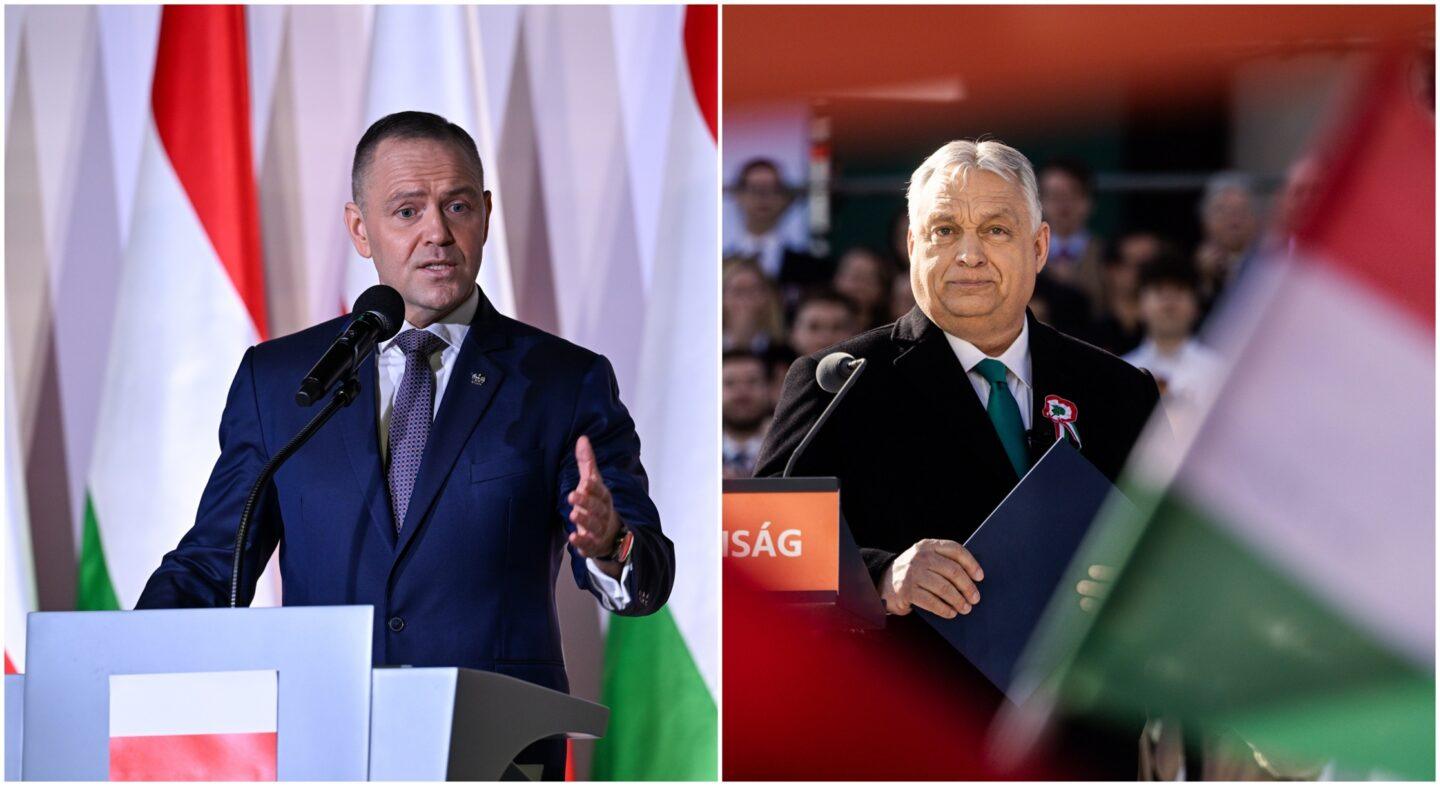
Ahead of the parliamentary elections in Hungary, competition between the main players is intense. According to a poll conducted by the Minerva research firm between March 10 and 11, the opposition party TISZA Party has the best chance of winning, with 51.3 percent support, while Orbán’s ruling Fidesz stands at 40.1 percent. Earlier polls had indicated a more closely contested race.
Polish echoes of the Hungarian elections
Hungary’s elections are also reverberating through Polish politics. This past Saturday, CPAC Hungary Conference took place in Budapest, Hungary, organized by American Republicans. A similar conference was held by Americans in Poland ahead of the second round of the presidential election. At that time, they backed Karol Nawrocki, and this time they are supporting Viktor Orbán, whose party Fidesz is fighting to retain power.
Among the foreign politicians attending the Budapest conference was former Polish prime minister Mateusz Morawiecki. He expressed his support for Viktor Orbán.
For the evening of Monday, March 23, President Karol Nawrocki scheduled a trip to Budapest. He met with Hungarian President Tamás Sulyok in Przemyśl, Poland, launching the Polish–Hungarian Friendship Days. The program includes meetings between President Nawrocki and both the president and the prime minister of Hungary in Budapest.
In parallel, Budapest is hosting a meeting of members of the international alliance “Patriots for Europe” on Monday. The guest list included, among others, Krzysztof Bosak, deputy speaker of the Sejm from the Confederation party (it is Confederation, not PiS, that sits in the same European Parliament group as Fidesz), Czech Prime Minister Andrej Babiš (online), French far-right leader Marine Le Pen, and Italian Deputy Prime Minister Matteo Salvini.
Still in Przemyśl [south-eastern Poland, near the border with Ukraine – ed.], President Karol Nawrocki stated during a joint press briefing with the Hungarian president that despite their friendship, differences persist between Poland and Hungary. One such difference is their stance on Vladimir Putin, with whom Viktor Orbán continues to maintain friendly relations despite the ongoing four-year-long invasion of Ukraine.
President Nawrocki emphasized that, for Poland, Vladimir Putin is a criminal and a threat. He assured that “Poles love Hungarians, but hate Vladimir Putin.” His Hungarian counterpart stated that he agreed that differences exist, adding that they do not undermine the foundations of mutual relations.
A tense response from the president
Such declarations do not make the issue of the Hungarian prime minister’s pro-Putin stance disappear. When a TVN24 reporter asked whether the president was troubled by Mr. Orbán’s closeness to Putin, Karol Nawrocki reacted with visible irritation.
“What are you trying to ask? Did you not listen to the press conference? Did you not hear what I think about Vladimir Putin, sir? You’ve been producing pieces saying that Putin is after me. Please get your facts straight and listen to what the President of Poland is saying. I am telling you, sir, Vladimir Putin is a criminal. Do you understand, sir?” Mr. Nawrocki said.
The claim of being “pursued by Putin” is frequently repeated by Mr. Nawrocki and politicians from Law and Justice (PiS). It refers to a Russian list of individuals wanted for the removal of Soviet monuments in Poland. Mr. Nawrocki ordered such removals while serving as head of the Institute of National Remembrance (IPN). On that list, alongside him, are also presidential aide Karol Rabenda and Roman Szełemej, the mayor of Wałbrzych in south-western Poland.
The president’s reaction, however, shows that the Hungarian prime minister’s friendly relations with the Russian dictator are not a comfortable topic for the right wing.
Within the conservative camp, not everyone finds Mr. Orbán’s stance easy to accept. His pro-Russian policy was described on Monday on Radio Wnet by columnist Bronisław Wildstein as anti-Polish. When asked to assess Karol Nawrocki’s trip to Budapest, he replied: “I am torn and do not have a straightforward answer.”
After Monday’s meetings in Budapest, Karol Nawrocki published a photo report that also included an image with Prime Minister Viktor Orbán. In the same post, he again emphasized the differences in both countries’ contemporary approaches to Russia.
“Centuries of shared history and common national heroes unite us. Hungary extended a hand to us when we were defending ourselves against Russian Bolshevism in 1920; we showed them solidarity in 1956 when Kremlin imperialism crushed their freedom. We Poles love Hungarians and hate the war criminal Putin. Russia will always be a threat to us, while Hungary is an eternal friend,” President Karol Nawrocki wrote.
The previous meeting had been canceled by President Nawrocki
Karol Nawrocki decided to travel to Budapest despite having canceled a meeting with Viktor Orbán last year precisely because of Orbán’s ties to Vladimir Putin. On November 28, the Hungarian prime minister was a guest at the Kremlin, and on December 3 he was scheduled to host President Nawrocki.
During his visit to Moscow, Mr. Putin praised Mr. Orbán’s stance toward Ukraine. Rafał Leśkiewicz, spokesperson for President Nawrocki, made it clear that the context of Mr. Orbán’s visit to the Kremlin was the reason the meeting was canceled.
Since then, however, Viktor Orbán has not changed his pro-Putin and anti-Ukrainian stance. He continues to treat Ukraine as an adversary and maintains close ties with Putin’s Russia. A recent report by The Washington Post points to regular Hungarian–Russian contacts.
According to the American newspaper, Russians reportedly offered Mr. Orbán the organization of a staged assassination attempt to boost Fidesz’s chances of winning. The fake attack did not take place, but the publication describes other details of Russian guidance. One example is the suggestion that the leader of the TISZA Party, Péter Magyar, is being controlled by Brussels.
Hungarian Foreign Minister Péter Szijjártó, according to the American daily, is said to have visited the Kremlin 22 times since the start of the invasion of Ukraine. He is also reported to have regularly informed Sergey Lavrov about discussions at EU-level forums concerning Russia, including during meetings of the Council of the European Union.
Hungarian authorities have denied the American reports. The European Commission, however, is seeking clarification regarding alleged leaks of information to Russia.
Mr. Orbán’s defeat – Mr. Ziobro’s extradition
Despite assurances of an anti-Russian stance, Poland’s right wing does not want to sever friendly relations with Viktor Orbán. A change of government in Hungary would mean losing an ally in disputes within the European Union.
For some politicians from Law and Justice (PiS), it would also entail direct personal consequences. Péter Magyar has announced that, if he wins the election, he would proceed with the extradition of Zbigniew Ziobro and Marcin Romanowski. The former heads of the Ministry of Justice – whom prosecutors seek to charge in an investigation into the Justice Fund – have been granted political asylum in Hungary and are actively involved in pre-election efforts supporting Mr. Orbán.
Read more about the case of Mr. Ziobro: Strongman rhetoric, weak exit
The leader of the Hungarian opposition does not hide his sympathies toward the Polish prime minister. In February, Péter Magyar visited Donald Tusk in Warsaw. He declared his willingness to cooperate with Poland and announced that Poland would be the first destination of his foreign visit if he becomes prime minister after the election.
Prime Minister Tusk described the meeting with these words: “Some wanted to make Warsaw into Budapest. Today, Budapest wants to be like Warsaw.” In doing so, he alluded to a statement made by Jarosław Kaczyński in 2011, after PiS lost the election, when he said he was convinced that “we will have Budapest in Warsaw.”


Key Takeaways
- Support for Orbán from right-wing politicians from Poland, across Europe, and also from the United States underscores the importance of the Hungarian elections for the balance of power in Europe. The election campaign in Hungary is highly competitive. The latest polls indicate an advantage for the TISZA Party, but Fidesz, Viktor Orbán’s party, is unlikely to concede defeat easily.
- There is a contradiction between the declarations made by politicians from Law and Justice (PiS) and President Karol Nawrocki, and their actions toward the Hungarian authorities. On the one hand, they present themselves as anti-Russian and anti-Putin; on the other, they are assisting in the election campaign of Viktor Orbán. His relationship with Vladimir Putin has not weakened since Russia’s invasion of Ukraine.
- For the right wing, a victory for Viktor Orbán would mean retaining an ally in disputes with EU institutions. By granting political asylum to two PiS politicians, Orbán also serves as a guarantor of support and security in the event that other politicians face potential charges. Donald Tusk, the prime minister, is counting on a victory for Mr. Orbán’s challenger, Péter Magyar.