

This article is a part of Poland Unpacked. Weekly intelligence for decision-makers
Grupa Pracuj’s success has placed Agnieszka Grabowska-Gacek and Przemysław Gacek among Poland’s wealthiest people and given them independence as investors. Their portfolio already includes four startups valued at more than USD 1bn each. They also devote millions of zlotys to philanthropy and criticize the weakness of financial education in Poland.
Industry remains the dominant sector among Poland’s wealthiest people, but it is steadily losing ground to technology. One of the most valuable Polish technology companies is Grupa Pracuj. Its market capitalization on the Warsaw Stock Exchange (WSE) is around PLN 4bn and exceeded PLN 5bn at its peak. Its combined net profit over the past five years surpassed PLN 1bn.
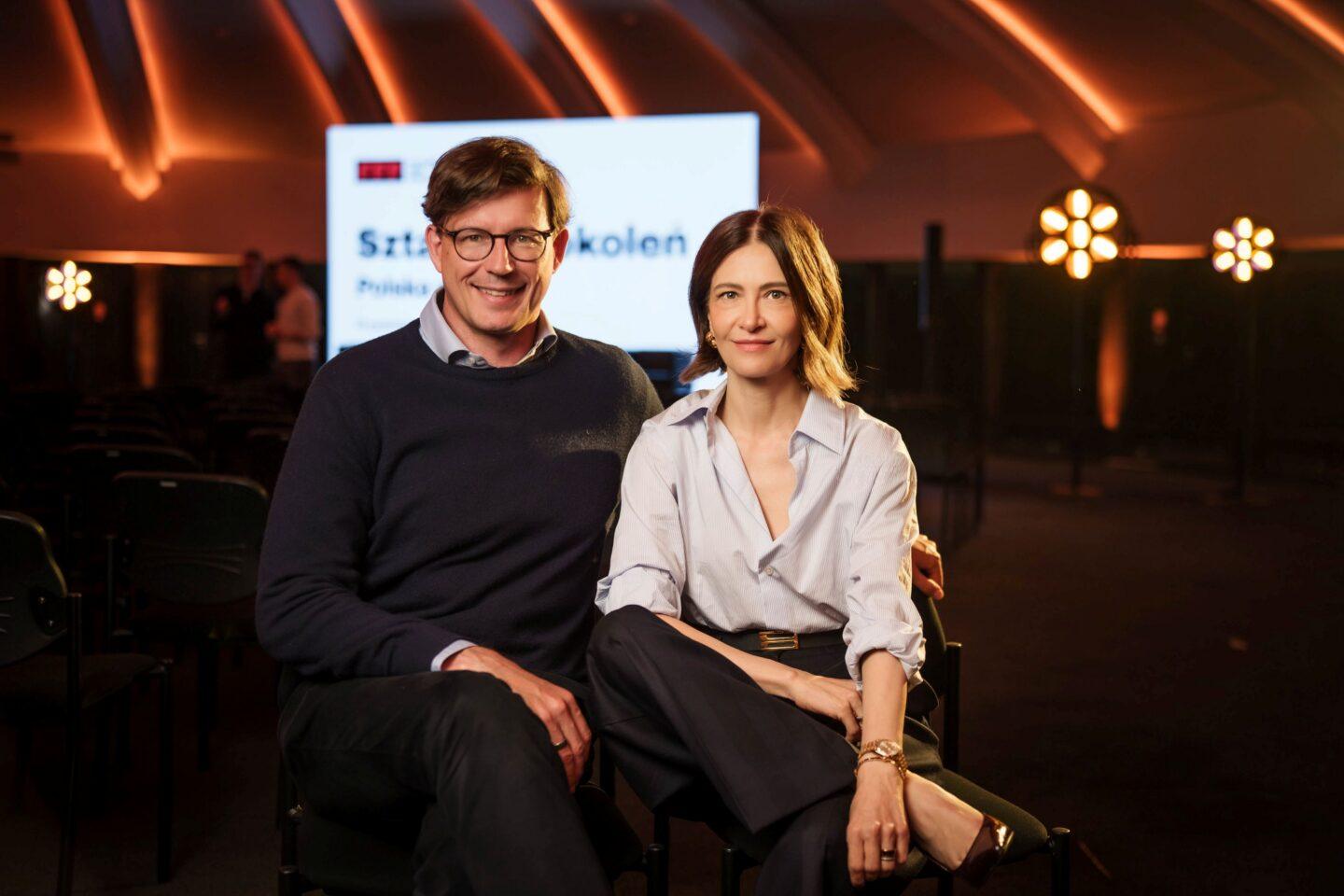
Przemysław Gacek conceived Grupa Pracuj, is its largest shareholder and has been its CEO continuously for 26 years. He and his wife, Agnieszka Grabowska-Gacek, have been active investors for many years. They discuss their involvement in startups and real estate, their promotion of philanthropy, and the barriers that prevent Poles from investing.
Who's who
Different careers, shared goals
Apart from internships, working for his own company was Przemysław Gacek’s first career step. A graduate of the University of Warsaw and later London Business School, he created Grupa Pracuj in 2000. He is a sailing enthusiast and world champion, and the author of the book Kurs na wzrost. Decyzje, które zbudowały Grupę Pracuj — roughly, A Course for Growth: The Decisions That Built Grupa Pracuj — published in 2026.
The company’s success is not the only evidence of his effectiveness as an entrepreneur. Grupa Pracuj is a leader among job websites in Poland and Ukraine, with European ambitions. In 2023, Gacek won the 21st edition of the EY Entrepreneur of the Year competition; 18 years earlier, he had won its New Business category. In 2018, he received the Polish Business Roundtable award in the Vision and Innovation category.
Agnieszka Grabowska-Gacek followed a very different path. She began her HR career in the 1990s and spent years in director-level positions at international organizations. She has been an adviser to Grupa Pracuj’s management board since 2006 and has managed the Hesta Investments family office since 2024.
She studied business psychology at SWPS University and completed an Executive MBA program at the Canadian International Management Institute, delivered in cooperation with Harvard Business School. She is involved in numerous initiatives, including those supporting civil society.
A well-matched investment duo
Mariusz Bartodziej, XYZ: You have both been known in business for years, but this is your first interview together, and it is about your joint investments. Does that add to the stress?
Agnieszka Grabowska-Gacek (AG-G), management board member at Hesta Investments: For me, yes, because I am not a media person. But we talk about these subjects regularly, so I believe the stress will pass quickly.
Przemysław Gacek (PG), CEO, co-founder and largest shareholder of Grupa Pracuj: We complement each other very well. Generally, I talk more about different projects, while Agnieszka devotes more attention to analyzing them. She brings a different, interesting perspective.
We try to invest all our surplus capital — including capital from Grupa Pracuj dividends [the company’s dividend for 2025 amounted to PLN 206.7m; Przemysław Gacek owns 51.95% of its shares — ed.] — wisely and in a diversified way.
Values matter more than profit
Which of you more often holds the other back from an investment?
AG-G: I do not feel that either of us particularly holds the other back. We often disagree, but we listen to each other’s arguments and know how to persuade one another. We invest most in technology companies because that is what we understand best. We try not to enter areas where we lack sufficient expertise, even if they look very promising.
PG: We are very different. I generally look at the world through rose-colored glasses. Agnieszka has the ability to examine a subject more deeply. She asks a lot of difficult questions about things that seem obvious to me. That is uncomfortable for me, but very important. As an entrepreneur, I tend to push forward with the attitude that “it will work or it won’t.”
There are not many projects we consider seriously because we are very selective. We are not a fund, so we do not have a set investment period or a return target to meet. For us, investing is a way to diversify our wealth wisely while remaining consistent with our values.
Values you both share?
AG-G: We have been together for 21 years. We have discussed and agreed on our values in depth, as well as a list of things we do not want to do. That pays off not only in our private lives but also in investing. We do not have to get involved in everything that makes a profit.
What do you mean?
AG-G: We have fairly clear views, for example, on raising children. Education and digital well-being are particularly important to us. So we generally do not consider supporting initiatives that run counter to our views, regardless of their potential return. That is why we do not invest in social media or video game producers, for example.
We also try not to invest in ventures that drive excessive consumerism. Likewise, we will not invest in any producer of intoxicants or stimulants. We have selected our investment areas very carefully, and the Hesta Investments family office we founded in 2023 gives us complete freedom in that respect.
PG: At Grupa Pracuj, defining what we did not want to do was crucial from the beginning. It allows us to focus our time and energy on what interests us. The same approach guides our investing.
GBP 1,000 to get started
You did not always have so much freedom to decide how to use your money. In 1999, you flew out for an internship with GBP 1,000 borrowed from your mother and holes in your shoes. How much did that sum mean to you at the time?
PG: Our son still does not believe the story about the holes in my shoes. But I noticed them very quickly because London was terribly wet.
My starting take-home pay at PwC was GBP 1,100 a month. A room in a house I rented with five colleagues cost GBP 450, and a monthly Underground pass was around GBP 100. That left me with an average of about GBP 15 a day to live on. I ate at the Mr Wu chain of Chinese restaurants, where I could eat as much as I wanted for GBP 4.99.
The GBP 1,000 I borrowed from my mother allowed me to make it to my first paycheck without sleeping on the street. And I know the stories of now-established Polish entrepreneurs who initially spent nights in parks. They wanted to see what the world was like. Those were student days: nobody worried about difficult conditions. You went for the experience.
Do you think young startup founders today, who quickly raise investment rounds worth millions, would be willing to make similar sacrifices? Or might that no longer be necessary?
PG: Regardless of the generation, if someone really wants to be an entrepreneur, they will do a lot to make it happen. They will be willing to work as much as 20 hours a day and sacrifice the best years of their youth without any guarantee of success.
Six years to buy an apartment and a car
You and your partners had little more than that GBP 1,000 a year later, when you founded Grupa Pracuj. How long did it take before the company allowed you to pay for more than basic needs?
PG: At the beginning, Jeremy Hunt [a former British minister and entrepreneur — ed.] supported us, mainly by giving us credibility. The first serious money — USD 200,000 — came from Jim Van Bergh of e-Katalyst, but we spent all of it developing the company.
The breakthrough came in 2006. US fund Tiger Global invested several million dollars in us at a valuation of USD 37m. Most of it went into the company as capital, but each founder sold part of their stake. It was enough mainly for a car and an apartment. That was when we first felt that creating the company was giving us something back.
So after around six years. Looking back, is that a long time?
PG: It is hard for me to say. What do you think, Aga?
AG-G: I think it is relatively short. Some companies increase in value at lightning speed, but they are a tiny fraction of a tiny fraction.
More than a decade investing in technology businesses
When did the time come to invest seriously?
PG: A few years after the global financial crisis, which we managed to navigate wisely as a company. It was a very stressful period at work for me, and it coincided with starting a family. Conversations with Aga, who by then was a certified coach and management board adviser, helped me deal with it.
A second wave of startups was emerging in Poland. The first had produced, apart from Grupa Pracuj, companies such as Allegro, Onet and Wirtualna Polska. We did not have enough free time to talk to founders of young companies, so in 2012 Maciej Noga, Paweł Leks, Marcin Zabielski and I founded Hedgehog Fund. Marcin ran it.
For several years, Hedgehog Fund invested only the private money of around 20 business angels — approximately EUR 6m–7m in total.
With what result?
PG: There were a dozen or so projects, but the scale was too small to generate large returns. For us, the most successful was the language-learning platform Preply. In its investment round this year, it reached a valuation of USD 1.2bn. The company’s founder, Kirill Bigai, has an approach to product and business similar to mine, so we clicked immediately.
How do you look back on those early days?
AG-G: Very fondly. Every new company was an opportunity to meet interesting people, understand their business idea and try to assess its chances of success. That process of discovering and analyzing new opportunities still gives us great pleasure.
PG: Around that time, Aga and I also made our first individual investments, including in DocPlanner, known in Poland for the ZnanyLekarz brand. I already knew its founder, Mariusz Gralewski, from his GoldenLine days. Grupa Pracuj had wanted to buy his website, but we were too late.
I remember our first meeting about investing in DocPlanner well because I literally ran in late after a problem with my bicycle. Even so, just as with Kirill, we clicked immediately.
Four billion-dollar companies in the portfolio
DocPlanner and Preply are two of several so-called unicorns — startups valued at USD 1bn or more — in your portfolio. How do you “hunt down” such companies at the right moment?
AG-G: I do not think many investors — if anyone — can say with complete confidence that they can recognize a future unicorn. We certainly do not have a formula, even though we now have four such companies in our portfolio. The people behind the companies we invest in matter enormously to us.
Both Mariusz at DocPlanner and Kirill at Preply thought about their companies on a large scale from the beginning. But what we particularly value in them is their ability to build teams.
How so?
AG-G: Neither is afraid to hire people who are better than they are in particular fields. That takes a lot of maturity and an ability to put one’s ego aside. Contrary to appearances, it is not that common among entrepreneurs.
We feel similarly about the founder of US company Stord, which offers technology and logistics solutions for e-commerce. The company has already reached a valuation of USD 3bn, and the development of artificial intelligence and AI agents in commerce may open up further opportunities for it.
We did not invest in all our billion-dollar companies at an early stage. We joined ICEYE late, and we very much regret that the investment opportunity did not reach us earlier. It is another example of a willingness to build a global company from day one.
PG: There is no magic number that lets you find a unicorn. Venture capital funds build broad portfolios in the hope of finding a company that will return all the capital invested, and more. We are highly selective, so we rely mainly on direct relationships and trust. It is easier for us to make a decision when we know someone well and can ask probing questions.
Some small losses, with most potential returns still ahead
You recently published Kurs na wzrost. Decyzje, które zbudowały Grupę Pracuj. In it, you write that “success is not just hard work, but also making wise use of other people’s experience.” How much do you draw on that experience when investing?
PG: One of our motivations for joining the venture capital ecosystem was gaining access to people who are wiser than we are. We know only a few areas well. In all the others, we are happy to listen to people. Bouncing ideas off others is useful to entrepreneurs and investors alike.
Your business partner Maciej Noga told me in an interview that he lost PLN 30m–40m investing in startups and later recovered more than that through a single investment. Have you had a similar experience?
PG: Maciek approaches investing differently from us. He is very creative, looks broadly at many different areas and needs to be involved in numerous projects. That is precisely why he and Paweł Leks founded our corporate fund, Pracuj Ventures.
We take a more selective approach. We have had a few unsuccessful projects, but they did not involve large amounts. And for the vast majority, the potential returns are still ahead of us. Some companies in our portfolio are gradually preparing for stock market listings, but that is more a matter of years than months.
As much as tens of millions of zlotys in one project
How large have your investments been so far?
PG: On average, we invest in one company a year, and not at the earliest stage. So we need to be prepared to commit at least several million zlotys, and sometimes more than PLN 10m, for an investment to make sense for us.
Once we believe in a business and it is developing well, we are willing to invest more. For example, we participated in four Preply funding rounds, investing tens of millions of zlotys in total.
In Preply’s case, patience has paid off so far. How important is it in investing generally?
AG-G: Very important, and it is easier when a single investment does not determine whether we sink or swim.
PG: I believe in long-term investing. It is said that a company builds only 10% of its value in its first decade and the remaining 90% in the next. That proved true for Grupa Pracuj, and there are other examples. Much is said about SpaceX’s astronomical market value, but Elon Musk founded the company more than 20 years ago. Its value only took off in recent years.
“You have to steal your first million”: stereotypes and a lack of financial education
What do you think is missing if investing is to become more popular in Poland?
AG-G: We still suffer from a lack of financial education. We do not like talking about money, or simply do not know how. Many people with substantial fortunes still use the Polish diminutive pieniążki — roughly, “little money,” for example.
PG: I often say pieniążki myself, and my wife laughs at me.
AG-G: I was not going to point the finger at you, but since you have admitted it yourself … Poland also has many familiar and hurtful sayings. For example, that if someone has money, they must have gotten it from “somewhere.”
Or that you have to steal your first million.
AG-G: Financial education has a very limited place in Polish schools. Young people should have a much better understanding of how to manage money, the difference between saving and investing, the risks involved and why it is worth starting as early as possible.
We talk about finances a great deal at home. Our family office meetings usually take place in my study, so our 17-year-old son has absorbed business topics along the way. He is very interested in finance.
He even asked us for small amounts for his first stock market investments. He chooses companies, looks for information and makes decisions himself. And he is really good at it. Probably better than we are, because we do not have much experience investing directly in the stock market.
PG: Lee Fixel, who was responsible for Tiger Global’s investment in Grupa Pracuj, was 26 at the time. He told us that, from the age of seven, he attended business meetings with his father and observed. By 13 or 14, he was allowed to invest in the stock market so he could learn early. The American approach is completely different from the Polish one.
What is missing beyond education?
AG-G: Financial incentives for the average Pole to invest for the long term. Taxes for entrepreneurs are not high here at all. After years spent in Germany, I believe Poland offers very favorable conditions in that respect.
But promoting investment in shares and bonds, for example, is another matter. If I can sell an apartment I have bought after five years without paying tax, perhaps a similar mechanism should be introduced for other assets? A step in the right direction is certainly the OKI [Osobiste Konto Inwestycyjne, or Personal Investment Account — ed.], which is due to start in 2027.
For real estate, premium homes in Germany
How do you invest in real estate?
AG-G: It is an important part of our portfolio, but we began investing in it out of our own needs. When we moved from Rome to Munich in 2018, we could not find a home that met our expectations. We eventually found a property requiring a complete rebuild, and I took charge of the design and renovation.
The result generated so much interest that we regularly received offers to buy it. Eventually, I thought it could be an interesting niche. I founded Hesta GmbH and began carrying out similar projects with a local partner.
We buy properties requiring major reconstruction and turn them into fully finished premium homes, ready to move into. We sell some and rent out others.
On what scale do you operate, and why the premium market?
AG-G: So far, we have completed several such projects, each worth around EUR 5m–7m. As with technology companies, we invest in an area of real estate that we understand well.
Although I do not have an architectural education, I have completed many comprehensive construction and renovation projects. I am personally involved in every stage: from planning the reconstruction and choosing technical solutions, through supervising the work, to designing the interiors and selecting materials. It gives me enormous satisfaction.
Is investing in real estate frustrating?
AG-G: Supervising construction is a thankless job, especially for someone as organized and meticulous about details as I am. When I worked in Poznań, friends told me I was more “Poznań” than the people of Poznań. Later, in Germany, they said I was more German than the Germans. As you can imagine, it was not necessarily meant as a compliment.
During the COVID-19 pandemic, I carried out one investment in Germany while completely rebuilding the apartment where we are talking now. I deliberately say “rebuilding,” not “renovating,” because I started by demolishing everything, including breaking up the floor screeds. On top of that, the work was on three levels, and there was no access road for heavy equipment. It was a genuinely complicated project.
I flew between Warsaw and Munich once a week. After about a hundred COVID tests, I felt as though my nose would fall off. I dealt with every possible construction problem, shortages of materials and delayed deliveries. Yet I finished the house only three months late. Given the conditions, that was hardly a delay at all. But it was exhausting.
Owning a business increases the chances of financial success
How do you avoid losing perspective when handling private investments worth millions?
PG: Money has never driven our actions. When I lived in London on GBP 15 a day, I did not feel I lacked anything. Aga and I have always been able to adjust our needs to our current means. We have never lived beyond our financial means, and we do not use credit. I do not think we have ever even had an overdraft on our cards.
For many years, I also resisted debt at Grupa Pracuj.
AG-G: In investing, that can be limiting. Sometimes it makes sense to borrow to take advantage of an opportunity. But as a family office, we do not need to invest aggressively to build the value of our portfolio.
In 2016, you and your partners used debt to buy out Tiger Global, and your holding reached its largest level to date: 63%. Grupa Pracuj was then worth several hundred million zlotys; today it is worth almost PLN 4bn. Is that proof that your own business is the best investment?
PG: You certainly understand your own business best. But whether it is the best possible investment depends on the time frame. Grupa Pracuj is worth many times more than it was a decade ago. On the other hand, five years ago its value exceeded PLN 5bn, compared with less than PLN 4bn now.
For me, Grupa Pracuj is the project of a lifetime. Some serial entrepreneurs sell a company after five or 10 years and start another. I never had those ambitions. I tried to grow alongside the company, and I know how many sacrifices that required.
AG-G: We have to acknowledge that being an entrepreneur increases the chance of financial success. That is why I am glad that in Poland we increasingly appreciate entrepreneurs and companies built from scratch through their founders’ ideas, determination and work.
Philanthropy and investing
Where is the line between investment and philanthropy?
AG-G: Despite appearances, the two activities have much in common. We entrust money to people we believe will carry out a particular vision. The difference lies in how success is defined. In investing, we expect a profit. In philanthropy, we expect positive social change.
On October 19, we launched a new venture in which we are involved: the Future for Poland fund. It is an initiative by a group of Polish entrepreneurs supporting projects that develop and attract talent to Poland, use modern technology to improve public institutions, and strengthen the position of Poland and its experts around the world.
Independent media and civil society are also important to us. I have been involved with the founding group of Fundacja Pismo from the beginning and sit on its council. I believe high-quality journalism helps people better understand reality, form their own opinions and participate in a thoughtful public debate.
We also co-founded Fundacja Sceny Operowej, which works to protect and develop the heritage of Poland’s opera scene and promote modern cultural patronage.
Beyond these long-term projects, we support various charitable initiatives and institutions. Przemek and I both feel a strong need to share what we have managed to build in life. Philanthropy is very important to us, and every year we devote several million zlotys to it.
Longevity investments for a narrow and a wider audience
What prompted you to invest in longevity in the broad sense? A personal interest in modern medicine?
AG-G: For me, it is a passion that gradually turned into a business interest. We invested in Longevity Center, and I also sit on its board of directors. The company is developing a comprehensive model of care in health, prevention and longevity, with clinics in Poland and Switzerland.
I also belong to the President’s Circle at the Buck Institute for Research on Aging, supporting research into healthy aging. As a program board member, I help develop the Warsaw Longevity Forum, which focuses on longevity’s effects on the economy, the labor market, society and quality of life. The idea of a “longevity home” is also very close to me.
What does that mean?
AG-G: It means designing homes so that the environment in which we live every day supports our health, sleep and recovery. We have used a range of advanced technical solutions in our home. These include mechanical ventilation with heat recovery and multistage air filtration, solutions to maintain appropriate temperatures and thermal comfort, water treatment and filtration systems, and solutions that improve lighting quality.
The idea is for the home not only to provide comfort but also to reduce environmental factors that can negatively affect our health. It is a fascinating area. I am currently working on another project that is even more advanced in this respect, and I am still learning something new.
You mention solutions available to a fairly narrow group of people. Are more widely accessible ways of supporting a long and healthy life also important to you?
AG-G: Of course. And, paradoxically, many of the most important things we can do for our health are available completely free of charge. Even the most advanced technologies cannot replace them. Good sleep, regular exercise, contact with nature, close relationships and the ability to manage stress are enormously important to our health. They are also very well documented scientifically.
Yet I have the impression that the more intensely we live — particularly in large cities — the more we work and travel, and the more responsibilities we take on, the harder it becomes to take care of those basics. We then start looking for solutions that will help compensate for what we do not provide ourselves day to day.
I use many modern methods to support health and recovery myself. But I am fully aware that none of them can replace the basics. Technology can help us, but it should not be a substitute for a healthy lifestyle.
“The vision of the world promoted by Musk does not appeal to me”
How do you keep more important values in sight when talking about money?
AG-G: The most important thing is remembering that money is a means, not an end in itself. It gives us opportunities, a sense of security and freedom of choice, but it cannot replace what truly gives life meaning.
For me, the most important things are living in line with our values, being close to the people we love and feeling that what we do matters. Equally important is respect for other people, regardless of who they are or what position they hold. I believe good relationships, mutual trust and the ability to cooperate are the foundation not only of our personal lives but also of the society in which we live. Those are the values we try to pass on to our children.
Each of us needs a purpose in life, motivation to act and a sense of being needed. That is why the vision of the world promoted by Elon Musk — in which machines do our work for us and provide everyone with a guaranteed income — does not appeal to me at all. I would not want to live in a world where technology takes away our need to act, create and take on challenges. I do not want to spend my life lying on a couch or wake up in an illusory world straight out of The Matrix.
A commentary by the series partner
This article is part of the From Profit to Profit: How Entrepreneurs Invest series (season 5).
It is worth preparing a company for growth
The first 10 years of a company’s operations often do not yet generate the largest share of its value. But this is when the things that later determine the pace and quality of growth are created: the brand, operating model, customer relationships, processes and knowledge of where the business can genuinely build an advantage.
At eFaktor, we often work with companies at precisely this stage. We see that rapid scaling does not fix a weak model. It can, however, magnify the consequences of its errors. If a company has previously organized its operations well, growth becomes a consequence of what it has already built, rather than an attempt to make up for shortcomings through higher sales or a larger team.
eFaktor developed in a similar way. For years, we built know-how in assessing companies, recognizing their needs and selecting financing. Today, we can scale much faster because we use the knowledge and processes developed earlier. As a result, growth does not come at the expense of service quality or the quality of the decisions we make.
Barbara Burzyńska
Regional director at eFaktor


Key Takeaways
- Business success and investment independence. The success of Grupa Pracuj, valued at around PLN 4bn on the WSE, has placed Przemysław Gacek and Agnieszka Grabowska-Gacek among Poland’s wealthiest people. Their investments are guided not only by profit but above all by their values, including their views on raising children. They avoid sectors such as games, intoxicants and social media, as well as ventures that encourage excessive consumerism. They therefore chose to invest directly through their Hesta Investments family office, focusing mainly on new technologies, including longevity.
- Can a billion-dollar startup be spotted early? They have invested in startups for more than a decade and are willing to commit several million to more than PLN 10m initially, and potentially more over time. One example is Preply, one of four unicorns in their portfolio alongside DocPlanner, ICEYE and Stord. They stress that there is no magic number for finding such a company and no investor can predict that potential precisely. “The people behind the companies we invest in matter enormously to us,” Grabowska-Gacek says.
- What Poland should change. The couple agree that Poland still suffers from a lack of financial education and, consequently, an inability to talk about money and investing. Insufficient financial education for children and persistent stereotypes about building wealth have negative consequences. Average Poles also lack financial incentives to invest for the long term. “If I can sell an apartment I have bought after five years without paying tax, perhaps a similar mechanism should be introduced for other assets,” Grabowska-Gacek suggests.