

This article is a part of Poland Unpacked. Weekly intelligence for decision-makers
With parliamentary elections still more than a year away, many political parties have yet to decide what form their campaigns will take. Nevertheless, the first announcements regarding electoral lists are already emerging.
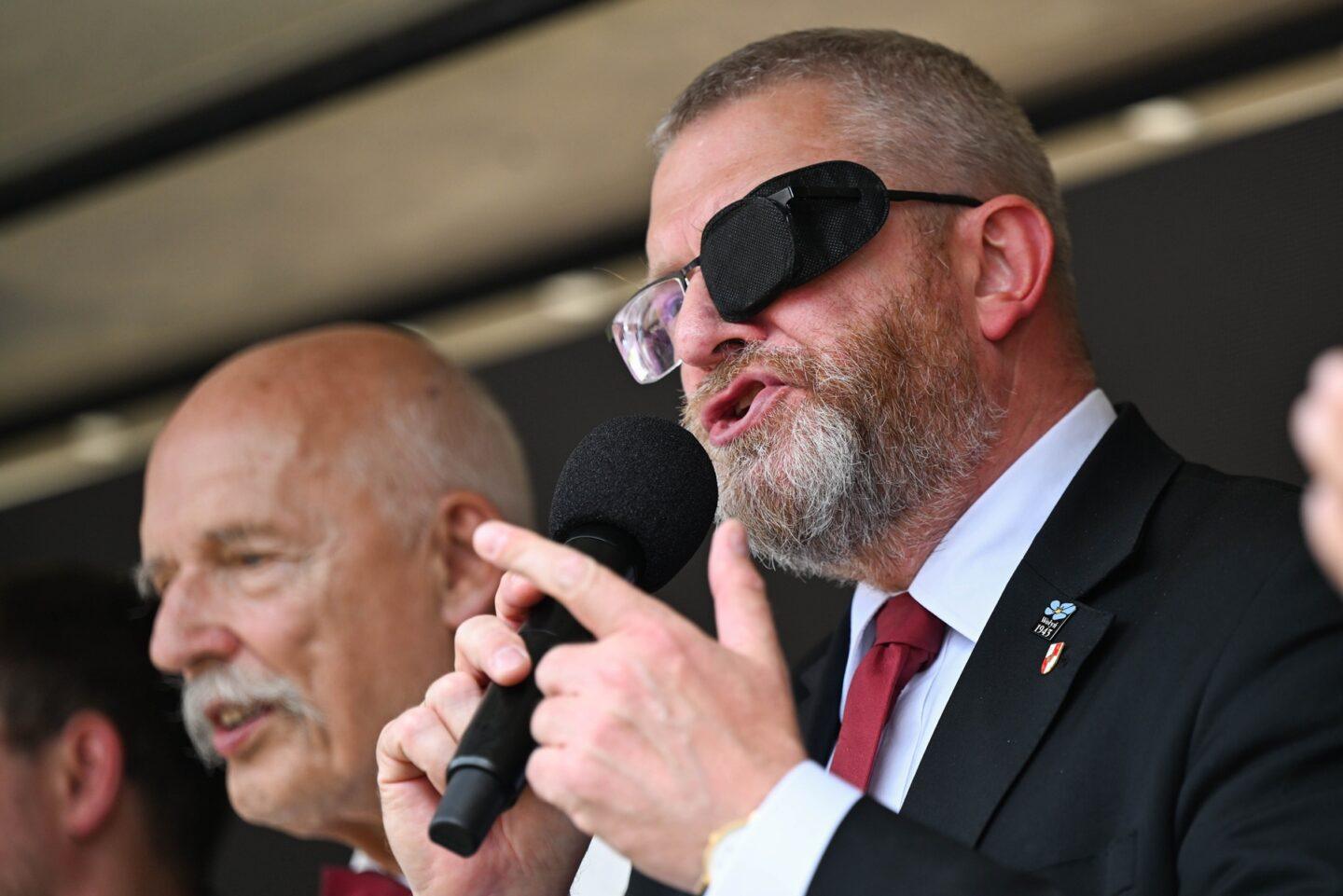
Last Thursday, Grzegorz Braun, a member of the European Parliament and leader of the Confederation of the Polish Crown party, made such a declaration. At a press conference held in front of the Armia Krajowa (Home Army) Monument in Warsaw, he announced that his party would place uniformed services personnel in fifth place on its Sejm candidate lists in all 41 parliamentary constituencies.
“The political goal of the Confederation of the Polish Crown is to restore security for Poles. But to achieve that, we must first restore security for the officers themselves,” Braun said on Thursday 30 July.
He added that his party wanted only Polish soldiers to have the right to operate on Polish territory, including in border protection.
Following Braun’s announcement on Thursday, the name of the first soldier set to run on his party’s lists was revealed. Lieutenant Piotr Powałka is expected to stand in fifth place in the Gdynia–Słupsk constituency. He is a reservist who served in the Polish Armed Forces for 15 years, until 2022. He currently conducts military training.
On social media, he posts content related to defence issues, but also material aligned with political narratives promoted by Grzegorz Braun. His accounts include anti-Ukrainian content. Among other claims, he has argued that “Bandera’s Ukraine poses a greater threat than Russia.” He has a substantial online following, with his YouTube channel attracting more than 300,000 subscribers.
What does the law say?
In 2025, Adam Dziedzic of the Polish People’s Party submitted a parliamentary inquiry asking about the eligibility of officers from services subordinate to the Ministry of the Interior and Administration to run for office. Deputy Interior Minister Czesław Mroczek of the Civic Coalition replied that police officers and Border Guard officers are not allowed to belong to political parties.
However, the laws governing the police, the State Fire Service and the Border Guard do not prohibit them from standing in elections. They also do not require candidates to obtain approval from their superiors or submit a formal report regarding their intention to run.
Active-duty soldiers are likewise barred from party membership. The Homeland Defence Act allows professional soldiers to stand for election to the Sejm, the Senate and the European Parliament. During an election campaign, a soldier is granted unpaid leave. If elected, they must give up their military status. If they fail to win a seat, they may return to active service.
Braun’s plan is a “provocation”
Grzegorz Braun’s announcement has sparked controversy. Prof. Antoni Dudek, a historian and political scientist at Cardinal Stefan Wyszyński University, wrote on social media that the move was an attempt to trigger a deep state crisis.
He warned that if a candidate placed fifth on Braun’s list failed to win a seat, they could still promote Braun’s political narrative within the uniformed services. Key elements of Grzegorz Braun’s political messaging include downplaying the threat posed by Russia and hostility towards Ukraine.
In an interview with XYZ, Janusz Zemke, a former deputy defence minister in SLD governments and former member of the European Parliament, described Braun’s announcement as provocative.
“The aim of this provocation is to create the impression that he has support among uniformed services personnel,” Zemke said.
The former deputy defence minister said he could not imagine active-duty officers standing in elections.
“Active soldiers and officers are bound by the principle of political neutrality and non-partisanship. I cannot imagine an active soldier running for office, because that would mean leaving the service. Having active personnel participate in political elections would undermine the foundations of the service. Retired officers can run from various lists, but such a candidate should be aware of what Mr Braun represents,” Zemke said.
“An attempt to destabilise the state”
Marek Biernacki, an MP from the Polish People’s Party parliamentary group and head of a Sejm committee, also points to the requirement for political neutrality and non-partisanship. He is a former minister of the interior and administration and a former special services coordinator. In his view, Braun’s announcement is dangerous.
“This is a crazy idea from Mr Braun. He is trying to build an alternative state in this way. It is an attempt to destabilise the state. I suspect this move is being driven by Russian influence. It is unfortunate that such people do not understand what 123 years of Russian partition, the 1920 war, Katyń and communism meant for Poles. Russians understand cooperation with Poland only in terms of subordination,” Biernacki said.
The former special services coordinator also highlighted the views promoted by Grzegorz Braun and politicians from his party. In Biernacki’s opinion, there should be no soldiers in the military who voice anti-Ukrainian slogans “at a time when Ukraine is fighting Russia and also protecting Poland”.
He also questioned another position associated with Braun and his supporters. Grzegorz Braun and politicians aligned with him oppose mandatory vaccinations, while soldiers taking part in foreign missions are required to receive certain vaccinations.
“I often travelled to various missions with Polish soldiers. Before going on missions, they had to be vaccinated, whether they wanted to or not. An anti-vaccine soldier would not have gone on missions. What kind of soldier is someone who has never served on a mission?” Biernacki said sarcastically.
The former minister also pointed to Braun’s questioning of Poland’s membership in NATO.
“Polish soldiers’ service on foreign missions continues to pay dividends today in terms of trust among NATO partners, especially our largest ally, the United States. Braun has a strongly pro-Russian and anti-American narrative, which is extremely dangerous. If someone still has illusions about Russia, their intentions are not genuine,” Biernacki said.
Braun’s party ranks highly in polls
Since last year’s presidential election, Grzegorz Braun’s party has consistently ranked fourth in many opinion polls. In an IBRiS poll for Rzeczpospolita daily conducted a week ago, the Confederation of the Polish Crown recorded support of 10.9%. In a Monday poll by the same firm for Polsat News TV, Braun’s party received 9.6% support.
If the Confederation of the Polish Crown maintained such polling levels until autumn 2027, it could translate into the election of several dozen MPs to the Sejm. Candidates placed fifth on electoral lists would not be considered favourites to win seats, although the current Sejm also includes MPs who secured mandates despite starting from lower positions on party lists.
Report examines soldiers’ political choices
Does Grzegorz Braun have the potential to attract uniformed services personnel to his electoral lists? A report titled “Electoral activity of soldiers during the 2025 presidential election” may help answer that question. It was prepared by Mateusz Domalążek and Przemysław Najmuł from the Stratpoints Foundation. Both are assistants to Senator Gen. Mirosław Różański of the New Poland – Centre parliamentary group. Between 2015 and 2017, Różański served as Commander General of the Polish Armed Forces’ branches. He is also the founder of the Stratpoints Foundation.
The analysis covered results from 34 polling stations in total. These included stations located at military units and in towns where soldiers voted after exercising their right to cast a ballot outside their registered place of residence. The study also included a polling station at the Polish military contingent in Kosovo.
The authors of the analysis show that polling stations located in the immediate vicinity of military units displayed a consistent shift in electoral preferences towards right-wing and national-conservative candidates.
In the first round, Sławomir Mentzen benefited from this trend more than Grzegorz Braun did. Mentzen’s average support was 9.07 percentage points higher than his nationwide result. In Braun’s case, the difference was a more modest 1.29 percentage points in favour of polling stations located near military units.
The most striking example was the polling station at the base of the Polish contingent in Kosovo. In the first round, Mentzen and Braun together received more than 65% of the vote there, with Mentzen securing as much as 51.2% and Braun 15.1%.
In the second round, Karol Nawrocki was the favourite among voters there. He received 56.91% of the vote, compared with 43.09% for Rafał Trzaskowski. In 22 of the 34 polling stations analysed, Nawrocki achieved a result that was 4.5 percentage points higher than his performance across the county where the polling station was located.
At both stages of the election, it was clear that the military community voted differently from the wider population of their municipalities. It displayed a more right-wing political profile.


Główne wnioski
- European Parliament member Grzegorz Braun wants uniformed services personnel to appear on the electoral lists of the Confederation of the Polish Crown. More than a year before the election, he has announced that his party will place such candidates in fifth position in each of the 41 Sejm constituencies. The party has already announced one such candidate in the Gdynia–Słupsk constituency. Braun added that his party’s goal is to restore security for officers. In making the announcement, he also questioned the presence and activities of allied troops on Polish territory.
- The law requires political neutrality and non-partisanship from police officers, soldiers and personnel of other state uniformed services. If they decided to stand in elections, however, they could take unpaid leave and would not need their superiors’ approval to run.
- According to former deputy defence minister Janusz Zemke, Braun’s announcement is an attempt to convince the public that he enjoys support among uniformed services personnel. Marek Biernacki, the MP who chairs the special services committee, argues that Braun’s attempt to recruit uniformed services personnel for electoral lists is an effort to destabilise the state.