

This article is a part of Poland Unpacked. Weekly intelligence for decision-makers
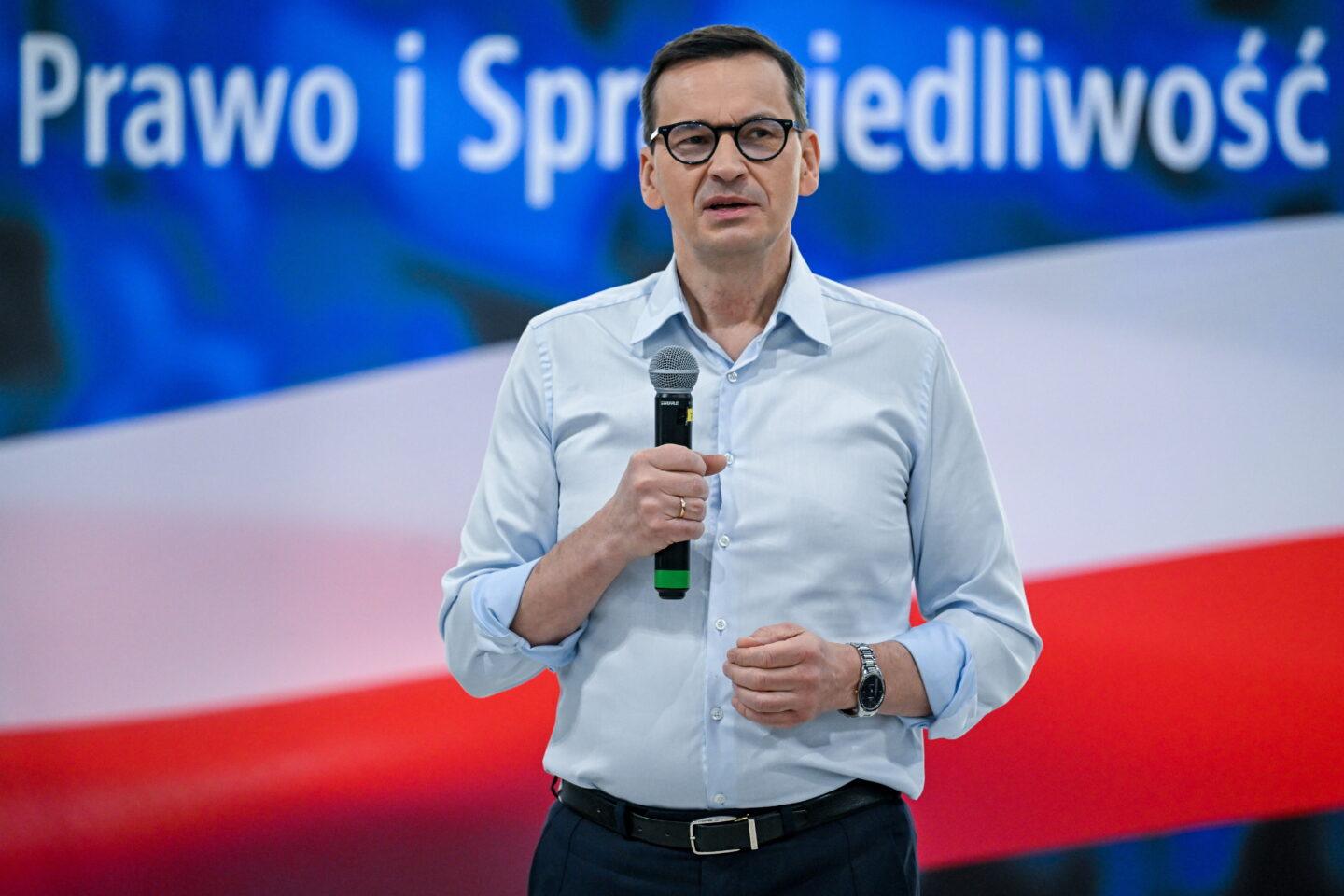
The PiS leadership’s midnight Thursday deadline for members of Mateusz Morawiecki’s association is approaching. The former prime minister and his allies could leave the party. Yet the history of previous splits suggests that rebellions against Jarosław Kaczyński have rarely ended in success.
Forty MPs ready to act, an event organized with 1,000 participants in mind, public airing of grievances on social media, and a clear pre-split atmosphere. Law and Justice (PiS) has reached a moment when further decisions are expected.
One realistic scenario is the departure from the party of politicians aligned with Mateusz Morawiecki. Even if it does not happen in the coming days, the possibility of a split cannot be ruled out in the months ahead.
Comparisons with earlier breakaways from PiS
The potential departure of Mateusz Morawiecki and his allies would only mark the beginning of the real challenges ahead. The history of splits within Law and Justice (PiS) may give the former prime minister reasons for concern. At the same time, Morawiecki has advantages that politicians from the Poland Comes First (Polska Jest Najważniejsza) movement and Solidarna Polska lacked.
In fact, almost the entire 20-year history of PiS can be seen as a story of recurring departures from the party and bold announcements of plans to build new right-wing political forces. More often than not, however, these attempts ended either with the rebels returning to PiS on Jarosław Kaczyński’s terms or with their gradual disappearance from the political scene.
PiS was founded in 2001 amid the rising popularity of Lech Kaczyński, who at the time served as justice minister in Jerzy Buzek’s government. In the following years, the party consolidated and integrated smaller right-wing groups, building a single political camp that went on to win both parliamentary and presidential elections in 2005.
A chronicle of fefeats for right-wing breakaways
The first major reshuffling came shortly before PiS lost power in 2007. Marek Jurek, then Speaker of the Sejm, left the party in protest after it rejected a constitutional amendment that would have introduced a complete ban on abortion. He went on to establish the Right of the Republic (Prawica Rzeczypospolitej), which remained a marginal political force.
Marek Jurek’s party contested the early parliamentary elections in autumn 2007 on the electoral list of Roman Giertych’s League of Polish Families (Liga Polskich Rodzin) but failed to clear the electoral threshold. The same pattern repeated in subsequent elections, when the Right of the Republic ran its own independent lists.
Marek Jurek eventually became a Member of the European Parliament in 2014, running on the Law and Justice (PiS) electoral list. Today, he works as a commentator, while the Right of the Republic remains a small party with no significant influence on Polish politics.
Also in 2007, several other prominent PiS figures, including Kazimierz Michał Ujazdowski, Jarosław Sellin and Jerzy Polaczek, left the party. The political group they created, Poland Plus (Polska Plus), failed to gain traction. Sellin and Polaczek returned to their former party after the Smolensk air disaster. Ujazdowski, meanwhile, moved to the opposite side of the political divide. He has been a senator for the past seven years — initially representing the Civic Coalition (Koalicja Obywatelska) and now belonging to the Senate Club of the Third Way (Trzecia Droga).
Poland Comes First
Electoral defeats became the catalyst for further departures from PiS. In the early presidential election of 2010, the party’s candidate was Jarosław Kaczyński, who lost the second round to Bronisław Komorowski. During the campaign, Kaczyński’s team sought to portray the PiS leader as a moderate and conciliatory politician. His campaign slogan was: “Poland Comes First.”
That slogan later became the name of the breakaway party, formed mainly by politicians involved in Kaczyński’s campaign. Joanna Kluzik-Rostkowska, Elżbieta Jakubiak, Paweł Kowal, Paweł Poncyljusz, Michał Kamiński and Adam Bielan contested the 2011 parliamentary election under the banner of PJN (Polska Jest Najważniejsza or Poland Comes First).
Without success – the party won just over 2% of the vote. Following the electoral defeat, the movement collapsed. Today, Kluzik-Rostkowska, Kowal and Poncyljusz are active within or around the Civic Coalition (Koalicja Obywatelska). Michał Kamiński sits in the Senate as a politician affiliated with the Polish People’s Party (PSL), although his future among the agrarian party’s ranks remains uncertain. Of the PJN founders, only Adam Bielan returned to the PiS camp and is now one of the more prominent figures attempting to reconcile the party’s rival factions.
Sovereign Poland formally lost, but…
The year 2011 brought another defeat for Law and Justice (PiS). The party was weakened, divided and lacked a convincing strategy for challenging Civic Platform (Platforma Obywatelska). The electoral defeat led to another breakaway. Following criticism of the failed parliamentary campaign, PiS expelled a group of MPs led by Zbigniew Ziobro and Jacek Kurski.
The rebels created their own parliamentary group and later founded the Solidarity Poland (Solidarna Polska) party. In the 2014 European Parliament election, the party narrowly missed the electoral threshold, winning 3.98% of the vote. It was its final independent electoral campaign. A year later, Solidarity Poland politicians ran on PiS electoral lists, becoming part of the United Right (Zjednoczona Prawica) project.
Formally, they remained a separate party, but they did not establish their own parliamentary caucus or parliamentary group. Despite their limited numbers, during eight years of right-wing rule they exerted influence over state policy far greater than their representation would have suggested.
Zbigniew Ziobro headed the Ministry of Justice for two terms, with many of the ministry’s key positions held by politicians from his party. Jacek Kurski, meanwhile, led Poland’s public media for years, which at the time were transformed into a propaganda base for the governing coalition.
Solidarity Poland, later renamed Sovereign Poland (Suwerenna Polska), therefore failed as an independent political force but succeeded as a small, disciplined faction within the ruling camp.
…its ideas took over the party from within
In 2024, Sovereign Poland (Suwerenna Polska) merged with PiS, and its leading politicians joined the party’s governing bodies. The formal history of the group came to an end, but its influence on the current state of Law and Justice remains significant.
PiS MEP Piotr Müller, an ally of Mateusz Morawiecki, even referred several months ago to the “Sovereign Poland-isation” (suwpolizacja) of the party.
“I would prefer us to remain focused on the core of the PiS program as a Eurorealistic party – critical of what is happening in the EU, but at the same time wanting to remain a member of the European Union and part of the broader Western community, in the classical and positive sense of the word,” Müller said in February 2026, when asked about the meaning of the term.
Sovereign Poland therefore disappeared as an independent organization, but the worldview it represented – regarding the European Union, the state and political polarization – has clearly pushed PiS further to the right.
Centre-right vs. the alt-right
A quick review of the fate of breakaway groups from Law and Justice (PiS) shows above all their defeats in confrontations with the party headquarters on Nowogrodzka Street in Warsaw. Today’s PiS, however, operates in a completely different environment than the party of 10 or 15 years ago.
Radical right-wing narratives are gaining popularity, pushing parties that emerged from the Confederation (Konfederacja) camp to record levels in opinion polls. Jarosław Kaczyński’s party has also moved in the same direction, as confirmed by the nomination of Przemysław Czarnek as the PiS candidate for prime minister.
Against this backdrop, Mateusz Morawiecki and his allies are attempting to build a different political narrative: one centered on a conservative Poland that is also modern, development-oriented and firmly anchored in the structures of the European Union.
However, in the event of a split, the “Development Plus” (Rozwój Plus) Association would face problems similar to those encountered by previous breakaway movements. Mateusz Morawiecki’s camp would have to build its own regional structures, create an electoral strategy from scratch, recruit recognizable candidates and, above all, finance a campaign without access to state party subsidies.
Political scientist: Morawiecki’s problems could also become his opportunity
This is highlighted by Dr Mateusz Zaremba, a political scientist at SWPS University.
“The fundamental challenge remains unchanged and is common to all splits of this kind: a new political group leaves its parent party without strong local structures. Experience shows that such initiatives initially grow rapidly thanks to media attention and voter interest, but over time their support declines precisely because of organizational weaknesses. We saw this in the case of Szymon Hołownia’s movement, which ultimately had to rely on the backing and structures of the Polish People’s Party (PSL) in order to survive,” Dr Mateusz Zaremba notes.
The political scientist also points to further challenges that Mateusz Morawiecki’s camp would have to address. However, he stresses that some of these difficulties could also represent an opportunity for a new political force.
“The key problem is the lack of state funding, which would be necessary to run an effective campaign and compete on equal terms with parties already established in parliament. At the same time, an apparent weakness – the withdrawal of some voters from active participation in politics – could become an opportunity. Public debate often focuses only on analyzing voter shifts between parties, while forgetting that an equally important, if not crucial, factor is the movement of voters between participating in elections and staying away from the polls,” the political scientist points out.
It is precisely this group that Dr Zaremba identifies as the potential electorate for a new party.
“Such a party could mobilize disillusioned voters who currently plan to stay at home and persuade them to return to the ballot box. The question remains who exactly Mateusz Morawiecki would choose to build this project with if he did indeed leave PiS. However, media reports suggest that the die has already been cast in this matter,” Dr Mateusz Zaremba believes.
Recognition as both an advantage and a burden
Mateusz Morawiecki’s high level of public recognition is an advantage over previous breakaway leaders, but it could also become a liability. His six years as prime minister remain relatively fresh in voters’ memories. The former head of government would therefore not need to build his political brand from scratch.
At the same time, he bears political responsibility for both the successes and failures of the United Right (Zjednoczona Prawica) governments. He is also burdened by unresolved allegations concerning the activities of state institutions during his premiership, including the Government Strategic Reserves Agency (Rządowa Agencja Rezerw Strategicznych).
Compared with previous rebels, Morawiecki may also count on a larger parliamentary base. Unofficial estimates suggest that his camp includes around 40 MPs, as well as a significantly larger group of local party activists. Until the deadline imposed on members of the “Development Plus” (Rozwój Plus) Association is resolved, however, these remain only speculation.
Polling ceilings remain low
Less speculative are the polling risks associated with the creation of a new party. The political right is already crowded, and another political force would find it difficult to attract new voters rather than simply take support away from PiS.
According to Łukasz Pawłowski, president of the National Research Group (Ogólnopolska Grupa Badawcza), a potential Morawiecki party would face an exceptionally difficult task.
“When we asked respondents in a poll about a party led by Morawiecki, such an initiative received around 5% support. Crucially, 80% of this group consisted of current Law and Justice voters. This means that, in the longer term, a loyalty mechanism could come into play, and some of them would simply return to their previous political camp,” Łukasz Pawłowski assesses.
A battle for internal influence within the PiS camp?
According to the president of OGB, Mateusz Morawiecki may not necessarily be planning to run independently in the 2027 parliamentary election.
“I am convinced that a potential departure from PiS does not mean that Mateusz Morawiecki intends to contest the election on his own. He is too experienced a politician not to recognize that there is no room for such a move on the current political scene. There is limited potential to attract new voters, especially among the electorate of the governing coalition. It should rather be seen as an element of an internal political struggle. A year remains until the election, so there is still time to reach an agreement and redefine relations,” Łukasz Pawłowski analyses.
A similar maneuver was previously carried out by Solidarity Poland (Solidarna Polska). The party contested national elections independently only once. By 2015, its politicians were already running on PiS electoral lists.
According to Łukasz Pawłowski, this analogy demonstrates the scale of the challenge Mateusz Morawiecki would face if he decided to leave the party.
“Everyone who has left Law and Justice so far has ultimately failed. Theoretically, the European Parliament election, due to lower turnout, should have been an easier test for such initiatives. Zbigniew Ziobro’s popularity among the party’s core electorate – when he was considered the party’s ‘golden boy’ – was significantly greater than Mateusz Morawiecki’s position today, and yet his project still ended in failure,” the head of OGB recalls.
In his view, a new political group would therefore serve primarily as a negotiating tool.
“I do not believe such an entity would be created to compete with PiS independently. Its main purpose would rather be to gain leverage in future negotiations – whether with the PiS leadership or with other political groups. The political landscape may be rearranged, and politicians have a year of negotiations ahead of them. Running independently simply to secure 4.5% or 5.5% support makes no political sense and carries too much risk,” Łukasz Pawłowski concludes.


Key Takeaways
- The history of splits within Law and Justice (PiS) reveals a recurring pattern. Attempts by Marek Jurek, the founders of Poland Plus (Polska Plus), and the creators of Poland Comes First (PJN) to establish separate political parties ended in electoral defeat and political marginalization. In most cases, the rebels either returned to PiS on the leadership’s terms or disappeared from the political mainstream.
- Mateusz Morawiecki’s camp has greater resources than previous breakaway factions: a nationally recognized leader, a sizeable group of MPs, and likely a stronger regional organization. At the same time, it would have to build party structures outside PiS, finance its operations without access to state party subsidies, and persuade voters that it is more than simply another faction of the former governing camp.
- The biggest obstacle remains the lack of political space on the right. Polling suggests that a Morawiecki-led party could win around 5% support, with most of its potential voters coming directly from the PiS electorate. As a result, any split may prove less the beginning of a durable independent political project than an attempt by the former prime minister to strengthen his negotiating position within the broader right.