

This article is a part of Poland Unpacked. Weekly intelligence for decision-makers
One of Poland’s largest general contractors is exiting the modular-construction business. After years of investment and mounting losses, MOD21 is being removed from the Group’s strategy, as Erbud shifts its focus to more profitable segments.
Erbud Group is winding down its modular-construction operations. Following a review of strategic options, the management board decided to stop making further investments in MOD21. The company plans to complete its contracted projects and cover warranty obligations before seeking buyers for its shares or assets. The decision was driven by the segment’s continued lack of profitability and the absence of any indication that its performance will improve in the foreseeable future.
MOD21 has been part of Erbud Group since 2021 and was intended to capitalize on the growing importance of low-carbon construction in Western Europe. Germany was its main market, where the company completed 21 projects. In Poland, MOD21 has completed or is currently carrying out seven projects.
“The wording used in the report refers to an economic assessment of the project under current market conditions. It means that we did not identify sufficient grounds to justify continued capital investment by Erbud Group in this segment on the same scale as before,” says Dariusz Grzeszczak, CEO of Erbud.
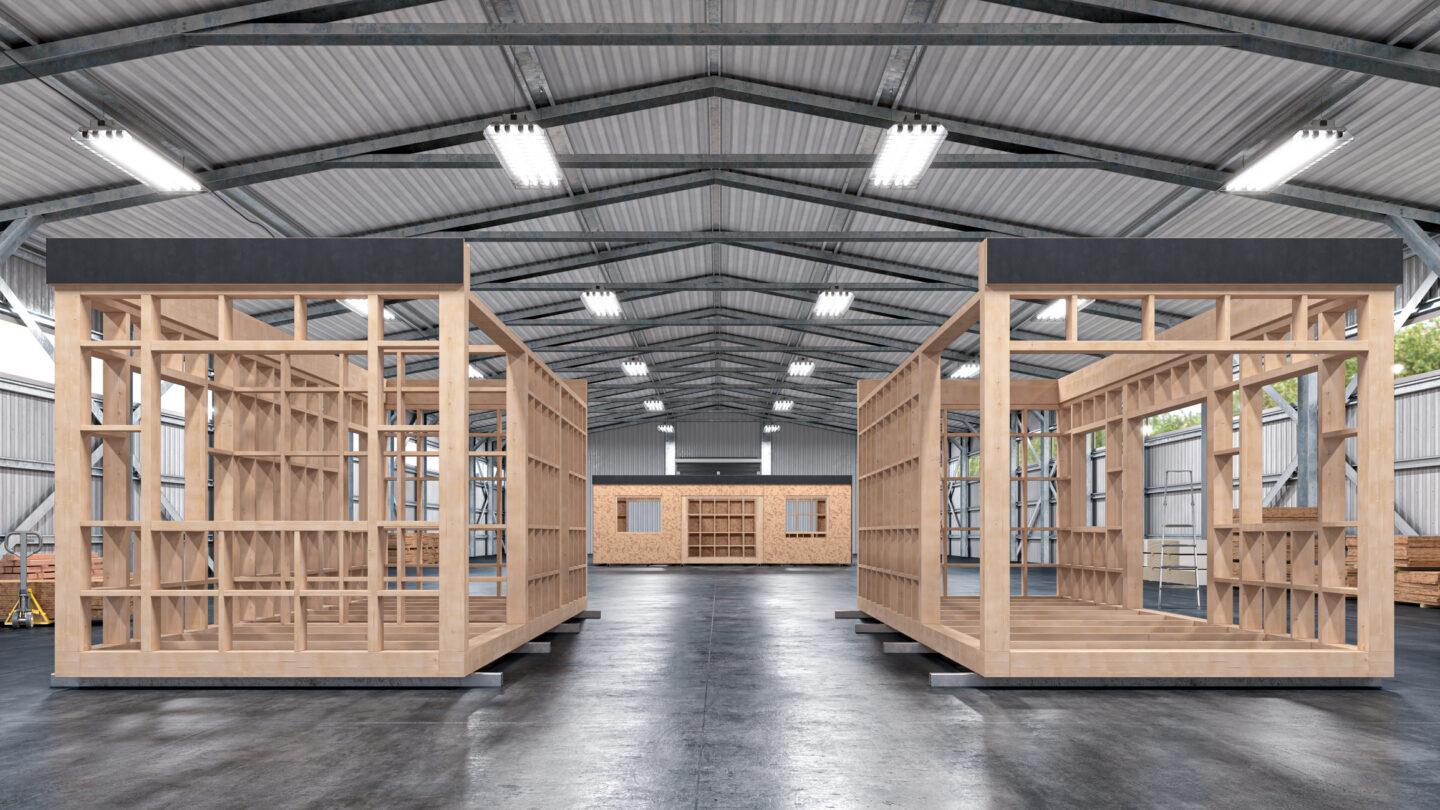
MOD21 built its manufacturing facility from the ground up. It has a 21,000-square-meter production hall and a machinery park equipped with two production lines.
“This is not an assessment of the team’s capabilities or the quality of the projects delivered. MOD21 employees have developed unique expertise and completed a number of demanding contracts in Poland and Germany,” the company’s CEO emphasizes.
Losses mounted, but the expected breakthrough never came
According to Bartłomiej Sosna, a construction-market expert at research firm Spectis, Erbud had already begun assessing the future of the segment, and the direction of change had become apparent over the following months.
“Erbud Group’s decision is primarily the formal conclusion of a process whose direction had already been visible for several months. Today’s announcement is therefore more a confirmation of a direction signaled earlier than a sudden strategic shift,” says Bartłomiej Sosna.
The economics of the business became the biggest problem. According to data cited by Spectis, after posting a small loss in 2021, MOD21 recorded a brief period of profitability in 2022. Its performance then deteriorated again. Net loss amounted to around PLN 14.8m (EUR 3.5m) in 2023 and PLN 12.8m (EUR 3.0m) in 2024. In 2025, it surged to around PLN 60.3m (EUR 14.1m).
“The latest figure, in particular, shows the scale of the problem. In 2025, modular construction was the only segment of Erbud Group that put such a significant drag on the group’s results,” the Spectis expert emphasizes.
The beginning of 2026 brought no improvement either. In the first quarter, MOD21 generated PLN 47.6m (EUR 11.1m) in revenue, but its operating loss widened from PLN 11.9m (EUR 2.8m) to PLN 16.9m (EUR 4m).
The project’s performance was also affected by the external environment. The business was established with a view to rapid growth in the German market and anticipated support for green building technologies. Instead, the German economy and its construction sector entered a period of serious slowdown.
“MOD21 was built as a new business practically from scratch, with substantial investment in the factory, production capacity and workforce, based on the assumption that the German market would develop rapidly,” Bartłomiej Sosna notes.
Expert's perspective
An unexpected but rational move


It was not the technology, but the economics of the business
Erbud’s decision to end its investment in MOD21 does not mean that timber prefabrication – or modular construction more broadly – has proved to be a dead end.
“This does not mean that modular construction as a technology or business model is inherently unprofitable. There are companies in the market that have been generating profits in this segment for years, showing that the key challenge is not the technology itself, but building the right economics for the entire business,” the Spectis expert says.
In MOD21’s case, the company was simultaneously investing in the plant, production lines and workforce.
“The MOD21 case therefore shows that investing in a modern factory and an attractive technology is not enough. Erbud Group failed to achieve, within the planned timeframe, the scale and operational efficiency needed to capitalize on the potential advantages of timber prefabrication,” Bartłomiej Sosna adds.
The Polish market itself offers a somewhat more optimistic signal. Spectis’s preliminary analysis of manufacturers’ performance indicates that nominal market growth was around 5% year-on-year in 2025. The year before, the market recorded a double-digit decline.
“This is more a moderate return to growth than a boom. The MOD21 case therefore cannot be treated as evidence of a structural failure of the entire segment.”
Hundreds of millions in write-downs and a possible breach of covenants
Exiting the segment will have a significant impact on Erbud’s reported financial results for the first half of the year. The company estimates that events related to the discontinuation of its modular-construction operations will reduce its standalone financial result by around PLN 470m (EUR 110m). At the consolidated level, the impact is expected to be around PLN 231m (EUR 54m).
Erbud emphasizes that the adjustments are primarily one-off and non-cash. They are mainly related to asset write-downs and historical spending on the development of the segment. The final amounts could still change if Erbud sells its stake in MOD21 or assets belonging to the segment.
“These amounts are primarily an accounting operation with little impact on the company’s cash position. They reflect historical investment spending in the modular segment, including the financing of its losses over the past five years,” says Agnieszka Głowacka, deputy CEO of Erbud.
The current report, however, also points to a consequence that the company does not highlight in its press release. Erbud expects that, following the first-half results, it may exceed the debt limits set out in its agreements with financial institutions.
The company has already announced talks on waiving claims related to breaches of these conditions. It is also assessing the risk of breaching the covenants attached to its Series E bonds. These are conditions stipulated in financing agreements that a company must comply with, such as limits on maximum debt or minimum profitability.
As of the end of March 2026, Erbud’s equity stood at PLN 368m (EUR 86m), while the Group’s consolidated equity amounted to PLN 552m (EUR 129m).
Erbud wants to make money where it already has scale
After closing the chapter on modular construction, the Group plans to concentrate its resources on three core areas: commercial and industrial building construction, renewables, and industrial services. In 2025, these segments generated nearly PLN 94m (EUR 22m) in combined EBIT.
Building construction generated PLN 1.6bn (EUR 374m) in revenue last year, up 6.5% year-on-year. At the beginning of 2026, despite lower sales partly due to weather conditions, its operating profit rose 28% year-on-year. By April, the Group had secured contracts worth nearly PLN 820m (EUR 192m) in this area.
Industrial services are also growing. The segment generated a record PLN 627m (EUR 147m) in revenue in 2025, an 8.2% increase year-on-year. Operating profit rose 27% to PLN 32.7m (EUR 7.6m). The business now accounts for nearly one-fifth of the Group’s total revenue.
In renewables, Erbud is expanding through ONDE, which has signed contracts to build energy-storage facilities worth more than PLN 450m (EUR 105m) in total.
“The decision reflects business and financial considerations, not a lack of commitment or professionalism on the part of the team. As management, it is our responsibility to allocate capital responsibly and focus on areas that offer the Group the greatest potential for long-term growth and profitability,” Dariusz Grzeszczak concludes.


Key Takeaways
- The MOD21 case shows that technological advantage is not enough without sufficient business scale. Heavy investment in the factory, machinery and workforce requires an order book large enough to cover substantial fixed costs.
- Erbud’s withdrawal from MOD21 does not spell failure for modular construction as a technology. After a sharp decline in 2024, the Polish market returned to moderate growth, while some companies operating in the segment remain profitable.
- Erbud is choosing to concentrate its capital rather than continue financing an unprofitable project. The one-off write-downs will be substantial and could result in covenant breaches, but after closing MOD21, the Group plans to develop segments that already generate profits and have significant order books.