

This article is a part of Poland Unpacked. Weekly intelligence for decision-makers
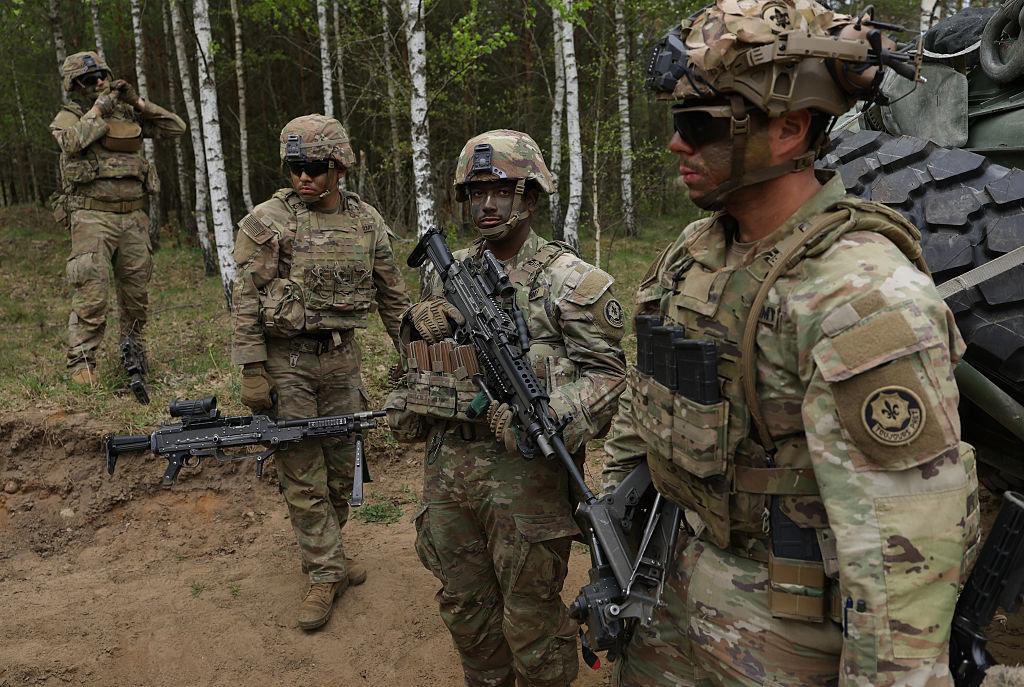
Around 4,000 soldiers from the 2nd Armored Brigade Combat Team will not be deployed to Poland after all.
The rotation has been suspended, even though some of the troops and roughly 70% of the equipment are already in the country. The obvious question is: what happens next? For now, no one seems able to answer it. Nor can anyone explain why both officials at the Ministry of National Defense (MON) and the president’s team at the National Security Bureau (BBN) appeared to be taken by surprise.
What has followed instead is a familiar round of blame-shifting.
The Ministry of National Defense – somewhat desperately – has tried to put a brave face on the situation, insisting that “no decision has been made” and that Poland “is and will remain a key US ally in Europe”.
The National Security Bureau, meanwhile, has washed its hands of the matter. “The Ministry of National Defense failed to obtain advance information regarding changes to the schedule for the movement of US forces to Poland, which has made it more difficult for the Presidential Office to support the ministry in negotiations with our strategic partner,” wrote the bureau’s head, Bartosz Grodecki.
So the usual political squabbling continues. But what about the country’s security?
America’s punishment over Iran. Europe has a problem
Around three weeks ago, reports emerged that the Americans wanted to reduce their military presence in Germany and Spain. In effect, it was a punishment aimed at Germany – and Europe more broadly – for refusing to take part in a US-Iran war.
The Enhanced Defense Cooperation Agreement (EDCA), signed between the US and Poland in August 2020, provides for a rotational yet permanent presence of American troops in Poland. In return, Poland is responsible for supplying the necessary infrastructure and logistical support. In other words, Warsaw must provide the Americans with accommodation, training grounds and airfields, as well as day-to-day operational support. US troops are stationed in the south-west of the country, mainly in Żagań and Świętoszów. They are equipped with Abrams tanks, Paladin self-propelled howitzers and armored vehicles.
In addition, Poland hosts a NATO Battlegroup – primarily stationed in Bemowo Piskie in north-eastern Poland – as well as the permanently based headquarters of the US Army’s V Corps. But what about the troops who were supposed to arrive in Poland?
Officials from the leadership of the Ministry of National Defense whom we contacted did not respond to our questions. Military representatives, meanwhile, referred us to the General Staff of the Polish Armed Forces (SG WP). It is worth noting, however, that several days ago the news outlet Onet reported that the information from the Americans had indeed reached the General Staff – but General Kukuła, the chief of the General Staff, had allegedly not yet managed to review it because it had been sent to the classified registry.
“Much ado about nothing”. We need to wait for official statements
News that the troop deployment had been suspended was first reported by the American media. It began with the military magazine Army Times, before being picked up – and expanded upon – by other outlets.
But have there been any official statements? At this point, no. The Pentagon has not commented publicly on the matter. That is why General Jarosław Gromadziński, the former commander of Eurocorps, is urging restraint. Speaking to XYZ, he argued that it is best to wait for official announcements before taking any action.
“For our security, this means... nothing,” says General Jarosław Gromadziński. “Everything happening now is much ado about nothing, because no decisions have been made and there have been no official communications. There is no point reading tea leaves, especially since the Americans themselves appeared surprised by the reports, as could be seen during the congressional hearings.”
In his view, “the Americans will find a way out of this somehow”. But first they need to make their own decisions. And Poland should not make those decisions for them.
“Allow them to save face”. Major investments in Lower Silesia
“We should give them a chance to save face,” adds General Jarosław Gromadziński. “After all, this is not only about Poland, but also about the Baltic states, which are likewise waiting to see what happens in Poland. At the same time, we keep talking about troop numbers as though they were a fetish, whereas the real discussion should concern the ‘quality’ of the soldiers deployed here.”
In his view, what we are witnessing right now is little more than “Twitter politics”. That is why, he argues, Poland should calmly wait for concrete information before drawing conclusions.
It is also worth noting that major investments have already been made in south-western Poland to support the American military presence. Railway lines, logistics depots, loading ramps and training facilities at military ranges in Lower Silesia have all been developed with the Americans in mind.
Not the decision itself, but the way it was communicated. “Let’s be brutally honest”
Jacek Tarociński, a defense analyst at the Centre for Eastern Studies (OSW, a government-affiliated think-tank), points to a different concern.
“While the possibility that the troop rotation would eventually come to an end had been circulating unofficially for some time, what raises doubts is the way the information was communicated. What we have are media reports and congressional hearings instead of an efficient and properly delivered official message on the matter. For Poland, this would mean a significant reduction – by around 40% - in the presence of US troops. That said, let’s be brutally honest: across a theatre of operations as large as Europe, one or two brigades are an added value, but not a decisive one,” says Jacek Tarociński.
In his assessment, far more serious is the way the information has been communicated – or rather, the lack of communication altogether.
According to the analyst, the most important element of NATO’s deterrence posture towards Russia has always been the Alliance’s cohesion and unity in decision-making.
The reallocation of troops is already under way
The expert points to another important issue. The Americans themselves had repeatedly said that the increase in their military presence linked to the war in Ukraine was temporary.
“Of course, we all know the saying that temporary solutions tend to become permanent – but unfortunately not this time. The first reduction in the number of US troops began in November in Romania, when one of the American units returned home without being replaced. The process of reallocating US forces within NATO in Europe is already under way. In fact, troop levels are now significantly lower than at their peak around 2022,” says Jacek Tarociński.
It is neither new nor recent that successive American administrations have wanted Europe itself to take greater responsibility for its own security. President Donald Trump spoke about this on numerous occasions.
The Baltic states’ problem
We must remember that roughly 60% of NATO’s European forces today are US soldiers. The administration of President Donald Trump wants to reduce that share to around 40%. This is why we are seeing a wave of urgent defense procurement across Europe.
But Europe needs more than defense spending. Above all, it needs to expand its human military capacity: increasing the size of national armed forces and improving the interoperability of units.
The Baltic states face an even greater challenge. In the case of Lithuania, Latvia and Estonia – particularly Estonia – some confusion has emerged. One of the battalions, specifically an Estonian battalion, had already completed its rotation and assumed duties just before news broke about the suspension of further rotations.
“We are dealing with the Americans stopping halfway through a process. It is clearly an ad hoc decision that came as a surprise even to the Americans themselves,” concludes Jacek Tarociński.
On the one hand, we must therefore wait for official information. On the other, if such a decision is ultimately taken and upheld by Donald Trump, it does not bode well for Europe – or for transatlantic relations. The continent has received yet another serious warning from the United States.


Key Takeaways
- Poland has made significant investments in Lower Silesia linked to the presence of US armed forces. A substantial portion of military infrastructure has been renovated and built with the US military specifically in mind.
- The reallocation of US troops in Europe is becoming a fact. However, according to Jacek Tarociński of the Centre for Eastern Studies, the real problem lies in the poor communication from the American side.
- General Jarosław Gromadziński, in turn, argues that one should wait for official US statements. He adds that the Americans will need to find a way to save face in the midst of the confusion they have created.