

This article is a part of Poland Unpacked. Weekly intelligence for decision-makers
The Taiwanese conglomerate could invest in Poland on a scale comparable to Intel’s previously announced commitment. Foxconn is not only preparing to engage in the production of a Polish electric vehicle, but – together with companies from the TEEMA business association – it also plans to build a technology park. Within it, the group could manufacture AI servers, batteries, or telecommunications equipment.
Prime Minister Donald Tusk announced this week that Foxconn will produce semiconductors in Lower Silesia. The company is set to build a factory on a site originally selected by Intel. The U.S. group abandoned last year its 2023 commitment to invest PLN 20 billion (approx. EUR 4.6 billion) in a semiconductor assembly and testing facility.
According to information obtained by XYZ, semiconductor production is still some time away.
The Taiwan Expo will take place in Warsaw on 22–24 June. On the first day, an investment will be announced that is expected to be a breakthrough for Polish–Taiwanese economic relations.
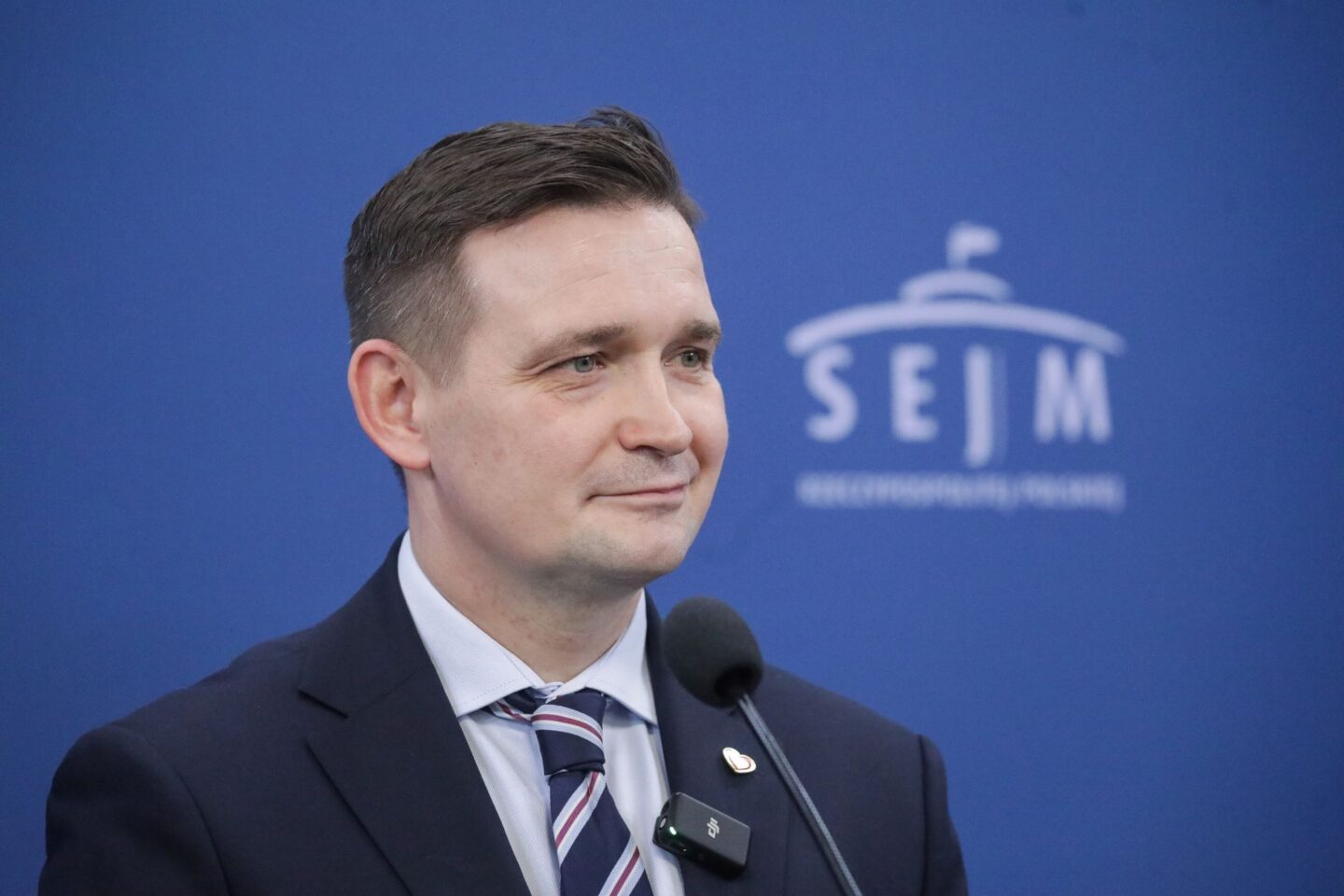
“Foxconn and the Taiwanese business organization TEEMA, currently chaired by Young-Way Liu, CEO of Foxconn, will announce where they plan to establish a technology park. This will not be a single factory, but a complex of factories operated by Taiwanese companies, located on a 150-hectare site. The project is much broader in scope – it envisages the creation of a kind of ‘tech city’ with a full technological ecosystem. Foxconn alone could invest up to USD 20 billion in this initiative. In the second half of the year, the company will present further details on planned production,” said Michał Jaros, deputy minister of development, who has been working for the past 18 months to attract Taiwanese investors to Poland.
The Taiwan Expo is being held in Europe for only the second time. The previous edition took place in Berlin. Poland was selected by Taiwan’s Ministry of Economic Affairs and the organization TAITRA, the Taiwanese counterpart to the Polish Investment and Trade Agency.
Will Foxconn invest USD 20 billion?
“As for the value of the investment in the technology park, I have heard very different figures. It is difficult to say whether it will be $20 billion,” said a source cited by XYZ, speaking on condition of anonymity.
“Intel was initially set to invest USD 4.7 billion in the first phase alone, which was only the first of six planned stages. In the case of Foxconn’s technology park, investments of USD 10–20 billion over a decade are possible. What matters, however, is that companies coming to Poland do not encounter barriers and do not conclude that we are not a good country for investment. This requires coordinated effort from all stakeholders,” said Max Dropiński, co-founder and vice president of Bearlake Group, a holding company of eight Polish technology firms that worked on Intel’s planned investment.
Taiwanese representatives have inspected five locations in Poland.
“These include a plot in Miękinia, as well as sites in Stryków near Łódź, Częstochowa, Pruszcz Gdański, and near Swarzędz,” listed Michał Jaros.
Although the prime minister referred to Lower Silesia, according to our sources, the final location will only be announced on 22 June.
Three sites made it onto the Taiwanese shortlist.
“TEEMA’s first choice was Miękinia, the same plot on which Intel was to invest. However, due to Foxconn’s planned cooperation with EMP, Częstochowa gained an advantage as it is relatively close to Jaworzno. The least likely of the three is Łódź,” said an anonymous source quoted by XYZ.
Max Dropiński, however, believes Miękinia remains the frontrunner.
“TEEMA plans to announce the presence of several to a dozen Taiwanese companies in the Polish technology park. Foxconn will be the lead investor. Some of the remaining companies will act as its subcontractors, while others will pursue independent investments. The final location will be chosen based on what works best for all investors. That is why Częstochowa is not necessarily optimal. The Miękinia site is the best prepared for technology investment – it already has the necessary permits, reports, and environmental assessments,” he said.
He adds, however, that the location itself is secondary.
“It does not matter which site the Taiwanese choose. What matters is that they locate advanced electronics production in Poland,” the Bearlake Group vice president said.
Pruszcz Gdański was the second European site – after Miękinia – on Intel’s shortlist. According to XYZ sources, it was personally proposed to Foxconn by Prime Minister Donald Tusk.
What Foxconn will produce
The key issue is the scope of Foxconn’s planned production in Poland.
“Foxconn will focus in Poland on robots and AI servers. As the company’s CEO Young-Way Liu told me, these are so-called downstream products. In its longer-term plans, Foxconn also intends to locate semiconductor production in Poland, which he described as ‘upstream,’” explained the deputy minister of development.
For this reason, the initial stage of Foxconn’s production process (upstream), involving semiconductors, will for now remain in Taiwan.
“The point is not to start by creating semiconductor technology, but to acquire it. First, we need to build an ecosystem. Universities must develop new study programs to train specialists, and suppliers must begin production,” said Michał Jaros.
What exactly could Foxconn produce?
“The group is considering four types of investment in Poland: automotive platforms, battery cells, telecommunications equipment, and AI servers. If it decided to manufacture telecommunications devices, it would definitely not include iPhones. That production is not economically viable in Europe; therefore, a more advanced project will come to us,” said Max Dropiński.
He confirms that semiconductor production is likely to be considered only in the longer term.
“At the conference on 22 June, Foxconn will not announce a decision on the type of production, and TEEMA will not publish a list of companies that will appear in the technology park. Therefore, some disappointment is possible. We will have to wait until autumn for concrete details,” Dropiński said.
Poland must produce semiconductors
Deputy Minister Jaros acknowledges, however, that his objective is to attract semiconductor manufacturing to Poland.
“I read Chip War [Chip War: The Fight for the World’s Most Critical Technology, by Chris Miller, published in 2023 and selected by the Financial Times and The New York Times as Business Book of the Year—ed.] before I became deputy minister. I realized that electronics play a fundamental role today. They shape the battlefield, as the war in Ukraine has made clear. They are critical in the times we live in. We do not fully appreciate how ubiquitous semiconductors are: they are found in washing machines, vacuum cleaners, and smartphones. A Tesla door handle contains three chips, and cars use as many as 400 to 800. They are an indispensable part of everyday life, yet Europe still does not produce them.”
“I have been part of the Polish–Taiwanese parliamentary team for many years. A month and a half after taking office as deputy minister, I made my first foreign visit to Taiwan with a clear objective – to attract technology from there. I began building relationships and engaging in intensive discussions with business representatives,” said Michał Jaros, who also serves as head of the Civic Coalition in Lower Silesia.
It is worth noting that one of his predecessors, Grzegorz Piechowiak of the Law and Justice party, who served as deputy minister of development between 2021 and 2023, also carried out several missions to Taiwan. In 2022, Poland and Taiwan signed agreements on cooperation in electronics, electromobility, and environmental protection. Economic consultations between Poland and Taiwan began in 2010.
How to start semiconductor production
Max Dropiński had different motivations.
“When I left Intel, after the company abandoned its investment in Poland, I decided to bring an equivalent project to Poland. Semiconductors rule the world the way oil once did. And yet we play almost no role in their production. We are working hard to change that. The timing is favorable, as Taiwan’s national strategy envisages expansion into Europe. Poland could become a gateway to Europe. Foxconn is the world’s largest producer of advanced electronics, employing over one million people. There are, of course, negative reports about its management in China. In Europe, however, things are different. The company is already present in Germany, the Czech Republic, and is now investing in France. There is still no technology park in Europe, which makes this a major opportunity for Poland,” said the vice president of Bearlake Group.
He also knows what is needed to start semiconductor production in Poland.
“You need to ensure demand. In France, Foxconn will produce semiconductors because it has a customer – Thales. In Poland, we do not have such a large anchor company, but a consortium of firms could be built to act as buyers. This would be a group of several to a dozen companies that currently order chips independently. They could create a shared architecture acceptable to all. Investment in production would also be encouraged by government action. If the government signaled that, in the future, it wants devices produced and sold in Poland to use chips manufactured in Europe, it would create an incentive to invest,” said Max Dropiński.
Foxconn aims to replicate Apple’s model in Poland
Foxconn produces PCB boards on which semiconductors are mounted. The company manufactures, among other products, iPhones. Apple designs the devices, manages software and services, and provides marketing, while Foxconn handles assembly.
“Young-Way Liu believes this is what the future of industrial production will look like. Foxconn wants to replicate in Poland the cooperation model it has tested with Apple,” said Michał Jaros.
He argues that while Japanese and Korean companies have already invested heavily in Poland, Taiwanese firms have so far more often chosen Hungary, Slovakia, and Czechia.
“In Poland, we have greater potential: skilled managerial and engineering talent, a developed industrial base, still-available investment land, and a larger domestic market. The current geopolitical situation is pushing everyone toward regionalization of production. Taiwan is doing so as well. Europe must also move toward shortening supply chains, reindustrialization, and regionalization of production. The process of deglobalization will continue. Poland can be attractive for Taiwanese companies. Of course, we face many challenges, including ensuring access to large amounts of cheap energy – preferably green. But we must be active, offensive, and effective in achieving economic goals,” said Michał Jaros.
Foxconn: eight electric vehicle models within two years
In May, Foxconn signed an agreement with ElectroMobility Poland, a state-owned company tasked with producing an electric car in Jaworzno. According to XYZ, Foxconn became interested in cooperation on the Polish electric vehicle project as early as 2024. At the time, the Ministry of State Assets was promoting a project involving China’s Geely. Later, another Chinese firm, Chery, also entered the picture.
“Foxconn’s advantage is its commitment to technology transfer,” said Deputy Minister Jaros.
He notes that Foxconn’s management decided in 2024 to enter the electric vehicle business. Today, the company has eight models, and Foxconn-branded cars are already operating on the streets of Taiwanese cities.
“We have a serious partner that wants to manufacture cars in Poland for the European market. The company intends to create a joint venture with ElectroMobility Poland, in which it will hold a minority stake. In the autumn, Foxconn will provide details of the cooperation and a timeline for the investment,” said Michał Jaros.
More Taiwanese companies to follow
Experts confirm that a breakthrough is underway in Poland’s relations with Taiwan.
“We can definitely expect an influx of Taiwanese investment into Poland in the near future. We are seeing many clear signals that Poland is on the radar of numerous Taiwanese companies, and cooperation between Polish and Taiwanese firms is already a fact, including in the semiconductor sector. TEEMA’s decision to establish a technology park in Poland and Foxconn’s announcement of cooperation with ElectroMobility Poland are only the beginning of a broader acceleration. In relations with Asia, and especially Taiwan, time and relationships matter. Some time has already passed since cooperation intensified, and we are now starting to see results,” said Marcin Fabianowicz, president of the Semicon Supply Poland association.
Taiwanese investment will not be limited to a single technology park. Preparatory work is also underway in the Poznań Nord Economic Zone, a park located on land owned by the Clip Group in Greater Poland. The site covers just over 1,500 hectares.
“Of course, industry will not occupy the entire area. We plan to allocate around 800 hectares for that purpose. Together with areas designated for shared additional functions, this will amount to roughly 1,000 hectares,” said Fabianowicz.
He confirmed that this location was also offered to TEEMA and Foxconn, which held meetings with local authorities.
“We are not concerned if the park is located elsewhere. The most important thing is that it is in Poland. There are companies and projects with different requirements, and for them our location – with 700 MW of available power, a large compact industrial area, and proximity to one of the largest cities, with limited competition for labor – will be ideal. Although we have signed a cooperation agreement with the Taiwanese–Polish Chamber of Industry and Commerce and Taiwanese companies are extremely important to us, we are designing the park in a broader scope,” said the president of Semicon Supply Poland.


Key Takeaways
- During the Taiwan Expo, an investment is expected to be announced involving the establishment of a technology park with Foxconn and other Taiwanese companies. This will not be a single factory, but a full industrial complex with supporting technological and business infrastructure. The value of the investment could reach as much as USD 10–20 billion over many years, although the final figure has not yet been confirmed. Among the locations under consideration are Miękinia, Częstochowa, and areas near Łódź.
- Foxconn initially plans to focus on more advanced end products such as AI servers, robots, telecommunications equipment, and automotive solutions. However, both the government and experts emphasize that the long-term objective is to develop domestic capabilities in this sector and gradually attract semiconductor production to Poland.
- The project is seen as an opportunity to attract advanced technologies, develop the electronics industry, and strengthen Poland’s position in European supply chains. Foxconn has already committed to cooperating with ElectroMobility Poland on an electric vehicle project and to transferring technology. Experts also expect that additional Taiwanese companies – particularly from the semiconductor and electronics sectors – may follow Foxconn to Poland.