

This article is a part of Poland Unpacked. Weekly intelligence for decision-makers
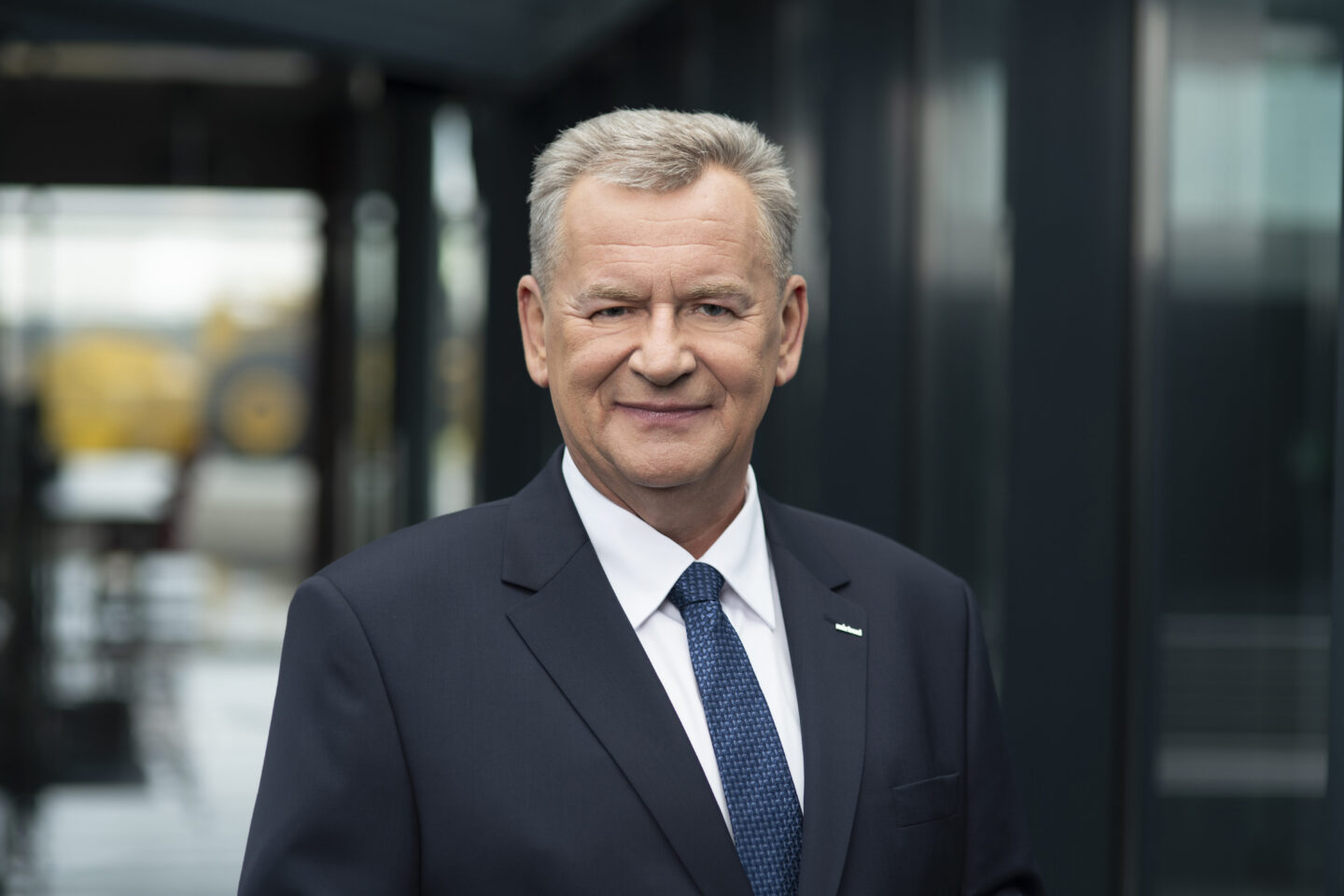
“Minister Balczun (minister of state assets – ed.) talks about supporting Polish companies and promoting local content. But when you look at what state-owned companies actually do, little remains of those promises," says Jerzy Mirgos, CEO of Mirbud. In an interview with XYZ, he also assesses the timetable for Port Polska, Poland's flagship airport and transport hub project, and discusses a missed opportunity to participate in the construction of Rail Baltica.
Who's who
Jerzy Mirgos
CEO and founder of Mirbud, one of Poland's largest construction companies. He has been involved with the Mirbud Group since 2002 and became CEO in 2012. In 2008, he founded JHM Development, where he serves as vice-president of the management board.
Emilia Derewienko, XYZ: Which Central Communication Port (CPK) tenders is Mirbud participating in?
Jerzy Mirgos, CEO of Mirbud: We are participating in most of CPK's procurement procedures. The most important is the tender for the construction of the passenger terminal. Equally important to us is the contract for the railway station and tunnel beneath the airport. We are also bidding for two high-speed rail sections. The prequalification stage has already been completed, and we have been shortlisted for the next round. So we are involved in the four largest tenders announced by CPK. We are also interested in upcoming contracts for airport pavements and further sections of the high-speed rail network.
Recently, however, the number of bidders interested in the terminal contract has fallen. Polimex-Mostostal has withdrawn from the competition. What is the biggest risk for a construction company bidding for this particular contract?
I won't pretend that Polimex's decision upset us. Less competition means a better chance of winning the contract. There are now four bidders instead of five. We have no intention of withdrawing. We are preparing our bid and intend to submit it. The contracting authority's requirements have not changed during the tender process, and they remain demanding. But we must remember that this is the largest construction project in Poland, both in terms of value and building volume.
The requirements are demanding, particularly when it comes to project execution, coordination and contractor liability. Of course, the client is paying and has every right to set high standards. We, in turn, have to factor those requirements into our bid. What matters is that CPK has been open to dialogue with contractors from the outset. We therefore hope for a reasonable allocation of risks and a partnership-based approach during construction. On a project of this scale, both sides need the right conditions to bring it to a successful conclusion.
And yet I detect a hint of frustration in your response, particularly over how much responsibility is being shifted onto the contractor.
We had hoped the contractors' perspective would be taken into greater consideration. After all, we are dealing with a major public contracting authority that will have a professional project engineer overseeing the work. I can imagine why CPK has taken this approach, and I understand it. In an organization of this size, now employing more than a thousand people, making changes can be a lengthy process requiring approval at several levels.
We can also see progress. CPK has demonstrated openness, and the dialogue has produced tangible results in some areas. We are awaiting the final version of the contract. I hope we will receive it in the coming weeks, perhaps even days, so that we can assess how the discussions have been reflected in its provisions. We appreciate CPK's willingness to engage. There are contracting authorities that do not even try...
Such as?
I'm referring to companies belonging to Polska Grupa Zbrojeniowa (PGZ), Poland's state-owned defense group. Minister Balczun talks about supporting Polish businesses, and there is plenty of emphasis on local content. But when you look at state-owned companies affiliated with PGZ, those promises amount to nothing.
Take the tender for the expansion of the PIT-RADWAR facility in Kobyłka. The tender requirements effectively disqualify every Polish company. Not a single domestic contractor stands a chance of meeting the eligibility criteria. That leaves companies belonging to international groups, which can draw on the experience and resources of their foreign affiliates. As a result, Polish contractors are excluded before they can even submit a bid.
Minister Balczun talks about supporting Polish businesses, and there is plenty of emphasis on local content. But when you look at state-owned companies affiliated with Polska Grupa Zbrojeniowa (PGZ), those promises amount to nothing. In the tender for the expansion of the PIT-RADWAR facility in Kobyłka, the requirements effectively disqualify every Polish company.
And that is what frustrates me most. We are not asking for preferential treatment. We are asking for conditions that allow us to compete and reflect the actual scale of the contract. If a state-owned company shuts Polish businesses out of public contracts, it is acting in direct contradiction to government policy and the national interest.
Perhaps we should first define what local content actually means and under what circumstances it applies. Under the law, a company with capital from outside the European Union but headquartered in Poland is still considered a Polish company...
Last year, the government introduced legislation restricting market access for companies from outside the European Union. It deserves credit for that. The measures provide some protection for the European market against competition from Asian companies.
But the concept of local content does not, in itself, determine whom we want to support. A company registered and operating in Poland is not necessarily a Polish company. When I talk about Polish businesses, I mean companies whose owners, management and decision-making centers are based in Poland. This is where decisions about investment, development and the allocation of profits are made. Many politicians fail to recognize this distinction, which is crucial to us, between a company operating in Poland and a genuinely Polish enterprise.
In a serious crisis, the foreign owner of a company operating in Poland could decide to withdraw from the country and transfer its resources and know-how to other markets. Polish companies, by contrast, see their future here. Foreign investors bring capital to Poland to make money, and they have every right to repatriate their profits. I have no objection to that. That is how business works – you invest to make a profit. But from the perspective of Poland's national interest, the state should recognize the value of domestic companies that ensure the profits and expertise they generate remain in the country.
That is why we established Wektor: Polska within the Polish Association of Construction Industry Employers. The initiative aims to represent the interests of Polish companies – small, medium-sized and large – and demonstrate why their growth serves the national interest. We also want to draw contracting authorities' attention to the need for tender requirements that reflect the scale of the contracts and give Polish businesses a genuine opportunity to compete. This is not about preferential treatment but about giving companies the chance to grow in their home market. It should be a priority in the state's long-term economic policy.
How have politicians responded?
Politicians express their support. But when we expect concrete measures, particularly from state-owned companies, that support rarely translates into action. We have written about this issue to Minister Balczun and the management board of Polska Grupa Zbrojeniowa, among others. The responses essentially amounted to claims that neither the ministry nor the group could influence the activities of its subsidiary.
As a result, defense spending that was supposed to stimulate the Polish economy will end up flowing to foreign companies. This is a serious failure to act. The Ministry of State Assets has the greatest scope to provide guidance to state-owned companies. It cannot dictate their decisions, but it can set strategic priorities. It is difficult to imagine the CEO of a state-owned company simply ignoring the position of the minister of state assets.
I see the biggest problem at PGZ. The group will have enormous investment funds at its disposal, yet its procurement practices still show little sign of an approach that would give Polish companies a realistic chance of securing these contracts. Government declarations alone are not enough.
Let's return to Port Polska. How do you assess the state of the project amid all the uncertainty surrounding it? There is no CEO, financing has not been secured, construction has not officially begun, tender schedules have been delayed, and one company has withdrawn from a major tender...
The absence of a CEO certainly does the company no favors, but we expect an appointment soon. CPK has professional structures, a large team and excellent managers, but it needs someone who can set the direction, mobilize teams and take responsibility for the entire project. Given the scale of the undertaking, the management board should be operating at full strength, particularly now, as the company enters its most intensive phase of awarding contracts.
Isn't it strange, though, that just months or even weeks before construction is supposed to officially begin, it turns out that PLN 20bn in EU funding for the high-speed rail network is missing?
We should remember that this money will not be needed for another two or three years. A lack of funding, or incomplete financing arrangements, does not prevent tender procedures from moving forward. If the first contracts with construction companies are signed next spring, as the contracting authority has indicated, that will be a major achievement, primarily because of the sheer scale of the investment. So CPK still has time to secure the financing.
The bigger challenges stem from the scale of the project itself. With an investment this complex, the pace of procurement also depends on the preparation of technical documentation and the administrative approvals required for individual components. CPK does not currently have a construction permit, nor does it have complete documentation for all the planned works.
Are you not concerned about delays? There are growing doubts about whether the airport can open in 2032.
Almost no strategic infrastructure project in Poland has been completed within its original contractual deadline. The reasons have varied, from administrative and organizational obstacles to public protests. This will not be the only project whose timetable slips. None of the opening dates announced so far – neither 2027 nor the current target of 2032 – has been realistic given the scale of the challenges involved. We need to communicate that clearly and not be afraid to say so.
None of the opening dates announced so far – neither 2027 nor the current target of 2032 – has been realistic given the scale of the challenges involved. We need to communicate that clearly and not be afraid to say so.
We are approaching the end of 2026, and contracts will not be signed until autumn 2027 at the earliest. You don't need to be an expert to see that opening the airport in 2032 is unrealistic. Construction alone is expected to take five years. The acceptance and commissioning procedures take another one to two years, followed by certification. If someone told me today that the airport would open in 2035, I would still consider that a major success. That is a realistic deadline, one that would allow contractors and the authorities to coordinate the entire project. We should remember that nobody in Poland has experience delivering an undertaking of this kind. No one has ever built an airport of this scale here.
At the same time, the project is moving steadily forward. Personally, I believe the process has now reached a point where nobody can stop it.
Could Port Polska be built under a public-private partnership (PPP) model?
There were ideas along those lines initially, although they were not described as PPP. The plan was to find a strategic investor and deliver the entire project as a single contract rather than dividing it into packages. That approach failed because, given the scale of the investment, financial institutions did not have sufficient guarantees to provide financing of that magnitude. The airport had also suffered from negative publicity from the outset, which certainly did not help.
Dividing the project into packages was a very sensible decision because it gives companies like ours a chance to compete for contracts. Had there been a single tender along the lines of "build us an entire airport," only two or three Arab or Asian corporations would have entered the competition. Only companies of that size could have undertaken the entire project. We would have ended up in a familiar situation, with Poland's largest infrastructure investment being delivered by companies from outside the European market.
Of course, dividing the project into smaller packages places enormous responsibility on the contracting authority to coordinate the work. But from the perspective of Polish contractors, it was a strategic decision that I personally strongly support. It gives us the opportunity to bid for all the most important contracts.
Looking back, how do you feel about losing the contract to modernize the Białystok–Ełk railway line, part of Rail Baltica?
Had we secured that contract, our group would be in a very different position today. Our ship would not merely be sailing – it would be racing across the waves. I feel we missed a major opportunity. We suffered reputational damage and lost the chance to join the very top tier of railway contractors. So yes, there is a certain amount of disappointment and frustration.
We suffered reputational damage and lost the chance to join the very top tier of railway contractors. So yes, there is a certain amount of disappointment and frustration.
On the other hand, the project would have had a good chance of success if the contract had been signed last year, when our bid was selected, and construction had already reached its second phase by now. If I had to sign that contract today, I would have serious doubts about its financial viability. A great deal has changed in the market over the past year: construction material prices have risen, subcontractors are harder to find, and the number of railway projects has increased.
So perhaps losing the court case was a blessing in disguise. Our bid reflected last year's market conditions, not those prevailing this autumn. That is why we are not dwelling on the loss.
Have you drawn any lessons for the future?
We have strengthened our legal department so that it can more thoroughly review developments across all our construction sites, of which we have around a hundred. The other issue is that a PLN 15,000 penalty seemed insignificant, certainly in the context of our ability to deliver a contract worth several billion PLN. I was the one who decided not to disclose it in the tender documentation, so I cannot even shift the blame onto anyone else.
Nevertheless, I still believe that courts and contracting authorities should apply the principle of proportionality when assessing such matters. This is particularly important when failing to disclose a minor penalty leads to the rejection of the most advantageous bid, significantly increases the cost of the investment and has no bearing whatsoever on the contractor's ability to deliver the project.
This was genuinely not about concealing anything. That penalty had no relevance to our ability to fulfill the contract.
Will Track Tec be able to deliver the contract?
I have no doubt that it will. However, in a consortium with four decision-makers, there is a considerable risk of disagreements over how the project should be managed. That is why Mirbud very rarely bids as part of a consortium, particularly one with such a complex structure.
Do you think PKP PLK was right not to split the tender into smaller sections?
Railway projects are more difficult to divide into separate contracts than road projects. In this case, it would certainly have been possible, especially since the Białystok–Ełk section is not particularly complex – it does not require tunneling or bridge construction. From the investor's perspective, however, it is easier to manage a single section with one contractor and one supervisory team.
There is certainly a shortage of railway tenders accessible to small and medium-sized enterprises. From our perspective, however, larger contracts are more attractive because they limit the number of potential bidders to some extent.
Poland's road network is almost complete. Does that mean railways will become the sector on which you want to build your business?
Road construction is coming to an end? I wouldn't say that. The General Directorate for National Roads and Motorways (GDDKiA) has a budget of between PLN 15bn and PLN 20bn for the next few years. Minister Klimczak himself has said that while the construction of new highways is nearing completion, there is still work ahead on adding third lanes, upgrading existing roads and resurfacing.
So I wouldn't worry about the road construction sector. Roads will remain a pillar of our business for at least another ten years.
Our second pillar is building construction, although it does not involve projects of the same strategic importance. Railways will become our third pillar, allowing us to maintain our position among Poland's leading domestic contractors. I believe we will always be among the top five, but had we secured the Białystok–Ełk contract, we would have ranked second.
One segment where we missed the boat last year was energy. We want to expand in this area, but rather than build our operations from scratch, we intend to pursue acquisitions. Discussions are already underway, and there are companies we could acquire. However, energy will not become a business on the same scale as roads or railways.
Then there is the defense sector, although gaining access to it is difficult. Investment is expected to reach around PLN 200–300bn over the next decade, but a significant share of that spending will go toward ammunition and equipment purchases. We are monitoring the sector and participating in tenders, but we do not see it as the main driver of our growth.
Which investments will have the greatest impact on Mirbud's future?
We are keeping a close eye on Ukraine. The characteristics of that market will give us an opportunity to compete with foreign companies. CPK will also have a significant impact on our future growth. After all, we are talking about PLN 100bn flowing into the market over the next decade.
The third area is Poland's much-discussed nuclear power plants. We hope to play a significant role in those projects. These are strategic opportunities that could provide a powerful impetus for the company's further development.
Do Polish companies have enough capital to compete with foreign consortiums on projects such as Port Polska?
In principle, the largest Polish companies have the capacity to compete independently for strategic contracts. Only the foreign corporations themselves know to what extent they invited Polish partners into their Port Polska consortiums because of their expertise, and to what extent they did so in response to expectations that Polish companies should be involved.
Nevertheless, the pressure to cooperate with domestic businesses is having an effect. Polish companies are participating in these consortiums as partners, rather than merely as subcontractors.
Only the foreign corporations themselves know to what extent they invited Polish partners into their Port Polska consortiums because of their expertise, and to what extent they did so in response to expectations that Polish companies should be involved. Nevertheless, the pressure to cooperate with domestic businesses is having an effect.
We should also remember that large investments can be divided into smaller packages, but not every part of a project can be broken down sufficiently for small and medium-sized companies to deliver it independently. For many of them, working as subcontractors is the only way to gain experience and grow.
That does not mean, however, that we should overlook large Polish companies. They have the capacity to undertake the biggest projects and open doors to new markets, including Ukraine. Participating in Ukraine's reconstruction will involve enormous risks. Companies will need substantial financial resources to manage them.
What, in your view, is the biggest constraint on Poland's infrastructure sector right now? Is it labor shortages, a lack of financing, or perhaps the much-anticipated tender boom that has yet to materialize?
Everyone keeps talking about a tender boom, but we are still waiting for it to arrive. The biggest problem, however, is labor shortages. Employment in construction is declining year after year. It is demanding work. You cannot work remotely on a construction site. The working day can last ten hours, regardless of the weather, and often involves being far from home. Those who stay in the industry are the ones who can cope with these conditions.
Perhaps the pay simply isn't good enough?
Wages in construction are very attractive. But pay alone is not enough, because working on a construction site requires flexibility and considerable commitment. Many people prefer to earn less in exchange for an eight-hour working day, the option to work remotely part of the week and a more predictable lifestyle. That is understandable.
As a result, although we train engineers, many ultimately choose not to work in the profession. We also need a cross-party agreement on simplifying the procedures for hiring foreign workers.
What other factors are working against the industry?
Elevated inflation is pushing up construction costs, while the price-adjustment caps in new contracts could be exhausted within a year or two. The industry would then once again face rising costs that could not be covered by the adjustment mechanisms written into contracts.
Materials and equipment are readily available. Nor am I seeing any signs yet of the much-heralded construction boom.
Overall, however, I consider the industry's situation stable. We complain that there are too few projects, but conditions have not been this good for several years. This stability allows companies to expand their capacity and compete for more contracts.
In the past, three to five companies would compete for major contracts. Today, there are at least ten, which demonstrates how much many businesses have developed.
Of course, the market has its ups and downs, but the stability and scale of ongoing investment projects ensure a steady flow of contracts. That, in turn, improves our liquidity and allows us to consider acquisitions, further investments and expansion into the Ukrainian market.
So I am looking to the future with considerable optimism.


Key Takeaways
- Mirbud's CEO believes the 2032 deadline for opening the airport under the Port Polska project is unrealistic. Construction contracts may not be signed until autumn 2027 at the earliest, while construction itself is expected to take five years. Acceptance procedures and certification will add further delays. Jerzy Mirgos therefore considers 2035 a realistic opening date.
- Mirbud's CEO believes the company missed an opportunity to join the top tier of railway contractors. The Białystok–Ełk contract could have significantly strengthened Mirbud's market position, but conditions have changed over the past year. Material prices have risen, subcontractors have become harder to secure, and the number of railway projects has increased. Mirgos acknowledges that, at today's costs, the contract's financial viability would be seriously questionable.
- Mirbud plans to expand into several sectors but has no intention of abandoning road construction. The company expects roads to remain a core pillar of its business for at least another decade, complemented by railway and building construction. It also plans to expand into the energy sector through acquisitions. Meanwhile, Mirbud is monitoring defense-related investments but does not regard them as a primary driver of future growth.