

This article is a part of Poland Unpacked. Weekly intelligence for decision-makers
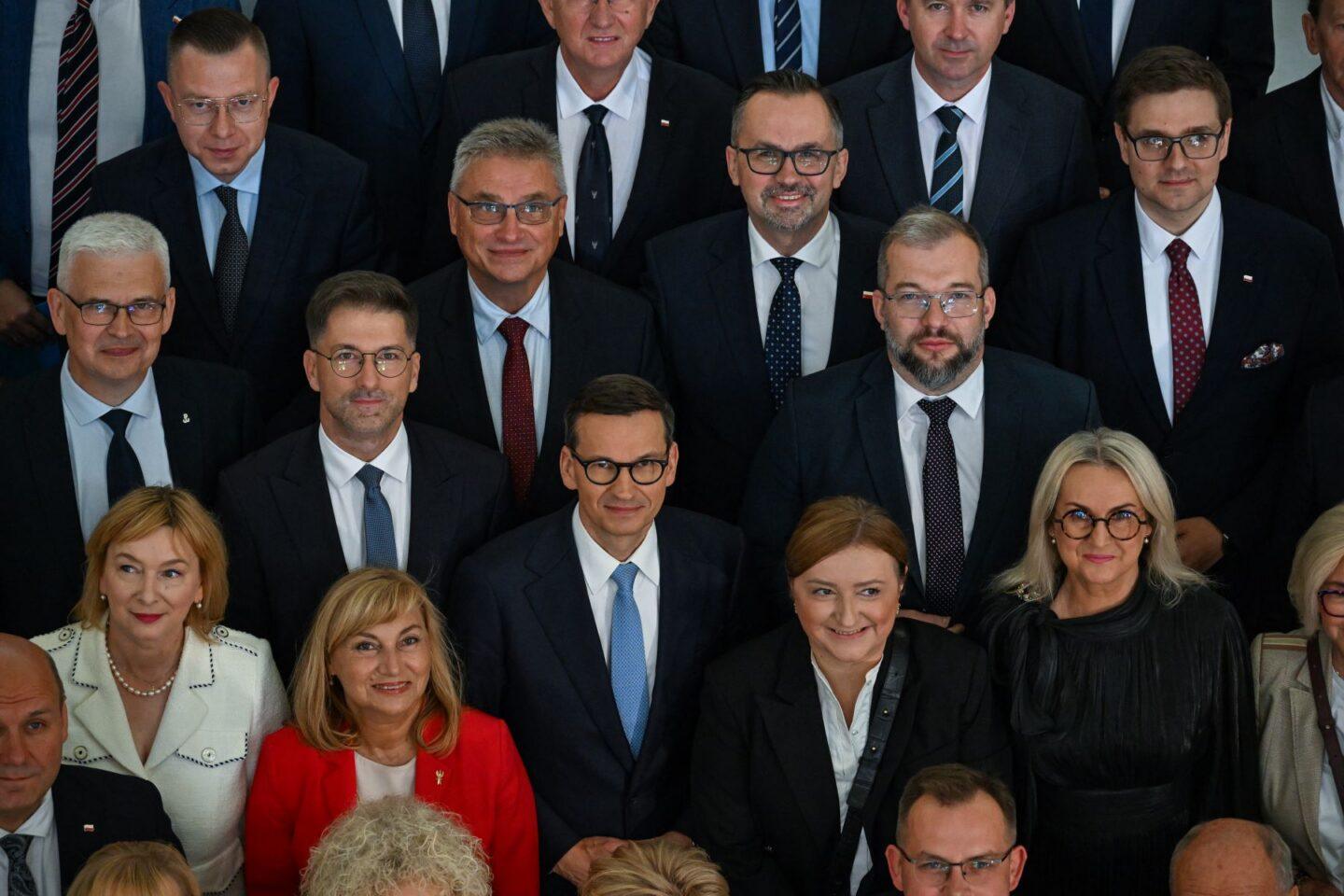
On Wednesday, 29th July, Mateusz Morawiecki, former PM and the leader of the Rozwój Plus Association within the Law and Justice (PiS), announced that his MPs would leave the PiS parliamentary caucus to form one of their own. The new caucus is expected to comprise 40 MPs and one senator, making it the third-largest parliamentary caucus in the current term of the Sejm. The Rozwój Plus (R+) breakaway will also cost PiS its status as the largest parliamentary caucus, with the title passing to the Civic Coalition (KO).
A major parliamentary caucus
Until now, PiS had 186 MPs in its parliamentary caucus, compared with 156 for the Civic Coalition (KO). Following the split, KO will become the largest caucus in the Sejm. PiS will fall to second place with 146 MPs, while Rozwój Plus, with 40 MPs, will move onto the parliamentary "podium," displacing the Polish People's Party (PSL), which currently has 32 MPs.
"We have decided to establish a parliamentary caucus, and it will serve as our platform for future action and our political forum. Within the Rozwój Plus Association, we already carry out a great deal of expert and development-oriented work. The caucus will provide us with the political platform to pursue those initiatives," said Rozwój Plus leader Mateusz Morawiecki.
The former prime minister also used the announcement of the new caucus to take several swipes at the Law and Justice leadership.
"What has happened is exactly what the Law and Justice leadership has been signaling for the past few days—taking two steps forward, one step back, and then reversing course. We have no intention of getting drawn into this kind of squabbling and political game-playing, because it serves no one. Above all, the real splitters, the schemers, will keep behaving this way. They want us to be consumed with our own internal affairs. Why? Because they are betting on our defeat. They know that if Law and Justice loses, they will be able to take over the party," Morawiecki said, criticizing his former colleagues.
Morawiecki: "Poles couldn't care less"
Morawiecki also called for an end to the internal maneuvering within PiS, arguing that "Poles couldn't care less."
"What Poles care about is building a strong Poland: their household finances, jobs for young people, housing, development, identity, culture, faith, and defending the Christian cross—the one hanging here in the Sejm. Those are our principles. That is our creed," the former prime minister said.
The Rozwój Plus leader announced that he would formally apply later on Wednesday to establish the new parliamentary caucus. He added that further details—including the group's nominee for deputy speaker of the Sejm—would be announced once the caucus had been formally constituted.
As early as Friday, 24th July, immediately after separate press conferences by Jarosław Kaczyński and Mateusz Morawiecki, XYZ predicted that this scenario would soon unfold. The expectation was that, on Tuesday, Law and Justice's Political Committee would formally expel the "breakaway" members from the party. They, in turn, would respond by forming their own parliamentary grouping and, ultimately, establishing a new political party.
Rozwój Plus members remain in PiS
Tuesday evening took a rather unexpected turn. First, Mateusz Morawiecki announced that he was stepping down as chairman of the European Conservatives and Reformists (ECR) Group, which includes Law and Justice's members of the European Parliament.
"It has been a great honor to serve as president of the ECR and to share such an important and rewarding journey with all of you," Morawiecki wrote in his resignation letter.
Shortly afterward came the decision of the Presidium of PiS's Political Committee on the fate of the "breakaway" faction. Contrary to expectations, the committee did not expel the rebels from the party. Instead, it referred their cases to PiS disciplinary spokesman Karol Karski, who is to review each one individually.
The party leadership argued that the party's statutes prevented it from expelling the politicians, even though they had refused to sign the so-called loyalty pledge—the issue over which Morawiecki and the PiS leadership had recently been at loggerheads.
That claim is incorrect. Article 41 of the party's statutes states that the PiS Political Committee may expel a party member "in the event of a serious breach of the party's statutes or a member's obligations that prevents or threatens the implementation of PiS's program or political line."
For several days, PiS politicians had maintained that the breakaway faction had clearly violated the party's political line. Yet no expulsions followed. Why?
The hidden logic behind Nowogrodzka's decision
There are two main theories. The first is that delaying the process serves the party's financial interests. As long as the MPs formally remain members of PiS, the party can continue collecting membership dues from them while also receiving funding from the Sejm Chancellery, which allocates money to each parliamentary caucus based on the number of MPs it includes. The larger the caucus, the greater the funding available for its operations.
The second part of that theory became obsolete after Morawiecki's announcement on Wednesday morning. The first part is also open to question, as it is no secret that, in recent months, Rozwój Plus politicians had been paying only a fraction of the membership dues required by the party.
There is, however, a second theory—one rooted purely in politics. The current standoff is ultimately about assigning blame for the PiS split. Each side is trying to avoid responsibility for the party's dramatic breakup in the hope of rallying as many bewildered right-wing voters as possible at the other's expense.
At the same time, PiS may be seeking to buy itself more time in the hope of persuading one or more of Morawiecki's current allies to switch sides. A prolonged and inconclusive "divorce" could also pressure some Rozwój Plus members to leave PiS of their own accord. That, in turn, would cast Morawiecki's new grouping in a somewhat less favorable light.
A battle over political blame
In the short term, it clearly suits Morawiecki and his allies to frame themselves as the faction seeking compromise—only to have it rejected by PiS headquarters on Nowogrodzka Street. Conversely, the party leadership is intent on pinning responsibility for the split on Morawiecki, who in recent days has been branded by politicians loyal to Jarosław Kaczyński as "Tusk's adviser" and accused of opposing both the flagship Family 500+ child-benefit program and the purchase of F-35 fighter jets.
Talking to XYZ several weeks ago, Marcin Duma, the former head of the polling agency IBRiS, argued that any split would ultimately hinge on who was held responsible.
"An amicable divorce is unlikely. If a split does happen, it will come with a finding of fault. Whose fault? That depends on whether Mateusz Morawiecki leaves of his own accord or is expelled. If he walks away voluntarily, he will be blamed. But if he is thrown out of PiS, responsibility will rest with Jarosław Kaczyński himself, as well as Przemysław Czarnek and the group within the party that has formed an internal opposition to Morawiecki. Morawiecki certainly won't accept the blame under such a scenario. What we are seeing now is a struggle over who will control the process—and who will emerge from it with the least political damage," Duma said.
Duma: Morawiecki leaving PiS voluntarily would be the riskier option
Duma argued that, for the former prime minister, leaving PiS of his own accord would be the more hazardous scenario.
"If Morawiecki walks away voluntarily, he can hardly expect any broader goodwill on the right. This is a classic blame game—a contest over who ultimately bears political responsibility. In the end, that is what this is all about," the former head of IBRiS said.
Several days into the split, that assessment appears to be playing out. Both camps are engaged in a battle over the narrative, each seeking to hold the other responsible for the breakup. By announcing the formation of a new parliamentary caucus on Wednesday, Morawiecki has, by that logic, put Jarosław Kaczyński in a somewhat stronger position.
Even so, responsibility for the party's breakup may prove less important over the longer term. If, after the summer recess, opinion polls show that Rozwój Plus can consistently command support above the electoral threshold, Morawiecki would be in a much stronger position to take a more assertive stance toward PiS headquarters on Nowogrodzka Street in any future electoral alliance or coalition negotiations next year.
Preparations for Rozwój Plus's inaugural barbecue
Meanwhile, Morawiecki and other Rozwój Plus politicians are preparing for the movement's Friday 31st July event in Warsaw. The details of its political program have yet to be unveiled and are expected to be presented on Friday.
On Tuesday, Morawiecki posted an outline on social media under the slogan "Ten Pillars for Poland." In reality, however, it contains few concrete policy proposals. The document speaks of, among other things, making "patriotism the guiding principle behind every decision," tightening tax collection, and opposing the European Union's climate policy.
Critics of the former prime minister have been quick to note, with some irony, that placing the pledge "Victory comes first" as the final item on the list is hardly the strongest possible start for his new political project.
Even so, it is far too early to say who—if anyone—will ultimately emerge victorious from the showdown between PiS headquarters on Nowogrodzka Street and the Rozwój Plus camp. For now, the initiative lies with Morawiecki's allies. The next round in the long-distance contest for the right-wing electorate will come on Friday, when Rozwój Plus holds its inaugural barbecue event.


Key takeaways
- Mateusz Morawiecki has announced the formation of a new parliamentary caucus bringing together members of the Rozwój Plus Association. The group will comprise 40 MPs and one senator. Once the split is formalized, Law and Justice (PiS) will lose its status as the largest parliamentary caucus in the Sejm, with the Civic Coalition (KO) taking the lead.
- The PiS leadership has stopped short of immediately expelling the breakaway faction from the party. Instead, the matter has been referred to the party's disciplinary spokesman, who will examine each case individually. The move is widely seen as a tactical effort to buy time while shifting full responsibility for the split on the right onto the former prime minister.
- A fierce battle for the political narrative is now underway between former allies, as both sides compete for the support of right-wing voters. Assigning blame for the breakup of PiS is likely to be crucial to each camp's political prospects in the years ahead. According to Marcin Duma, the future of Morawiecki's new movement will largely depend on whether it can maintain support above the electoral threshold after the summer recess and on the substance of its political program, the first outlines of which are due to be presented on Friday 31st July.