

This article is a part of Poland Unpacked. Weekly intelligence for decision-makers
1. First power from offshore wind
In 2026, the first offshore wind farm in Polish waters will come onstream. Of the several projects under way in Poland’s part of the Baltic Sea, the most advanced is Baltic Power, owned by Orlen and Canada’s Northland Power. The farm is located 23 km offshore, off the coast near Łeba and Choczewo. It covers an area of more than 130 square kilometers.
The first turbines have already been installed. In total, the site will host 76 turbines, each with a capacity of 15 MW and a height of 250 meters including the foundation. Together, they are expected to generate up to 4 TWh of electricity annually, equivalent to about 3% of Poland’s total power demand.
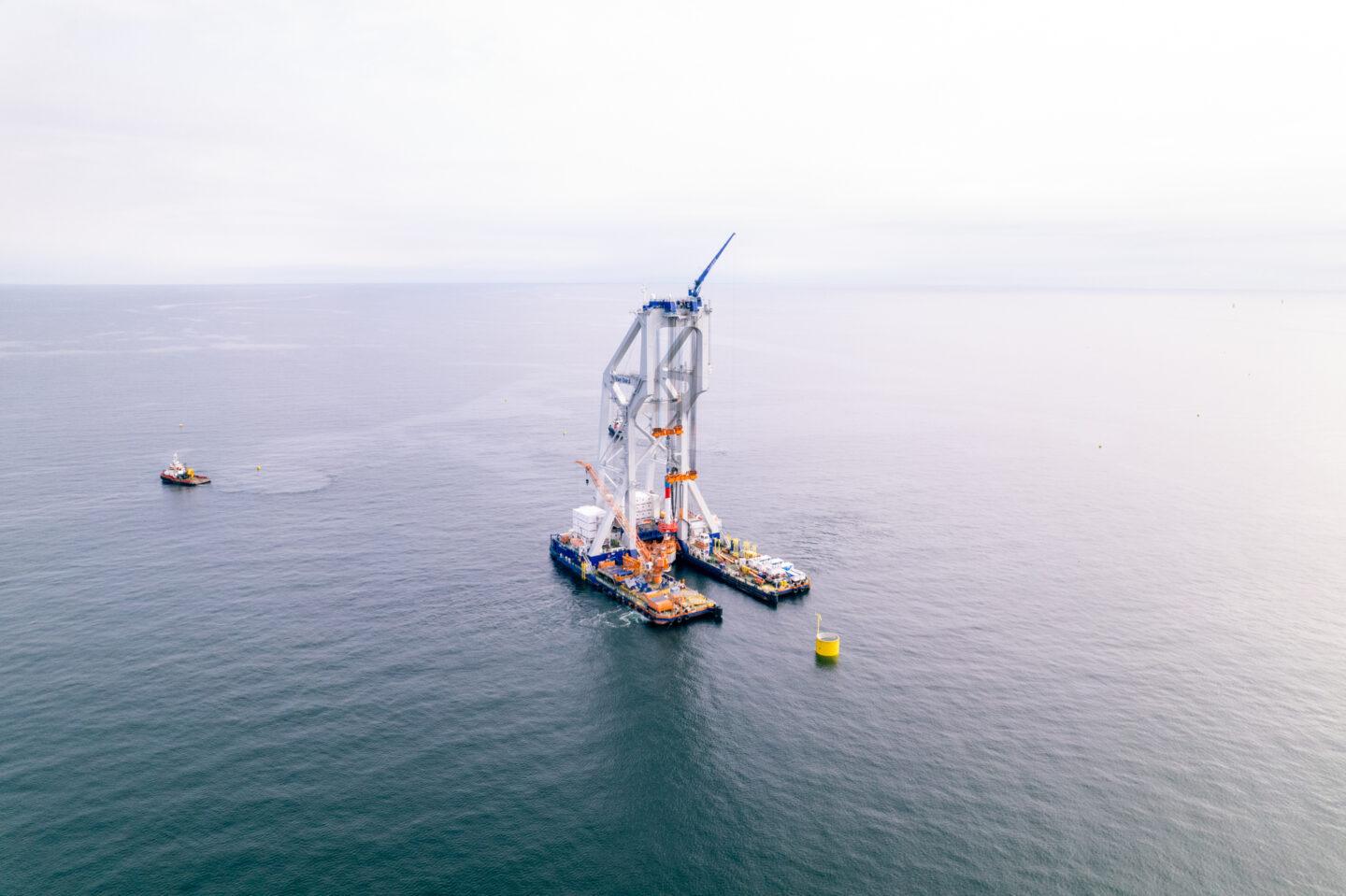
At the end of 2025, the investors installed two offshore substations in the Baltic Sea, each weighing 2,500 tons. These are critical components of the project, responsible for collecting the electricity generated by the turbines and transmitting it to shore.
The exact commissioning date for the Baltic Power farm has not been announced. Construction is scheduled to be completed in the first half of 2026, after which a complex process of testing, certification, and permitting will begin.
Keeping to the timetable required the on-time completion of substations and transmission lines designed to carry electricity from the offshore turbines to consumers across the country. On December 30, Polskie Sieci Elektroenergetyczne (PSE), the national grid operator responsible for network investments in Pomerania, confirmed the technical readiness of the transmission infrastructure to accept power from Baltic offshore wind farms.
“The new Choczewo substation and the expanded Żarnowiec substation, together with the 400 kV line connecting them, are ready to transmit electricity from the wind farms being built in the Baltic Sea to consumers inland,” said Włodzimierz Mucha, vice president of PSE.
2. Contract for Poland’s first nuclear power plant
Preparations for the construction of Poland’s first nuclear power plant are also moving ahead at full speed. In 2026, the sector expects the signing of the single most important contract for the project: the engineering, procurement, and construction agreement. Negotiations are under way between the investor, Polskie Elektrownie Jądrowe (PEJ), and the contractor – an American consortium of Westinghouse and Bechtel.
“For the success of the Polish project, it is crucial that the contract is negotiated and signed as quickly as possible. I believe we can expect this by mid-2026. At that point, we will immediately place orders for key components of the plant, many of which have long lead times,” said Dan Lipman, president of Westinghouse’s Energy Systems business unit.
The investment, with a total cost approaching PLN 200 billion (around EUR 45 billion), is being developed in the Pomeranian municipality of Choczewo. For months, geological surveys and design work have been under way at the site. These activities will continue until the final contract with the contractor is signed.
The investor can count on massive state support in the form of a capital injection of PLN 60 billion (about EUR 13.5 billion). This package also includes free-of-charge guarantees covering 100% of the project’s debt. In addition, a two-way contract for difference has been signed allowing the plant to sell electricity at a fixed price for 40 years. In early December 2025, the European Commission approved this form of state aid. On December 30, PEJ received its first tranche of government bonds worth PLN 4.6 billion (approximately EUR 1 billion), enabling the continuation of preparatory, design, and engineering work.
In the coming months, alongside contract negotiations, PEJ will prepare the documentation required to obtain further administrative decisions. These are essential to launching construction of the nuclear power plant. The company will also hold advanced talks with banks and financial institutions to secure the project’s debt financing.
3. Full launch of the Central Energy Market Information System
After several years of preparation and delays, the full version of the Central Energy Market Information System (CSIRE) will go live in October 2026. For electricity consumers across Poland, this will amount to a quiet revolution.
By logging in at mojeire.csire.pl, users will have free access to data on their electricity consumption, contracts signed with power suppliers, and the technical and commercial parameters of their metering points. Through the portal, consumers will also be able to share their data with a selected electricity supplier, making it easier to obtain tailored offers or assess options for reducing energy costs.
“The rollout of CSIRE is not just another IT project in the power sector – it is a new foundation for how the entire industry operates. The system will allow the future of the sector to be built on precise data and automation, while at the same time simplifying processes so they are transparent and convenient for customers,” said Andrzej Modzelewski, CEO of E.ON Polska.
The system officially launched on July 1, 2025, but the largest electricity network operators will join in October 2026. At that point, households nationwide will be able to use the new platform. CSIRE will provide consumers with detailed metering data, enabling them to track electricity usage almost in real time.
Energy suppliers say the system will allow them to develop personalized pricing offers that reflect demand variability and lower prices at certain hours. Businesses will also be able to use CSIRE to better plan operations, optimize energy consumption, and reduce operating costs.
4. National Energy Strategies
In 2026, the sector expects the government to adopt several key strategic documents. The ruling coalition had promised that the most important strategies for Poland’s energy sector would be approved by the end of 2024. So far, that has not happened.
The most advanced document is the National Energy and Climate Plan (KPEiK). The Ministry of Energy published the latest draft on December 17. It sets out two possible paths for the energy transition. Under the baseline scenario – recommended by the ministry – greenhouse-gas emissions would fall by 43% by 2030 and by 61% by 2040. Under an accelerated transition scenario, emissions would be cut by 53% by 2030 and by 75% by 2040.
These differences translate directly into the scale of investment, the structure of the power-generation mix, and the pace at which energy costs decline. Under the baseline scenario, total investment would amount to PLN 2.7 trillion (around EUR 610 billion); under the more ambitious option, PLN 3.5 trillion (roughly EUR 790 billion). Higher investment, the ministry argues, would mean faster modernization of the system, lower energy prices in the long term, and greater resilience of the economy to turbulence in global markets.
Work on the document dragged on for so long that the European Commission filed a case against Poland with the Court of Justice of the European Union (CJEU). The government is now expected to adopt the KPEiK in January and submit it to Brussels.
As next steps, the Ministry of Energy has announced an update of the Polish Nuclear Power Program and the launch of work on a new Energy Policy of Poland through 2050. Beyond that, the sector is still waiting for a strategy for district heating, a strategy for carbon capture and removal, an update to the hydrogen strategy, and a fully-fledged industrial policy. According to experts, such documents are badly needed by the Polish economy.
“The KPEiK can become the foundation for sector-specific strategies – for example in district heating, industry, or power generation. It can also bring order to the administration’s work on planning the transition and make coordination between ministries easier. At present, they often operate in silos, without a comprehensive view of the transformation. Swift finalization of the document is also important for companies, as it allows them to plan investment processes that extend beyond a single political term,” said Paweł Wiejski, a senior public policy analyst at the Reform Institute.
In his view, the government’s adoption of the KPEiK could be the first step toward a systemic approach to managing the energy transition – something Poland has lacked for years.
The Ministry of Energy has not said when work on the remaining strategic documents will be completed. A question sent to the ministry on October 28, 2025, remains unanswered.


Key Takeaways
- In October 2026, the full version of the Central Energy Market Information System (CSIRE) will be launched. The platform will give energy consumers across Poland free access to data including their electricity consumption and existing power-supply contracts. Once consumers choose to share their data with suppliers, they will receive personalized offers tailored to their needs. Another milestone for the sector will be the government’s adoption of the National Energy and Climate Plan, expected in January 2026, which will pave the way for further strategic documents shaping Poland’s energy policy.
- In 2026, Poland’s first offshore wind farm will come onstream. Built by Poland’s Orlen in partnership with Canada’s Northland Power, the facility – comprising 76 turbines – will be capable of covering up to 3% of national electricity demand. Its launch will mark a breakthrough moment in the transformation of Poland’s energy sector.
- The signing of the contract for Poland’s first nuclear power plant is expected in mid-2026. The facility, to be built in the Pomeranian municipality of Choczewo, will be delivered by the American Westinghouse–Bechtel consortium. Concluding the agreement in 2026 is essential to keeping the project on schedule.