

This article is a part of Poland Unpacked. Weekly intelligence for decision-makers
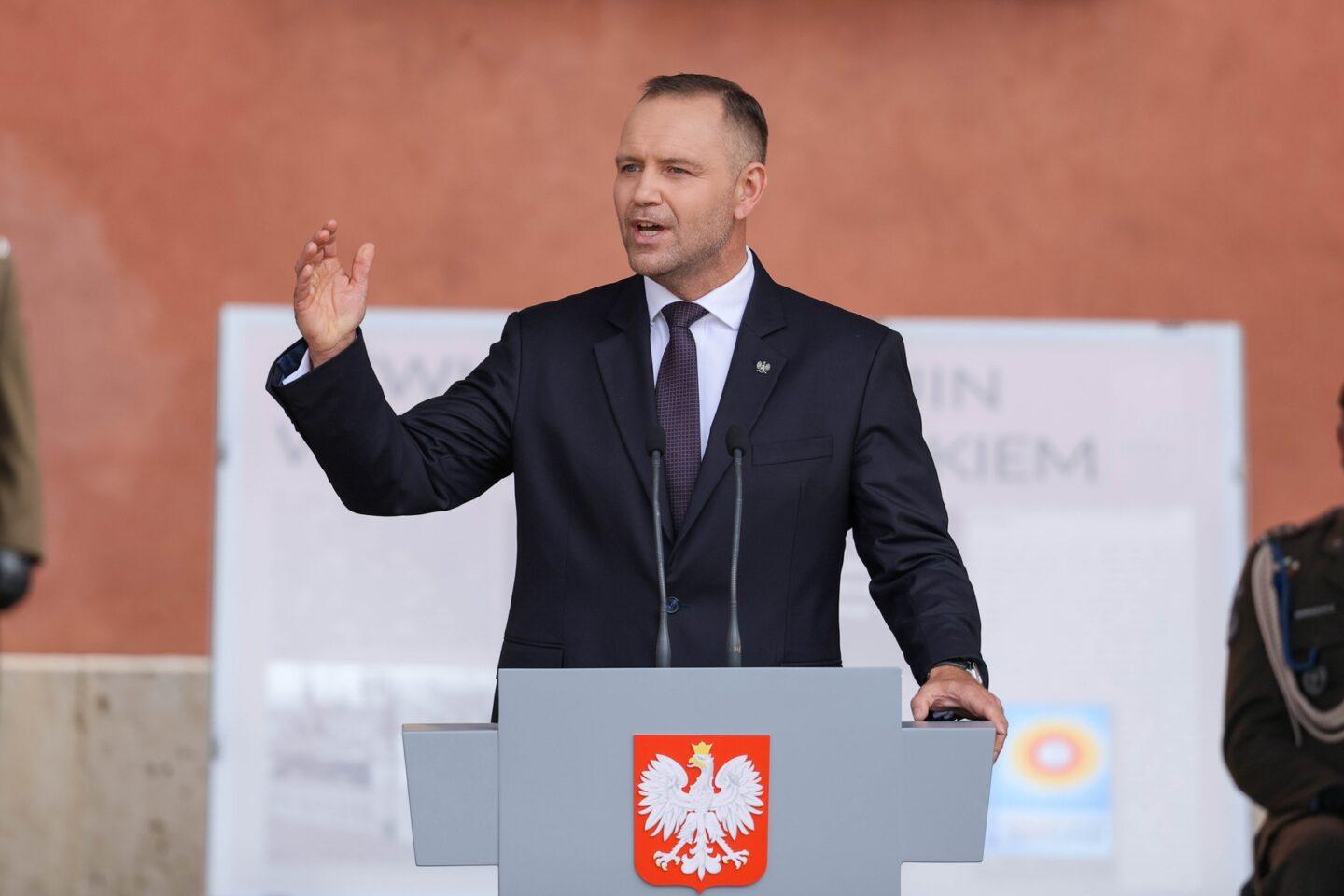
In his inaugural address to parliament, Karol Nawrocki outlined a vision of a presidency that would be both active and openly confrontational toward the government. He pledged to pursue a broad reform agenda, with a new constitution as its centerpiece. He also took a critical tone toward Prime Minister Donald Tusk and his cabinet.
One year of Karol Nawrocki’s presidency
From the outset, Nawrocki also signaled a different style of presidency from that of his predecessor, fellow Law and Justice (PiS) politician Andrzej Duda. According to Professor Sławomir Sowiński, a political scientist at Cardinal Stefan Wyszyński University in Warsaw, the past year has confirmed that distinction.
“This has been a presidency shaped by profound uncertainty, a style of political leadership bordering on populism, and a return to the hard rules of 19th-century realpolitik. More clearly than President Andrzej Duda, President Nawrocki has responded to the defining anxieties of our time: the decline of the liberal-global order, the resurgence of the strong nation-state, and concerns over migration and war. It is the presidency of a ‘people’s tribune’ who likes to demonstrate his political effectiveness,” says Professor Sławomir Sowiński.
A second key difference, he argues, is Nawrocki’s greater political independence from Jarosław Kaczyński.
“He is calmly watching the authority of his former patron diminish so that, at the right moment, he can step onto the political stage as the figure who renews the Polish right,” Professor Sowiński adds.
Karol Nawrocki entered the Presidential Palace with broad support from right-wing voters—not only from Law and Justice. Backing from supporters of Confederation (Konfederacja) and the Confederation of the Polish Crown also proved important. Professor Arkadiusz Modrzejewski, director of the Institute of Political Science at the University of Gdańsk, notes that PiS politicians consistently presented Nawrocki as an independent civic candidate.
“We knew that this ‘civic’ label was overstated and that he was, in fact, a party-backed candidate. The past year has shown that nothing has changed in that respect. He is a strong-willed individual, although some may have disliked the way he shouted at journalists or his tone during his inaugural speech in parliament. Still, he has the potential to change—but that would require genuine willingness on his part,” says Professor Arkadiusz Modrzejewski.
 Interactive chart
 A record number of vetoes
The University of Gdańsk political scientist points to another key difference between Nawrocki and his predecessor. Critics of President Andrzej Duda often mocked him for signing almost every bill put forward by the Law and Justice (PiS) government. Karol Nawrocki, by contrast, began his presidency during a period of cohabitation with Donald Tusk’s government. As a result, the defining feature of his first year has been his frequent use of the presidential veto.
Over the past 12 months, he has vetoed legislation 41 times. The governing coalition mockingly dubbed him a “veto machine.” In doing so, Nawrocki has set an all-time record among Poland’s presidents. The previous record belonged to Aleksander Kwaśniewski, who vetoed 35 bills—but over the course of a decade in office.
Interactive chart “That is unfortunate, because this is not what the presidency is supposed to be about. It exposes the original flaw in our Constitution: the direct election of the president. A president’s democratic mandate can sometimes extend beyond the constitutional spirit because it rests on direct popular legitimacy. It also reflects a misunderstanding of the head of state’s role as someone who should unite the nation. Polish society is deeply polarized, and in the current geopolitical environment we need unity. Instead, the president has become a participant in political infighting,” says Professor Arkadiusz Modrzejewski.
Nawrocki’s first veto blocked legislation aimed at easing restrictions on wind farm development. He later vetoed bills concerning assistance for Ukrainian citizens, so-called chain legislation, the National Council of the Judiciary (KRS), the Digital Services Act (DSA), and, on several occasions, government proposals regulating the crypto-asset market.
One of the most controversial decisions was his veto of legislation related to the SAFE fund. Reflecting Law and Justice’s opposition to the EU’s defense financing initiative, the president proposed an alternative solution together with the governor of the National Bank of Poland. Contrary to claims from the presidential camp, the proposed “SAFE at 0%” plan would not have been cost-free. Later, however, Nawrocki publicly praised the government’s investment plans linked to SAFE. Until then, relations between the Presidential Palace and the Prime Minister’s Office had remained relatively cooperative on national security matters.
Another unexpected episode followed Nawrocki’s veto of legislation designed to curb the use of pretrial detention. The decision prompted critical banners targeting the president to appear at football stadiums across Poland, despite the fact that football supporters and fan groups have generally been sympathetic to him.
“An inability to rise above party interests”
One of the president’s most high-profile recent vetoes concerned the bill on the legal status of a designated next of kin, intended as a substitute for legislation on civil partnerships. During the election campaign, however, Nawrocki had indicated that he would be willing to support such a solution.
“The greatest weakness of this presidency is its inability to rise above party interests. That should concern every citizen, particularly in the context of restoring the rule of law. The president does not appear to feel responsible for repairing the damage done to the rule of law during the years of PiS government,” says Professor Arkadiusz Modrzejewski.
Vetoes are not the only means by which the president has obstructed the governing coalition’s agenda. He has also influenced appointments to institutions central to the rule of law. In recent months, this has been particularly evident in relation to the Constitutional Tribunal, where the president has selectively decided which newly appointed judges will be sworn into office and which will not.
Beyond judicial appointments, Nawrocki has also withheld military promotions. During his first year in office, he did not sign a single ambassadorial appointment.
“This is an unfortunate legacy inherited from President Andrzej Duda. The president is withholding not only ambassadorial appointments but also academic professorships, the best-known example being Professor Michał Bilewicz. That cannot be justified,” says Professor Arkadiusz Modrzejewski.
Professor Sławomir Sowiński, meanwhile, argues that the president, buoyed by his electoral victory, has been “trying to push the limits of the rather narrow constitutional powers vested in his office.”
“Our Constitution grants the president a strong democratic mandate while at the same time confining his formal powers. Particularly in the legislative process, the president’s role is essentially that of a reviewer, an auditor, or, to some extent, a notary. Like Lech Wałęsa before him, President Nawrocki feels politically strong and is attempting to move beyond those constitutional boundaries. He is signaling a willingness to influence the legislative process in ways that are not consistent with the logic of the Constitution. Through his vetoes, he is testing the political patience of the governing coalition and its voters. That may be an effective strategy for strengthening his position on the right, though not necessarily for appealing to the political center,” says the UKSW political scientist.
Reform ambitions that exceeded reality
The president’s reform agenda has so far produced 22 legislative initiatives, although not always in the form originally promised. One example is the bill intended to lower electricity prices. It was supposed to take effect within the first 100 days of Nawrocki’s presidency. In practice, by that deadline it had only been submitted to parliament.
The first bill introduced by President Nawrocki concerned the Central Communication Port (CPK) megaproject. Subsequent proposals covered areas including the shipbuilding industry, pensions, tax relief for families, technology development, mining, and agriculture. He also introduced a judicial reform bill that, according to critics, went even further in its punitive provisions than the reforms pursued by Zbigniew Ziobro during the Law and Justice (PiS) government.
On several occasions, Nawrocki responded to bills he had vetoed by submitting alternative versions that removed the provisions he opposed. This was the case, for example, with the wind energy bill, which also included measures to freeze electricity prices. The president objected to provisions making it easier to build onshore wind farms. The government typically introduced nearly identical legislation, which passed through parliament and was ultimately signed by the president. Meanwhile, the president’s own bills remain stalled in the Sejm.
Interactive chart According to Professor Sławomir Sowiński, Nawrocki’s main mistake was raising unrealistic expectations about the scale of the reforms he could deliver.
“He could never have fulfilled those promises, because in Poland responsibility for shaping the state’s reform agenda lies with the government and the parliamentary majority. We also know relatively little about Karol Nawrocki’s ability to operate behind the scenes. He is an effective campaign-style politician, but we do not know whether he possesses the political skills required for behind-the-scenes negotiations—the kind at which Jarosław Kaczyński once excelled,” the political scientist says.
The president also announced plans to draft a new constitution. In May, he appointed an expert panel to work on the project. One of its members was Professor Ryszard Piotrowski, who has publicly argued that Poland does not need a new constitution.
Nawrocki also attempted to hold a referendum on the European Union’s climate policy. However, the proposed referendum question was framed in a way that suggested EU climate policy was driving up the cost of living. The Senate rejected the proposal, but the president has indicated that he intends to try again.
A missed opportunity
The president’s advisory bodies are a separate issue. Their members come largely from the conservative end of Poland’s political spectrum. For a time, the parliamentary advisory council included two MPs from the Polish People’s Party (PSL), but both resigned after Nawrocki vetoed the bill on the legal status of a designated next of kin. Although the advisory groups include respected experts, some appointments have proved controversial, including a member of the council on new media who had previously published pro-Russian content online.
Professor Sławomir Sowiński believes Nawrocki missed an opportunity to build a lasting relationship with the PSL, which could have given him influence not only over the opposition but also within the governing coalition.
“I am referring to the period when his cooperation with Deputy Prime Minister and Defense Minister Władysław Kosiniak-Kamysz appeared to be developing well. Had Karol Nawrocki invested in maintaining that relationship, he might have gained influence not only on the right of the political spectrum but also in the center. Perhaps we would now be revisiting the idea of a ‘Coalition of Polish Affairs [under this name, leading Law and Justice (PiS) politicians sought to formalize cooperation with the Polish People’s Party (PSL) and Confederation (Konfederacja).]” says the UKSW political scientist.
One early attempt to confront the government ended unsuccessfully for the president. At the beginning of his term, Nawrocki convened a meeting of the Cabinet Council, hoping to publicly hold government ministers to account. Instead, it was Prime Minister Donald Tusk who was widely seen as having emerged victorious from the confrontation.
“After that verbal duel with Prime Minister Tusk, he abandoned that approach. Those political skills—or the lack of them—will become crucial this autumn, when the contest begins over who will shape the Polish right ahead of the 2027 parliamentary election. Will it be the party chairman or the president? It remains unclear whether Karol Nawrocki has the experience and political dexterity required to prevail in such a struggle,” says Professor Sławomir Sowiński.
Strong ties with Trump, more strained relations with Zelensky
President Karol Nawrocki has also pursued an active foreign policy. Within the first weeks of his presidency, he emerged as the White House’s preferred interlocutor in relations with President Donald Trump. Professor Arkadiusz Modrzejewski describes this as a positive surprise.
“Compared with his predecessor, it is clear that he does not approach Donald Trump from the position of a subordinate, which was often the impression created by Andrzej Duda. President Nawrocki is able to speak to Trump as an equal,” says the University of Gdańsk political scientist.
During his first year in office, Nawrocki made 28 foreign visits. He traveled several times to the United States and Italy, as well as to the Baltic states and the countries of the Visegrád Group. One episode that stands out was his endorsement of Viktor Orbán ahead of Hungary’s election. Orbán ultimately lost, after which the Presidential Palace distanced itself from Nawrocki’s earlier support. The president also reacted irritably when questioned by a TVN24 journalist about his backing for Orbán, who has often been described as sympathetic to Vladimir Putin.
Nawrocki has also shown less sympathy toward war-torn Ukraine than his predecessor. On several occasions, he accused the Ukrainian authorities of failing to show sufficient gratitude for Poland’s support. Historical issues have been a particular source of tension in his relationship with President Volodymyr Zelensky. After Zelensky named a military unit after the Ukrainian Insurgent Army (UPA), Nawrocki launched an initiative to revoke the Order of the White Eagle that had previously been awarded to the Ukrainian president. Zelensky returned the decoration to Poland and withdrew from the Gdańsk Conference on Ukraine’s Reconstruction.
In July, Nawrocki and Zelensky met in Ankara in what may prove to be a step toward easing tensions. However, President Nawrocki acknowledged that the two sides had failed to reach agreement on the issue of the UPA.
A pre-election year awaits the president
Karol Nawrocki continues to rank among Poland’s most trusted politicians. According to the latest IBRiS poll for Onet, more than half of Poles say they trust the president after his first year in office.
The coming year will present Nawrocki with a new domestic political challenge. He has an opportunity to play a significant role in shaping the right ahead of the next parliamentary election. Confederation (Konfederacja) sees him as a potential patron of a joint Senate election pact. His political influence may also be strengthened by the weakening of Law and Justice (PiS), which recently experienced an internal split.
Professor Arkadiusz Modrzejewski believes the president sees his mission as “building a broad right-wing alliance with a nationalist-populist profile.”
“A weakened PiS will need support, and the right will increasingly look to Karol Nawrocki in the hope that he can unite it. But I want to emphasize that the president’s role is not to become the savior of the right. His role is to unite the national community. Under Poland’s constitutional system, the president is not meant to be an active participant in political conflicts. He should be helping to defuse them,” says Professor Modrzejewski.
A weakening PiS and a new dynamic on the right
Professor Sławomir Sowiński, however, argues that the most significant political consequence of Karol Nawrocki’s first year in office has been the emergence of a new dynamic on the right of the political spectrum. In his view, it has triggered a fundamental reshaping of the conservative camp.
That process has laid the groundwork for a broader realignment on the right, which could unfold this fall—potentially under the president’s patronage, according to the UKSW political scientist.
“The first year of his presidency has coincided with the accelerating decline of the PiS–PO polarization, or what we call the ‘post-Solidarity’ conflict, in which Donald Tusk and Jarosław Kaczyński have dominated Polish politics. Although this is a presidency backed by PiS, it is simultaneously disrupting the political order of which PiS itself was one of the two main pillars,” says Professor Sławomir Sowiński.
The political scientist adds that, although Jarosław Kaczyński chose Karol Nawrocki as the party’s presidential candidate, he ultimately “created serious political problems for himself.”
“Unintentionally, he showed right-wing voters that their camp could have a leader who is younger, more dynamic, and unburdened by the political baggage associated with PiS. In doing so, he created his own rival. The weakening of Jarosław Kaczyński’s position has fueled tensions within PiS and contributed to the party’s split. Today, the Polish right is considerably less defined by PiS than it was before the presidential election. That may well be President Nawrocki’s most significant political achievement,” Professor Sowiński concludes.


Key takeaways
- Karol Nawrocki’s presidency has been confrontational toward Donald Tusk’s government from the outset. The president has vetoed 41 bills, setting a record among Polish heads of state. He has also delayed military promotions, selectively administered oaths to newly appointed Constitutional Tribunal judges, and blocked ambassadorial nominations. Professor Arkadiusz Modrzejewski argues that the president has failed to rise above party interests. Professor Sławomir Sowiński, meanwhile, believes Nawrocki is attempting to expand his influence within the constitutional limits placed on the presidency.
- The president has submitted 22 bills, but none has passed through parliament. Initially, he treated the mere submission of legislation almost as a political ceremony. However, he failed to secure a parliamentary majority for his proposals. According to Professor Sowiński, one of Nawrocki’s mistakes was promising unrealistic reforms before the election, such as lower electricity prices within 100 days of taking office. The president has also been active in foreign policy, building particularly strong relations with Donald Trump while maintaining more strained ties with Volodymyr Zelensky.
- The most significant political consequence of Nawrocki’s first year in office has been the shift in the balance of power on the right. Law and Justice (PiS) is weakening, while Karol Nawrocki is gaining influence. He has the potential to become the patron of a broader right-wing alliance ahead of next year’s parliamentary elections.