

This article is a part of Poland Unpacked. Weekly intelligence for decision-makers
One of the world’s largest offshore installation vessels has completed work on the foundations for the Bałtyk 2 and Bałtyk 3 wind farms. Poland’s section of the Baltic Sea is already becoming crowded, with further projects in the pipeline. More than 300 turbines are expected to be operating there in the coming years.
Poland’s Polenergia and Norway’s Equinor have just completed foundation installation work for the Bałtyk 2 and Bałtyk 3 offshore wind farms. The projects are being built next to another wind farm, Baltic Power, developed by Orlen and Northland Power, which delivered electricity to Poland’s national grid for the first time in July this year. The foundations were installed by the crew of Thialf, one of the world’s largest offshore installation vessels. The Bałtyk 2 and Bałtyk 3 projects will cost around PLN 27bn (EUR 6.3bn), with completion scheduled for 2028.
A giant in the Baltic
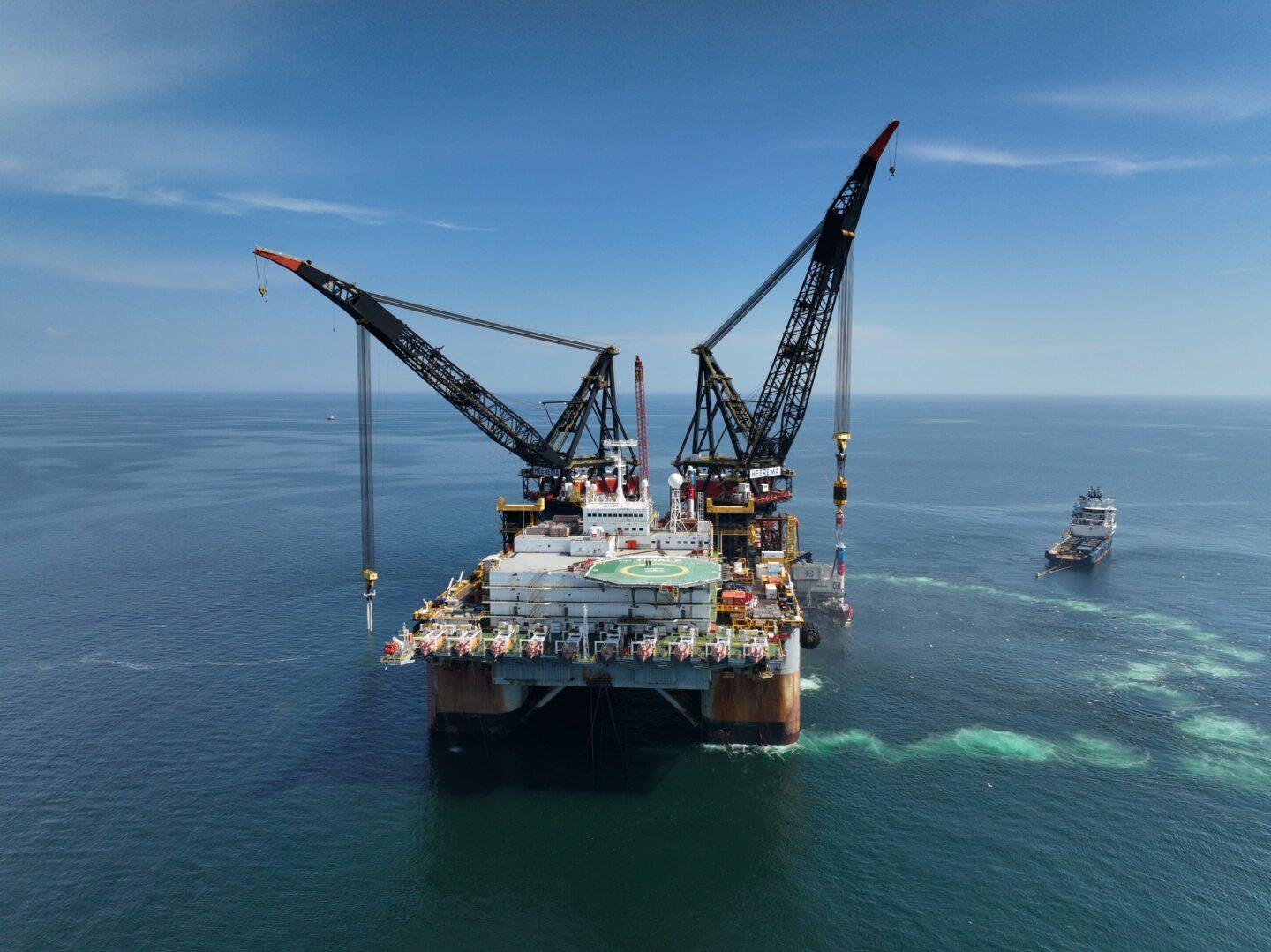
The deployment of Thialf, a floating installation vessel more than 200 meters long and 88 meters wide, underscores the scale of the undertaking. The vessel is owned by Heerema Marine Contractors. It is equipped with two massive cranes used to lift the foundations, or monopiles, from transport vessels and drive them into the seabed with a huge hammer. Transition pieces about 17 meters high are then installed on top of the monopiles. These distinctive yellow structures rise above the waterline. Together with the monopiles, they form the foundations on which the wind turbines are installed.
Installing monopiles on the Baltic seabed using the Thialf vessel. Photo: Equinor
The installation campaign for the Bałtyk 2 and Bałtyk 3 wind farms began in May this year and ran through the end of August. Thialf’s crew worked around the clock in shifts. By late August, about 350 people from around the world were on board, including surveyors, crane operators, hydraulic hammer operators, electricians, engineers, welders, environmental specialists and managers. Some flew in for two weeks, others for several months. In addition to Thialf, more than 30 vessels were involved in the project, mainly transport ships.
Work is also under way on neighboring wind projects, making Poland’s section of the Baltic Sea increasingly crowded.
Using cranes, Thialf’s crew installs the distinctive yellow transition pieces on top of the monopiles. Together, they form the foundation on which a wind turbine will stand. Photo: Equinor
An intense year ahead for the developer
The contractor installed a total of 100 monopiles in the Baltic. This year’s work also included, among other things, laying subsea cables connecting individual turbines and export cables for the Bałtyk 2 wind farm.
“In 2027, we plan to install the wind turbines, lay the export cables for the Bałtyk 3 wind farm and protect the seabed using stone specially brought in for this purpose. Next year, electricity will flow from the first turbine, while commercial operation of the entire wind farm is scheduled for 2028. For now, we are on schedule,” says Semund Høsøien Simensen, deputy manager of the Offshore Package for the Bałtyk 2 and 3 project.
To reduce underwater noise caused by driving monopiles into the seabed, the contractor used a bubble curtain. Air bubbles form a barrier around the foundation, reducing noise that could be harmful to marine mammals. The presence of marine mammals is continuously monitored, and the hammer can only operate when no such animals are nearby.
“This method is used mainly in the Baltic, but it is gradually becoming standard across the offshore wind industry,” Semund Høsøien Simensen says.
The contractor has now installed all 100 planned foundations for the Bałtyk 2 and Bałtyk 3 wind farms in the Baltic Sea. Photo: Equinor
A crowded Baltic
Work is proceeding simultaneously on other wind farms in the Baltic. The turbines at Baltic Power are already turning, for now as part of testing. The project is being developed by Poland’s Orlen and Canada’s Northland Power. The 1.2 GW wind farm is due to officially enter service at the end of this year.
At the end of August, Polska Grupa Energetyczna and Denmark’s Ørsted also completed the installation of monopiles on the Baltic seabed. At the offshore construction site for the Baltica 2 wind farm, 111 foundations were installed—107 for wind turbines and four for offshore substations. The process differed somewhat from that used for the Polenergia and Equinor projects, where the Thialf vessel played the key role. PGE and Ørsted deployed two specialist Van Oord vessels, Svanen and Aeolus, to install the monopiles. Additional equipment needed for the wind farm’s later operation is now being fitted to the installed foundations. Installation of the additional steel structures is expected to continue until the end of 2026. The developer also plans to install further components of the wind farm this year, including offshore substations and export cables. The laying of inter-array cables and installation of the wind turbines are scheduled for 2027.
“Every stage completed according to plan confirms how important it is to prepare a project of this scale consistently and comprehensively. Alongside the work at sea, we are intensively developing the onshore infrastructure, including facilities needed to transmit electricity from the wind farm to the national power system, as well as the operations and maintenance base. These are key elements of the overall project and will ensure the offshore wind farm can operate efficiently and safely for decades to come,” says Patrycja Kunc-Rozbój, vice president of PGE Baltica.
The first electricity from the 1.5 GW Baltica 2 wind farm is expected in the first half of 2027. Full commercial operation is due to begin later that same year.
At the Baltica 2 wind-farm construction site, the developer deployed two specialist Van Oord installation vessels to install the foundations. Photo: Ørsted
Another wind farm in the pipeline
In 2027, construction of the BC-Wind farm, with capacity of up to 390 MW, will also move into its offshore phase. The project is located about 23 km from the coast, off the municipalities of Krokowa and Choczewo. The developer is Ocean Winds, a company owned by Portugal’s EDP Renewables and France’s Engie. Plans for 2026 include, among other things, building the onshore grid-connection infrastructure, constructing an operations and maintenance base in Władysławowo and renovating the port quay. L
ast week, the company said it had completed three horizontal directional drilling operations along the onshore route of the export cable. The technology made it possible to route the cables through sensitive locations – beneath a dune, a peat bog and archaeological sites – while limiting disruption to the surrounding environment.


Key Takeaways
- Polenergia and Equinor have completed the installation of foundations on the Baltic seabed for the Bałtyk 2 and Bałtyk 3 wind farms. The work involved Thialf, one of the world’s largest installation vessels, owned by Heerema Marine Contractors. The installation campaign began in May this year.
- The next stage of the projects will involve installing wind turbines, laying export cables and protecting the seabed. All of this work is scheduled for 2027. Electricity from the first turbine will flow to the grid next year, while commercial operation of both wind farms is planned for 2028.
- Work on other offshore wind farms is proceeding in parallel. The first of them, Baltic Power, will become fully operational by the end of this year. Another project, BC-Wind, is also in preparation, with its developer planning to begin offshore construction in the Baltic in 2027.