

This article is a part of Poland Unpacked. Weekly intelligence for decision-makers
Three universities in Krakow want to join Poland’s quantum race with a project far larger than any other in the country. Their target is the most powerful quantum computer in this part of Europe. Newag, a listed manufacturer of rolling stock, is expected to buy the machine for more than PLN 100m (EUR 23m).
Krakow is promising to create a Quantum Valley. The initiative is a joint venture between three prominent universities and listed company Newag. The project is important, complex and expensive, with costs estimated at PLN 100m-150m (EUR 23m-EUR 35m). That is the expected price of the quantum computer to be installed in the capital of the Małopolska region.
In June, Kraków University of Technology, Jagiellonian University and AGH University of Science and Technology, together with Newag, signed a letter of intent on the project. The announcement was notably sparse on detail: the universities will provide the research and development infrastructure, while Newag is expected to finance the purchase of the computer.
The most likely supplier appears to be Finnish company IQM Quantum Computers, which has already sold systems to several Polish research centers, as discussed later. If the partners agree on a cooperation model and establish an entity responsible for the project, the new quantum computer should arrive in Poland in 2027.
On an unprecedented scale
“It won’t be the first, but it will be exceptional,” says Prof. Andrzej Szarata, rector of Kraków University of Technology. He says the Kraków project will surpass all previous quantum investments in Poland in scale. But he remains tight-lipped about the details.
“A private company wants to buy the most powerful quantum computer in this part of Europe, many times more powerful than anything currently operating in Poland. I can’t say more because the project is still in the preparation stage,” says the rector of Krakow University of Technology.
The computer is expected to have computational power of more than 150 qubits. But the rector stresses that the investment is about more than simply buying computing power.
“Our concept is to learn how to build and expand quantum computers, rather than simply use their computing capacity. That is why we plan to buy a computer together with the underlying technology and the ability to develop it further,” says Prof. Andrzej Szarata.
Quantum computing power itself can be rented for relatively little money. Several companies offer such services, but Krakow wants to develop the broader ecosystem of quantum computing and quantum devices.
Searching for an operating model
In a few weeks, in September, we are expected to learn what legal form the project will take – whether it will be a company or perhaps a foundation. The signatories to the letter of intent are still looking for a solution that works for all participants.
Newag will take responsibility for financing the computer. The universities will have to contribute to the costs of staff, research conducted on the new equipment and infrastructure maintenance. The details are still being worked out.
“All I can say today is that I expect each of the universities to be highly active in securing grants,” says Prof. Piotr Jedynak, rector of Jagiellonian University, who also cautions that it is too early to discuss the details of the cooperation.
Newag is committing, but keeping its cards close to its chest
Newag is the driving force behind the partnership. According to information from Jagiellonian University, the company’s CEO approached the leadership of Krakow’s universities with a proposal to finance the purchase of a large quantum computer. The company would also identify potential practical applications for the machine.
“We want to be the business catalyst for this revolution. We want to bring not only financial support to the project, but also our business know-how, commercialization experience and market expertise, so that together we can set new technological standards,” Zbigniew Konieczek, Newag’s CEO, said when the letter of intent was signed.
He is not willing to say much more about the project for now. In an email to the editorial team, he thanked us for our interest in the initiative.
“There is no doubt that this is a project worth watching, both from the perspective of developing advanced technologies and of cooperation between academia and business,” Zbigniew Konieczek said.
He confirmed that the partners are still working on the project’s ultimate parameters, its objectives and a possible cooperation model.
“The project is currently at the stage of defining its final organizational and substantive structure. We are analyzing possible development paths and potential areas where quantum technologies could be used in the future. It is too early to provide detailed information on the scope of each party’s involvement, financing or the project’s formal organizational structure,” Newag’s CEO said.
Trains and qubits
The materials accompanying the letter of intent point to potentially lucrative business applications – from new materials, energy and transportation to cybersecurity and new drug therapies. Does Newag want to find a cure for cancer?
How do scientists see the quantum computer being used? The three universities bring expertise spanning quantum physics, biology, chemistry, computer science, applied mathematics, advanced computing systems and data analysis.
Jagiellonian University points, among other things, to the potential use of the quantum computer for molecular modeling in chemistry and biology, solving complex optimization problems and applications related to machine learning. An important role in preparing the project has been played by the university’s Faculty of Physics, Astronomy and Applied Computer Science, where researchers work on information theory and quantum algorithms, cryptography, quantum computer testing and sensors.
Qubit investments
Several Polish universities have already invested in quantum computers. Different models for adopting the technology are emerging. Wroclaw is developing expertise around its own small-scale machine; Poznan has assembled infrastructure using several different technologies and is combining quantum computers with classical systems; and Warsaw is working on its own solutions. The Polish market also offers several different ways of financing quantum computers.
Interestingly, Newag is not the first case in Poland of private capital seeking to enter the quantum sector.
Zielona Góra – 54 private qubits
In Zielona Góra, Galaxy Systemy Informatyczne has ordered an IQM Radiance system with 54 superconducting qubits from Finnish company IQM Quantum Computers.
The machine is due to be installed at the company’s headquarters in the fourth quarter of this year. Galaxy is buying the physical computer and plans to operate it in its own data center. Access to the infrastructure, however, will also be offered to researchers and other interested businesses.
The company plans to use the machine in projects involving, among other areas, energy, finance and space technologies. It is developing Quantum AI Cloud, a commercial service combining a quantum computer with a conventional high-performance computing node. The entire project is valued at PLN 73.8m (EUR 17.1m), of which PLN 35.9m (EUR 8.3m) is grant funding. The price of the 54-qubit computer itself has not been disclosed.
This will be the largest quantum computing resource available on the Polish market to date. But if the Krakow project goes ahead, the capacity of Małopolska’s Quantum Valley will be almost twice that of all the other projects currently in operation combined.
Wroclaw – a computer for building expertise
Wroclaw University of Science and Technology has opted to buy its own machine and use it primarily to build expertise. In May last year, the university’s Wroclaw Network and Supercomputing Center launched Odra 5, a five-qubit IQM Spark quantum computer. It cost PLN 4m (EUR 0.9m) and was physically installed on campus.
Odra 5 is primarily a laboratory. Students and researchers can work directly with the quantum processor, program it, test algorithms and learn about the hardware’s limitations. The Wroclaw model is therefore based on gaining hands-on experience with a real quantum device.
Poznań builds an ecosystem
Poznan has taken a different approach. There, several quantum technologies operate alongside one another and are connected to conventional supercomputing infrastructure. The largest of these systems is PIAST-Q, operated by the Poznan Supercomputing and Networking Center (PSNC), which is affiliated with the Institute of Bioorganic Chemistry of the Polish Academy of Sciences.
The system was supplied by Austrian company Alpine Quantum Technologies. It uses trapped-ion technology and has more than 20 programmable qubits. The installation cost EUR 12.28m (PLN 53.0m). Half was financed by the EuroHPC Joint Undertaking, with the remainder covered by Poland’s ministries responsible for digital affairs and science.
PIAST-Q was launched in April this year. It is designed to work alongside classical supercomputers and serve both academia and industry. Potential applications include optimization, chemistry, materials science and machine learning.
The Poznan center also installed two photonic ORCA Computing PT-1 systems in 2023. These British-made machines use photons and function as quantum accelerators.
Poznan University of Technology also brought its own computer online in May this year. The five-qubit IQM Radiance 5 cost PLN 10m (€2.3m) and was fully financed with public funds. It is intended for teaching and research, including work on hardware calibration and error reduction. It has been connected to a classical server equipped with three GPUs.
Warsaw is developing its own technology
Warsaw University of Technology is pursuing yet another approach. At CEZAMAT, researchers are developing MIKOK, a Polish prototype quantum computing infrastructure based on trapped calcium ions.
The initiative was launched by the Cyberspace Defense Forces, while Warsaw University of Technology is leading the consortium carrying out the project. Researchers believe the priority is to develop domestic technological expertise relevant to areas such as cybersecurity and cryptology. The project is still in the development phase and is not yet a finished commercial system like the machines being purchased from IQM or AQT.
Good to know
Quantum Computers in Poland:
- Poznan: PIAST-Q - 20 qubits
- Poznan: IQM Radiance 5 - 5 qubits
- Wroclaw: IQM Spark Odra 5 - 5 qubits
- Plus: Two photonic ORCA systems
- Plus: Warsaw - one domestic MIKOK prototype in an advanced stage of development
Planned: 54-qubit IQM Radiance in Zielona Góra (Q4 2026)
Choosing the technology: Chinese or Finnish
The Kraków project is likewise driven by the need and desire to research and develop quantum technologies.
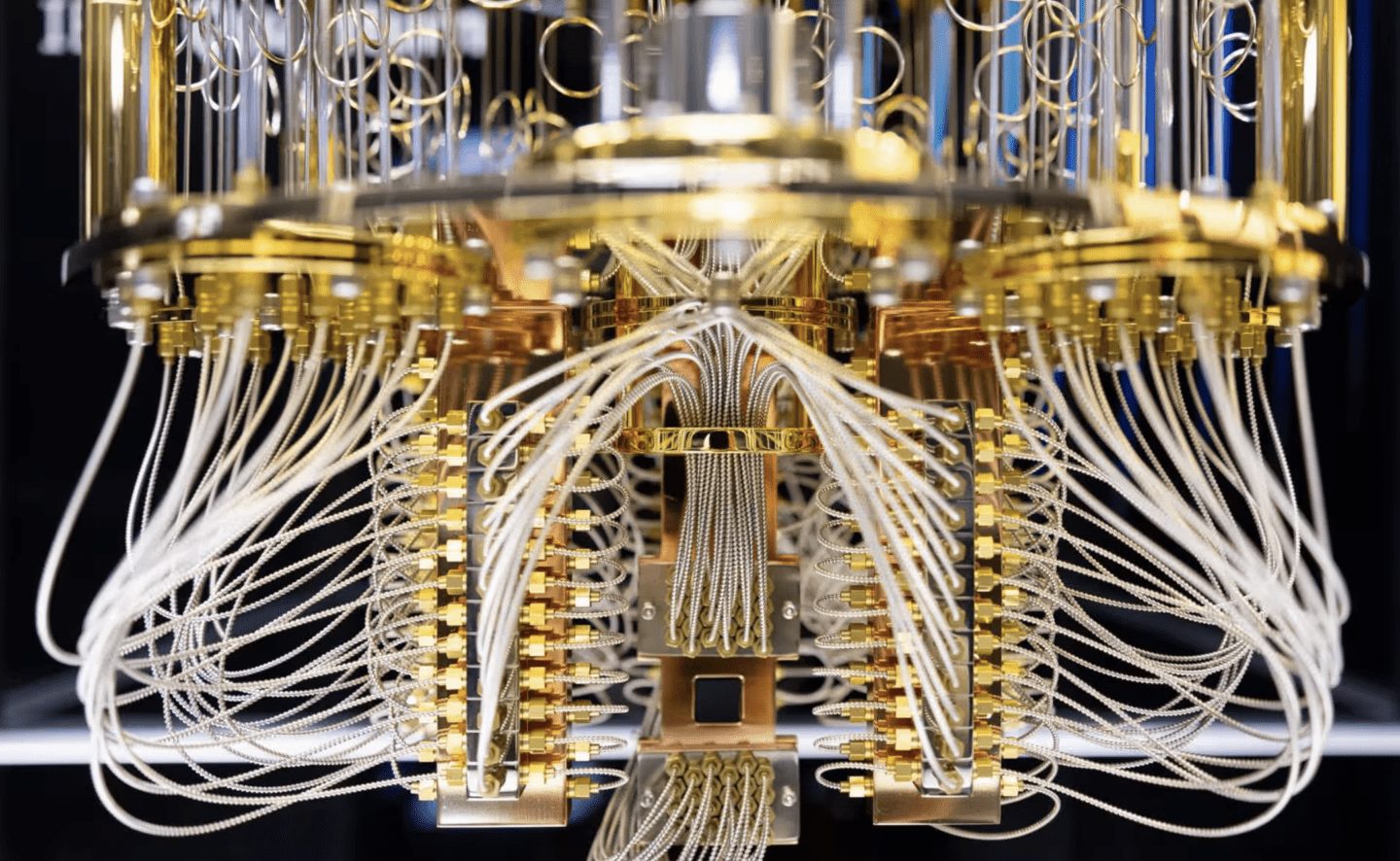
Operating a machine with more than 150 qubits will involve substantial running costs. Continuous cooling will be particularly expensive, as the computer operates at temperatures close to absolute zero.
The Kraków team of scientists is also examining an alternative technology: photonic quantum computers, which use laser beams and operate at room temperature. China is particularly strong in this field. We have learned that talks with Chinese counterparts about “various possibilities,” as one of our sources puts it, are also under way.
Good to know
Technology from China
China is developing quantum computers across several technological platforms in parallel. The most prominent are successive generations of the photonic Jiuzhang computers. But superconducting machines are also being developed, as are specialized optical computers by companies such as TuringQ and QBoson.
Chinese companies and research centers are working not only to increase the number of qubits or photons, but also on their own chips, light sources, detectors, software and integration with data centers. Photonics is attracting particular attention because some of these systems can operate without costly cryogenic cooling.


Key Takeaways
- Krakow plans to build a Polish Quantum Valley around Jagiellonian University, AGH University of Science and Technology and Krakow University of Technology. The initiative was launched by Newag, which is expected to finance the purchase of a large quantum computer. The project is intended to cover not only research, but also technology development and commercialization.
- The planned machine is to have at least 150 qubits, potentially making it one of the largest in this part of Europe. The investment could cost PLN 100m-150m (EUR 23m-EUR 35m). The universities want not only to access computing power, but also to learn how to develop their own quantum infrastructure.
- Polish research centers are pursuing different approaches: Wroclaw is focusing on building expertise, Poznan on a broad HPC-plus-quantum ecosystem, Warsaw on homegrown technology, and private company Galaxy on a services-based model. Krakow wants to bring academia, private capital and commercialization together.