

This article is a part of Poland Unpacked. Weekly intelligence for decision-makers
In recent years, DL Invest Group has evolved from a commercial real-estate developer into an integrated infrastructure platform. Today, with an asset portfolio worth billions of zlotys, the group is not only developing new projects but also preparing further transactions. At the same time, it is moving into digital infrastructure investments.
“At this stage, we can disclose that we are in the process of acquiring a portfolio of assets in Poland worth more than €200m,” says Dominik Leszczyński, chief executive of DL Invest Group.
The deal forms part of the group’s broader strategy. The company is now developing not only retail, office and logistics projects, but also data-center investments. That direction, however, requires ever larger amounts of capital and increasingly sophisticated financing structures.
“The projects we are considering today - particularly in digital infrastructure - are so capital-intensive that the public markets and well-structured investment vehicles are becoming a natural direction for our development,” the chief executive says.
Going public is not an end in itself. Rather, it is intended as a tool to finance growth, streamline the corporate structure and provide greater flexibility for large-scale projects.
“With plans of this scale, the question is no longer whether we will need access to the public markets, but when and in what form it will be most effective for us,” adds Mr. Leszczyński.
For now, however, the company is not disclosing further details regarding the planned transactions.
From commercial real estate to an infrastructure platform
The story of DL Invest Group is one of steadily expanding capabilities. The group began in the traditional commercial real-estate market, but over time it developed an increasingly integrated operating model. Having been active in the market for more than 18 years, it now acts both as a developer and a long-term investor.
The model is based on carrying out investments through the group’s own structures and then actively managing them as owner. The aim is therefore not simply to build and sell assets, but also to create a portfolio that generates stable cash flows.
“Today, after more than 17 years of consistent growth, DL Invest Group works with more than 400 clients, manages an asset portfolio worth in excess of PLN 5bn (EUR 1.2bn), and employs a team of more than 260 specialists,” says Dominik Leszczyński.
The scale of the business has become one of the foundations for further expansion. According to the group’s 2025 financial statements, assets exceeded PLN 5.1bn (EUR 1.2bn), up from just under PLN 4bn (EUR 930m) a year earlier. The value of investment properties alone rose to more than PLN 4.45bn (EUR 1bn).
This shows that the group has grown not only through new projects, but also by increasing the value of the assets it already owns. In practice, this marks a shift toward a model in which controlling the entire investment cycle is key.
Expert's perspective
A new phase of the market: from warehouses to data centers
The modern economy is built on data, computing power and uninterrupted access to digital systems. Without stable digital infrastructure, no advanced economy can function - this applies to public administration, finance, industry, logistics and services. In this context, data centers are becoming a natural complement to traditional commercial real estate and one of the key elements of the emerging economic architecture.
The main growth drivers are ongoing business digitalization, increasing adoption of cloud computing and the rapid expansion of artificial intelligence. It is precisely the demand for computing power - largely driven by AI - that will become one of the most important engines of data-center demand in the coming years, extending beyond traditional IT needs.
The scale of change is already measurable. Over the past three years, Poland’s data-center capacity has doubled and exceeded 200 MW, while forecasts suggest it could surpass 600 MW by 2030. This shows that, alongside logistics and manufacturing, there is real room for the development of more specialized real-estate formats.
Poland will not replicate the path of the United States - geopolitical conditions, the scale of the domestic digital sector, and access to cheap, stable energy all limit the pace of growth. This implies a more selective, gradual expansion focused on the best locations and projects with the highest technical specifications.


Financing as prerequisite for scale
Growth under such a model requires far more capital than traditional property development. That is why the group’s financing structure has become just as important as the projects themselves.
One of the key elements in financing the company’s operations was the issuance of eurobonds. In July 2025, DL Invest Group issued unsecured bonds worth EUR 350m (PLN 1.5bn), maturing in 2030. The bonds were listed on the Euro MTF market in Luxembourg, an alternative exchange operated by the Luxembourg Stock Exchange.
“The eurobond issue was a milestone for us. As the first private company from Poland’s commercial real-estate market, we raised around PLN 1.5bn (EUR 350m) through this structure. We moved into an entirely different league when it comes to financing,” says Dominik Leszczyński.
The proceeds from the eurobond issue were used, among other things, to redeem existing bonds and repay selected loans and borrowings. As a result, the group’s debt structure has taken on a more long-term character.
A REIT as the next piece of the puzzle
In 2025, DL Invest Group acquired a significant stake in Abrdn European Logistics Income plc (ASLI), a company listed on the London Stock Exchange, becoming its largest shareholder.
“For several years we have been waiting for sensible REIT legislation in Poland. But in practice nothing has changed on that front. So we began looking for a solution that could be implemented outside Poland,” says Dominik Leszczyński.
When the opportunity arose, the company decided to take the risk.
“That is why we acquired the largest stake in a UK-listed REIT. We saw the company as a potential public platform for further growth,” says the chief executive of DL Invest Group.
The company owned a portfolio of logistics assets located across Western Europe, including in France, the Netherlands and Spain. At the same time, its business model had been built under very different macroeconomic conditions, which affected its position by the time DL Invest Group entered the picture.
“We joined after the launch of a controlled asset-sale process. Some investors were interested solely in a rapid exit scenario, whereas we viewed the platform from a long-term perspective,” says Mr. Leszczyński.
The objective was not merely to take advantage of market conditions, but also to test in practice how a public investment platform operates and how it might be used in the future.
“Our intention was to halt the destruction of value and demonstrate that such a structure could continue to be developed, including on the basis of assets from Poland and the wider region,” adds Mr. Leszczyński.
Although the eventual outcome favored a continued asset-disposal process, the experience gained remains an important part of the group’s strategy.
“If this process is completed, we will analyze whether the same public platform can be used to accumulate income-generating assets from our own portfolio in the future,” says the chief executive of DL Invest Group.
Expert's perspective
Financing diversification and stock market entry as a marker of real-estate sector maturity
Public-company status enables shareholder diversification, access to additional capital and partial liquidity for existing shareholders. At the same time, it comes with stringent reporting obligations, which can represent a significant challenge, particularly in the early stages of operating within capital markets.
For the real-estate sector, a greater number of large listed companies is a positive development. Beyond diversifying investment products - both for institutional and retail investors - it also increases transparency and signals market acceptance of real-estate-derived income streams.
A larger presence of listed real-estate companies may also support the popularization of the REIT concept in Poland and increase the chances of completing legislative work on dividend-based investment funds.
A build-to-own model rather than straightforward development
For years, DL Invest Group has stressed that it does not want to be merely a developer delivering projects for sale. At the heart of its strategy is a build-to-own model - developing assets with the intention of holding them over the long term.
“From the very beginning, our objective was not to build a real-estate portfolio solely to generate income, or to serve as an object of sale or investment speculation. Our ambition was to create a platform that, through real estate, provides a comprehensive service to tenants - genuinely supporting their growth and strengthening their competitive advantage,” says Dominik Leszczyński.
The model helps explain why the group has developed its own in-house capabilities in design, construction, asset management and finance. This allows it to maintain direct control over quality, costs, schedules and tenant relationships.
The strategy is not based on speculative projects either. The group says it focuses on pre-lease investments - leasing space before construction is completed - supported by a land bank, building permits and secured financing.
“We expanded step by step - from retail parks, through the office sector, and then into logistics and manufacturing facilities. From our perspective, the latter was the most demanding segment, because from the outset we were competing with global players operating under a purely development-driven model, focused on selling assets, often while projects were still under construction. In that model, the tenant was part of the investment product rather than a long-term partner,” says Mr. Leszczyński.
Data centers as the next stage of growth
The clearest symbol of DL Invest Group’s strategic shift is its move into digital infrastructure. For investors, data centers are no longer a niche adjunct to the real-estate market. They have become one of the key pillars of modern infrastructure.
 Interactive chart
 “We decided more than two years ago to expand our operations into digital infrastructure. It is a natural stage in the evolution of DL Invest Group and stems from our long-term strategy of building an integrated infrastructure platform,” says Dominik Leszczyński.
The group is developing data-center assets aimed at the cloud-computing and artificial-intelligence sectors. A flagship project is DL Invest Park Bielsko-Biała, southern Poland, described by the company as a hyperscale campus designed for cloud operators, AI companies and providers of GPU and HPC infrastructure. (GPU, or Graphics Processing Unit, and HPC, or High Performance Computing, refer to advanced computing systems that use graphics processors and high-performance computing environments to process large volumes of data rapidly, including for artificial intelligence and analytics.)
“We could see very clearly what was happening in the world’s most advanced markets, especially in the United States. The digitalization of the economy is accelerating at an unprecedented pace,” says Mr. Leszczyński.
The growing importance of data centers is driven above all by the expansion of cloud services, artificial intelligence and data processing.
“Naturally, this is leading to the development of data-center infrastructure, which is becoming the foundation of the modern economy,” says the chief executive of DL Invest Group.
Bielsko-Biała as a strategic asset
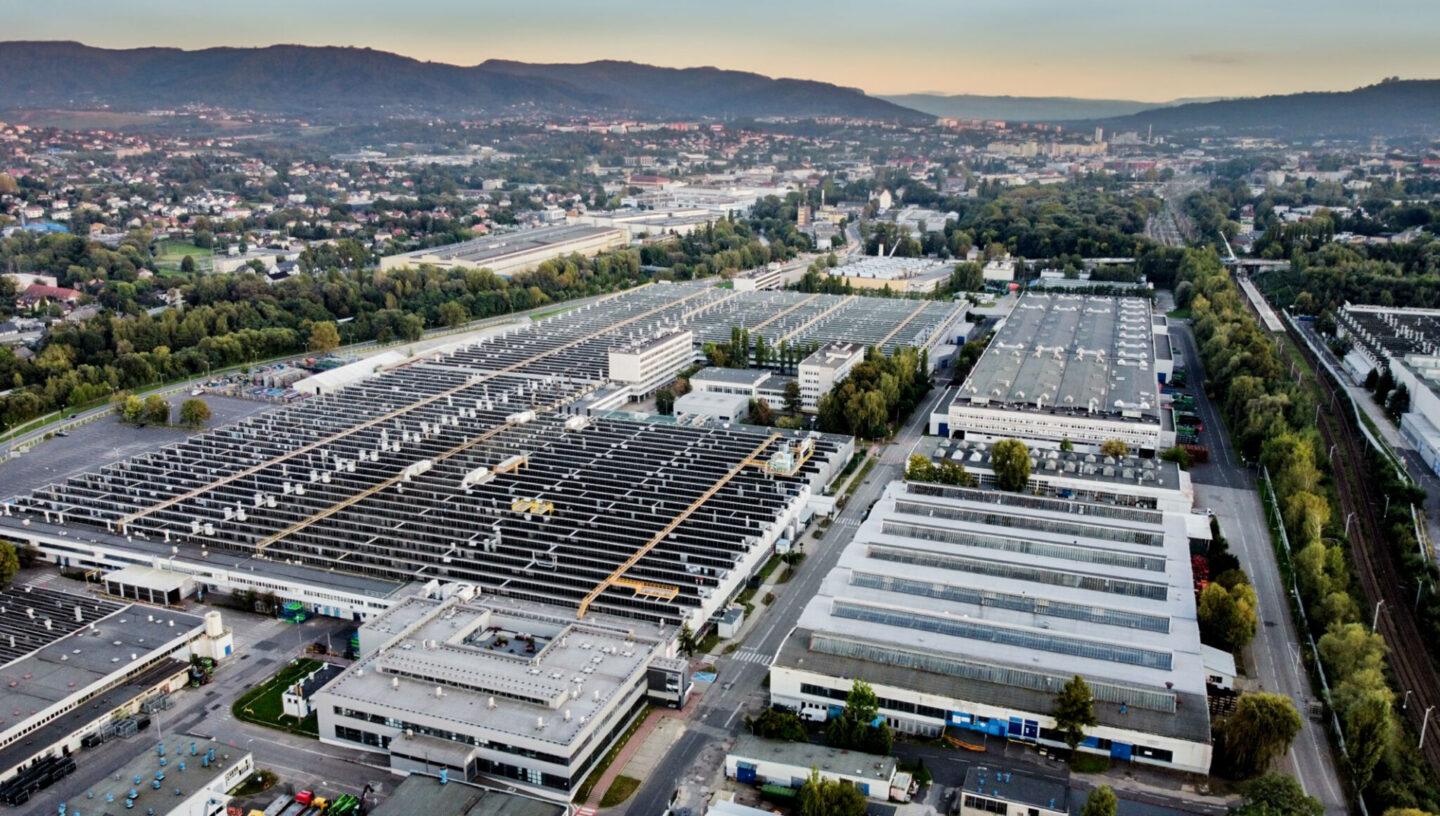
DL Invest Park Bielsko-Biała II comprises a complex with more than 267,000 square meters of leasable space and spans an area of 52.8 hectares.
The scale of the project goes beyond traditional logistics. This direction has been further strengthened by a joint venture with Boosteroid, one of the global providers of cloud gaming services. The cooperation envisages the development of a European network of data centers based on infrastructure developed by DL Invest Group.
“Bielsko-Biała is a model example for us of a very successful acquisition. We are talking about 52 hectares in the center of a city, at the intersection of key transport routes, with existing infrastructure and significant transformation potential,” says Dominik Leszczyński.
Logistics, energy and infrastructure assets can be developed in parallel, provided they are of sufficient scale and have access to utilities.
“It is also a good example of how post-industrial land can take on an entirely new role when viewed not only through the lens of traditional real estate, but also through the prism of the new needs of the digital economy,” adds the chief executive of DL Invest Group.
Digital infrastructure - already critical?
The way data centers are perceived by states and public institutions is also changing.
“Today, digital infrastructure is no longer just another asset class or a new segment of the real-estate market. It is becoming critical infrastructure - for business, for the state, for security, and for defense,” says Dominik Leszczyński.
This argument carries particular weight in a geopolitical context. The war in Ukraine has shown that digital systems, communications, data processing and technological security are all elements of national resilience.
“If we talk about protection systems, drones, automation, energy storage or solutions for the defense sector, all of this is underpinned by cloud infrastructure, data processing and computing power. The war in Ukraine has only made this more visible,” says Mr. Leszczyński.
From an investor perspective, this changes the rules of the game.
“The question is no longer whether such infrastructure is needed. It is where it will be located, who will control it, and whether we will develop it domestically or become dependent on solutions built outside Europe,” he says.
This is why DL Invest Group presents data centers as a natural stage of development rather than a one-off diversification move. The group intends to leverage its land bank, energy infrastructure, execution capabilities and financing relationships.
Interactive chart Energy as the key constraint
The common denominator - and the biggest challenge - across all areas of DL Invest Group’s business is energy. Without it, the development of data centers, modern industrial projects and large logistics campuses is simply not possible.
“Energy has become one of the key factors determining the development of the entire real-estate market today, and in the case of digital infrastructure - data centers - it is absolutely fundamental,” says Dominik Leszczyński.
In the case of data centers, an attractive location and a building permit are no longer sufficient.
“We are no longer talking solely about available capacity or the possibility of securing a grid connection, but in particular about execution time and the ability to efficiently manage energy distribution and costs throughout the entire project lifecycle. In this segment, location alone is no longer enough. Competitive advantage is now determined by full infrastructure readiness - access to power capacity, serviced land, and the ability to rapidly launch an investment,” says the chief executive of DL Invest Group.
To address this, the group is developing its own energy component. This includes renewable energy projects, energy storage facilities, and the DL Energy strategy, based on leveraging the potential of its existing asset portfolio.
“At DL Invest Group, we have recognized the importance of this area from the very beginning. That is why we are developing capabilities in energy management and integrating them into our real-estate platform. Our approach covers both consumption optimization and distribution management. But it also includes the development of solutions based on renewable energy sources,” says Dominik Leszczyński.
The race for digital infrastructure is only the beginning
The development of data centers is already becoming increasingly dependent on which countries can offer investors access to energy, predictable regulation and competitive costs. Poland has potential, but it must compete with markets that are moving faster in building out infrastructure.
Expert's perspective
Poland may become one of Europe’s key data center markets
Clients and end users will choose locations that provide rapid access to high-capacity grid connections and stable investment conditions. Poland offers such advantages. First, its relatively low average temperatures support improved energy efficiency, resulting in lower PUE (Power Usage Effectiveness), a key indicator of how efficiently data centers use energy. Second, the country is undergoing an energy transition: by 2030, approximately EUR 185bn in investments are planned for grid modernization and decarbonization, alongside the development of nuclear energy and SMRs (small modular reactors).
Over the next decade, these measures could reduce energy costs and increase power availability - both critical factors for the data-center sector. An additional advantage is Poland’s well-developed district heating system, which enables heat recovery and improves operational efficiency.
Labor availability, a mature industry ecosystem, access to land, and comparatively lower investment costs versus other European markets are also important factors. Another key asset is the extensive fiber-optic infrastructure.
“This is a real race - not only between projects, but above all between countries competing for investment in digital infrastructure,” says Dominik Leszczyński.
Against this backdrop, DL Invest Group is attempting to combine several areas into a single strategy.
“If there are no more competitive conditions - both in terms of access to power and energy costs - Poland may struggle to compete with other European markets for this type of investment,” says the chief executive of DL Invest Group.


Key Takeaways
- DL Invest Group is undergoing a clear transformation - from a traditional commercial real-estate developer into an integrated infrastructure platform that combines retail, logistics, energy and digital projects within a single business model.
- Its entry into the data-center segment significantly changes the scale of operations and requires access to substantially larger pools of capital, as well as more sophisticated financing structures, in which public markets and institutional investors are becoming increasingly important.
- The company is not only assessing potential applications of the REIT model but is also actively building capabilities in this area, including through investments in the UK market. This could, in the future, translate into the creation of its own investment platform based on stable income-generating assets.