

This article is a part of Poland Unpacked. Weekly intelligence for decision-makers
PZL-Świdnik (peh-zed-el shveed-neek) feels the effects of Ministry of Defense order. In 2022, the Ministry of National Defense (MON) contracted 32 AW149 support helicopters for the Land Forces, including logistics packages and training-simulator systems. The total value of the contract amounts to PLN 8.25 billion (EUR 1.76 billion, gross).
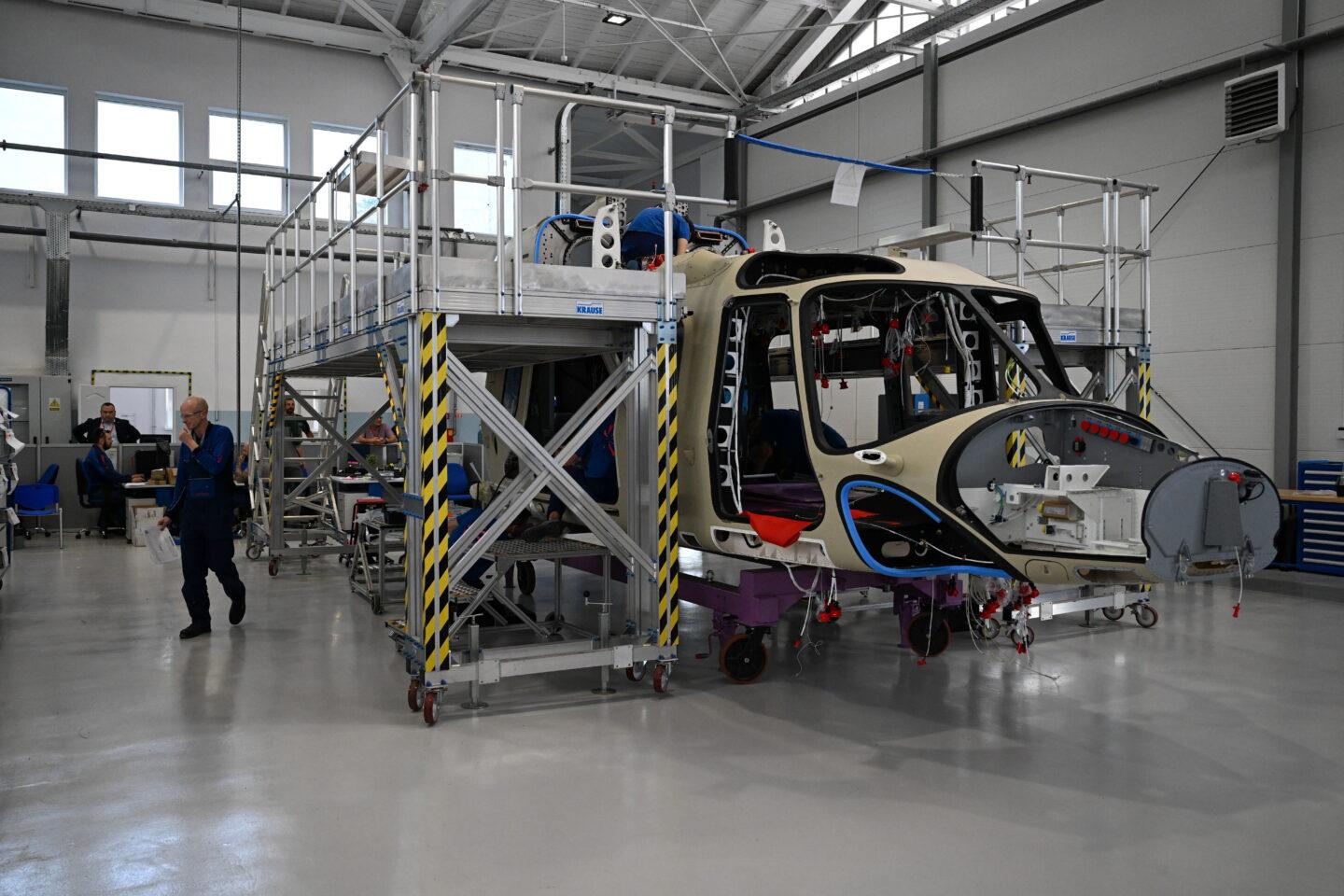
On November 27, 2025, Deputy Prime Minister and Minister of National Defense Władysław Kosiniak-Kamysz attended a meeting with soldiers of the 7th Aviation Squadron of the 25th Air Cavalry Brigade to mark the delivery of the first AW149 helicopter produced entirely in Poland. The first ten aircraft had been manufactured in Italy. PZL-Świdnik will deliver the remaining units by 2029.
On December 15, PZL-Świdnik representatives signed a grant agreement at the Ministry of Development and Technology. The funding will support an investment project carried out between 2024 and 2028, which will expand production capacity and diversify operations at the Świdnik plant. The investment is valued at at least PLN 196.9 million (EUR 41.9 million), with the government grant of PLN 26.5 million (EUR 5.6 million) scheduled for disbursement in 2029.
This is another major state-supported project. In early 2025, ZSP Niewiadów received a government grant of PLN 91.5 million (EUR 19.5 million) to support the construction of an ammunition factory worth PLN 508 million (EUR 108 million).
What the company plans
Under the agreement, PZL-Świdnik will increase employment by 285 positions by the end of 2028. At the time of the grant application in autumn 2024, the company employed around 2,900 people; currently, the workforce stands at 3,200.
The investment is already underway. In 2025, the company spent over PLN 72 million (EUR 15.3 million). The bulk of the expenditure is scheduled for 2026, when investments will reach PLN 105 million (EUR 22.3 million). In 2027–2028, spending will total PLN 18.6 million (EUR 4 million). The company will also allocate at least 15% of the grant – PLN 3.9 million (EUR 830,000) – to cooperation with universities.
“PZL-Świdnik is making multi-million investments to further develop its production capabilities. The launch of the AW149 multi-role helicopter production line for the Polish military is the best example of this,” said Dariusz Szulc, the company’s spokesperson.
Expert's perspective
This should become the new standard
At the same time, domestic manufacturers are showing growing appetite for investment in new technologies and expanded production capacity. This trend is expected to continue in 2026, paving the way for further large-scale investment projects.
Currently, the government grant program is undergoing what could be described as both a facelift and a deeper reform. Simultaneously, budgetary resources are being sought for the next phase of the mechanism. This is an ideal moment to set clear priorities for the defense sector and design a dedicated project evaluation pathway. It is crucial to define the key areas in which the state wants to build industrial capabilities and align support criteria accordingly.
One example could be moving away from the rigid requirement to increase or maintain employment, which already represents a significant barrier for investors.
The grant awarded to PZL-Świdnik, like earlier support for the Niewiadów plant, marks only the beginning of an investment wave expected to gain momentum in 2026. Short-term plans include new factories under the ammunition program, significant expansion of air defense capabilities, and infrastructure investments as part of the Eastern Shield initiative. In addition, more dispersed – but increasingly frequent, especially among private companies – projects are emerging in drone technologies.
For companies like PZL-Świdnik, this means not only stability in orders from the Ministry of Defense but, above all, tangible support for production diversification and expansion of service centers.
I would like to believe that in the coming years, government grants and other targeted support instruments will cease to be exceptions and instead become a deliberate tool for building the technological sovereignty of Poland’s defense industry. Investments of tens or hundreds of millions of zlotys in individual plants – such as Niewiadów or Świdnik – should set a new benchmark for the ambitions of Poland’s defense sector.


A broad offering
The company is part of the Italian Leonardo Group. Leonardo Helicopters, formerly AgustaWestland, was established in 2001 through the merger of Italy’s Agusta and the UK’s Westland. The group’s main factories include seven plants in Italy, two in the United States, and one each in the United Kingdom and Poland.
PZL-Świdnik brings 70 years of experience and is Poland’s only manufacturer of both civil and military helicopters, producing more than 7,400 units in total. The Świdnik plant primarily serves Leonardo Group companies, supplying components – including fuselages, tail booms, and other parts – for the AW139, AW101, AW109, AW189, AW169, and AW159 helicopters. The company also produces engine gondola assemblies for Bombardier Challenger 300, Gulfstream G280, and Embraer EA3 aircraft.
Its portfolio includes commercial helicopters – SW-4, W-3A – as well as military and government models: SW-4, W-3PL, and AW149.
In 2024, PZL-Świdnik reported revenues of PLN 3 billion (EUR 638 million), up from PLN 2.4 billion (EUR 511 million) the previous year. Net profit rose from PLN 144.4 million (EUR 31 million) to PLN 213.4 million (EUR 45.4 million). Revenues from clients in the EU and Poland amounted to just over PLN 1.2 billion (EUR 255 million) each, while sales in other markets generated more than PLN 500 million (EUR 106 million). Sales of fuselages and helicopter components brought in PLN 1.6 billion (EUR 340 million), and helicopter sales contributed PLN 1.1 billion (EUR 234 million).
Where orders are coming from
In 2024, the company secured orders totaling PLN 2.4 billion (EUR 511 million). The bulk – PLN 2 billion (EUR 426 million) – came from the Leonardo Group and concerned deliveries of aircraft structures. The Polish Ministry of National Defense (MON) placed orders worth PLN 145.6 million (EUR 31 million), while its Czech counterpart ordered PLN 102 million (EUR 22 million), mainly for helicopter overhauls, repairs, and spare parts. GKN Aerospace ordered components valued at PLN 76 million (EUR 16 million).
MON also signed Annex no. 2 to the contract for the delivery of AW149 helicopters to the Polish Armed Forces. By the end of 2024, when the company delivered five helicopters, 24 units remained to be handed over, according to the financial report.
The company also fulfilled customer support orders for MON and foreign clients, including the defense ministries of Czechia, Algeria, and the Philippines.
In 2024, PZL-Świdnik allocated PLN 19.5 million (EUR 4.1 million) to research and development, covering projects such as satellite communications for the SW-4 Satcom and the use of the unmanned SW-4 SOLO in the European eMUM-T Musher defense program.
Strategic client: the Ministry of National Defense (MON)
The company’s reported strategy envisions closer collaboration with MON, including the delivery of multi-role helicopters for the Navy and Land Forces under long-term strategic contracts. The plan also includes offering the Polish Armed Forces optimized solutions in the segment of medium and medium-heavy multi-role helicopters.
Strategic plans further call for increased production of parts for the AW109 helicopter, as well as the implementation of production lines for electrical harnesses, rigid wiring, and control systems. The company has also prepared to serve its key strategic client – MON – through an expansion of service capabilities to ensure the operation and maintenance of delivered AW109 and AW149 helicopters.
Another element of the strategy is maintaining the airworthiness of a fleet of approximately 160 helicopters, including Mi-2, W-3, SW-4, AW101, and AW149 models. The company also plans to implement a maintenance program for the W-3 Sokół fleet, with operations projected to continue at least until 2035.
Bartosz Śliwa, CEO of PZL-Świdnik, recently emphasized in interviews that the company is well-prepared to execute contracts for MON. The company is particularly anticipating orders for the AW109 TrekkerM helicopters, which could be used for training purposes. Production of cabins for these machines has already begun, and if the contract is secured, full helicopter production is planned to follow.
Good to know
Sobieski Institute: a defense-focused investment pathway
Given the geopolitical situation and the availability of substantial national, EU, and international funds, projects in the defense and dual-use sectors should receive a dedicated “defense pathway” within the support system. This proposal is put forward by the Sobieski Institute in its report “Switch on the Engine of Growth: A New Investment Support System Post-2026.”
The authors note that under the SAFE program, Poland is set to receive EUR 43.7 billion for investments in armament modernization, infrastructure, ammunition production, drone systems, and digital transformation. They propose that support should cover both manufacturing and R&D projects in areas such as unmanned systems, ammunition and artillery production, optoelectronic systems, reconnaissance and communications, defense software, data centers, cybersecurity and AI, production and integration of military vehicles and mobile logistics systems, as well as new materials, including composites, lightweight armor, and radar-absorbent materials.
The Sobieski Institute also recommends speeding up grant procedures – 10 days for a PAIH decision and 14 days for approval by the inter-ministerial grant committee – and enabling investors to use the special defense investment law, which would significantly shorten the investment and construction process.
Support could be granted outside the limits of regional state aid. Article 346 of the Treaty on the Functioning of the European Union allows exceptions for projects related to arms production and development, as well as the protection of fundamental national security interests.
Poland’s neighbors are already implementing extensive incentive programs for defense and dual-use investors. The Czech Republic has established a Defense Hub contact point within CzechInvest, its equivalent of the Polish Investment and Trade Agency. Lithuania, in turn, offers a range of financial support instruments to entrepreneurs in the sector.


Key Takeaways
- The grant for PZL-Świdnik represents the second case of government support for a defense-sector company. Earlier in 2025, a grant agreement was also signed with the Niewiadów plant, which plans to build an ammunition factory worth around PLN 500 million (EUR 106 million). The Sobieski Institute emphasizes that this is only the beginning of a broader wave of investment. It argues that a dedicated support pathway for the defense sector should become a permanent element of the state’s industrial policy – especially considering that under the SAFE program alone, Poland could receive EUR 43.7 billion for the development of defense and technological capabilities.
- On December 15, PZL-Świdnik representatives signed a government grant agreement at the Ministry of Development and Technology. The funding will support an investment project carried out between 2024 and 2028, through which the company will expand production capacity and diversify operations at its Świdnik plant. The investment is valued at at least PLN 196.9 million (EUR 41.9 million), with the government grant of PLN 26.5 million (EUR 5.6 million) scheduled for disbursement in 2029.
- The investment stems from an order placed by the Ministry of National Defense (MON). In 2022, MON contracted 32 AW149 support helicopters for the Land Forces, including logistics and training-simulator packages. The total value of the contract is PLN 8.25 billion (EUR 1.76 billion, gross). The first ten helicopters were manufactured in Italy, while in November 2025 the company delivered the first unit produced entirely in Poland. PZL-Świdnik will deliver the remaining helicopters by 2029.