

This article is a part of Poland Unpacked. Weekly intelligence for decision-makers
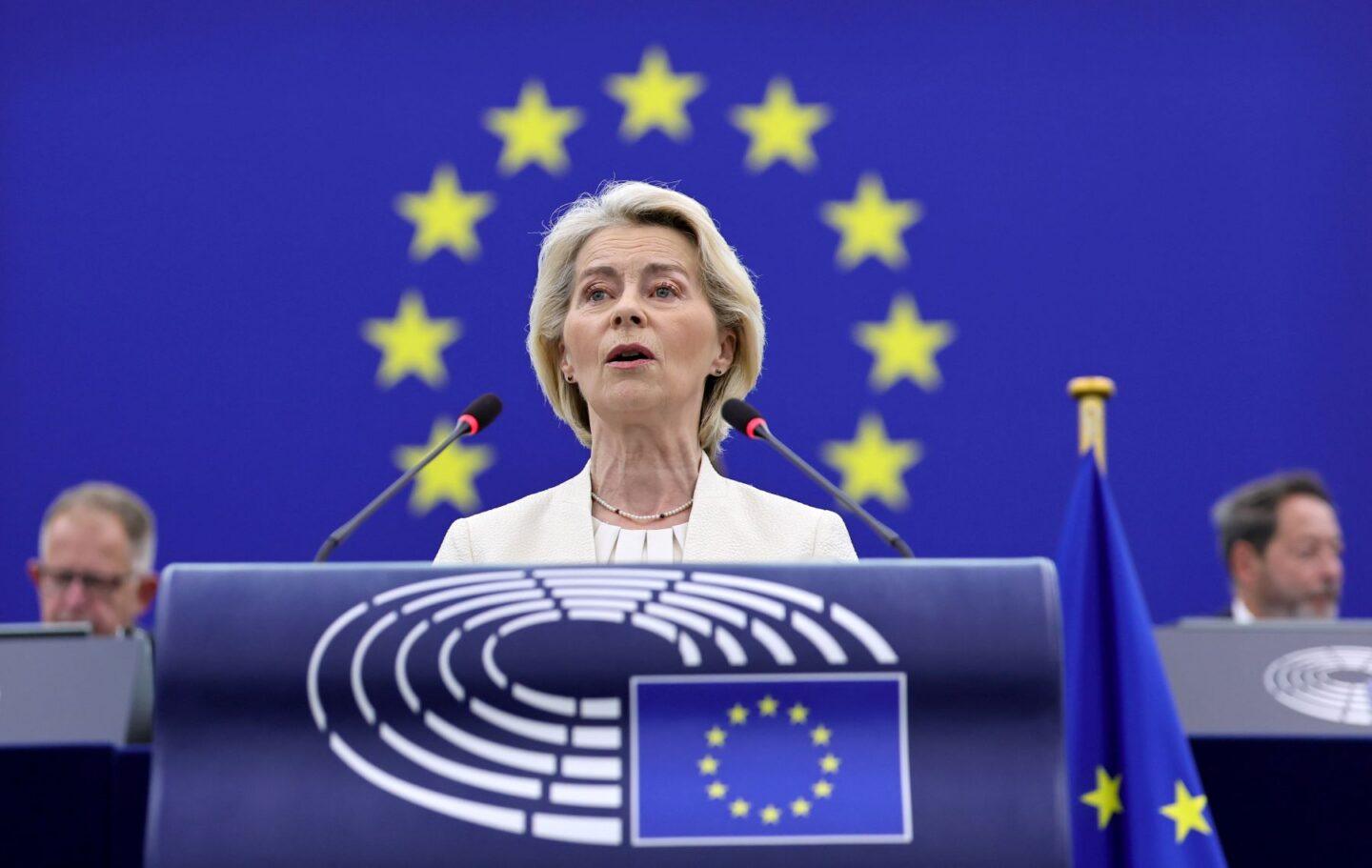
In her annual State of the European Union address, European Commission President Ursula von der Leyen spoke about closer cooperation with Canada, deregulatory proposals for European business and ideas for strengthening Europe’s defenses. But there was no mention of the ETS, the fuel-price crisis or Donald Trump.
Canada as an associate member of the European Union, an EU security mechanism modeled on NATO’s Article 4, a ban on social media for children under 13, further deregulatory proposals for European businesses and opposition to the trade imbalance with China.
Record interest and pressure on the Commission president
These were among the issues addressed in Ursula von der Leyen’s speech, which lasted more than an hour. This year’s annual State of the Union address attracted record media and political interest. More than 400 journalists were accredited for the European Parliament’s September session in Strasbourg.
Outside the EU complex in Strasbourg, demonstrations were also taking place, including protests by animal-rights activists. The organizers of an exhibition devoted to King John III Sobieski staged their own event, featuring reenactors dressed as Polish hussars on horseback.
The sheer number of accompanying events, combined with the grand expectations built up around this year’s State of the Union by EU institutions, created widespread curiosity in Strasbourg about what the Commission president would say.
The political context of the State of the Union
The political context in which the European Commission is trying to operate is also crucial. Next year, more than 200 million EU citizens will go to the polls to elect new authorities, including, of course, in Poland. Potential political changes in Paris, Rome, Madrid or Warsaw could bring significant shifts not only within individual member states, but also in the direction of decisions taken by the Commission.
Among circles close to the EU mainstream, there is an outward appearance of calm, but also widespread concern about eurosceptic parties taking power in the bloc’s largest economies—particularly in next year’s election in France.
Common security is the priority
There is also obvious concern over the escalation of Vladimir Putin’s imperialist policy toward Europe. A growing number of provocations and attempted acts of sabotage against European critical infrastructure have raised expectations for new and more concrete measures to strengthen European security.
At a press briefing ahead of the Commission president’s speech, Lithuanian MEP Petras Auštrevičius made clear what he believed should dominate the Commission’s work—and that of the EU more broadly—over the coming year.
“We need implementation, implementation and implementation again. We already have several absolutely effective tools; we simply have to start using them. If we do not, there will be no flowers, dancing people or other pleasures. There will be no economic development. We must continue supporting European defense,” the Lithuanian MEP said.
The best of times and the worst of times
And indeed, the Commission president began by emphasizing the gravity of the present moment. Von der Leyen quoted the English novelist Charles Dickens.
“It was the best of times, it was the worst of times,” the Commission president began, referring to Dickens’s description of Europe at the time of the French Revolution.
The rest of the speech repeatedly mixed optimistic assurances about the strength of a united Europe with warnings about the overwhelming number of challenges the continent now faces.
And there are certainly many of them.
Ursula von der Leyen devoted a substantial part of the speech to security and international affairs. The Commission president said she intended to strengthen EU defense by introducing a mechanism similar to NATO’s Article 4, allowing member states to convene consultations in the event of incidents or provocations.
Borrowing from NATO
“It is time for a European Article 4 - an emergency security protocol. Once triggered by one member state, all countries would meet to coordinate Europe’s response to the threat,” von der Leyen said.
A European Security Council is also to be created. The new format for European leaders would focus entirely on the continent’s security. Importantly, it would also be open to countries outside the EU: the United Kingdom, Norway, Canada and Ukraine.
Another new institution would be the European Strategic Capabilities Facility. It would provide shared EU systems in areas such as air defense, transport and cybersecurity. Together, these measures are intended to strengthen the EU’s defense capabilities.
“Europe will defend every single square meter of its territory,” von der Leyen declared.
Critics of the Commission president’s speech, however, point to the lack of clear detail on how joint defense among member states would be strengthened outside NATO structures. It is also not yet clear to what extent the Commission wants to rely on cooperation with the North Atlantic Alliance and to what extent it wants the EU to act independently.
Canada as an associate member of the EU
The announcement that attracted the most attention was von der Leyen’s invitation for Canada to join EU structures as the first-ever associate member of the European Union.
“Dear Mark, you said that we urgently need to rethink our partnerships. That is why I would like to work with you to open the door for Canada to become the EU’s first associate member. We share one ocean, one set of values, one way of seeing the world. And now we will also build our common future together. Thank you for being here,” von der Leyen said, addressing Canadian Prime Minister Mark Carney, who was present in the plenary chamber.
Carney, one of the stars of this year’s Davos conference, is also a guest at the European Parliament’s September session in Strasbourg. On Thursday, he is due to deliver his own speech and appear at a press conference with European Parliament President Roberta Metsola.
Carney’s presence in Strasbourg is no coincidence. Canada had already become involved in the SAFE program, while uncertainty over US policy toward the EU and Canada has led Carney’s government to significantly deepen ties with Brussels in recent months.
The European Union is expected to strengthen cooperation with Canada in areas including common security, AI development, defense production and joint economic initiatives.
More details are likely to emerge at the EU-Canada summit scheduled for late October.
Kobosko: The speech lacked courage
According to MEP Michał Kobosko of the Center Union and the Renew Europe group, this was the biggest surprise in von der Leyen’s speech.
“We still do not know what type of membership we are talking about, because no such procedure currently exists. Canada is probably not the only country interested in this kind of cooperation. Such a declaration certainly shows how close the ties between the EU and Canada are. In Canada itself, 44% of people already considered EU membership a sensible idea a year ago,” Kobosko said.
Beyond the Canada announcement, however, Kobosko was not surprised by von der Leyen’s address.
“It was a very safe speech and, in that sense, a disappointing one. It lacked bolder declarations on the economy. We did not get them,” the MEP said critically.
In Kobosko’s view, the structural problems facing European competitiveness require a bolder vision—one he felt was missing from von der Leyen’s speech.
“We are moving too slowly. Many sectors of European industry are now practically begging us for help. That is hardly surprising, because companies are having to deal with high energy prices and an influx of cheap products from China,” Kobosko noted.
A structural imbalance in relations with China
Von der Leyen acknowledged the problem of structural imbalance in trade relations with China and pledged action to reduce it.
“Our trade deficit with China now stands at €1 billion a day. We have reached a turning point. Some say a second China shock is coming. But it is already here. We depend on China for more than 80% of many critical raw materials, and for 90% in the case of some rare-earth metals. (…) That is why we will establish a new European Critical Raw Materials Corporation,” the Commission president said.
However, no details were provided about the scope of the new EU institution’s powers.
China was not the only subject von der Leyen addressed only in broad terms. The speech also included fairly general proposals on simplifying regulation for European businesses, initiatives to protect against droughts and heat waves, accelerating Europe’s electrification and supporting the development of artificial intelligence in key European industries.
Support for Ukraine
The Commission president also declared unwavering and unconditional support for Ukraine. Joint defense projects were also discussed.
“We want to develop an affordable and modular missile-defense system together with Ukraine,” von der Leyen said.
No more social media for children
The speech also included plans to ban social media use for children under the age of 13. Between the ages of 13 and 15, use would be permitted only under appropriate supervision.
Social-media platforms would also be required to redesign their algorithms for their youngest users to make them less addictive.
“We make the rules in Europe, not Big Tech,” von der Leyen argued.
Details of the legislative proposals are expected soon.
What von der Leyen did not mention
It is also worth noting what was absent from von der Leyen’s lengthy speech.
The Commission president did not mention the ETS emissions-trading system, which remains a major point of contention for many governments in negotiations with the European Commission.
Nor did we hear any declarations on public health, tackling pollution or, above all, high fuel prices and ways of addressing Europe’s increasingly probable energy crisis.
Canadian Prime Minister Mark Carney’s name appeared repeatedly in the Commission president’s speech. US President Donald Trump’s name did not appear once.
In the shadow of the American eagle
This fits with the European Commission’s cautious policy in recent months of not commenting on Donald Trump’s confrontational statements. The reason, of course, is Europe’s military security.
“Fully replacing the Americans in defense terms would cost Europe €500 billion,” Defense and Space Commissioner Andrius Kubilius told journalists.
Kubilius’s remark in some ways summed up the Commission president’s speech. Von der Leyen accurately identified the directions that are crucial for the EU. But catching up after years of underinvestment in defense, as well as improving the innovation and competitiveness of the European economy, will require ambitious plans and effective implementation.
Von der Leyen presented broad ambitions without offering a detailed vision of how they would be carried out.
“We have a leadership crisis across the whole EU. President von der Leyen has tied her own hands, because I do not see any force in the EU that could actually forbid her from doing something,” Michał Kobosko said.
Will von der Leyen be forced to take up the mantle of leader of Europe’s political mainstream in 2027, after a series of national elections? Or will the winds of political change make the Commission president’s position even more complicated?
For now, however, we are welcoming Canada—almost—into the EU, and preparing children for a ban on social media.


Key Takeaways
- Ursula von der Leyen proposed making Canada the first associate member in the history of the European Union, widely seen as the biggest surprise of this year’s State of the Union address. The proposal coincided with announcements of new security mechanisms, including a European equivalent of NATO’s Article 4 and a security council open to non-EU countries such as the United Kingdom, Norway, Canada and Ukraine. The Commission president did not, however, present a detailed procedure for associate membership because no such legal mechanism currently exists.
- Von der Leyen highlighted the growing trade imbalance with China, putting the EU’s daily trade deficit at €1 billion and stressing that Europe is more than 80% dependent on China for critical raw materials, rising to 90% for some rare-earth metals. She announced the creation of a European Critical Raw Materials Corporation but did not specify its powers. Michał Kobosko of Renew Europe described the overall speech as too cautious and lacking bolder economic proposals.
- The speech omitted several important subjects, including the ETS emissions-trading system, public-health policy and ways of addressing high fuel prices. Canadian Prime Minister Mark Carney was mentioned repeatedly, while US President Donald Trump was not mentioned once, reflecting the Commission’s cautious approach toward Washington.