Poland Unpacked week 39 (14 - 20 September 2026)

Welcome to this week’s edition of our Poland Unpacked, where we deliver key insights and trends shaping the economic, corporate and political landscape. Catch the most important insights from Poland in this week’s briefing.

Loading the Elevenlabs Text to Speech AudioNative Player...
Business
Deals, capital and vertical ambition
Grzegorz Nawacki

Marcin Grzymkowski is a Polish entrepreneur who scored a major success by building eObuwie, the country’s leading online footwear retailer, and selling it at a valuation of more than PLN 1 billion (EUR 235 million). A few years later, he founded sports retailer Sportano. From the outset, his ambition was to turn it into another billion-zloty business. He is getting closer. Sportano has just secured a heavyweight investor, pushing its valuation above PLN 600 million (EUR 141 million). The fresh capital is intended to accelerate its expansion.

Polish entrepreneurs looking for capital have a new option. One of the Baltic region’s leading investment groups is joining the ranks of investors scouting for companies in Poland. The investment firm, which manages billions of euros, is prepared to put EUR 160 million into Polish businesses. Here is what kind of companies it is looking for.

Polish companies are becoming increasingly ambitious in their international expansion. Grupa Kęty, a leading producer of aluminum profiles, has decided on a huge acquisition. It will buy the Metra group for PLN 2.8 billion (EUR 658 million), gaining a strong brand in Western Europe and a foothold in the United States. A deal of this size, however, brings risks as well as opportunities.

Katowice is a major city in southern Poland and the heart of Upper Silesia. Once a center of coal mining and heavy industry, it has reinvented itself as a modern hub for business, technology and culture. More recently, the city has also been growing upward faster than ever. When it comes to residential skyscrapers, it is soon set to overtake Warsaw. Some are delighted. Others are less impressed.

Economy & Markets
Moody’s downgrades Poland. The real economy delivers good news
Michał Kulbacki

On Friday evening, Moody’s downgraded Poland’s long-term foreign-currency rating from A3 to A2, while maintaining a stable outlook. The decision reflects forecasts of a lasting deterioration in the country’s fiscal position. The agency also said that the effectiveness of fiscal policy had weakened, as an increasing share of the growing debt burden is being accumulated outside Poland’s domestic debt rules.

This is the first downgrade of Poland’s rating by the agency in 24 years. Until now, however, Moody’s had rated Poland one notch higher than the other major agencies, S&P and Fitch.

The decision can be viewed in the context of the draft 2027 budget, which assumes that the general-government deficit will remain at around 7% of GDP for a third consecutive year. The government is already grappling with weaker VAT revenues. Moody’s said that public debt could rise to 70–75% of GDP by the end of the 2020s, from around 60% today.

The downgrade could have consequences in the form of higher yields on Polish government bonds. That, in turn, would increase risks for domestic banks, which have the highest share of government bonds in their assets of any banking sector in the EU.

The past week also brought fresh data from the Polish economy, and the figures were positive. First, manufacturing continues to perform solidly: output rose by 3.4% year on year in August. The increase is being driven mainly by higher corporate spending.

Second, Poland’s services sector is expanding rapidly. Output rose by 6.3% year on year in June on a seasonally adjusted basis. By this measure, Poland has been among Europe’s strongest performers over the past two years.

Third, Polish exports are growing. From January to July this year, exports, measured in euros, rose by 5.9% year on year. What is more, growth was recorded in all of Poland’s 20 largest export markets. There are also some interesting shifts in imports. For the first time, the monthly value of imports from China exceeded that from Germany.

Last week, we also took a closer look at two developments affecting the Polish economy. One was the growing number of people working under ‘civil-law contracts’ – and why this is happening. The other was how much the strength of the Polish passport has increased over the past 15 years, and what has driven that rise.

Politics & Policy
Warsaw looks to Washington as politics heats up at home
Rafał Mrowicki

Important news for Poland came from across the Atlantic. Donald Trump said on Thursday that preparations for a US Army base in Poland had advanced. Its location is to be announced soon. Mr. Trump also stressed the importance of President Karol Nawrocki’s leadership, calling him a friend.

Mr. Nawrocki had already been busy at home. Shortly before Mr. Trump’s announcement, he and Donald Tusk, Poland’s prime minister, traded barbs on social media. Speaking on the anniversary of the Soviet Union’s invasion of Poland, the president said that Poland was a nation that “may lose territory, but does not lose its soul”, according to the official account of the presidential chancellery. Mr. Tusk rebuked him, saying that Poland would not surrender a single piece of its land.

Mr. Nawrocki replied that he had been referring to 1939, and urged the government instead to take up his proposal to cut fuel prices. At some gas stations these have reached PLN 9 a liter, or more than EUR 2. As recently as this winter, before the American and Israeli attack on Iran, a liter of fuel in Poland cost just under PLN 6.

Russia, meanwhile, again tested Poland’s vigilance. An armed drone was found on a beach in central Pomerania. Then, on Thursday, air-raid sirens sounded once more in eastern Poland after a Russian missile strike in Ukraine, around 4 km from the Polish border.

At home, the parliamentary election is drawing closer. Civic Coalition (KO) still leads the polls, but Mr. Tusk, its leader, has cause for concern: support for his party is slipping. We take a closer look at the coalition’s position.

In Strasbourg, XYZ’s correspondent listened at close quarters to an address by Ursula von der Leyen, president of the European Commission. His account noted several politically and economically important omissions, among them the EU’s Emissions Trading System, public health and measures to curb rising fuel prices.

From the European Parliament, we also examined work on the EU’s next budget. Behind closed doors, ideas for spending cuts are beginning to circulate. The budget is expected to total EUR 2 trillion, with Poland set to be its biggest beneficiary.

There has also been movement in Poland’s parliament. Since the start of the current Sejm term, one seat on its presidium has been left vacant for a representative of Law and Justice (PiS), which governed Poland from 2015 to 2023 and backed Mr Nawrocki in the presidential election. The present parliamentary majority refused to accept Elżbieta Witek, a former speaker of the Sejm, as PiS’s representative.

A different candidate, Marcin Ociepa, a former deputy defense minister, was proposed by the Rozwój Plus parliamentary group. It consists of former PiS politicians gathered around Mateusz Morawiecki, the former prime minister. In the end Marcin Horała, another Morawiecki ally, became a deputy speaker of the Sejm, infuriating PiS politicians.

Szymon Hołownia has generated more noise still. The former speaker of the Sejm entered politics after years as a television presenter and Catholic columnist. He has now become head of the Poland 2050 parliamentary group – the party he founded, but whose leadership he lost at the start of this year. Over the summer there was speculation that he might join the government. Nothing came of it.

Next week Mr. Morawiecki will convene a congress of local-government politicians. His nascent party is attracting popular local figures from regions where the right polls strongly. The maneuvering is a dress rehearsal for next year’s elections.

Kraków, meanwhile, will elect a president on Sunday, September 27. The previous office-holder, Aleksander Miszalski of Civic Coalition (KO), was recalled in a referendum in May. After his defeat Mr. Tusk removed him as the party’s regional leader. A runoff will most likely be needed.

Startups / VC / Tech
Meta’s scam-ad problem and Poland’s venture-capital push
Anna Bełcik

How much of Meta’s revenue in Poland – the owner of Facebook and Instagram – might come from advertisements used by fraudsters, or scams? According to Instrat, which has published a report on the scale of the problem across Meta’s platforms, the share could be as high as one-third.

The report’s authors estimate that Meta could be earning as much as PLN 2m (around EUR 458,000) a day from fraudulent ads. A major problem is the limited transparency of its advertising system. According to the report, as many as 41% of scam ads may not be properly visible in Meta’s Ad Library, meaning the true scale of the problem could be larger still.

Meta makes money from advertisements that misuse the images of journalists, politicians and businesspeople. Public figures targeted in this way include President Karol Nawrocki, Prime Minister Donald Tusk and entrepreneur Rafał Brzoska – InPost founder – who has openly criticized Meta over the problem. But ordinary Poles also fall victim to such scams. According to Instrat, Meta’s conduct in this area is systematic. Here's the full story.

The past week also brought several noteworthy announcements in venture capital – the business of investing in young, fast-growing companies.

Hard2beat has raised additional capital and now plans to expand its activity outside Poland. The amount available for investment has risen from PLN 84m (around EUR 19.3m) to PLN 110.3m (around EUR 25.3m). The money came from the fund’s existing investors; Hard2beat did not seek new backers for the raise.

The additional capital is intended to allow the fund to maintain its pace of investment as funding rounds for advanced-technology, or deep-tech, companies become larger; increase its exposure to the strongest companies already in its portfolio; invest more broadly abroad; and build relationships with European funds.

A significant share of the new capital came from a public institution, PFR Ventures. Hard2beat’s partners also link the increase in funding to their participation in Starter Science, a program created by PFR Ventures to support investment in projects emerging from the scientific community. All the deteails in our story here.

AIP Seed, another fund, joined the seed round of Expanse, which has just raised USD 5.3m for further development. The round was led by Crane Venture Partners, with PXN Ventures also participating.

AIP Seed’s portfolio is becoming increasingly international. Its investment in Expanse also fits a broader trend of Polish funds backing foreign companies co-founded by people with Polish roots.

Expanse is based in San Francisco and was founded by four engineers who graduated from the University of Edinburgh. The company develops software designed to help businesses use the infrastructure required to run artificial-intelligence systems more efficiently. Its main focus is GPUs, the processors used for demanding AI computations. Access to them is expensive and often constrained, while companies do not always make full use of the computing capacity they already have. So, what's the plan?

AIP Seed has also invested in a funding round for TesterArmy. The startup developed through Y Combinator, one of the world’s best-known startup accelerators, based in San Francisco. Its founders, however, first met while working at the Polish company Callstack.

TesterArmy’s investors include Y Combinator, AIP Seed, Eight Capital, Script Capital and a group of entrepreneurs linked to the global and Polish technology sectors, including founders or executives from Vercel, Expo and Callstack.

The company’s operational base remains in Poland, but its strategic focus is the United States and winning increasingly large international clients.

TesterArmy is developing a platform that uses AI agents to test web and mobile applications autonomously. Instead of creating separate, rigid test scenarios, users can describe in ordinary language what an application is supposed to do. The system then carries out the relevant actions itself and checks whether everything works as intended. The tool can also analyze changes to code made by developers, prepare a testing plan and report the results directly in GitHub. Here's their plan.

After hours
When old money meets new money
Michał Szcześniewski

Why Poles are suddenly talking about Lalka (The Doll)? Imagine a novel that is simultaneously a national schoolroom institution, a portrait of Warsaw and a surprisingly sharp book about money, status and social climbing. Bolesław Prus published it in instalments from 1887, building his story around Stanisław Wokulski, a self-made businessman hopelessly in love with aristocratic Izabela Łęcka. But the romance is only the surface.

Behind it lies a society being pulled between fading aristocracy and rising capitalism, inherited privilege and earned wealth, romantic dreams and cold calculation. That combination has helped make Lalka one of Poland’s canonical novels – it remains required reading in secondary schools – while also giving generations of Poles a shared stock of characters, references and arguments.

This September offers an unusually accessible way into that world. Netflix released Paweł Maślona’s deliberately modern reworking , while Maciej Kawalski’s much more traditional big-screen adaptation arrives on September 30, reportedly with a budget exceeding PLN 60m.

Either version offers more than costume drama. Watch how Wokulski tries to buy his way into a social class that is happy to take his money but reluctant to accept him; how old elites cope with economic decline; and how entrepreneurial energy collides with hierarchy, resentment and romantic obsession. In other words, Lalka is a story about nineteenth-century Poland that keeps finding ways to sound contemporary. It may even make your next walk down Krakowskie Przedmieście look different: many of the places associated with Prus’s fictional Warsaw can still be traced in the city today.

fun fact about poland
The many Polands of the world
Michał Szcześniewski

Poland, it turns out, has been hiding in plain sight across the world’s flag catalogue. Turn Indonesia upside down and there it is. Wait for Canada’s leaves to change color and – almost – Poland again. Greenland offers Poland within Poland; Chile is the premium edition, Gibraltar the fortified one, Malta the sideways model and Lebanon the Christmas special. Geography has rarely looked so much like a branding exercise.
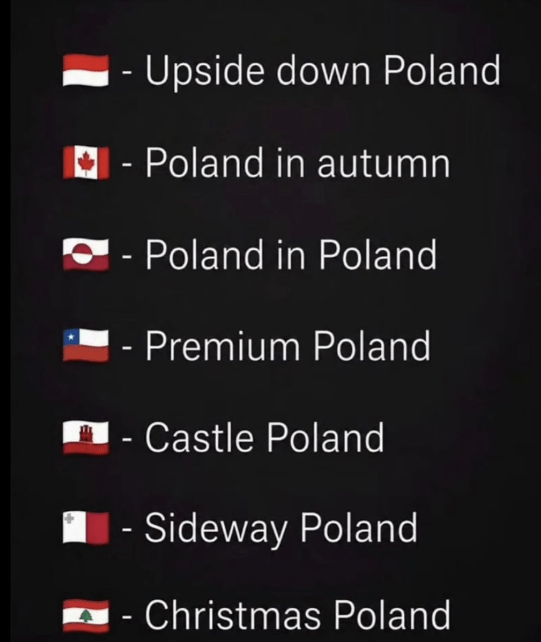
The Polish flag multiverse, explained.

The joke works because Poland’s flag is wonderfully uncomplicated: two horizontal bands, white above red, leaving plenty of room for accidental international impersonators. Of course, vexillologists may object that these flags have entirely different histories, proportions and symbols. But that is rather beside the point. Once you have seen “Premium Poland”, it becomes surprisingly difficult to look at Chile in quite the same way again.