

This article is a part of Poland Unpacked. Weekly intelligence for decision-makers
Poland 2050 is scraping the bottom of the polls and is attempting to emerge from a deep crisis under the new leadership of Katarzyna Pełczyńska-Nałęcz. The party has unveiled key slogans aimed at the salaried middle class while simultaneously adopting a sharper stance toward its own coalition partners. The Warsaw congress was intended to symbolize a deliberate break from the group’s recent reputational setbacks.
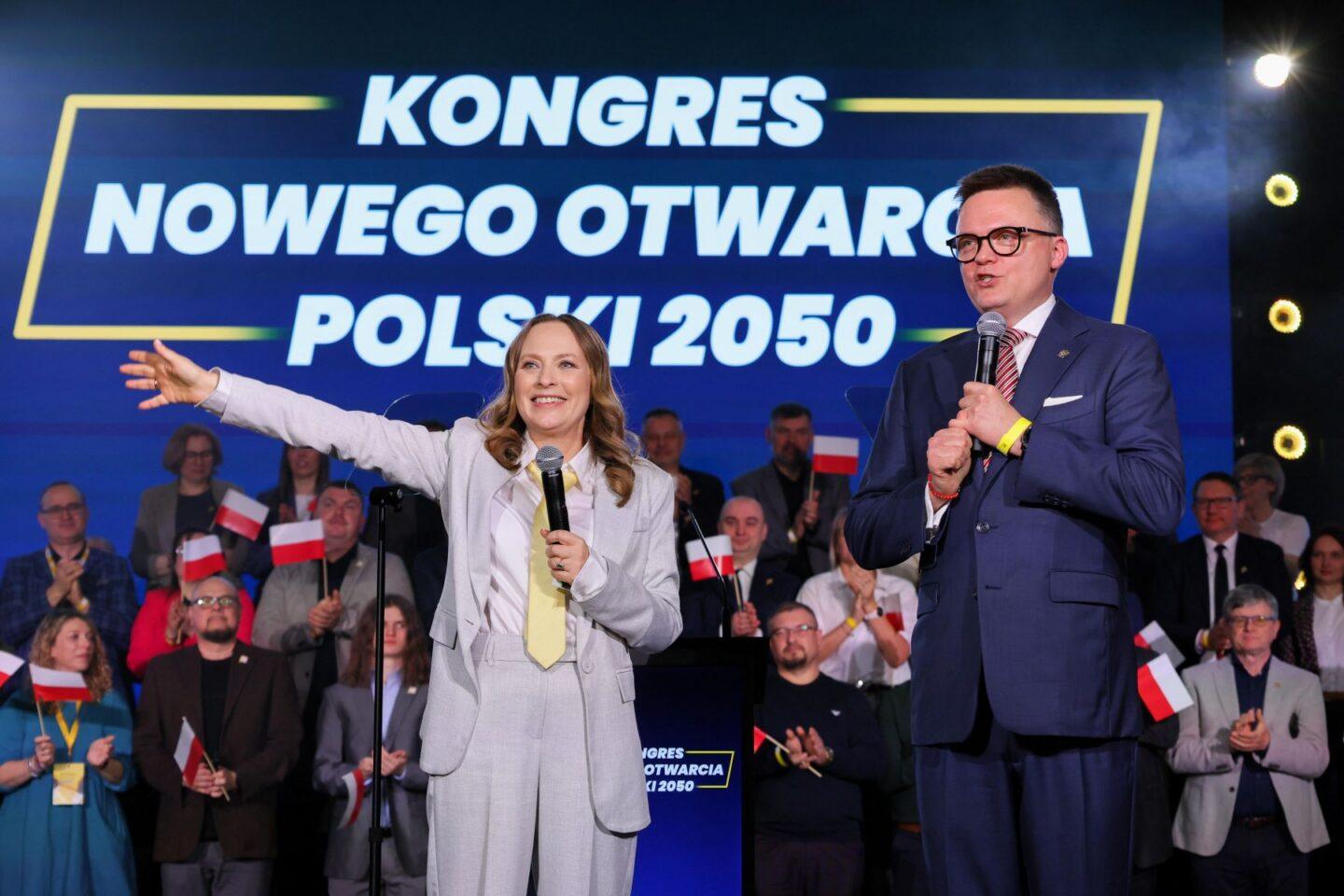
In Polish tradition, March 21 is associated with the ritual farewell to winter, symbolized by the drowning of the “Marzanna” effigy. This year, March 21 also saw a symbolic drowning of a political Marzanna. At the Centrum Konesera in Warsaw, Poland 2050 held its convention, titled a “congress of a new opening.”
Spring cleaning
Even the most optimistic party insiders could not hide the fact that Poland 2050 needed a fresh start as badly as oxygen. The formation had been battered by the controversy surrounding the internal election of its leader, and then fractured further after some MPs left to form a parliamentary circle called “Centrum.” In March, the party’s average polling support did not exceed 2 percent. As one activist present at the congress remarked behind the scenes: things can hardly get any worse, because they simply cannot.
The party was steered through this turning point following the leadership contest by the Minister of Funds and Regional Policy, Katarzyna Pełczyńska-Nałęcz. The turmoil triggered by the party’s fragmentation has now begun to subside. This was a favorable moment for Poland 2050, in its new configuration, to attempt to redefine itself. What will we remember from the Saturday event? A cosmetic rebranding of the party, the slogan “work, pay, and housing,” and Pełczyńska-Nałęcz’s speech in the vein of pro-European and pro-labor populism, aimed at the salaried middle class. But let us take things in order.
Behind the scenes of the party’s facelift
Even before the event began, rumors were circulating about a possible name change. Prior to the congress, some participants were wrapped in yellow scarves bearing the party’s logo. However, a small detail had been altered in the party’s “merch.” In the logo, instead of the customary “2050,” one could notice the overseas-style construction “2K50.” Why would the party opt for a facelift in such a specific direction?
“Even before Poland 2050 was registered as a party, someone outside the camp preempted Szymon Hołownia and filed a court application to register a party called ‘Poland 2050.’ That is where the later name ‘Poland 2050 of Szymon Hołownia’ came from. Now, after the change in leadership, it was also a good moment to change the name,” said one of the party activists.
He suggested even before the event began that we might expect a name such as “Poland 2K50” or something similar. A change did indeed take place, but it turned out to be far more cosmetic.
“Poland 2050 of the Republic of Poland. As of today, that is the name of our party,” announced chair Katarzyna Pełczyńska-Nałęcz together with the party’s founder, Szymon Hołownia.
On stage, the party leader frequently exchanged courtesies with the former Speaker of the Sejm. Pełczyńska-Nałęcz praised Hołownia’s tenure as Speaker, while he in turn lauded her as a “distinguished leader.”
“Szymon Hołownia decided to share his name with us and said from the very beginning that it was, as it were, a temporary loan,” Pełczyńska-Nałęcz explained the name change.
The aforementioned activist expressed surprise at replacing Hołownia with “the Republic of Poland” in the party’s name.
“The materials with the new logos had already been printed. In the end, however, the announced name was chosen. At least we have exclusive scarves,” the activist concluded.
“Work, pay, and housing,” or Poland 2050’s new triptych
The change of name was, of course, not the only thing we heard from the stage. A programmatic speech was delivered by chair Katarzyna Pełczyńska-Nałęcz, followed by brief interventions on specific issues from MPs and party activists. In a single breath, Pełczyńska-Nałęcz listed the three most important demands of Poland 2050 in its renewed form.
“Work, pay, housing. This is the trinity of Poland 2050’s secure everyday life,” Ms. Pełczyńska-Nałęcz said, outlining the party’s core values.
Throughout the speech, there were repeated references to ensuring decent working conditions, reforming the tax system in favor of salaried employees, and introducing legislation to make it easier for young Poles to purchase their first home. This is hardly new, as similar proposals have long been voiced by the Minister of Funds (Ms. Pełczyńska-Nałęcz – ed.). The Saturday congress nevertheless confirmed that this is also the party’s own agenda.
Previously, Poland 2050 had started out as a relatively economically liberal party, and during its first two years in parliament a mix of often conflicting ideas circulated within its ranks. Although the party has since shrunk, the congress demonstrated that it has at the same time consolidated its vision for its role on Poland’s political stage.
Raising the second tax bracket, reforming family foundations, and a digital tax
The party chair also briefly presented new policy proposals.
“Raising the second tax bracket to at least PLN 140,000 (approximately EUR 32,000), reforming family foundations, and a flat-rate tax for micro-entrepreneurs – not millionaires,” Ms. Pełczyńska-Nałęcz listed.
Explainer
Family foundations
Poland's family foundation (fundacja rodzinna), introduced in 2023 to help wealthy families preserve assets and plan succession, quickly became a popular vehicle for tax optimization rather than its intended purpose – with over 1,200 registered by mid-2024 and thousands more pending.
The most controversial tactic involved founders transferring company shares into foundations before selling them, deferring or eliminating tax liabilities, prompting the Finance Ministry to announce reforms taking effect in January 2026, including a three-year period during which assets sold after being contributed to a foundation would be taxed immediately rather than deferred.
Business groups argue the crackdown overshoots its target and risks undermining legitimate family succession planning – leaving Poland's promising new legal instrument mired in controversy before it has fully found its footing.
She also addressed the privileged position of technology giants within Poland’s tax system.
“A digital tax. Let big tech join in as well. Do you know how much Facebook earned last year? PLN 1.85 billion (approximately EUR 425 million). And how much tax did it pay in Poland? PLN 10 million (approximately EUR 2.3 million). Half a percent,” Ms. Pełczyńska-Nałęcz noted.
These figures are consistent with data presented in June 2025 by Press magazine.
The battle for the discontented middle class and jabs at Civic Coalition (KO)
Ms. Pełczyńska-Nałęcz did not distance the party from its membership in the governing coalition, but throughout her speech she repeatedly – albeit indirectly – criticized circles associated with Civic Coalition.
“The smiling establishment has for years looked at Poland solely through the prism of the best neighborhoods (…) and has completely forgotten about the rest, about ordinary people,” the chair of Poland 2050 declared from the podium.
She also diagnosed growing dissatisfaction among Poland’s middle class, which the party’s new program seeks to target.
“In the middle class, among ordinary people, anger toward the system is awakening, because they feel that the system works against them,” the minister said.
Another phrase that stood out from the speech was “PRP cooperatives,” referring to Polish tax havens. According to Ms. Pełczyńska-Nałęcz, these contribute to generating anger among the working middle class.
“You, the ordinary person, the common man – work, pay for the army and schools, for roads and railways, while for the chosen few a system has been created of the so-called Polish tax havens – which some, incidentally, also take advantage of,” Ms. Pełczyńska-Nałęcz said, clearly addressing the middle class drifting away from the government.
She also announced an effort to make the tax system more realistic.
“It is time to clean up an unfair tax system in which millionaires pay nothing on their vast fortunes and then place them in family foundations – a system in which loopholes allow the privileged class to pay just a few percent. At the same time, a teacher and a nurse fall into the second tax bracket and pay 32 percent. This is absurd, and it must change!” the chair of Poland 2050 stated firmly.
Fighting populism with populism?
After the speech, during the media conference, references to the right wing were also in no short supply.
“We live in difficult times. In such times, politicians who are eager to demolish our home grow like mushrooms after rain. Fire-extinguisher pirates, pseudo-conservatives who have been divorced and have had two church weddings,” the chair of Poland 2050 said, clearly alluding to the party of Grzegorz Braun.
Explainer
Mr. Braun’s Fire Extinguisher Movement
“Braun’s Fire Extinguisher Movement” (Ruch Gaśnicowy Brauna) originated from an incident in December 2023 when Polish MP Grzegorz Braun used a fire extinguisher to disrupt a Hanukkah candle-lighting ceremony in the Sejm, parliament's lower house, prompting his temporary exclusion from proceedings and widespread media coverage.
The phrase has since been adopted by Mr. Braun and his supporters as a rallying slogan for his Confederation of the Polish Crown (KKP) faction, framing it as symbolic resistance against perceived cultural and political threats during his 2025 presidential bid and efforts to form a parliamentary group.
During the post-convention press conference, she added that Poland 2050 intends to go on the rhetorical offensive in opposition to the right.
“We are not driven by polarization (…) The values of Poland 2050 are solidarity, freedom, and respect for the other person. We talk too little about these values. There is too much defensiveness, too much retreat in the face of this pseudo-right and pseudo-conservatives. Freedom, solidarity, and respect for the other person. And in addition, work, pay, and housing. Democracy is attacked by the evil of populism, but it is killed by the lack of ideas among democrats,” Ms. Pełczyńska-Nałęcz concluded.
Indeed, the change in leadership – from Szymon Hołownia, known for his conciliatory style and reluctance to make clear-cut declarations, to the more outspoken Katarzyna Pełczyńska-Nałęcz – also entails a shift in the party’s image. Until the recent changes and internal scandals, it was difficult to define Poland 2050 unambiguously in ideological terms.
This congress, even if it did not provide an answer to how the slogan “work, pay, housing” is to be implemented, certainly made clear the direction in which Ms. Pełczyńska’s party intends to move. Paradoxically, its anti-populist declarations can themselves be classified as a form of “populism for the working middle class.” After all, it is well known that even substantive policies struggle to break through without distinctive – and sometimes populist – slogans.
Post-congress conclusions and the direction ahead
Poland 2050 is choosing the role of a government vanguard acting in opposition to the dominant figure of Donald Tusk. This was acknowledged by Ms. Pełczyńska-Nałęcz herself, who described her relationship with the prime minister as a “rough friendship”- a term familiar from the era of Leszek Miller and Aleksander Kwaśniewski in the 2000s. At times, one might even have had the impression that what we were observing resembled a rally of a party more in opposition than in government. The “smiling establishment” [“smiling coallition” is a term often used by the opposition to describe the ruling coalition that “does nothing and only keeps smiling” – ed.] was not explicitly defined, but there should be no doubt as to whom Ms. Pełczyńska-Nałęcz was directing her message.
This leads to a further conclusion. In the near term, Poland 2050 will attempt to appeal to voters dissatisfied with the government, but also to those who do not necessarily sympathize with the right. At present, this segment of the electorate is being targeted by the party Razem [left – ed.], a formation that previously ran on joint lists with the New Left. In 2024, however, a split occurred within the left-wing coalition. Since then, the New Left has been part of the governing coalition, while the opposition party Razem has often criticized Donald Tusk’s cabinet.
This will, of course, be a rather difficult balancing act. The party of Adrian Zandberg [Razem – ed.] finds it easier to be credible in its criticism of the government, as it is not part of it. How voters will receive Poland 2050’s confrontational stance toward Tusk, given that it is a member of the governing coalition, remains to be seen. The coming months will provide the answer.
This paradox, however, may serve as a starting point for positioning ahead of the 2027 elections. Within Poland 2050, no one is openly discussing the formation of a broader bloc for the next electoral cycle, but polling arithmetic leaves little room for dreams of an independent run by Ms. Pełczyńska-Nałęcz’s party. One of the party activists, speaking to XYZ, outlined possible scenarios.
A partner for the next election has not yet been sought
“It is, of course, too early for any declarations. But perhaps, if the party’s program fails to gain sufficient traction within the government, we will have to consider unconventional moves. We will not go with the Polish People’s Party (PSL), as returning to the Third Way coalition with them with diverging agendas would be unserious. There is too much that divides us from Civic Coalition (KO), so that leaves only the New Left and Razem. However, Razem is outside the government. For now, it is difficult to conclude anything, because no one is taking this seriously yet – though in my view they should,” the activist said.
He did note, however, something that at the same time has become the most important short-term takeaway from Saturday’s congress.
“As was visible, attendance was solid and we managed to cement the party. More importantly, no one will keep bringing up the embarrassment of the internal elections. The key thing is that we can finally move forward,” the activist concluded.


Key Takeaways
- Katarzyna Pełczyńska-Nałęcz is adopting a more assertive and confrontational tone toward the leading force within the governing coalition. Her critical rhetoric aimed at financial elites positions Poland 2050 as an internal opposition. This strategy is intended to help capture voters disappointed with the government and to provide a clear counterweight to right-wing parties. It may also serve as preparation for shaping electoral lists ahead of the 2027 elections.
- A cosmetic modification of the party’s name is intended to signal a symbolic fresh start. In this way, the formation seeks to decisively distance itself from internal electoral scandals and stabilize its position. The trio of slogans - “work, pay, housing” – is also meant to define the party’s rhetorical direction.
- Poland 2050 is clearly shifting its programmatic emphasis toward pro-labor policies. The new agenda focuses on defending the interests of the salaried middle class. The party proposes changes to the tax system and legislation aimed at facilitating home ownership for young citizens purchasing their first property.