Poland Unpacked week 36 (24-30 August 2026)
Welcome to this week’s edition of our Poland Unpacked, where we deliver key insights and trends shaping the economic, corporate and political landscape. Catch the most important insights from Poland in this week’s briefing.
This article is a part of Poland Unpacked. Weekly intelligence for decision-makers
Big tech is coming under mounting pressure in Poland. Rafał Brzoska, the founder of InPost, is taking the fight to the platforms. On August 27, the entrepreneur unveiled ScamWatch, a new tool developed by Polish specialists. Augurium, a startup, has built the system to detect, document and connect suspicious campaigns, then hand platforms ready-to-use evidence that a scam has taken place.
“Today, we are doing for Meta what Meta should be doing itself,” says Mr. Brzoska.
A few days earlier, the InPost chief launched the 150% initiative. Its goal is to change the law so that platforms that profit from fraudulent advertising would face fines equal to 150% of the revenue generated by such ads. A petition supporting the proposal is available at 150proc.pl.
Mr. Brzoska had previously taken aim at Meta in a sharply worded post. Fake ads using his image continue to appear on social-media services owned by the company, despite an April 2026 ruling by the Warsaw Court of Appeal that went in favor of Mr. Brzoska and his wife, Omena Mensah, in their dispute with Meta. According to documents obtained by XYZ, the court held the company responsible for advertisements published on its platforms.
Krzysztof Gawkowski, Poland’s deputy prime minister and minister of digital affairs, has also stepped into the dispute. He said he had asked the European Commission to impose a €250 million fine on Meta. He had previously questioned the company about ads using people’s images and the steps it was taking to curb scams. Its response failed to satisfy him. Read our full story here.
Poland needs a national-security strategy, says General Tomasz Piotrowski, a reserve general who joined the employers’ organization Pracodawcy RP after more than 36 years of military service. In an interview with XYZ, he argues that excessive regulation and a lack of trust are getting in the way of preparing Poland for war. Here's the interview.
Why are stock markets rising when the geopolitical outlook remains so uncertain? Piotr Kuczyński, an analyst and market commentator who is now chief analyst at Dom Inwestycyjny Xelion, offers his explanation in an interview with XYZ. He also has a warning for the years ahead. The world, he says, could face a debt crisis within the next 10–15 years. Yet he does not necessarily see such a crisis as entirely bad news. Periods of upheaval can make it easier to push through far-reaching reforms that would otherwise be politically difficult. Poland, he argues, badly needs such reforms - particularly in health care, taxation and pensions. Have a read here.
Erbud, one of Poland’s largest general contractors, is shutting down its modular-construction division, MOD21. The business had been loss-making since its inception, with a net loss of PLN 60.3 million last year. Some experts saw the decision coming. Others were caught off guard, having expected the company to find a partner for a venture in which it had invested heavily. Erbud built a 21,000 sq m plant equipped with two production lines for the project. Details in our article here.
Zarys, a family-owned company from Zabrze, is having a very different experience. It makes medical gloves, dressings, surgical kits and disposable medical products such as syringes. The Covid-19 pandemic gave Zarys and other medical-equipment suppliers a major boost. In 2020, the company increased its revenue from PLN 200 million to PLN 850 million. Revenue subsequently fell, but Zarys used the pandemic years to lay the foundations for further growth. Investment and expansion into export markets have since helped the company build momentum. Zarys is now targeting revenue of PLN 1 billion in 2028. Full story here.
The government has just approved the draft budget for 2027. In the shortest possible version: little will change compared with 2026. From a macroeconomic perspective, the key figure is the planned general government deficit, which is expected to come in at 7.1% of GDP. That is exactly the level current estimates put the deficit at this year.
Poland will therefore have the highest deficit of any EU member state and is on a path toward a very rapid increase in public debt relative to GDP. The ratio crossed 60% in the middle of the year and, according to our estimates, could be close to 70% by the end of 2027. And in the meantime, parliamentary elections are due in autumn 2027. In recent years, elections have increasingly become a pretext for introducing further measures, chiefly involving higher spending.
Fiscal stimulus is nevertheless translating into very strong economic performance in Poland. This is evident, among other things, in the latest retail-sales figures: sales rose 3.9% year on year in July, measured at constant prices, and by 3.7% year on year over the January-to-July period. The increase has been driven mainly by stronger sales of durable goods.
Notably, households report a very high propensity to save in surveys. Some of these savings subsequently find their way into Polish government bonds, helping finance public debt. For now, it appears that this mechanism, together with foreign investors’ favorable view of Poland, is enabling the government to finance the state’s borrowing needs without a sharp rise in bond yields. We will see how long this will be enough…
To be fair, the government has also proposed, as part of the tax reform unveiled recently, an increase in corporate income tax (CIT). This raises some questions, particularly because it is intended to apply to companies with revenues above EUR 50 million (about PLN 212.5 million). There are concerns, for instance, about using a revenue threshold for an income tax, as well as about the fact that a higher CIT runs counter to the need to build large companies with Polish capital.
The Zondacrypto investigation has taken a new turn. Przemysław Kral, head of the Zondacrypto exchange, who had been hiding abroad for several months, has been charged with participating in fraud and says he wants to cooperate with prosecutors. His lawyer is Roman Giertych, a Civic Coalition (KO) MP and former deputy prime minister in the first government of Law and Justice (PiS), the largest opposition party.
New details have emerged about Mr. Kral and his company. According to Onet news portal, he sought to acquire a substantial stake in Telewizja Republika, the right-wing broadcaster that supports Law and Justice (PiS). Wirtualna Polska and TVN24 news outlets, meanwhile, reported that Mr. Kral invited PiS MP Michał Moskal to Ibiza last year. Moskal subsequently became involved in efforts to oppose the cryptocurrency bill.
Mr. Kral is also alleged to have helped arrange a stay in the United Arab Emirates for PiS MP Marcin Romanowski, who is wanted in connection with an investigation into irregularities in the spending of Justice Fund money under PiS rule. Former Justice Minister Zbigniew Ziobro, who is also abroad, is wanted in the same case.
It has also emerged that Kral gave an expensive watch to Radosław Piesiewicz, president of the Polish Olympic Committee, which was sponsored by Zondacrypto. Piesiewicz has been detained by prosecutors.
Prime Minister Donald Tusk has called on Sejm Speaker Włodzimierz Czarzasty to hold another vote on overriding the president’s veto. President Karol Nawrocki has vetoed the government’s bill regulating the cryptocurrency industry three times.
The affair is also hurting the political standing of the right, both PiS and Confederation, the far-right party that competes with PiS.
This autumn, former Prime Minister Mateusz Morawiecki, who left PiS with a group of MPs, may form a new party. His Rozwój Plus association is already the third-largest parliamentary group. We examine how his movement intends to distinguish itself from PiS. Hint: the differences are not particularly significant.
Riding on entrepreneur Rafał Brzoska’s campaign to protect people’s images from misuse by Meta, the Ministry of Digital Affairs is seeking multimillion-zloty fines against the digital giant. At the same time, NASK, the state cybersecurity institute, is urging people not to use TikTok. There is an obvious complication: both the president and the prime minister have accounts on the platform, as do other public institutions. How do they explain this? Read our article.
The political week ended with events aimed at young people. Rafał Trzaskowski, the mayor of Warsaw and deputy leader of the ruling Civic Coalition, once again hosted Campus Polska Przyszłości. Guests included leading coalition politicians headed by the prime minister, as well as Nobel laureate Ales Bialiatski, Andrzej Poczobut and Patrick Gaspard, a former adviser to Barack Obama.
President Karol Nawrocki took a cue from his rival in last year’s election. At the presidential residence in the seaside resort of Jurata, he organized a meeting under the banner “Przyszłość.pl” (future dot pl), inviting several hundred young people.
Parliament returns from its summer recess next week. Besides another vote on the president’s veto of the cryptocurrency bill, MPs may also vote on the candidacy of former minister Maciej Berek for a seat on the Constitutional Tribunal.
The past few days have not brought any spectacular funding rounds for Polish startups. That does not mean the sector is quiet. Companies are still looking for opportunities to expand and scale their operations. A case in point is Polish fintech PragmaGO. As CEO Tomasz Boduszek tells XYZ, key decisions on the Polish company’s further international expansion could be made within weeks.
PragmaGO, a Polish company specializing in lending and factoring, has tested two expansion strategies, entering Spain and Croatia this year, and is now setting its sights on additional markets. Portugal, Greece and Italy are among those on its radar. Acquiring competitors is also one option under consideration. Here's the full story.
Another new player is also making its mark: Ares Shield. The company was founded by the former CEO of SatRev, a space company listed on Warsaw’s NewConnect market. So far, Ares Shield has reportedly raised PLN 2.4m (EUR 0.6m) from private investors.
Ares Shield’s solution is a modular defense platform combining AI, data from multidomain sensors and HPM (high-power microwave) technology. The system is designed to detect, classify and neutralize threats to satellites in orbit.
The company has just begun working with America’s Lonestar Data Holdings. The US company is developing infrastructure for storing and processing data in space, including in orbit and, eventually, on the Moon. In other words, space-based data centers. What will come of the partnership?
Polish deep-tech fund Balnord took part in a funding round for REGENT Craft, a developer and manufacturer of Seaglider drones. The company has just raised USD 240m (PLN 892m; EUR 207m) in a Series B round led by Mare Liberum and AE Ventures. The new funding will take the company from the early development stage to full-scale production. The Polish team and capital are expected to help make that happen.
Meanwhile, R+VC, a Polish family office specializing in deep tech, defense and dual-use technologies, has invested in Principal Mineral. The US company raised USD 280m (PLN 1.04bn; EUR 241m) from investors to build a supply chain for materials used to manufacture printed circuit boards (PCBs).
In recent days, Polish venture builder Iterion also announced its first investment. It is PromptEye, a company developing a system for the autonomous management of brand visibility in AI language models. According to the company, within four months of starting sales, PromptEye reached PLN 0.6m (EUR 0.14m) in annual recurring revenue, or ARR, and acquired several dozen customers, including companies and institutions from the financial and public sectors.
For a bracing dose of Polish social history in paint, make time for Edward Dwurnik. Pride and shame at the Museum of Modern Art in Warsaw. The exhibition returns to Dwurnik’s 1970s and 1980s series Sportsmen and Workers: crowded, caustic, tender portraits of people trying to hold on to dignity in a country that was forever promising a better tomorrow. Dwurnik rejected the idea that art belonged to a rarefied elite; he wanted painting to be a language shared with its subjects—and his canvases remain wonderfully unruly, full of bodies, ambition, awkwardness and hard-won self-respect.
More information here.

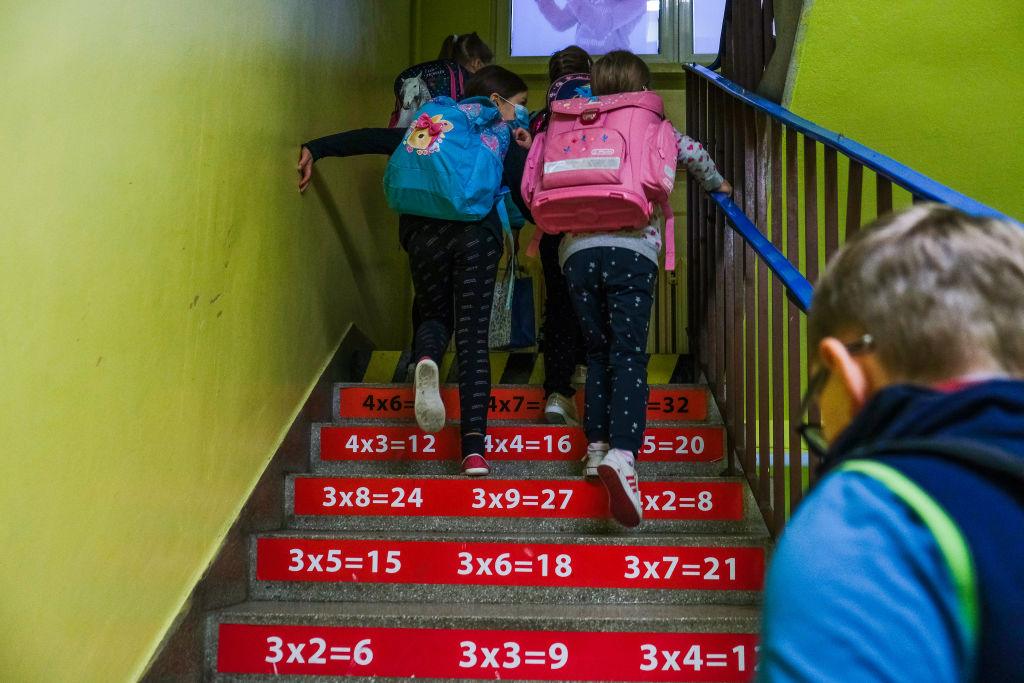
Poland’s annual September ritual of new notebooks, ceremonial outfits and nervous first-years has a surprisingly grand ancestor. On 14 October 1773, the Polish–Lithuanian Commonwealth created the Commission of National Education (Komisja Edukacji Narodowej, or KEN), widely considered Europe’s first modern ministry of education.
At a moment when the state itself was under immense pressure, it decided that schooling deserved not merely good intentions, but a central public institution. The Commission took charge of much of the former Jesuit educational network and used the order’s assets to finance schools, teachers and an ambitious reform programme.
Its task was not modest: build a more coherent system of public education across the Commonwealth and cultivate useful, civic-minded citizens. So, before Poland had the September scramble for exercise books, it had already turned education into a matter of statecraft.