

This article is a part of Poland Unpacked. Weekly intelligence for decision-makers
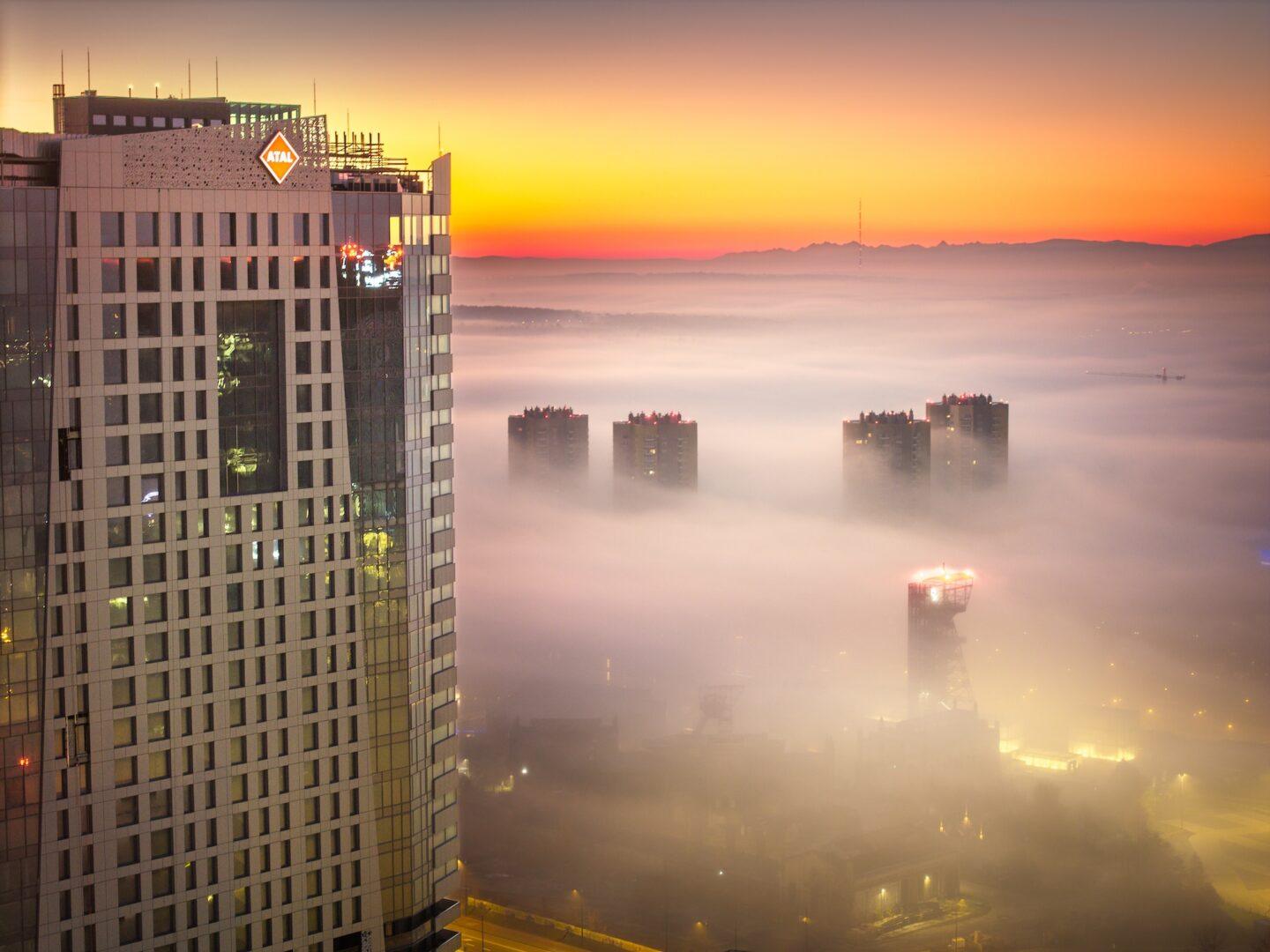
The capital of Silesia is growing skyward faster than ever. It is soon set to overtake Warsaw in the number of residential skyscrapers. To some, this is a symbol of metropolitan ambition; to others, an increasingly aggressive – and unnecessary – intrusion into the urban fabric.
Until recently, Katowice’s skyline was defined by a handful of standalone towers. Today, high-rises are beginning to form entire clusters, particularly around the city center and the Koszutka district. ATAL has opted for residential buildings more than 100 meters tall, while Trust Investment is developing further high-rise projects. Other investors are preparing additional schemes.
The latest proposal, at 1 Chorzowska Street opposite Spodek, has sparked an unusually heated debate. The dispute is no longer about a single tower. It is about how tall Katowice should become – and who should decide what its new skyline looks like.
Katowice reaches for the sky
Katowice is no stranger to high-rise architecture. The pre-war Drapacz Chmur, Superjednostka, the Gwiazdy estate, the Kukurydze towers on the Katowice-Chorzów border and, later, Altus have shaped the city’s skyline for decades. But the scale of the current wave of development is different. Height is no longer the preserve of standalone office towers and is increasingly making its way into residential construction.
ATAL Olimpijska stands 128 meters tall and has 35 floors. Another 35-story building is taking shape at ATAL Sky+. Trust Investment is developing O27 on Opolska Street, with 29 floors and 406 apartments, while its portfolio also includes Nowa Gwiazda on Bogucicka Street. High-rise residential buildings are thus becoming a distinct market product rather than merely an architectural experiment.
“Katowice is becoming more attractive. It is drawing executives, IT professionals and people from abroad, and investors are following them. These trends have accelerated sharply over the past decade, and their effects can also be seen in the city’s skyline,” says Zbigniew Juroszek, CEO of ATAL.
Developers see this shift as an opportunity to create a product previously associated mainly with Warsaw. In Katowice, it is also intended to help recast the image of a city moving beyond its industrial past.
“After Warsaw, Katowice has become the most dynamic high-rise market when measured against the size of its population. We see this as a success to which we have contributed,” Juroszek says.
Good to know
Warsaw dominates, but regional cities are also reaching higher
Warsaw remains in a league of its own when it comes to high-rise development. According to current tallies, the city has 33 completed buildings at least 100 meters high, including 13 above 150 meters, four above 200 meters and one above 300 meters. The tallest is Varso Tower at 310 meters, followed by the Palace of Culture and Science at 230.7 meters, Warsaw Spire at 220 meters and Warsaw Unit at 200.7 meters. Next come Skyliner at 195.1 meters, the residential Złota 44 at 192 meters, Warsaw Trade Tower at 187.2 meters, The Bridge at 174 meters and the residential Cosmopolitan Twarda 2/4 at 165.4 meters.
Most of Warsaw’s skyscrapers are office buildings, with the largest clusters in Śródmieście and Wola. The capital currently ranks first in Poland and fifth in Europe by the number of completed buildings at least 150 meters tall. And the high-rise boom is not over yet: further buildings above 100 meters are under construction.
Outside Warsaw, the scale is far smaller. Wrocław stands out most clearly, with Sky Tower rising above 200 meters. The complex combines apartments, offices and retail and service space. Another major residential tower is now joining the city’s skyline. Quorum Tower has already reached its final height of 137 meters and will offer 634 apartments. Completion is planned for the first quarter of 2027.
Buildings over 100 meters tall can also be found in other major cities, but they are usually isolated landmarks. In Gdańsk, Olivia Star is 156 meters high; in Kraków, Unity Centre reaches 102.5 meters; and in Poznań, Andersia Tower stands at 102 meters. This underlines Warsaw’s scale. At the same time, the emergence in Katowice of several residential towers reaching roughly 100–130 meters within a relatively short period will make the city stand out among Poland’s regional markets.
 Interactive chart
 Height as part of the city’s strategy
The city authorities do not see the growing number of towers as a random series of private developments. Katowice links this trend to the city’s transformation, its growing role at the heart of the metropolitan area and the way its best-connected sites are used.
“The increase in high-rise development is primarily the result of changes in Katowice’s spatial and economic structure. The city is the main urban center of the Górnośląsko-Zagłębiowska Metropolis, and its central, well-connected areas are attractive to both residents and investors,” says Sandra Hajduk, spokeswoman for Katowice City Hall.
One argument for denser development is that it can help limit urban sprawl. Taller buildings make it possible to provide more homes in areas that are already served by public transport, roads and other infrastructure.
“This does not mean, however, that the city has a policy of promoting high-rise development everywhere. Permitted building heights and development density are determined primarily by local spatial-development plans,” Hajduk says.
At the same time, Katowice is preparing plans for former industrial sites that could accommodate some of the city’s future development. One example is an area of around 100 hectares associated with the former Wujek coal mine. The city is also developing pocket parks and microforests. The idea, then, is that greater density in the center should not simply mean building on every available plot.
Interactive chart High-rises will not solve every housing problem
The growing number of towers does not, however, stem from a simple calculation showing a shortage of housing. Katowice currently has no up-to-date data on the scale of any such gap. Indeed, the city’s housing strategy even points to the possibility of a statistical surplus of homes.
Based on assumptions about population and household size, the number of households could stand at around 119,000 in 2030. If no new homes were built and none of the existing stock disappeared, that would imply a surplus of roughly 27,000 units. The city cautions, however, that this figure should be treated carefully. Among other things, it does not fully account for unregistered migration, students or the continued decline in average household size.
Demand is also evident in data from the Katowice Social Housing Association, or KTBS. Its offer is aimed primarily at middle-income residents who do not qualify for municipal housing but lack sufficient borrowing capacity to buy on the private market. A development of 111 apartments on Kosmiczna Street in Giszowiec attracted 231 applications. Another 271 people applied for 75 units at 7 Kossutha Street. Over the past five years, KTBS has delivered around 400 apartments, and the city is already preparing further projects.
“Effective housing policy should primarily estimate future demand and adjust supply to residents’ changing needs. This applies not only to the size and standard of homes, but also to their location and price,” says Sandra Hajduk.
And this is where a significant divide in Katowice’s housing market becomes apparent. Strong demand for TBS housing points to a genuine need for affordable homes. It does not, however, prove that there is equally strong demand for apartments in high-rise buildings.
Expert's perspective
Weaker demographics will not kill demand
In recent years, Katowice has also opened up significantly to new investment, which is gradually reshaping the urban fabric. A large supply of homes means competition among developers is intense, while the city has one of the more favorable ratios of apartment prices to earnings among Poland’s largest housing markets.


Chorzowska 1 has become a symbol of the dispute
The most visible conflict has erupted around a small plot opposite Spodek. In August, MTX Development and Konior Studio unveiled a preliminary concept for Chorzowska 1. It envisages a 132.6-meter building with 34 above-ground floors and 332 apartments. The scheme also includes commercial space, a publicly accessible terrace and 193 parking spaces. Proceedings over development conditions are still under way, while the investor is holding a series of meetings with local residents.
The location is particularly sensitive. On one side, the plot sits next to Spodek, the Culture Zone and the .KTW towers. On the other, it almost directly adjoins the much lower, more orderly development of Koszutka.
The first meeting devoted to the concept drew more than 100 participants and generated over 40 questions. Another meeting with residents was scheduled for September 15, this time focusing on mobility, parking and transport. The very fact that the investor began a consultation process before finalizing the design illustrates just how socially sensitive the site has become.
“As far as the site at 1 Chorzowska Street is concerned, I am not opposed to a new building being constructed there. But I believe it should have no more than ten floors and should fit the character of the district, which has been shaped over decades,” says Katarzyna Ossolińska, a historian and librarian who works at the Scientific Information Centre and Academic Library in Katowice and lives in Koszutka.
Her criticism is not directed at the district’s development itself. The problem, she argues, is the pace and manner in which new construction is changing the existing urban layout.
“I have nothing against new developments, but do they really have to be apartment blocks squeezed onto tiny plots, surrounded by sparse greenery and playgrounds resembling prison exercise yards? What concerns me is excessive densification,” Ossolińska says.
The city responds that the scale of a project alone cannot be grounds for rejecting it. What matters are the regulations and planning procedures in force.
“The city cannot rule out private developments solely because of their scale if they comply with applicable regulations and planning guidelines,” says Sandra Hajduk.
Prestige, demand or simply the economics of land
The debate over height can easily be reduced to a clash over aesthetics. But the economics of such projects matter just as much. High-rise development allows an investor to extract more usable floor space from an attractive plot that cannot be expanded.
“In such a situation, an investor working with a limited supply of land looks for ways to maximize the investment potential of a particular property. Building height is one of the most obvious ways to increase the amount of usable space that can be developed on a site,” says Joanna Maj, an attorney-at-law at SWK Legal Sebzda–Załuska Wójcik.
In Katowice, however, this mechanism does not explain everything. Land and apartment prices are lower than in Warsaw or Kraków, while plots remain relatively more available. Height is therefore also becoming a marketing tool and a marker of status.
“There is also a certain ‘race for prestige’, which generally fits well with the image of a modern city. But when it comes to demand, some problems are beginning to emerge,” says Tomasz Delowski, head of the Silesian branch of the Polish Association of Developers, or PZFD.
According to PZFD, part of the high-rise offering is designed primarily with investment buyers in mind. That changes both the way such buildings function and the profile of their residents.
“A very large number of units in these buildings are designed as investment properties for rent, and in this segment we are seeing increasing saturation,” Delowski says.
ATAL sees the market differently. In the company’s view, the transformation of Katowice is also changing what buyers expect from a home in terms of location, standard and surroundings.
“Customers in Silesia are no longer looking only for conventional apartments. They are increasingly ‘buying’ an inner-city lifestyle, with services on their doorstep. They value distinctive views, high-rise architecture and proximity to cultural and business amenities,” says Zbigniew Juroszek.
Two different products therefore meet in the same market. One is intended as a home to live in; the other as an investment asset. In high-rise buildings, the line between the two can be particularly pronounced.
“Not everyone wants to live on the 30th floor, but for some buyers the view and a good location are precisely what make up a significant part of an apartment’s value,” says Joanna Maj.
Interactive chart A skyscraper cannot be an island
Height alone does not determine whether a development is good for a city. What happens at street level may matter much more. A ground floor without services, a multi-story parking garage and closed-off common areas can produce a building that looks impressive on the skyline but contributes little to the surrounding neighborhood.
“Tall buildings can become a positive symbol of a city, but we have to make sure they do not become ‘islands’ for a select few, detached from their surroundings, with dead ground floors and too little parking,” says Tomasz Delowski.
It is precisely this impact on neighbors’ everyday lives that may determine whether such projects gain public acceptance.
“Alongside the push upward, these buildings need to provide plenty of publicly accessible services, and the architecture needs to be genuinely exceptional rather than simply designed to maximize development parameters,” says the head of PZFD’s Silesian branch.
Koszutka illustrates another dimension of the dispute. The district is not a random collection of buildings. Much of it was developed according to coherent urban-planning concepts.
“As a result, Koszutka today comes across as a harmonious, coherent and orderly district. Quite simply, it is attractive – and its residents are proud of that,” says Katarzyna Ossolińska.
City Hall stresses that high-rise development will not be treated as a default solution across Katowice.
“The location of tall buildings requires an individual approach in every case. Spatial planning remains the key instrument in this respect,” says Sandra Hajduk.
Plans will shape the skyline, but the conflict will remain
Spatial planning will therefore become increasingly important. Katowice is currently working on a general plan, which will in turn shape what can be built under subsequent planning documents.
“It is still too early to speak of a lasting change in Katowice’s development model, although we are undoubtedly seeing a clear revival of interest in high-rise construction. The general plan, followed by local spatial plans, will play a major role in determining what kind of development – including its height and density – can be delivered in different parts of the city,” says Joanna Maj.
Residents can submit comments and take part in consultations, but that does not amount to a veto over every development. Participation matters most at the stage when planning documents are being prepared. Once a project has secured the required approvals, the scope for effective intervention becomes much narrower.
That does not, however, settle the broader question of the city’s direction of travel. Developers see height as a way of giving Katowice a more metropolitan character. Some residents fear that the city is beginning to equate development with the number of floors.
“I am not persuaded by developers’ narrative about the inevitable development of cities and the role of landmark towers in the urban landscape. By all means, let the city develop – but does development have to mean ever taller buildings? Good architecture is not measured by the number of floors,” says Katarzyna Ossolińska.
On the other hand, vertical development can reduce pressure on the outskirts and allow more people to live close to public transport, services and jobs. But that depends on the quality of the architecture and public realm, not height alone.
“More intensive vertical development in the city center is also a way of using space rationally and preventing urban sprawl,” says Zbigniew Juroszek.
Katowice has therefore begun to resemble Warsaw in one important respect: height is no longer merely a technical parameter. It has become part of urban policy, a commercial product and a debate over the city’s identity.


Key Takeaways
- High-rise construction in Katowice is being driven not only by housing needs, but also by land economics, prestige and investment demand. Some of the new apartments are being developed specifically for the rental market.
- The absence of a fully developed planning framework means disputes over building height tend to erupt around individual projects. Only the general plan and subsequent local spatial plans will allow the city to manage the scale of development more consistently and reduce conflicts such as the one surrounding Chorzowska 1.
- High-rises can help curb urban sprawl if they are well integrated into their surroundings. Active ground floors, services, greenery, transport links and the quality of public space are crucial.