

This article is a part of Poland Unpacked. Weekly intelligence for decision-makers
Ascend Elements, which the Polish government had pledged PLN 1.2 billion (approx. EUR 276 million) in grants to support, filed for creditor protection in April. The move raises questions over the planned construction of a battery component factory in Opole. A second project, carried out with Poland’s Elemental Holding, remains on track.
The investment is intended to be one of the largest foreign projects in Poland. The U.S. firm plans to build a plant in Opole producing precursor cathode active material (pCAM). The project is valued at PLN 6.7 billion (approx. EUR 1.54 billion).
In December 2025, the Ministry of Development and Technology (Ministry of Development and Technology) signed a grant agreement worth PLN 1.2 billion (approx. EUR 276 million) with the company. The funding comes from a state aid program supporting projects deemed strategic for the transition to a net-zero economy.
In March this year, the Polish Investment and Trade Agency (Polish Investment and Trade Agency (PAIH)) awarded the project its “Manufacturing Investment of the Year 2025” prize.
However, on April 9, Ascend Elements filed for Chapter 11 bankruptcy protection in a Texas court. The company stated that its assets are valued at USD 1–10 billion, while liabilities range between USD 0.5–1 billion.
Opportunity for investor and bridge financing
U.S. courts operate quickly. Since the filing in April, several hearings have already taken place. From the outset of the bankruptcy proceedings, the company has said it is in talks with a potential investor. Ascend Elements has also filed a request for debtor-in-possession (DIP) bridge financing of USD 30 million (approx. PLN 123 million / EUR 28 million). Of this amount, USD 20 million (approx. PLN 82 million / EUR 19 million) is earmarked for Poland. At the end of May, the deadline for the purchase of land in Opole expires.
“We are awaiting approval of the DIP financing request from a potential investor who is prepared to acquire all of Ascend’s assets, including its operations and projects in Poland. Once court approval is granted, an auction of all or selected Ascend assets will take place. The company will evaluate bids and select the most favorable for shareholders. We cannot speculate on the outcome of the auction. However, we can confirm that Polish operations and the Opole project are part of the assets being valued by potential investors. The commitment to building battery materials production capacity in Poland and Europe remains a goal we would like to achieve through this process,” read a statement from Ascend Elements dated May 14.
They know – and they wait
The investment in Opole is set to be carried out within the Wałbrzych Special Economic Zone (WSSE) “Invest-Park.”
“Ascend Elements has not received from us any decision on support. Given the company’s legal situation, we are not providing any further information,” said Klaudia Wendycz of WSSE.
“We are aware of the situation regarding Ascend Elements. We remain in regular contact with the company’s representatives regarding the implementation of the investment in Poland,” Monika Grzelak, director of the Investment Support Department at the Polish Investment and Trade Agency (PAIH), told XYZ.
“Unfortunately, the battery sector does not have it easy in Europe, and pressure from China is enormous. On top of that comes the impact of the United States’ dynamic policy. The Ascend investment is under the supervision of the ministry and PAIH, and the land belongs to WSSE, so we are waiting for their actions. From our side, we continue to see strong interest in the plots in Wrzoski. At the end of the year, Kumho will launch an investment there worth PLN 2.5 billion (approx. EUR 0.6 billion), and additional investors are already asking about the land. We will soon see whether the Ascend investment moves forward,” said Adam Leszczyński, spokesperson for the Opole City Hall.
Expert's perspective
“We need Ascend Elements’ technology”
The zero-emission transition will be delayed by 5–10 years, but it will happen. The fact that the company’s grants have been withdrawn in the United States points to the financial fragility of its business model. Still, the arrival of this investor in Poland is, on balance, a positive signal.
Ascend holds patents and strategic importance for both Europe and the United States. I am keeping my fingers crossed that Poland secures this investment as part of an automotive value chain, and that the project does not end up sharing Northvolt’s fate.


The Ministry of Economic Development and Technology (MRiT) said it is aware of the current situation of Ascend Elements and remains in contact with the company’s representatives.
“The investor has assured MRiT that developments in the United States have no impact on the investment being implemented in Poland. The restructuring process was undertaken to improve investment financing and is described as an ownership restructuring. At present, this situation does not affect the implementation of Ascend Elements’ investment in Poland. A condition for receiving state aid is that the investor fulfills its contractual obligations. If the investment is discontinued or the conditions for its maintenance set out in the agreement are not met, the agreement may be terminated and support will not be granted,” the ministry’s press office said.
Expert's perspective
Hard to compete with China
China accounts for more than 70 percent of global production of battery cells for electric vehicles, and the government in Beijing has long supported the sector – through financing, R&D, and by securing access to raw material supplies. In the United States and Europe, such a comprehensive approach is often lacking.
While it is difficult to be overly optimistic in this regard, we keep our fingers crossed for the success of the restructuring process or a potential acquisition of Ascend Elements’ assets, as well as for the continuation of the investment in Opole.
The plant in the Wałbrzych Special Economic Zone (WSSE) was expected to create around 200 new jobs, and concentrating as much production capacity as possible in Poland is crucial for the long-term competitiveness of the domestic automotive industry.
Elemental Holding: “We know, we continue without changes”
In Poland, alongside plans to build a plant in Opole, the company has established a joint venture with a subsidiary of Elemental Holding in Zawiercie. The USD 200 million facility focuses on recovering platinum group metals.
“Ascend Elements informed us that it has filed for Chapter 11 proceedings. It remains in contact with us regarding the restructuring process in the United States. The lithium-ion battery recycling plant in Zawiercie, implemented jointly with Ascend Elements, is operating without disruption. The details of the cooperation within the joint venture are covered by trade secrecy. For that reason, we do not comment on them publicly,” said Sylwester Puczen, spokesperson for Elemental Holding.
The second phase of the Polish company’s investment in Zawiercie is the Polvolt project. It consists of two parts: the production of copper, gold, and silver from e-waste, and the production of metals from batteries. Elemental Holding has received a government grant of more than PLN 1 billion (approx. EUR 230 million) under the TCTF program (Temporary Crisis and Transition Framework). At the same time, the European Commission has proposed a EUR 150 million grant from the Innovation Fund.
Paweł Jarski, CEO of Elemental Holding, said last year in XYZ that the second phase of the Zawiercie investment involves producing metals from black mass in the form of salts or carbonates. At this stage, cooperation with Ascend Elements is also possible. The company is also considering partners from South Korea and China.
Could the Polish company take advantage of its partner’s difficulties and carry out an acquisition, thereby gaining access to its technology?
“We do not comment on speculation regarding potential acquisition transactions or interest in the assets or projects of third parties. In terms of investment, we are focused on the implementation of the Polvolt project. This is a strategic investment by the Elemental Group in the field of producing strategic metals from urban mining in Europe. It has been included on the European Commission’s list of strategic projects under the Critical Raw Materials Act. It is supported by national and EU funding. Polvolt is an important element in building a European raw materials supply chain,” said Sylwester Puczen.
From science to business
The story of Ascend Elements dates back to 2015. It was founded by Dr Yan Wang, Dr Eric Gratz, and Dr Diran Apelian of Worcester Polytechnic Institute. The spin-out was created to commercialize research they began in 2011.
In 2022, the company changed its name to Ascend Elements, and within three years it raised approximately USD 1 billion in financing. In 2023 alone, USD 542 million came from Decarbonization Partners, Singapore’s Temasek, and the Qatar Investment Authority.
Headquartered in Westborough, Massachusetts, Ascend Elements specializes in lithium-ion battery recycling. It recovers so-called black mass (a powder produced after shredding used batteries), cathode precursor (pCAM), and lithium carbonate. The company holds 154 granted or filed patents.
It operates a plant in Covington, Georgia, and has also begun construction of a pCAM facility in Hopkinsville, Kentucky. In addition, it runs an R&D center in Westborough, Massachusetts, and a laboratory in Novi, Michigan.
As of April this year, the company employed 102 people. Its estimated revenue for 2024 amounted to USD 35 million.
Good to know
Not all projects succeed
Sweden’s Northvolt was meant to be Europe’s answer to Asia’s dominance in the electric vehicle battery market. The company was founded in 2016. It secured a USD 55 billion order book from clients such as BMW, Scania, Volkswagen, and Volvo, while its investors included Volkswagen, Goldman Sachs, and BMW.
In March 2025, the company filed for bankruptcy. Its assets came under the control of a Swedish receiver.
In November 2024, the U.S. company Lyten acquired a battery production facility in California. In early July 2025, it took over Northvolt2 – the plant in Gdańsk, the largest energy storage system production facility in Europe. In August 2025, it acquired Northvolt’s assets in Sweden (Northvolt Ett, the first battery plant) and its R&D center, as well as assets in Germany (Northvolt Drei, the third battery plant).
The assets acquired by Lyten were valued at USD 5 billion. They include 16 GWh of existing production capacity, 15 GWh under expansion, and planned scaling up to 100 GWh.
Troubled plants
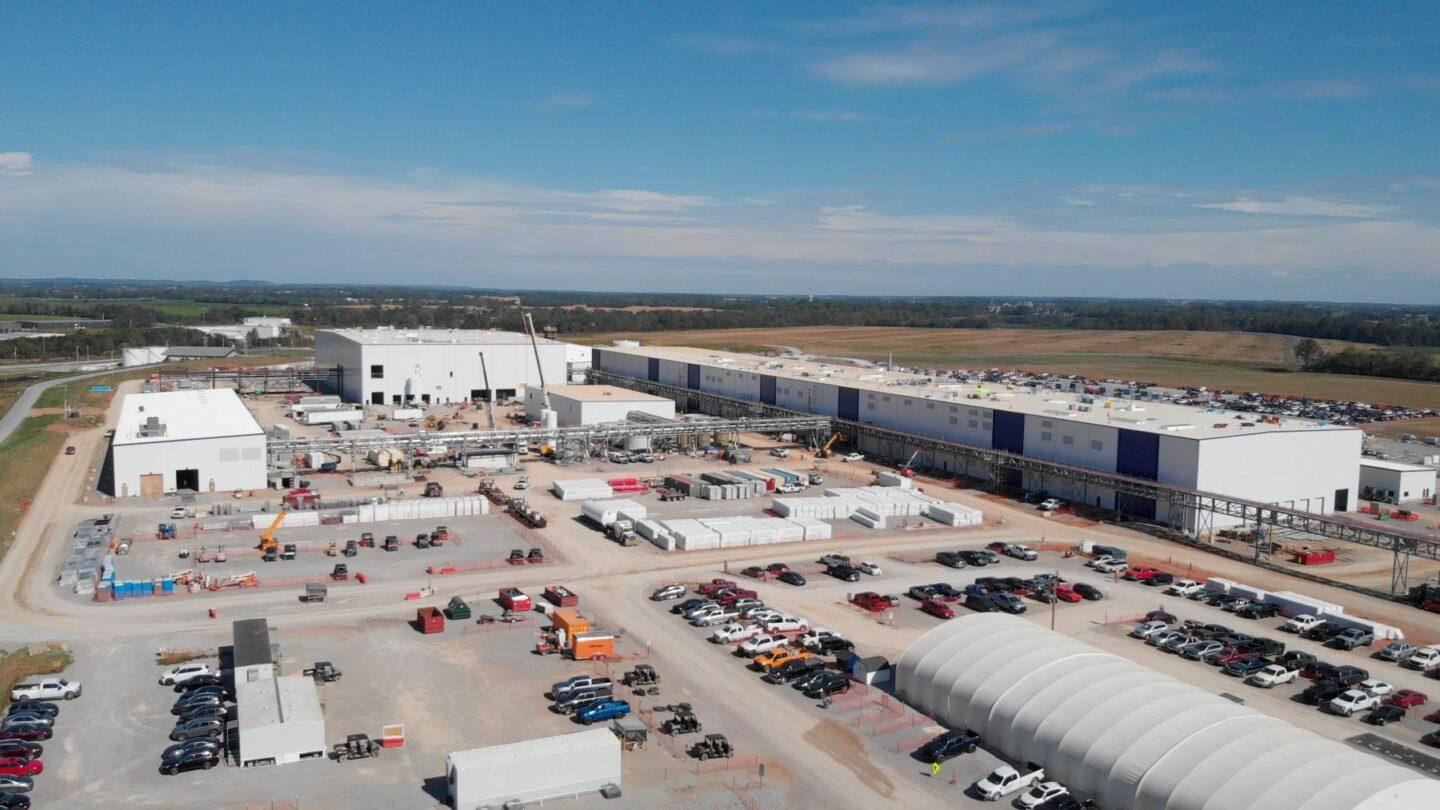
Both of Ascend Elements’ U.S. facilities have been facing difficulties. The company’s Hopkinsville plant in Kentucky became the direct trigger of its bankruptcy.
It was intended to be the first commercial-scale U.S. facility producing pCAM and lithium carbonate, with capacity to supply pCAM for 750,000 electric vehicles annually. The project was originally estimated to cost USD 878 million. The U.S. Department of Energy supported its construction with a USD 207 million grant.
The plant was about 60 percent complete, but work has now been suspended. The company owes its contractor USD 138.4 million.
The facility was built – or rather, was being built – by TKJV (Turner-Kokosing JV), a joint venture between Turner Construction Company, owned by Germany’s Hochtief and Spain’s ACS Group, and Kokosing Industries.
During construction, costs rose from USD 310 million to USD 878 million.
Ascend has accused TKJV of inflating invoices, while TKJV has accused Ascend of non-payment. In November 2025, Ascend halted construction of the plant and stopped payments to the contractor. It claims that TKJV and one of its subcontractors inflated the budget by USD 16 million. TKJV, in turn, notes that USD 16 million is less than 12 percent of the USD 138.4 million owed to it. A subcontractor has also joined TKJV in its claims.
Meanwhile, the Covington, Georgia facility – into which the company has invested more than USD 120 million – has faced safety issues. Between March 2023 and February 2025, there were 14 fire incidents on site. The local fire department ordered the plant to be shut down in February 2025. Operations resumed in August 2025.
The plant is capable of processing around 30,000 cubic tons of batteries per year into 20,000–30,000 cubic tons of black mass.


Key Takeaways
- On April 9 this year, Ascend Elements filed for Chapter 11 bankruptcy protection in a Texas court, seeking protection from its creditors. The insolvent company declared assets of USD 1–10 billion and liabilities of USD 0.5–1 billion. Since filing for bankruptcy, the company has been in talks with a potential investor.
- Ascend Elements has announced one of the largest foreign investments in Poland. It plans to build a pCAM (precursor cathode active material) plant in Opole. The project is valued at PLN 6.7 billion (approx. EUR 1.55 billion). In December 2025, the Ministry of Economic Development and Technology signed an agreement with the company for a PLN 1.2 billion (approx. EUR 0.28 billion) grant under a state aid program for strategic projects supporting the transition to a net-zero economy. In March this year, the Polish Investment and Trade Agency awarded the company the “Production Investment of the Year 2025” prize.
- Ascend Elements operates two plants in the United States. Its Covington, Georgia facility, in which the company has invested more than USD 120 million, has faced safety-related issues. The Hopkinsville, Kentucky plant was about 60 percent complete, but work was suspended in November 2025. The company owes the contractor USD 138.4 million.