
Poland Unpacked week 16 (6 - 12 April 2026)

Welcome to this week’s edition of our Poland Unpacked, where we deliver key insights and trends shaping the economic, corporate and political landscape. Catch the most important insights from Poland in this week’s briefing.

Loading the Elevenlabs Text to Speech AudioNative Player...
Business
A step toward “repolonization” and pricier electronics
Grzegorz Nawacki

The week’s most important economic development was the government’s announcement of a definition of “local content”. This is a set of criteria under which an entity will be classified as domestic (not to be confused with Polish). Under the newly unveiled strategy of economic “repolonization”, domestic entities will be given preference in winning contracts from the public administration and state-controlled companies. Here are the details.

Łukasz Dojka started with a gym in a basement. Today, with backing from the bValue fund, he is expanding the Xtreme Brands fitness club network. His plans are ambitious: 500 fitness clubs across several countries, 150 play centers and 100 venues under a new concept. International expansion will begin this year. It will require substantial investment – around PLN 750m (approx. EUR 175m) – to be funded by the company and several hundred franchisees. Read the full story here.

Poland’s steel industry is expecting a strong rebound. One sign is that ArcelorMittal is preparing to restart blast furnace No. 3 in Dąbrowa Górnicza. Yet some of the sector’s problems remain unresolved, and the situation is further complicated by the war in the Middle East. Enjoy the full article here.

“This is not a temporary anomaly. It is the biggest disruption the industry has seen in 30 years,” says Dariusz Piotrowski, head of Dell in Poland, in an interview. The consequence of this “disruption” will be sharp increases in electronics prices. The culprit is a severe shortage of silicon wafers. They are everywhere – from watches and refrigerators to large-scale data centers. Why the interview is worth reading? Because it explains why shortages persist, what the consequences are and will be, and why companies need to rethink their IT plans. Read it here.

Economy & Markets
Fiscal drift meets monetary restraint
Marek Skawiński

In the past week, the most significant development was the decision by the Monetary Policy Council (RPP) — the body within the National Bank of Poland (NBP) responsible for monetary policy - to leave interest rates unchanged (our full article is here). This outcome had been widely expected. It followed an earlier rate cut and a rise in inflation to 3% year on year in March, effectively ruling out both further easing and any rate hike.

At the press conference, NBP governor Adam Glapiński highlighted the differences between the current macroeconomic environment and that of 2022–23. He pointed, among other things, to lower commodity price pressures despite tensions in the Middle East, weaker global demand and a more stable zloty. In addition, wage growth has moderated and interest rates remain relatively high, which helps to contain the risk of a sharp resurgence in inflation.

Statistics Poland (GUS) recently reported that the general government deficit reached 7.2% of GDP in 2025. This is, once again, higher than the 6.9% projected by the Ministry of Finance in the budget act. It is also 1.7 percentage points above the target set in the fiscal-structural plan from autumn 2024. The deviation from the planned path is enabled by the EU’s defense clause.

Among the fourteen EU countries that have so far published their results, Poland has the highest deficit. Romania is likely to overtake it on this measure. Notably, among countries with deficits exceeding 3% of GDP in 2024, all - except Poland - have reduced their deficits. Read the full story here.

This divergence does carry risks, particularly in the face of unexpected shocks. One such shock is currently unfolding in connection with the US and Israeli aggression against Iran. Yet there is another side to the story. There is little doubt that fiscal policy in Poland in 2024–25 supported GDP growth, even as household savings rates increased. This is evident, for instance, in the rise in the share of public consumption, from 18.9% of GDP in 2023 to 21.3% in 2025.

As part of our structural analyses, and marking the program’s 10th anniversary, we examined Poland’s most important social policy initiative since the economic transition. This is the child benefit, initially set at PLN 500 (approximately EUR 115) and later increased to PLN 800 (approximately EUR 185), introduced on April 1st 2016. We assess its impact on fertility, poverty and public finances here.

In another analysis, we argue that Poland could become a larger trading partner for Germany than France. On this trajectory, Poland would rank as Germany’s fourth-largest partner, after China (EUR 252bn in 2025), the United States (EUR 241bn) and the Netherlands (EUR 209bn). Read our full analysis here.

Politics & Policy
The Tribunal, the mayor and the party
Rafał Mrowicki

Poland’s constitutional crisis is entering a new phase with each passing week. Ahead of Easter, President Karol Nawrocki swore in only two of the six newly appointed judges to the Constitutional Tribunal – the body charged with reviewing legislation. During the rule of Law and Justice (PiS) from 2015 to 2023, the court came to be dominated by judges affiliated with the party. The president accepted the oath from just two of the new judges, while the remaining four waited nearly a month without receiving an invitation.

In response, those four judges invited the president themselves to the Sejm. When he did not attend, they took the oath before the Speaker of the Sejm and a notary. Presidential aides argue that, by doing so, the judges have forfeited their right to sit on the Tribunal, though they have not provided a legal basis for delaying the oath-taking in the first place. The constitutional crisis is deepening, leaving citizens without a fully functioning key institution. Read our update on the matter here.

In Kraków, a date has been set for a referendum. The city, one of Poland’s largest and its medieval capital, is governed by Mayor Aleksander Miszalski of Civic Coalition (KO), the ruling party led by Prime Minister Donald Tusk. Residents have grown increasingly dissatisfied with rising municipal debt and allegations of nepotism within city agencies.

Mayor Miszalski himself is urging a boycott of the referendum. Kraków’s residents will vote on his future on May 24. Do you want to know why it is so difficult to recall a mayor in Poland? We have the answer here.

Tensions are also mounting on the right of the political spectrum. Within Law and Justice, a rift is widening between the camp of former prime minister Mateusz Morawiecki and a rival faction aligned more closely with Przemysław Czarnek, the party’s current nominee for prime minister ahead of next year’s elections.

Mr. Morawiecki has announced plans to establish a new association, while the party leadership has once again turned against his allies. This time the target is MP Krzysztof Szczucki, who not only broke ranks in a vote on overturning the president’s veto of changes to detention law, but has also publicly argued that the president should swear in all newly elected Constitutional Tribunal judges.

Polish politicians are also being swept up in the run-up to Hungary’s elections. The ruling coalition in Warsaw is rooting for the Tisza party led by Péter Magyar. Law and Justice, for its part, is backing Viktor Orbán’s Fidesz, with a sizable group of party politicians traveling to Hungary to support him. Two PiS MPs – Zbigniew Ziobro and Marcin Romanowski – have been granted political asylum there by Mr. Orbán. Should he lose, they may be forced to leave Hungary.

Startups / VC / Tech
Venture, war and watts: capital, defense tech and the energy strain of AI
Anna Bełcik

Poland’s venture capital market is expanding year by year. Yet the participation of Polish investors in large Western European and American funds remains clearly limited. The reasons are not only a shortage of sufficiently large pools of capital, but also the absence of strong networks and collaboration in technology investing.

One Pole seeking to bridge the gap between the Polish and American markets is Bruno Wejchert, a partner at San Francisco–based Strike Capital. The fund’s investors already include representatives of domestic technology firms, family offices, prominent business families, and partners of Polish private equity funds, including Przemysław Gacek, co-founder of Grupa Pracuj, and Michał Brański, co-founder of Wirtualna Polska. With their backing, the fund aims to support its portfolio companies in expanding into Central and Eastern Europe, while also opening a path for Polish investors to finance companies across the Atlantic. In the coming years, investments in Polish companies may also follow - read all about here.

Another European venture capital fund, Darkstar - previously covered in these pages - focuses on defense technologies tested in the real conditions of the war in Ukraine, where the pace of innovation is unprecedented. Instead of traditional pitch decks, it organizes boot camps on military training grounds, where startup solutions are verified directly by soldiers.

The fund leverages this specificity by investing exclusively in technologies ready for immediate deployment or rapid testing on the front line - departing from the traditional startup evaluation model in favor of practical validation under combat conditions. Its focus is on systems that enhance autonomy, leverage AI, and enable advanced data analysis, building entire technological ecosystems rather than single products. Poland is on its radar, although the local market continues to develop more slowly than, for example, the Baltic states. You can read the full story here.

“We still see untapped potential in Poland at the intersection of science and business - many valuable projects originating in universities fail to reach commercialization or secure market financing,” said Mikołaj Raczyński, Vice President of the Polish Development Fund (PFR). Its investment arm, PFR Ventures, has decided to expand one of its public funding programs for venture capital funds investing in early-stage companies (PFR Starter - detailed info here) with a new module - PFR Starter Science.

The institution has officially announced the changes and stated that managers investing in companies emerging from the scientific and academic community will be eligible for an asymmetric profit-sharing mechanism upon exit. PFR Ventures will forgo its share in favor of private investors and the fund’s management team.

We have previously covered the details of the PFR Starter Science module here.

Separately, drawing on Canada’s experience, we examined how citizens perceive AI and data centers. The country is currently grappling with the growing impact of this sector on the energy market. The rapid expansion of AI is turning data centers into some of the largest electricity consumers - competing with households and displacing, among others, cryptocurrency mining - while energy demand is set to rise sharply in the coming years.

Provinces such as Québec and British Columbia are attempting to capitalize on the trend by introducing regulations and higher tariffs for AI companies, while shielding residents from price increases. Their advantage lies in access to cheap renewable energy, primarily hydropower. By contrast, regions less favorable to renewables, such as Alberta, are losing investment due to infrastructure constraints. The expansion of data centers is also raising public concern - Canadians are skeptical about their proximity to residential areas and fear rising energy costs and pressure on public resources, making AI a political challenge as well. Here is the full picture.

Looking ahead
A quiet week? Unlikely
Rafał Mrowicki

This week in Polish politics looks set to be relatively calm - though recent months suggest calm is hard to come by.

The start of the week will bring reactions to the outcome of Hungary’s elections. The days that follow will add further chapters to the battle over the Constitutional Tribunal.

After hours
Crimea, beyond the headlines
Michał Szcześniewski

If you’re in Warsaw, one exhibition worth your time is the new Crimea-focused show at Ujazdowski Castle Centre for Contemporary Art. Rather than treating the peninsula as a distant geopolitical flashpoint, it approaches Crimea as a place of memory, attachment, exile, and contested meaning.

Through works by contemporary Ukrainian artists, including Crimean Tatar voices, the exhibition explores what was lost after Russia’s occupation in 2014: not only territory, but also homes, communities, identities, and ways of seeing. Some pieces are intimate and mournful, others ironic or quietly defiant, but together they offer something rare - a way to think about Crimea beyond headlines, maps, and military updates.

At a moment when Europe still struggles to fully grasp what Crimea means, the show feels both artistically rich and politically necessary.

When: 21 March - 28 June 2026
Where: Warsaw (https://u-jazdowski.pl/en/programme/exhibitions/what-we-talk-about-when-we-talk-about-crimea?tid=t_content)

Source: IG account of Ukrainian Institute
fun fact about poland
The Frog that runs Poland
Michał Szcześniewski

If Poland had an unofficial ministry of everyday survival, it would probably operate through Żabka (small frog). The small green convenience store that appears to exist every 200 meters and somehow remains exactly where you need it: below your flat, beside your office, near the tram stop, and occasionally seemingly next door to another Żabka.

It is an emergency food hub, coffee stop, parcel point, hot-dog dispenser, and quiet symbol of Polish urban survival. Forgot breakfast? Żabka. Need oat milk at 10 pm? Żabka. Want to pay a bill, pick up a package, and buy a banana and a power drink in one deeply confusing transaction? Also Żabka.

Żabka is also where many non-Polish speakers first learn what might be called “Żabka Polish”: the compact set of essential phrases needed to function in daily life. Not enough to discuss Polish literary classics or monetary policy, obviously, but enough to handle the basics - “dzień dobry”, “kartą”, “mam aplikację”, “to wszystko, dziękuję.”

In that sense, Żabka is more than a convenience store. It is a national institution, a social equalizer, and an accidental language school with fluorescent lighting and very good geographical coverage. Speaking of coverage – there is a map showing the saturation of Warsaw with Żabka stores.
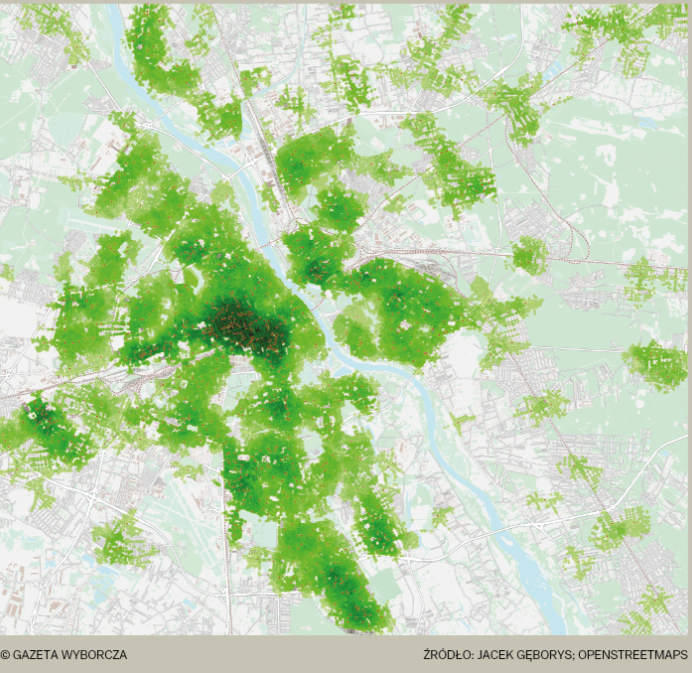
Some say Żabka coverage sets the ultimate boundaries of human civilization…